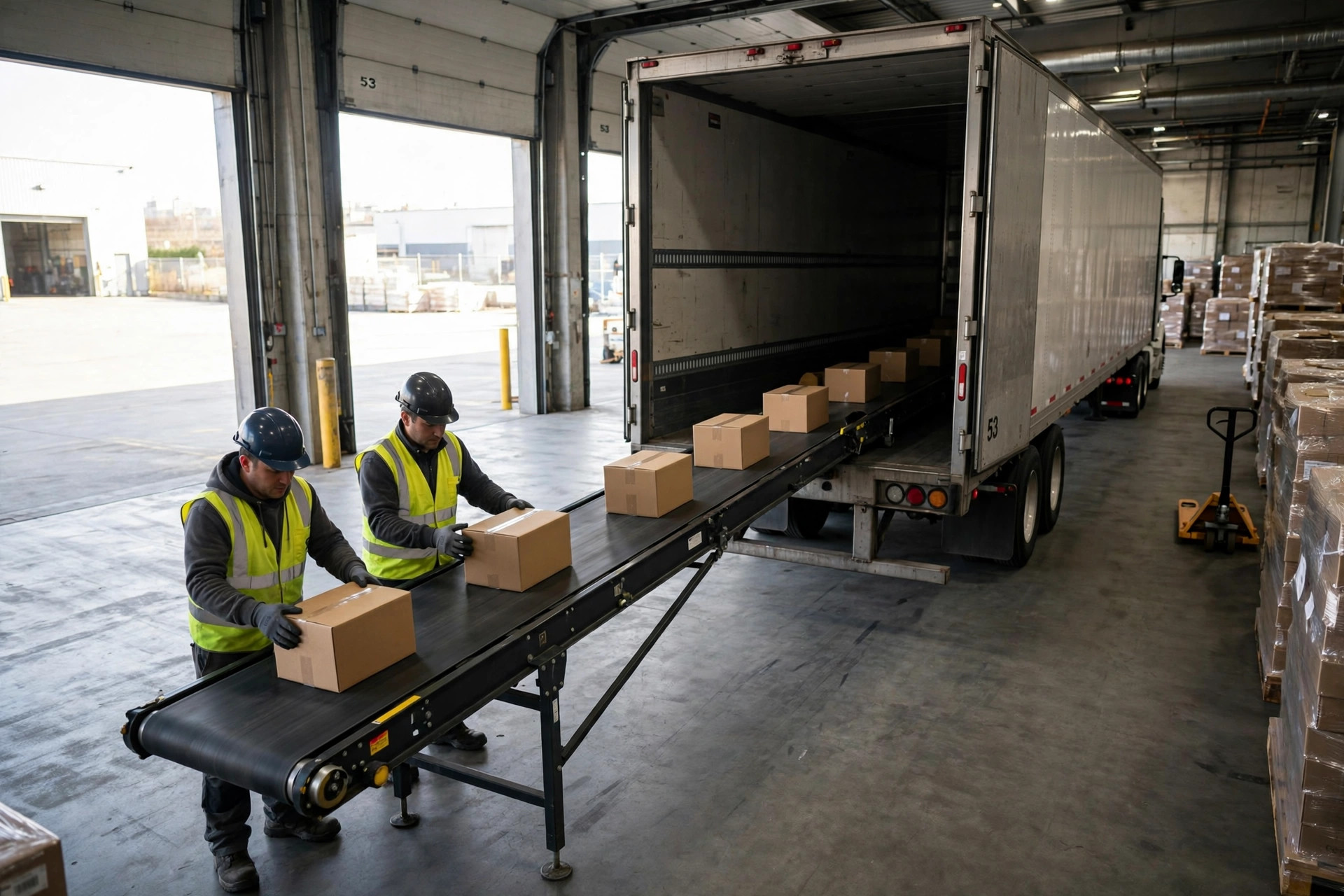
Let me open with numbers I timed myself. Fall 2024, a 3PL warehouse in Ontario, California: one 53-foot trailer, 1,200 cartons of apparel, four guys hand-carrying from deep inside the trailer — 2 hours 40 minutes, with two breaks. Next day, same freight, two of the same guys plus an 18-meter telescopic belt conveyor — 1 hour 5 minutes, trailer empty.
That's nearly 2.5x. But I'm not here to sell you a telescopic belt conveyor. After years running integration projects, I've watched too many warehouses spend tens of thousands on a machine that collects dust. How much of that 2.5x is the machine, how much is the process, and which dollars should never have been spent — let's get it all on the table.
How a telescopic belt conveyor actually works: a conveyor that learned to reach
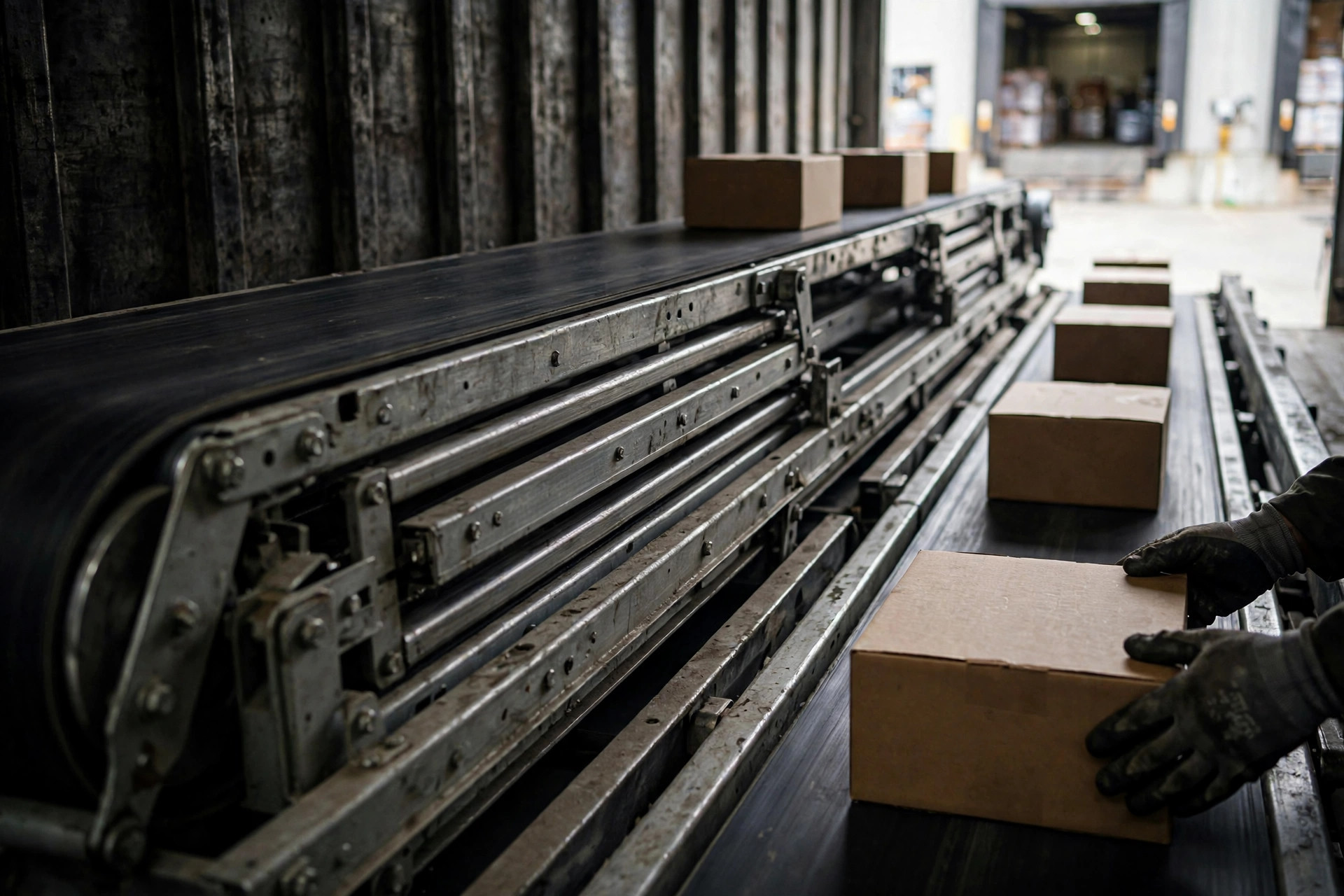
The principle in one sentence: nested boom sections slide out like a telescope, driven by motors, with one continuous belt running the whole length. Think of it as an ordinary belt conveyor that learned to reach into the nose of the trailer, so cartons ride out without anyone carrying them.
What it eliminates was never the act of lifting a box. It eliminates the walk. A 53-foot trailer is about 16 meters deep inside. The most punishing part of manual unloading is carrying a 30-pound carton through a hot trailer for those 16 meters, dozens of trips a day. The conveyor moves the pick point from the dock edge to deep inside the trailer — walking distance drops from 16 meters to about one meter. That's the real source of the gain: not that the machine runs fast, but that people stop walking.
Know the mainstream specs cold, or a salesperson will walk you in circles: extension roughly 7 to 30 meters (per manufacturer specs — same disclaimer applies below); belt widths 600/800mm; load rating around 50 lbs per foot; drive motors 2.2–5.5 kW; belt speed variable via VFD, typically 20–40 meters per minute. The telescoping motion is slow, a few meters per minute — it's for positioning, not racing.
Telescopic belt conveyor vs. manual labor vs. fixed conveyor: three ways to count the cost
First, the comparison table — the unvarnished version:
| Manual labor | Telescopic belt conveyor | Fixed conveyor line | |
|---|---|---|---|
| Time per trailer (53-ft, ~1,200 cartons) | 2.5–3 hrs, 4 people | 1–1.2 hrs, 2 people | 0.8–1 hr, 2 people |
| Capital outlay | $0 | $20k–$50k per unit (per vendor quote) | $80k–$200k custom install |
| Flexibility | Maximum, goes anywhere | High, moves dock to dock | Zero, bolted to one dock |
| Trailer compatibility | All types | All types | Fixed trailer type + fixed dock only |
| Maintenance | $0 (but injuries and turnover are the hidden bill) | A few thousand $/yr in parts and labor | $10k+/yr in service contracts |
Second, the payback math. The formula is dead simple:
Payback (months) = total machine cost ÷ monthly labor cost saved Monthly labor saved = trailers/day × man-hours saved per trailer × hourly wage × 22 days
Plug in the Ontario numbers: per trailer dropped from 4 people × 2.7 hrs to 2 people × 1.1 hrs — about 8.6 man-hours saved. At 5 trailers a day and $20/hr (typical US dock range $18–$22), that's roughly $19,000 a month in theory. Against a $35,000 mid-range machine, theoretical payback is under 2 months.
Don't place the order yet — that number is the theoretical ceiling. Blunt truth: it only counts if saved man-hours turn into real dollars, meaning fewer hires or less overtime. If headcount stays the same and everyone just goes from "exhausted" to "fine," what you bought is fewer injuries and lower turnover. Still worth money — the dock is a top injury zone, and one serious comp claim can eat half the machine's price — but that's a different calculation.
On the conservative "two fewer hires" basis: a US dock worker costs roughly $4,000–$4,500/month all-in. That's $8,000–$9,000 saved monthly, payback in 4–5 months. That's the number you can defend in front of your boss.
Third, the cost everyone forgets: peak-season hiring pain, veterans' backs giving out, new hires quitting in week one — all of it converts into overtime and late penalties. The conveyor deletes the heaviest physical work, and the scheduling headache gets cut in half.
Three dividing lines for spec'ing a telescopic belt conveyor
Line one: daily trailer volume. Under 3 trailers a day — don't buy it. Manual labor plus a pallet jack wins; the machine will sit idle most of the year. Three to eight a day is the sweet spot for one unit. Above eight, think two units, or a fixed conveyor paired with a telescopic unit — the fixed line handles volume, the telescopic covers the flexible docks.
Line two: carton profile. Average carton over 15 kg and the machine's value doubles — the heavier the box, the more expensive every walked meter is. Flip side: everything under 5 kg, hand-tossing is already fast and the conveyor's edge shrinks to maybe 30%, stretching payback past a year. Oversized items: 600/800mm belt width is a hard limit. Measure your biggest carton before buying anything.
Line three: dock and trailer mix. Fixed dock position, 53-footers all day, deep enough dock — a fixed conveyor works and moves more volume per dollar. But the moment your trailer mix varies — 53-foot vans, 40-foot containers, box trucks rotating through — or one machine floats across three or four dock doors, the telescopic conveyor is the only answer. Fixed lines can't move; manual labor can't keep up.
Now the part where I get blunt. Three flavors of fake requirements I see every year:
First: "buy the longest, 30 meters, future-proof it." Every extra 5 meters adds roughly 30% to the price — and every extra boom section multiplies belt-tracking and jamming problems. Your deepest trailer is 16 meters; a 30-meter machine means a third of it sits idle forever. Spec for your deepest trailer plus 2 meters of margin.
Second: "we want lift, pivot, and a built-in scale — the works." Straight talk: 90% of warehouses use straight extension 90% of the time, and every added function is another failure point. In 2023, an auto-parts warehouse in New Jersey bought the loaded configuration with pivot and lift. Three years later the pivot had been used fewer than 10 times, the extra $15,000 was pure waste, and the pivot mechanism had broken down twice — three days of downtime per repair.
Third: "it'll impress clients on tours." Dock equipment is for working, not showing off. Spending tens of thousands on a prop? Put it into hourly wages instead.
Four maintenance traps that eat telescopic belt conveyors alive
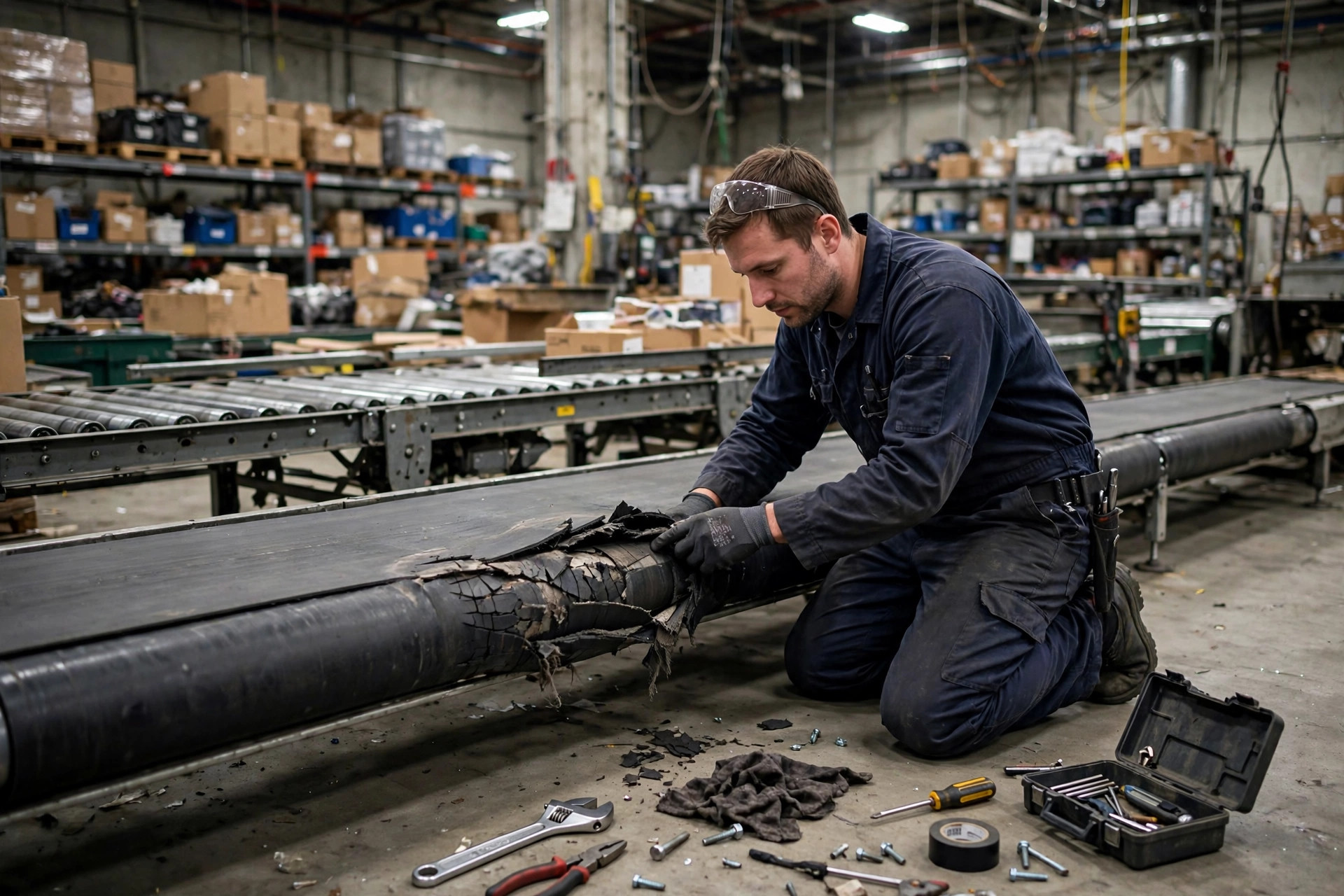
Trap one: belt mistracking. The number-one killer. More sections, worse tracking drift; take-up roller bolts loosen slowly over time. A food distributor in Texas shredded a belt in three months — edge wear straight through — and burned through 4 belts in a year before anyone found the cause: a loose take-up roller on one boom section, 2 cm of drift, ignored for three months. Ten minutes of tracking inspection a week costs 1/100th of a replacement belt.
Trap two: boom section jamming. Pallet splinters and dust pack into the slideways; the boom groans and sticks. Blow out the slideways monthly — 15 minutes with an air gun. Skip it and you'll cook a drive motor worth several thousand dollars.
Trap three: roller bearings. Heavy loads plus a dusty dock: bearings last 1–2 years, period. Keep spares on the shelf — order after failure and you're down a week waiting on parts and a repair crew. During peak season, that's a disaster. A well-maintained unit holds 95%+ uptime; a neglected one breaks down noticeably in year three.
Trap four: electrics and hydraulics. On lift-equipped models, watch for hydraulic cylinder weep. VFDs hate moisture — a dock that leaks in rainy season will kill a drive cabinet once, and the repair bill will hurt for half a year.
One counterintuitive call most buyers miss: the telescopic conveyor is an unloading weapon and a loading afterthought. Unloading is loose freight coming out — the machine delivers cartons to hands at the dock. Loading is constrained by stacking and cubing inside the trailer; the machine only delivers cartons to the trailer mouth, and someone still goes inside to build the load. If your operation is mostly outbound full-trailer loads — say, FBA replenishment — cut the ROI in half before running the numbers.
Whether the money is worth it comes down to one number: labor cost per trailer.
Run your own numbers: trailers per month, crew size, hours, wage — that's your cost per trailer today. Then the conveyor scenario: 2 people, a little over an hour. Subtract, multiply by monthly volume, divide the machine price by monthly savings. Five-plus trailers a day with cartons averaging over 15 kg, and payback on a reduced-headcount basis lands at 4–8 months — worth it. Below that volume, or all lightweight parcels, the number gets ugly enough to make you quietly close the quote.
The machine is dumb; the math is everything. A telescopic belt conveyor is not magic that creates efficiency — it deletes the waste of people walking. How big your waste is decides whether the money is well spent.
By Da Liu, Automation Engineer