Start with the bill.
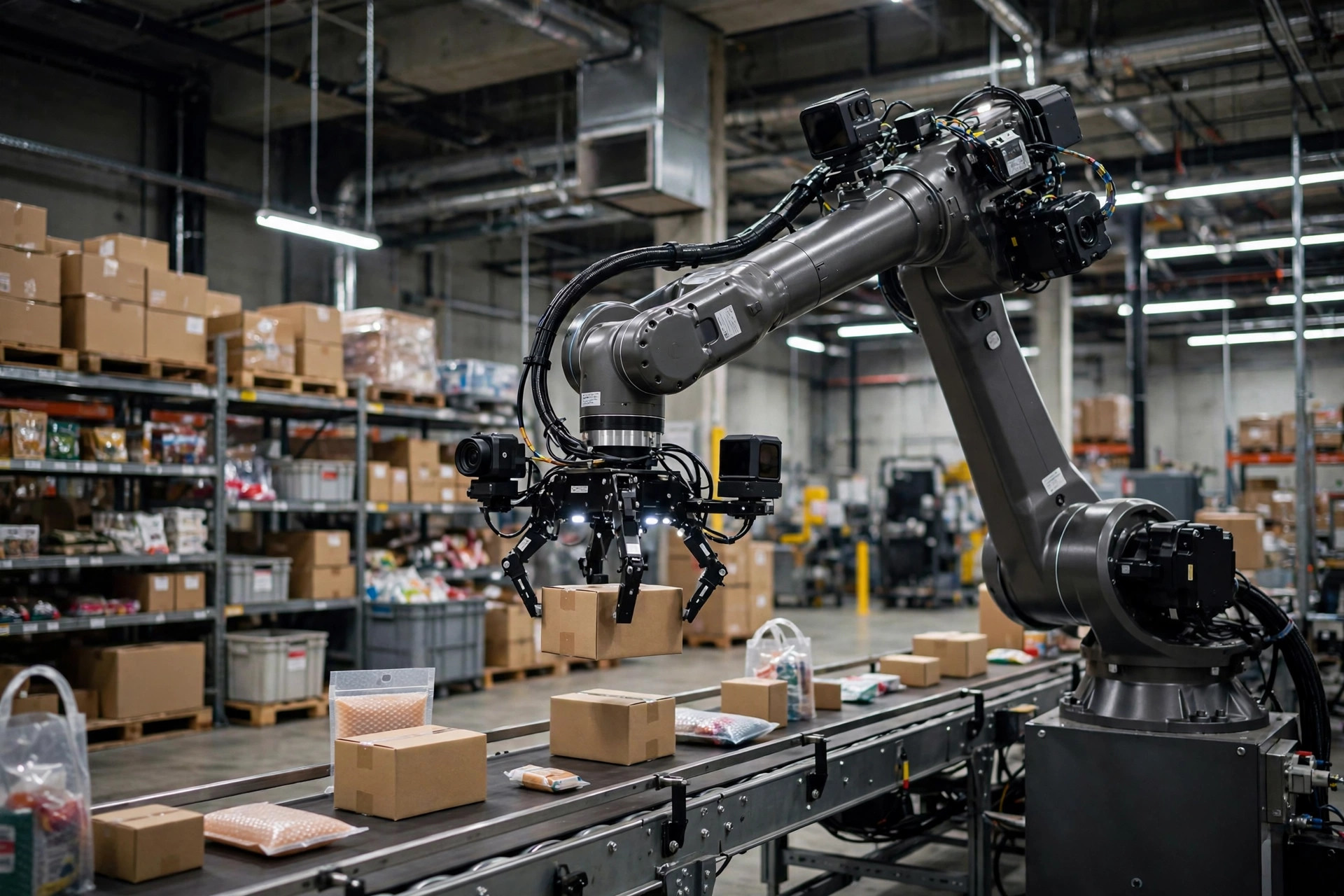
Teaching a picking robot to recognize cartons takes about 100,000 training images. Hand-label them, and public vendor price lists put simple bounding-box work at $0.10–$0.50 per image: $10,000–$50,000 for the first pass alone.
Three months later the packaging supplier switches carton stock, winter lighting shifts the glare, and the model stops recognizing half the boxes: another 20,000 images, a few thousand more dollars, gone.
So this piece isn't about neural networks. It's about money: how warehouse AI vision models are trained, what each route costs, where the traps are — and one arithmetic problem to plug your own quotes into.
Start With the Bill: How Warehouse AI Vision Models Are Trained Comes Down to Three Routes
Vision-model training data has exactly three sources: photographed by humans, drawn by humans, or generated by machines.
Route 1: Real photos + human labeling. Shoot on the warehouse floor, draw boxes by hand — "this is a carton, this is a pallet, this is damage."
Route 2: CAD simulation rendering. With accurate 3D CAD drawings, drop virtual parts into a virtual bin, randomize lighting, quantity, textures, and noise, and render hundreds of images. Labels generate themselves — the engine knows where every part sits; human time goes to tuning parameters.
Route 3: Generative-AI synthetic data. No drawings needed. Generative AI "paints" annotated warehouse scenes directly — including the ugly states: crushed cartons, dust, stretch wrap. Cost comparison table is below; one route at a time first.
Route 1: Real Photos + Human Labeling — the Dumbest, the Priciest, the Most Honest
The oldest route, still the one most warehouse vision projects take. No magic: shoot, draw boxes, QA, train.
The math, from public vendor price lists (Basic.ai): $0.03–$1.00 per box, $0.10–$0.50 per image for simple work. At 4 boxes per image and $0.30/image, 100,000 images = $30,000 — before QA, where double-pass review is standard and a 1.5–2x total-cost multiplier is normal.
In 2024 I costed a real one: a Kunshan 3PL site, picking robots, 2,000+ SKUs, 80,000 images shot. Vendor quote: $0.08 per box, 4 boxes per image — 80,000 × 4 × 0.08 = $25,600 on paper. With project management and about 15% rework, the real check cleared $30,000.
Six months after go-live, the carton supplier switched from kraft to white coated stock. Reflectivity changed; recognition dropped 6 points. Another 20,000 images — nearly $10,000 more.
The truth about Route 1: real data isn't a one-time purchase, it's a subscription. Every packaging, lighting, or season change can trigger another labeling round. You're not signing one contract; you're signing a standing bill.
Its virtue is real too: fidelity. Models trained on real data carry the smallest sim-to-real gap — training and deployment environments are the same place.
Route 2: CAD Simulation Rendering — Cheapest When You Have the Drawings
With accurate 3D CAD models, life gets simple: a simulation tool drops virtual parts into a virtual bin, varies quantity, lighting, textures, and camera noise, and renders hundreds of images. Annotation is free — the engine knows where every part sits.
A May 2026 RoboticsTomorrow piece nailed it: with an accurate CAD model, this is "the most reliable and least resource-intensive approach" — engineer time goes to tuning parameters, not drawing boxes.
Two fatal flaws. First, no drawings, no party — legacy parts, supplier components, and as-built drift give simulation nothing to stand on. Second, renders come out too clean: real images carry oil, scratches, flickering lights; renders don't. Models trained on pristine data fall apart on the floor.
The counter-intuitive call: CAD simulation's problem was never "not realistic enough" — it's "too tidy to be true." Warehouses aren't cleanrooms; models don't fear ugly, they fear unseen mess.
Route 3: Generative-AI Synthetic Data — What Zebra's STRIPES Is Actually Solving
Route 3 is 2026's hottest answer to how warehouse AI vision models are trained. Its flagship: Zebra's STRIPES dataset (Sim-to-Real Industrial Perception for Warehouse Scenes), released September 2026.
The numbers: 30,000 images, 3,000 unique box textures and geometries, one million labeled boxes — not one drawn by a human.
STRIPES' three innovations cut exactly at Route 2's weak points: generative-AI image creation with no static 3D models, so scene diversity escapes your drawing library; simulated wear and tear — crushed cartons, dents, surface dust, stretch wrap — the dirtiest warehouse states, and the pipeline's most valuable step; and physics-enabled clutter, where gravity simulation stacks boxes into naturally dense, tilted, interlocked configurations across three real phases: shelf storage, floor staging, and truck loading.
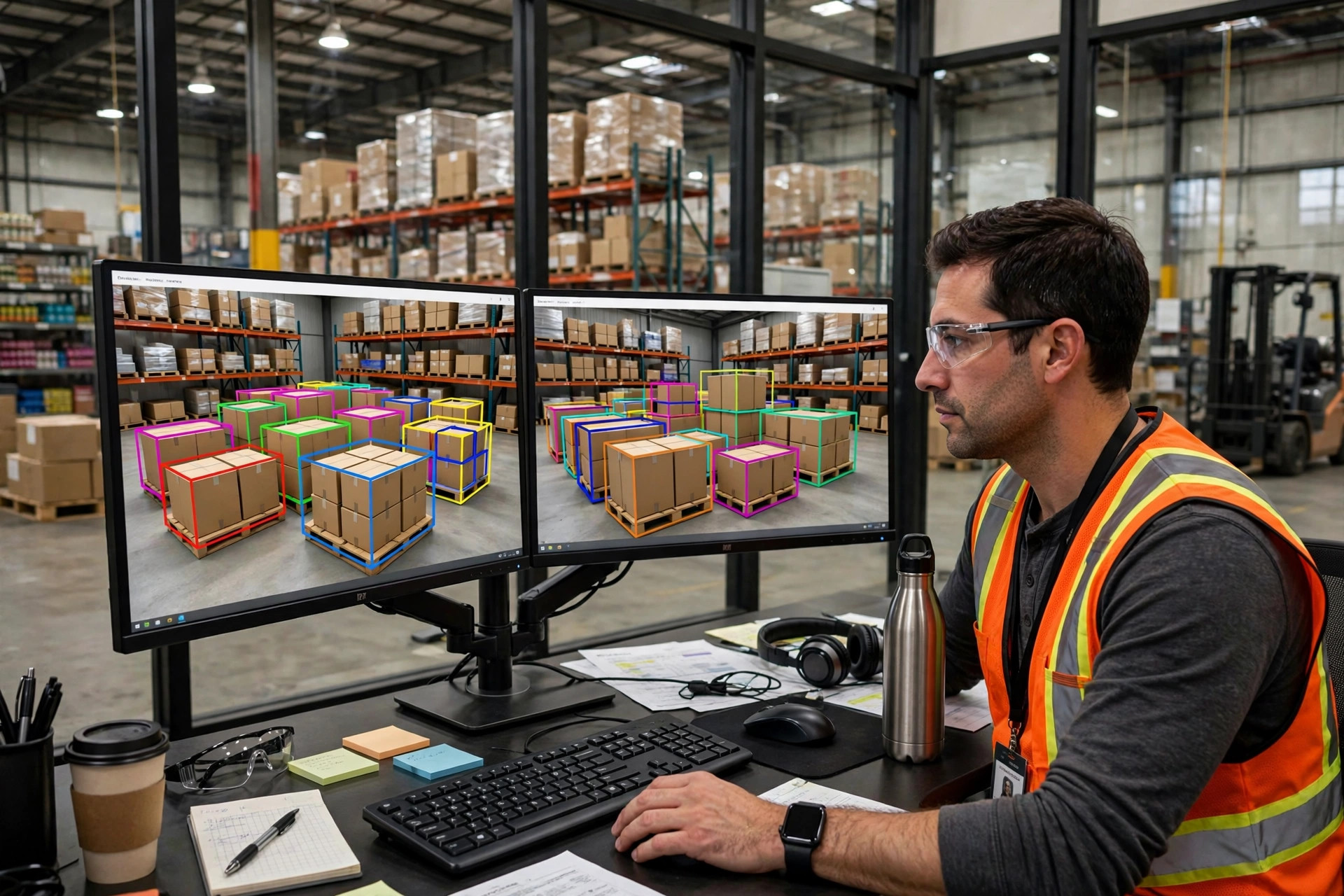
See it? STRIPES isn't solving "does synthetic data look real" but "is it dirty enough." Synthetic data doesn't need to be prettier — it needs to be filthier. A 99 in simulation means nothing; what matters is how many kinds of dirt the model has seen there.
On cost: 30,000 images and a million boxes, marginal cost in compute, not labor. But Route 3 demands the highest fixed investment of the three — generative models, physics simulation, pipeline engineering, all upfront. Small projects can't afford the ticket; big ones get cheaper with scale.
The Sim-to-Real Gap: 99 in the Lab, 92 on the Floor
The sim-to-real gap: the difference between the training environment and the deployment environment. In May 2026, Robotics and Automation News called closing it "one of the most high-value objectives in modern robotics."
How brutal? September 2026: Telexistence fine-tuned NVIDIA's DreamZero — a model predicting actions and camera video together — for convenience-store restocking. Clean simulated picking data: 45% success. Real teleoperation recordings: 0%. Root cause: mismatched joint distributions and state scales between sim and reality.
45% to 0% isn't "a little off" — it's a different universe. The gap isn't image count; it's whether the distributions line up.
TELUS Digital's Steve Nemzer said it well in April 2026: use synthetic data to fill specific gaps, but anchor training on real-world data — it can't teach a model about sensor artifacts or production's adversarial conditions.
My translation: synthetic data is a patch, not the foundation. The foundation stays real data; patches cover the long tail you can't photograph or afford to wait for.
On that long tail: this site's October 7, 2026 piece — "Anomaly Samples You Can't Photograph" — is the hands-on patching manual; this one is the three-route panorama with the bill attached.
Three Routes, One Table
| Route 1: Real + Human Labeling | Route 2: CAD Simulation | Route 3: Generative Synthetic | |
|---|---|---|---|
| Marginal cost / image | $0.10–$0.50 (public vendor rates) | Render compute, far below human | Generation compute, far below human |
| Fixed investment | Low (mostly shooting labor) | Medium (pipeline + engineer tuning) | High (generative models + physics sim + pipeline) |
| Bill at 100K-image scale | $10K–$50K, times 1.5–2x QA multiplier | Lowest with drawings, fixed cost amortized | Cheapest at scale; small projects can't break even |
| Fidelity | Highest, smallest gap | Medium — fears "too clean" | Medium-high — STRIPES is fixing "the dirt" |
| Fatal flaw | Can't capture the long tail; re-labeling on every SKU / environment change — cost is a subscription | Dead without drawings | Heavy upfront; uneconomical at small scale |
Two more counter-intuitive calls:
First, the data-labeling industry is being eaten by the models it trains. AI pre-annotation plus human review is now the standard vendor playbook; pure manual box-drawing is ending, and unit prices keep falling. A big long-term pure-manual contract today likely means buying at the top.
Second, the most expensive data isn't the labeling fee — it's the data you can't capture. A long-tail anomaly sample's marginal cost approaches infinity: wait three months and you'll never get a standard photo of "forklift smashed the pallet." Synthetic data's real pricing power isn't cheap — it's the unbuyable.
Lao Zhou's Verdict: "How Warehouse AI Vision Models Are Trained" Is an Arithmetic Problem
Which route? No gut feel — calculate. Route 1 total ≈ N × p × q (N: images needed; p: per-image quote, public range $0.10–$0.50; q: QA multiplier, 1.5–2). Route 3 total ≈ F + N × m (F: pipeline fixed investment; m: marginal cost per image, far below p). Break-even N* = F ÷ (p × q − m): past N*, synthetic wins.
Worked example (illustrative inputs — plug in your own quotes): F = $30,000, p = $0.30/image, q = 1.5, m ≈ $0.05/image. N* = 30,000 ÷ (0.45 − 0.05) = 75,000 images.
The verdict: past about 75,000 images — or with fast SKU churn and shifting environments pushing N ever up — the synthetic route pays. Otherwise, stick with human labeling; don't pay extra for "more advanced."
Whether the money was well spent, the formula decides.
By Lao Zhou, Logistics Cost Analyst