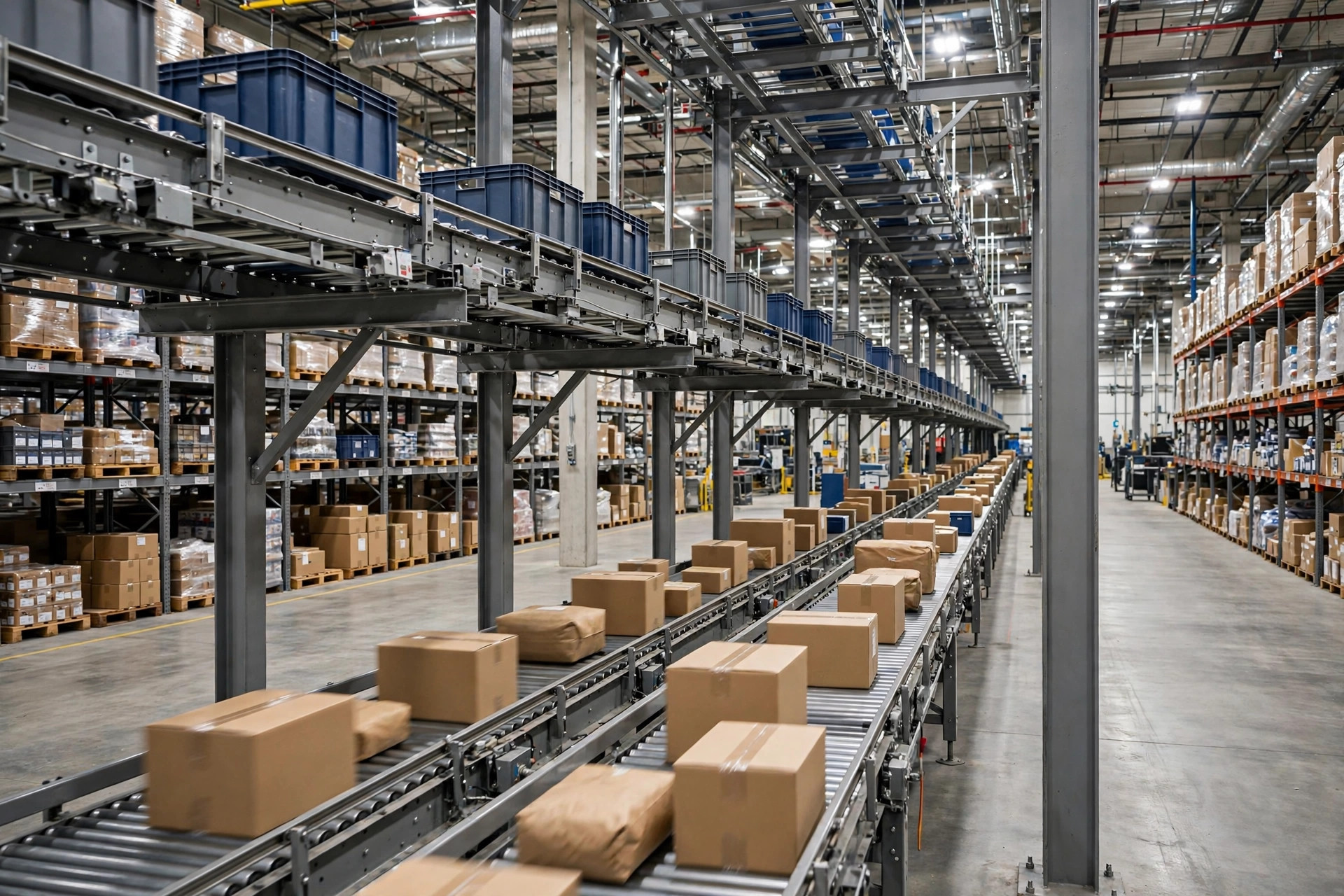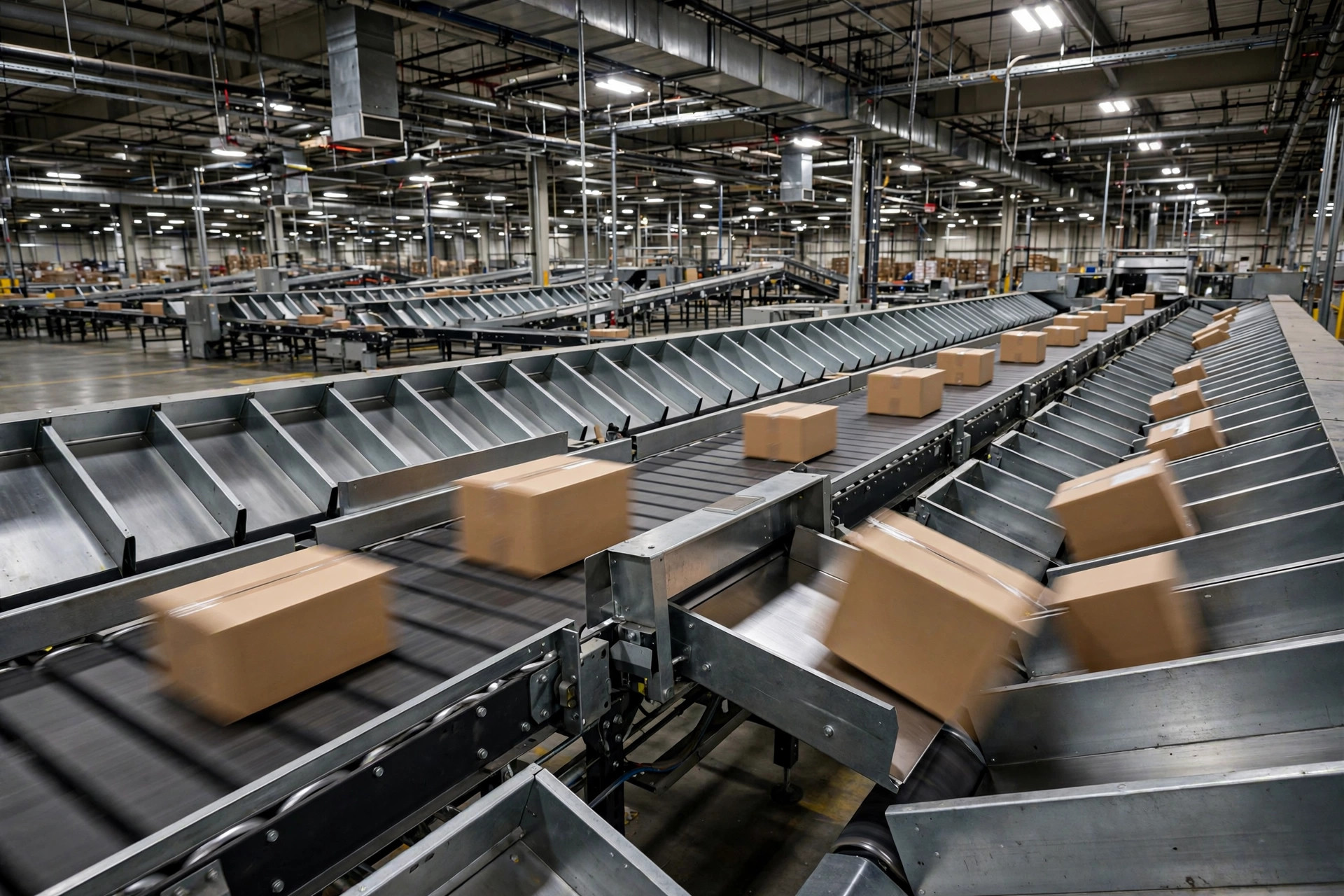
Let me start with the money. A cross-belt sorter, at the price ranges common in the U.S. market over the past couple of years: $1.2 to $1.8 million for the equipment, another $200k to $400k for steel structure and civil work, and a five-year total cost of ownership comfortably above $2.5 million. Your warehouse does 8,000 orders a day, 250 working days a year, 10 million orders over five years — that is $0.25 per order. Your manual sort costs $0.15 to $0.20 per order today. The machine is more expensive than the sorters. That money is wasted.
This is not an argument against automation. It is an argument against automation whose math does not close. Sorter selection is, at its core, an arithmetic problem.
Three options, side by side
Break the five-year cost of each option open and the numbers speak for themselves (based on 8,000 orders/day, 250 days/year):
| Cost item | Cross-belt sorter | Swing-arm / sliding-shoe sorter | Pure manual sort |
|---|---|---|---|
| Equipment | $1.2M–$1.8M | $250K–$450K | $0 |
| Civil / steel work | $200K–$400K | $30K–$80K | $0 |
| Annual energy | approx. $30K–$50K | approx. $10K | $0 |
| Annual maintenance / spares | approx. $50K–$80K | approx. $15K–$25K | $0 |
| Annual labor | 2–3 operators | 4–6 sorters + inductors | 12–15 sorters |
| 5-year TCO | $2.5M+ | $700K–$1.0M | approx. $1.8M–$2.2M in labor |
| Per-order cost | approx. $0.25 | approx. $0.08–$0.10 | approx. $0.18–$0.22 |
See it? At 8,000 orders a day, the cross-belt is the most expensive option — 15% to 30% pricier than manual labor. The swing-arm sorter lands at roughly half the per-order cost of manual.
In 2024, an apparel e-commerce warehouse in Phoenix taught me this lesson the hard way. Doing 6,000 orders a day, they bought a used cross-belt for $900k and felt clever about it. Two years later their SKU count grew from 3,000 to 8,000 and they ran out of chutes. The integrator quoted $60k to $80k per additional chute — track, chute, controls, all of it. Twenty more chutes meant $1.2 million, more than the used machine cost in the first place. Cross-belt chutes are sold by the unit: you buy the machine by the meter, but you expand it by the chute, and the tax is brutal. That is the cross-belt's most hidden cost.
Three levers hiding in the cost structure
Open up the TCO and see where the cross-belt's money really goes:
First, the equipment is only about 60%. Most buyers compare equipment quotes only — the first trap. Steel structure, fire sprinkler rework, and electrical capacity upgrades routinely eat 30% of total investment. Sprinkler rework is the nasty one: the moment the sorter goes up, fire zones change, and $100k+ retrofit bills are common. Anyone comparing equipment prices alone will blow their budget.
Second, energy runs 3 to 5 times a swing-arm line. A cross-belt keeps hundreds of carts circulating whether loaded or not; a swing-arm only moves at the divert moment. The electricity gap is $20k to $40k a year, $100k to $200k over five years. It never appears as a line item on the quote, but the meter does not lie.
Third, maintenance complexity differs by an order of magnitude. Hundreds of carts, each a failure point; $50k to $80k a year in maintenance is normal, plus you need a technician who actually understands the system. A swing-arm is belts and divert arms — a failed part swaps out in half an hour. Small warehouses routinely underestimate this line by half.
Here is the counterintuitive call: the cross-belt's real enemy is not its price — it is rigidity. Volume up 30%, chutes run short, expansion is expensive. Volume down 30%, the machine idles while depreciation keeps ticking. A swing-arm setup adds chutes at a few thousand dollars each and scales shifts up or down freely. E-commerce volume swings are the norm, and the flexible option is the natural fit.
The threshold: 10,000 orders a day is the line
The break-even math is simple:
Break-even daily volume = annual fixed-cost gap ÷ (manual cost per order − machine variable cost per order) × working days
Plug in cross-belt numbers: annual fixed cost (depreciation + maintenance + energy) of roughly $350k to $450k, manual cost $0.18 per order, machine variable cost about $0.03. The break-even lands at 11,000 to 13,000 orders a day. Below that, the machine costs more than the people; above it, scale economics kick in.
So my verdict is blunt:
- Above about 12,000 orders a day, or 5,000+ SKUs with complex waving, or a site that allows a long straight layout — the cross-belt deserves a conversation.
- Below 10,000 a day — swing-arm or sliding-shoe, no hesitation. Take the $1.5 million you saved, spend $200k on chute optimization, pocket the rest.
- Below 3,000 a day — buy neither. Manual plus gravity chutes is enough. Get ABC slotting and wave management right first and per-order cost drops under $0.15.
The small-warehouse playbook: copy the chute-optimization homework
In 2023, a 3PL in New Jersey showed me what spending little to achieve a lot looks like. At 9,000 orders a day, they installed a $350k swing-arm sorter — then spent the savings where it mattered, on chute optimization:
- ABC chute zoning: A-SKUs (70% of order lines) got chutes at both ends nearest the divert arms, B in the middle, C at the far end. Inductor walking distance fell 40%, induction throughput jumped a tier.
- Shared chutes for the tail: C-SKUs shared chutes instead of getting dedicated ones, with manual secondary sort at the chute end. Chute count dropped from 120 to 60, the line shortened 30 meters, civil work saved $50k.
- Wave consolidation: six daily waves merged into three big ones. Chute reuse doubled and the mis-sort rate actually fell — fewer waves mean simpler chute-to-order mapping.
- Pre-sort: oversized and irregular items were pulled out manually before the sorter. The machine handled standard cartons only, and jam rates dropped 70%. The most-ignored move on the list.
The result: $0.11 per order sorted. Compare a same-city warehouse doing 10,000 orders a day on a cross-belt at $0.23 per order. Half the cost — the difference between "equipment thinking" and "systems thinking." The sortation bottleneck is never divert speed; it is chute planning.
One last calculable conclusion — grab a calculator:
Your daily orders × 0.18 × 250 days × 5 years, versus the candidate system's 5-year TCO. If the left side is bigger, the cross-belt is off the table. If the right side is bigger, then sit down and talk.
When a salesperson pitches "3× throughput," ask one question: how much did cost per order drop? If they cannot answer, walk away. A sorter is a cost center, not a showroom. If the math does not close, nothing else matters.
By Lao Zhou, Logistics Cost Analyst