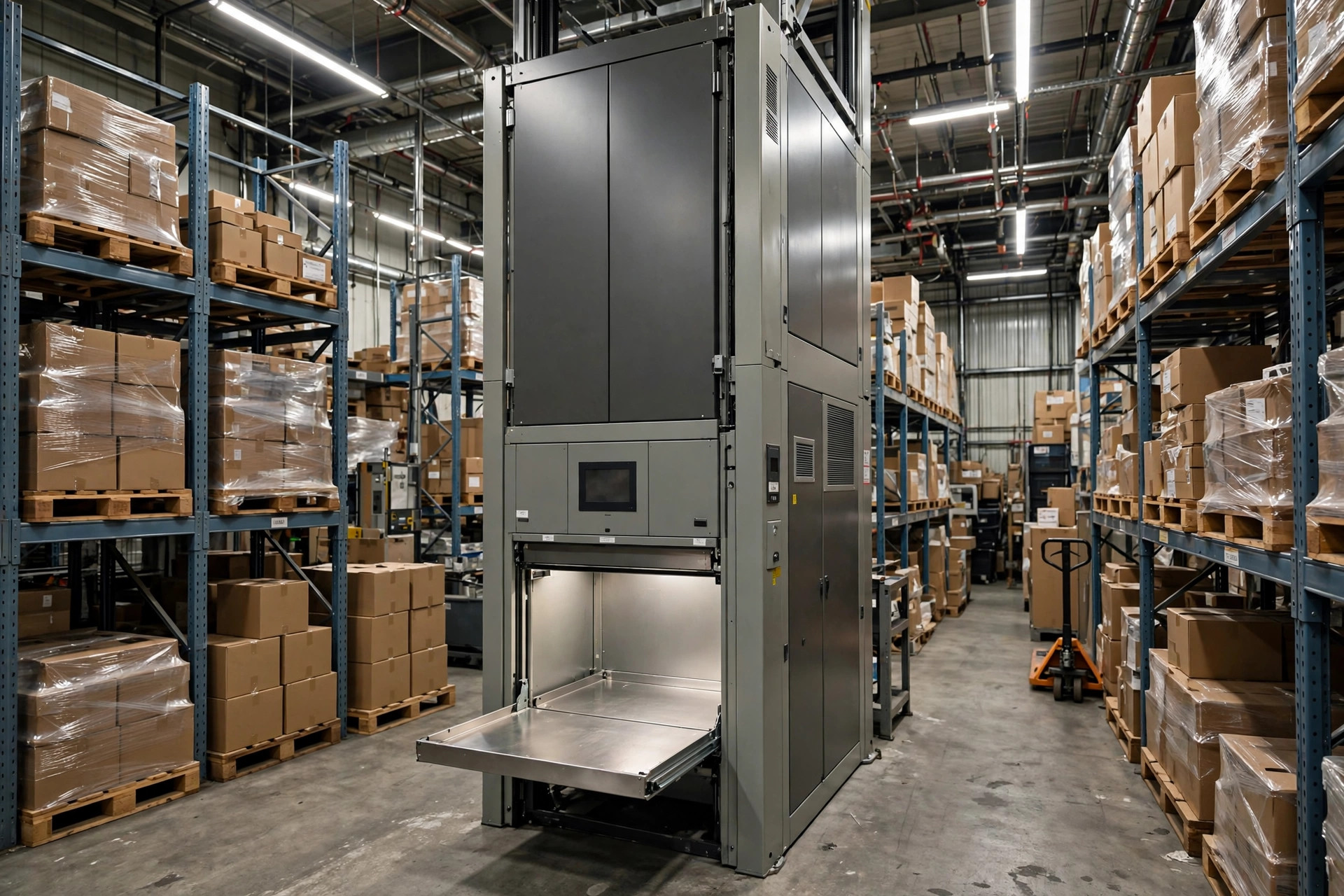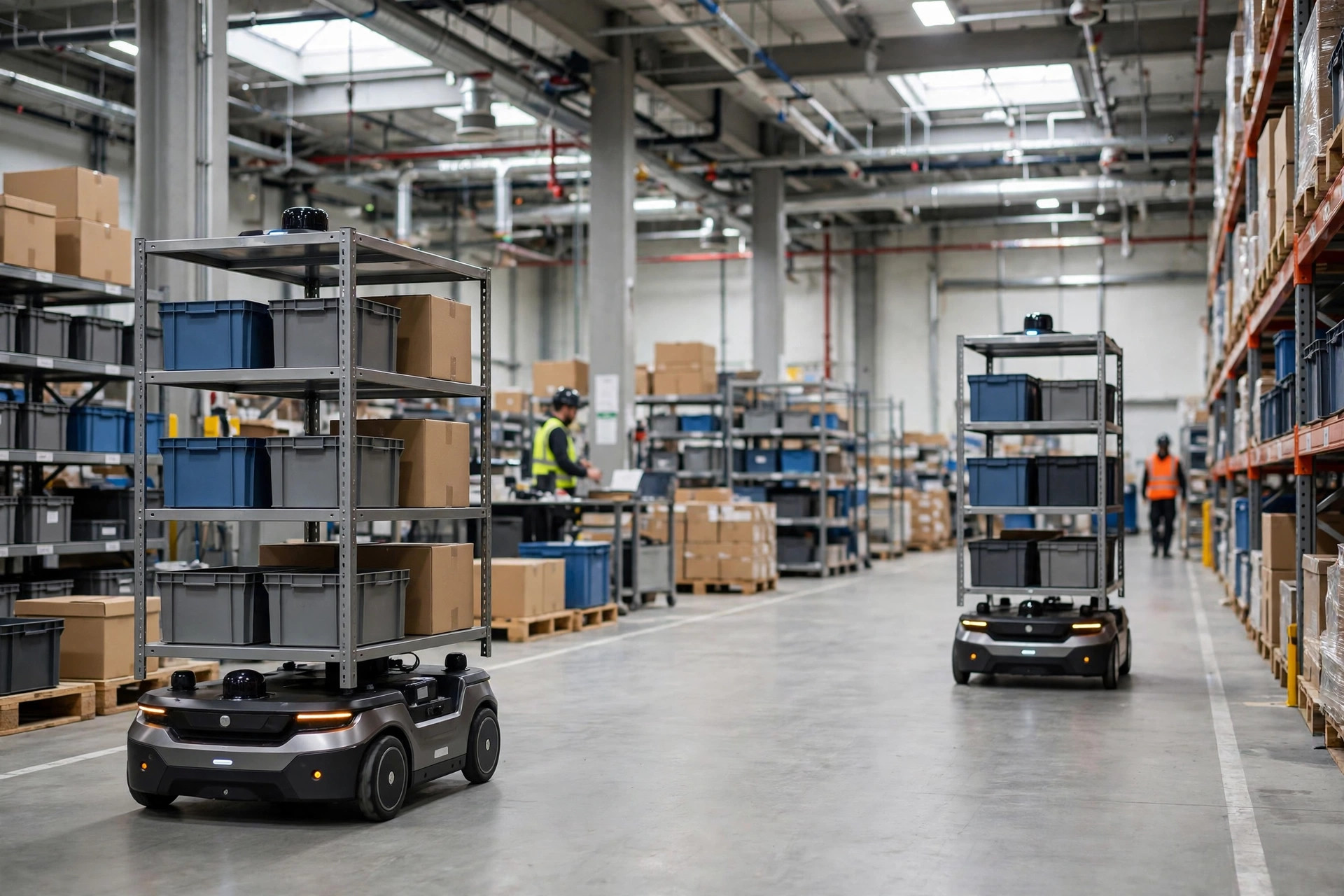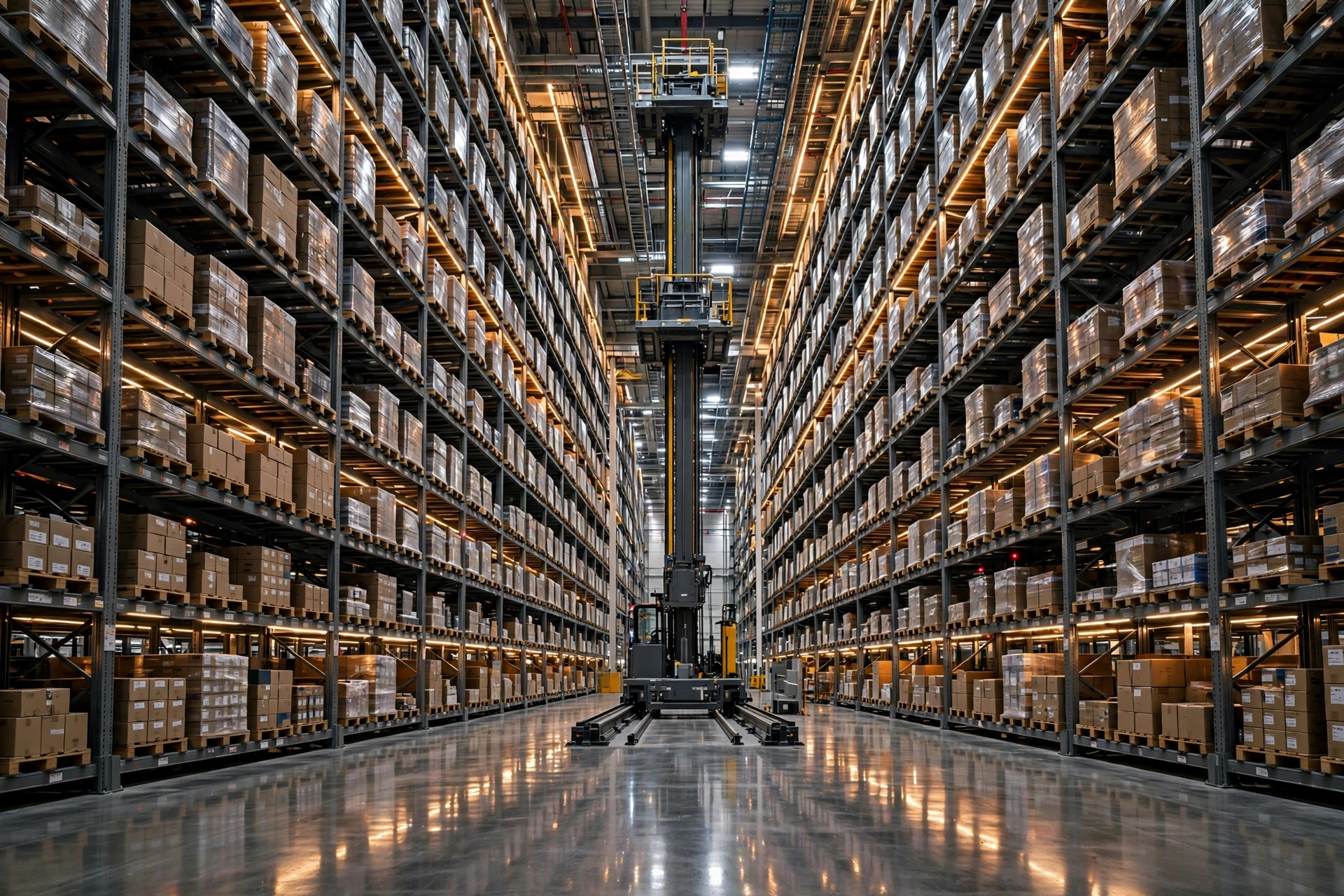
At the end of 2024, I ran the ASRS payback math for an e-commerce warehouse: 80,000 pallet positions needed, two options on the table. Option A: lease two 50,000-square-meter conventional warehouses. Option B: install an automated storage and retrieval system inside one 25,000-square-meter high-bay facility. Over five years, how far apart are the two options? Several years of the company's net profit apart.
Here's my conclusion up front: ASRS payback has two ledgers — one called labor savings, one called rent savings. Anyone who counts only one of them is doing the math wrong.
ASRS Payback, Ledger One: Labor Savings
A conventional warehouse with 80,000 pallet positions needs about 60 people per shift across two shifts — 120 forklift operators and pickers. At a fully loaded cost of roughly $50,000 per person per year (wages plus benefits; varies widely by market — use your local numbers), that's $6 million a year. With an ASRS, the aisles are empty of people; you only staff the inbound/outbound docks, exception handling, and system maintenance — 35 people is plenty, about $1.75 million a year. Annual labor savings: $4.25 million.
This ledger is easy to compute, and it's the one every vendor loves to talk about. But one warning: labor math has a hidden variable — hiring difficulty. In major metros it's not just that wages are high; it's that you simply cannot hire night-shift forklift drivers at any price. The cost of unfilled positions never shows up on the P&L, but operations pays it every single day.
ASRS Payback, Ledger Two: Rent Savings
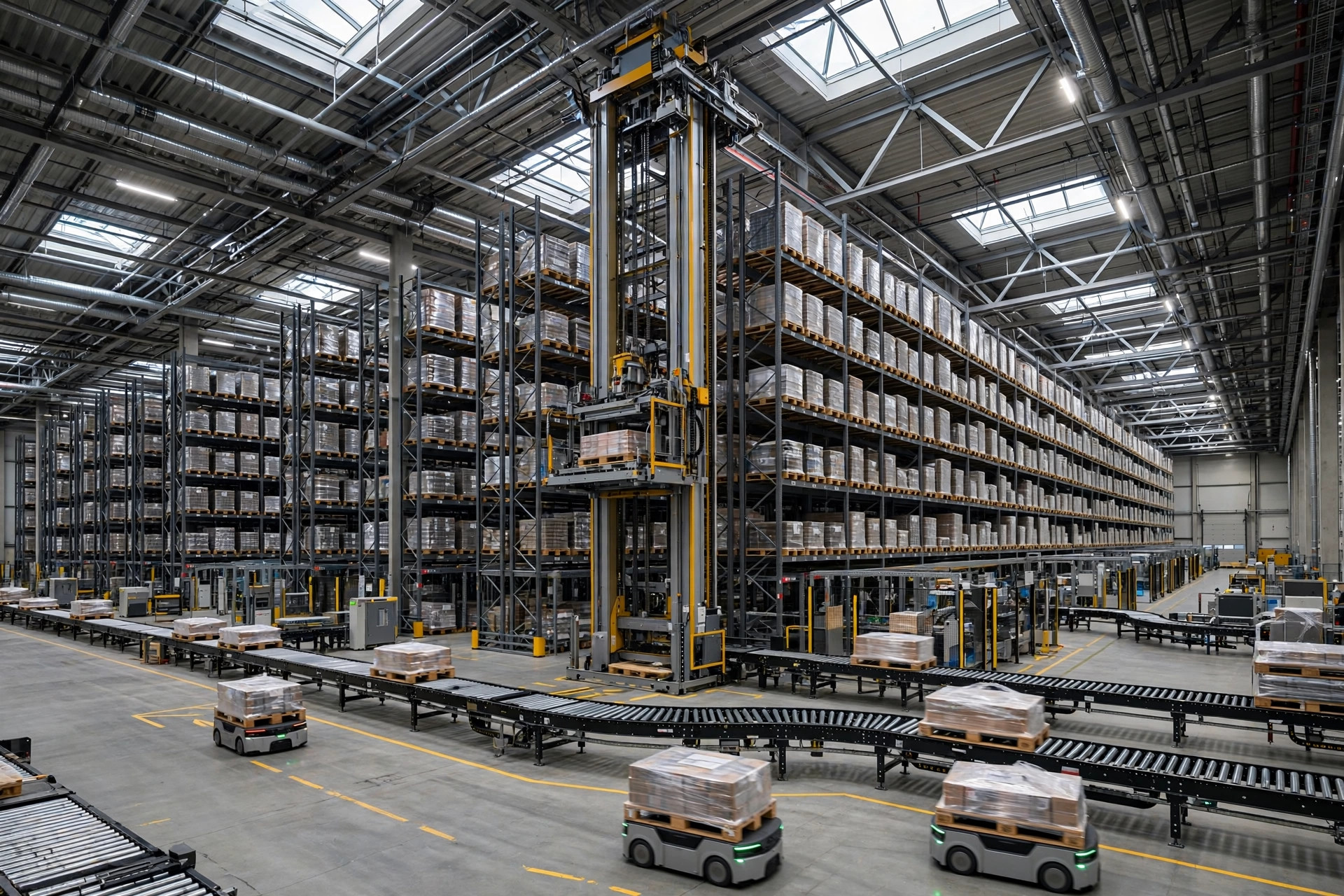
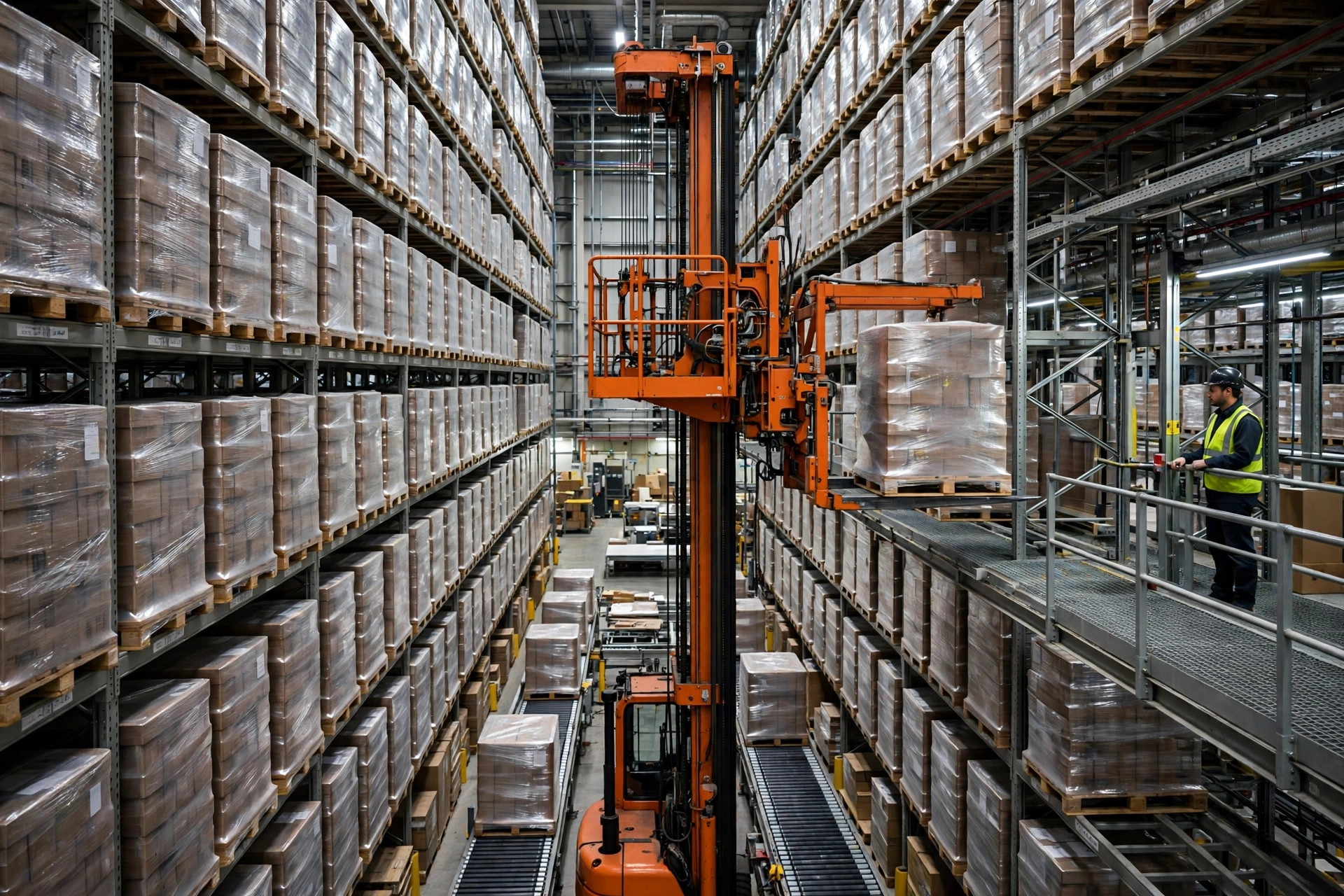
An ASRS stacks racks more than 20 meters high. The same 80,000 pallet positions shrink from 100,000 square meters of floor to 25,000. At going rates in a top-tier logistics market — say roughly $10 per square foot per year in a US coastal market in 2024 (markets vary enormously; use your actual local rent) — Option A costs about $10.8 million a year in rent, Option B about $2.7 million. Annual rent savings: roughly $8.1 million.
Notice that? The rent ledger is nearly double the labor ledger. That's the first counterintuitive finding: most people assume an ASRS mainly saves labor. Wrong — in expensive markets, rent savings are usually the bigger number. In the projects I've worked on, rent savings routinely account for more than half of total savings, with labor as the smaller piece.
Both Ledgers Combined: Five-Year Total Cost
| Cost Item | Option A: Conventional | Option B: ASRS | | Capacity | 80,000 pallet positions | 80,000 pallet positions | | Footprint | ~100,000 sqm | ~25,000 sqm | | Annual rent | ~$10.8M | ~$2.7M | | Annual labor cost | ~$6.0M (120 people) | ~$1.75M (35 people) | | Equipment investment | Negligible | ~$80M (~$1,000/pallet position incl. racking, equipment, software — get vendor quotes) | | Added annual maintenance/power | — | ~$0.4M | | 5-year total cost | ~$84M | ~$104M |
Wait — that math doesn't favor the ASRS. Annual savings = ($10.8M − $2.7M) + ($6.0M − $1.75M) − $0.4M = $11.95M per year against an $80M investment: about a 6.7-year static payback. And that's exactly the point I want to make: inputs decide outputs. At these US-market inputs, this project barely clears my bar. In a market where rent is half and labor is half, the answer flips entirely — which is why the cautionary case below matters more than any single calculation.
The Cautionary Case: A Payback That Stretched to Seven Years
In 2023, a 3PL in southern China built a dedicated warehouse for a single large customer and went all-in on an ASRS. The original model showed a four-year payback — beautiful on paper. But that customer's SKU profiles changed three times in one year, and the storage compartments had been engineered around the first round of SKUs. Round two arrived and half the compartments couldn't fit the new goods — they got downgraded to manual slots. Round three arrived and equipment utilization sat stuck just above 60% for months. The payback stretched from four years to more than seven, and the CFO shook his head every time he saw me for two years.
That's the second counterintuitive finding: the most expensive line item in an ASRS project isn't the equipment — it's certainty. You're placing a bet on your SKU profiles and order patterns five to eight years out. Win the bet and it's a money printer; lose it and it's expensive sculpture. Fast-changing SKUs, a single dominant customer, weather-dependent business — stay away from ASRS for now. That money would be spent in vain.
Three Hidden Traps in the ASRS Ledger
Three costs never make it into the vendor's model, and they're the ones that blow up payback:
First, software and integration. The equipment quote is only the starting point. WCS-to-WMS integration development, commissioning, and dual-running labor during trial operation routinely add 15% to 25% on top of the equipment price in this industry, with 6-to-12-month implementations being normal (go by the vendor's actual delivery record). Leave it out of the model and your payback is understated by a year.
Second, compartment reconfiguration. The cautionary case above: SKUs change, compartments must change, and one reconfiguration starts in the hundreds of thousands. What an ASRS fears most isn't volume swings — it's profile changes.
Third, downtime risk. In a conventional warehouse, a broken forklift gets swapped for another one. In an ASRS, one dead stacker crane idles the entire aisle. Spare-parts lead times and maintenance response times belong in the contract SLA — cheap equipment without them becomes expensive downtime later.
Sensitivity Analysis: Which Variable Hurts Most
| Variable shift | Annual savings | Static payback | | Base case (high rent + high labor) | $11.95M | ~6.7 yrs | | Rent −30% | $9.52M | ~8.4 yrs | | Rent +30% | $14.38M | ~5.6 yrs | | Labor −30% | $10.68M | ~7.5 yrs | | Labor +30% | $13.23M | ~6.0 yrs |
See the pattern? A 30% swing in rent moves payback by nearly three years; a 30% swing in labor moves it by about a year and a half. Rent is the first-order variable in ASRS payback — which is why I say an ASRS is a real-estate decision first and an automation decision second. When in doubt, negotiate the rent before you negotiate the equipment.
Decision Framework: Four Quadrants, Find Your Spot
| | High rent (tier-1 cities / cold chain) | Low rent (smaller cities / owned land) | | Expensive, hard-to-hire labor | Go — fastest payback | Lead with the labor math | | Cheap, easy-to-hire labor | Lead with the rent math | Hold off — spend on process improvement first |
Plus three hard gates — pause if any one fails: first, SKU profiles must be broadly stable for the next five years; second, you own the building or hold a long lease (8+ years) — never sink fixed assets into a short lease; third, modeled peak utilization must clear 75% — idle equipment is the most expensive cost of all.
One Formula to Take Home
Payback years = total equipment investment ÷ (annual rent savings + annual labor savings − added annual maintenance)
My hard rule: a static payback under five years is worth serious discussion; over seven years, you're better off renegotiating the rent or moving to a cheaper location. An ASRS is a fine machine — but fine machines still need the math done first, both ledgers, neither one skipped.
By Lao Zhou, Logistics Cost Analyst