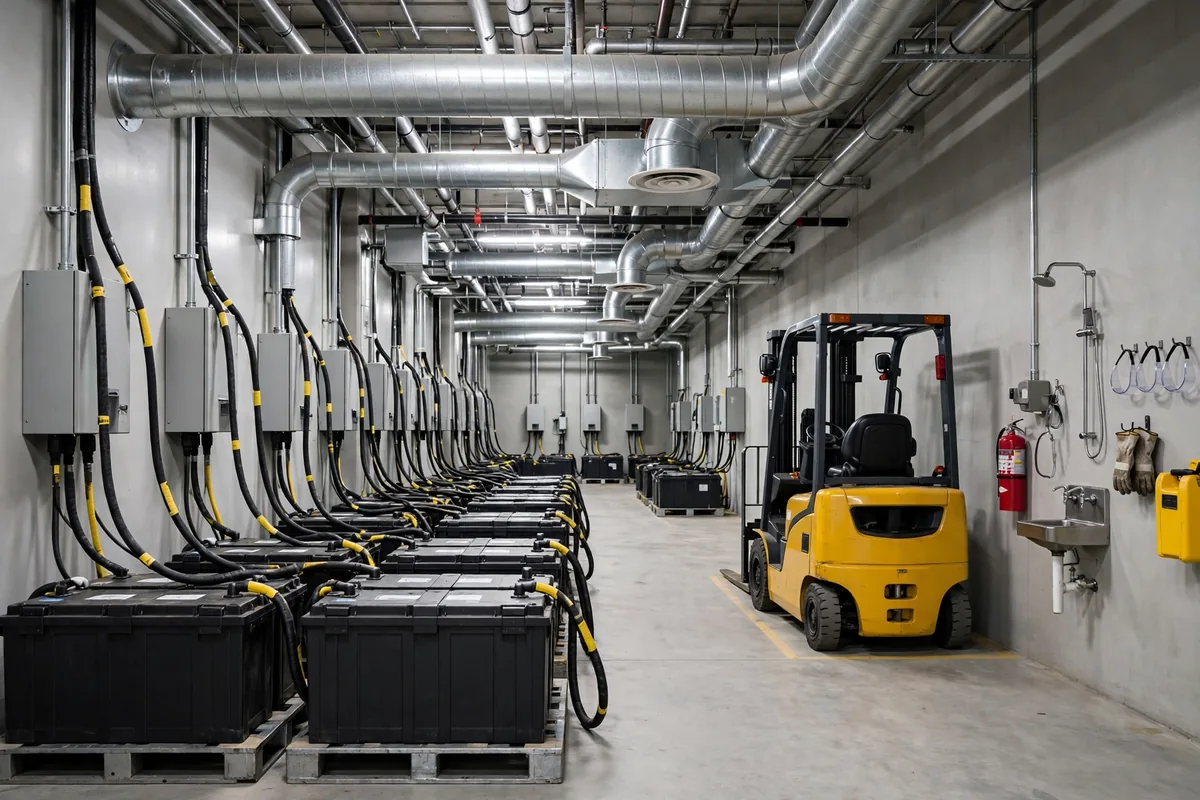
Warehouse battery charging room ventilation seldom tops the agenda in planning meetings, yet it governs one of the few spaces where electrical equipment, a flammable gas, and round-the-clock operations meet. Reviews by European operators suggest near-misses in charging areas rarely begin with dramatic failure. They begin with drift: a fan that no longer runs when chargers run, a duct partly detached, a room slowly becoming a storage corner. The risk accumulates quietly, which is why one-off commissioning checks miss it.
Warehouse battery charging room ventilation and the chemistry behind it
To understand warehouse battery charging room ventilation, it helps to start with what a lead-acid battery actually does near the end of a charge. As charging progresses and cells approach full charge, an increasing share of the electrical energy goes into splitting water in the electrolyte into oxygen and hydrogen. The hydrogen leaves the cell surface and rises. A single battery releases only a small amount, but a fleet of counterbalance trucks, pallet trucks, or lead-acid powered handling equipment charging at the same time releases enough in aggregate that dilution cannot be left to chance. Hydrogen is colourless, odourless, and much lighter than air, so it collects high in the room: under the ceiling, behind beams, above cable trays, and in any pocket the exhaust airflow does not reach. Once an accumulated layer enters its flammable range and meets an ignition source, the consequences are severe. The specific concentration limits and ventilation calculations that apply in a given building must be taken from local current regulations and equipment manuals, and this article deliberately does not quote a single universal figure, because national codes and battery types do not share one calculation basis.
Battery chemistry changes the risk. Lithium-ion areas are managed mainly around thermal runaway and smoke; lead-acid areas around a slow, continuous release of hydrogen. Fleet conversions often replace trucks and chargers but keep the room, the fan, and the inspection sheet, so checks keep covering hazards that have changed while new ones go unexamined.
How ventilation fails: three quiet pathways
Field reviews point to three recurring pathways. The first is loss of interlock. Ventilation is designed to run whenever charging runs, but a signal wire left disconnected after maintenance, a timer switched to manual, or a fan turned off at night because of noise can leave charging continuing without extraction. The second is air short-circuiting. If supply and exhaust openings sit too close together, fresh air is pulled straight out again and the centre and upper corners of the room are never effectively swept. Standing in the doorway and feeling a draught is not evidence that the high layer is being diluted. The third pathway is created after handover. Charging rooms gradually acquire spare parts racks, cartons, and idle pallets. Low-level inlets get blocked, new trays and covers create fresh stagnant pockets above head height, and none of these changes ever makes it back onto a drawing.
In autumn 2021, a regional distribution centre of roughly 20,000 square metres in northern Germany was flagged during a third-party safety walk. More than a dozen lead-acid trucks charged overnight. The exhaust fan showed as running, but the flexible connector on the roof duct had partly pulled away, sharply cutting exhaust volume, and a new cable tray had created a stagnant band behind a beam. No incident had occurred. The operator reconnected the duct, modified the tray, added fan status to the mandatory night-shift check, and introduced periodic testing of high-level gas detection, with thresholds handled under local rules and supplier manuals. Six months later a similar separation appeared in a smaller charging corner, but the weekly inspection caught it. The lesson was not about one repair; it was about whether the routine was built around the failure pathways themselves.
A second case comes from a fulfilment warehouse in central Poland in 2023. For peak season it added rented trucks and spare batteries, expanding from eight charging positions to fourteen, without a matching review of the ventilation system. Some batteries ended up outside the original airflow path on temporary cabling. After peak, the operator acknowledged that the decision logic had been capacity first, assessment later, and the assessment was then forgotten. Expansion itself was not the mistake. The mistake was the absence of a trigger: once the number of positions, the battery mix, or the simultaneous charging factor changes, the assumptions behind warehouse battery charging room ventilation have changed too, and nothing in that warehouse forced a second look.
What European warehouses commonly do with charging-area layout
Across European practice, several layout principles recur though national rules differ. Charging tends to sit in a separated area against an external wall, shortening the exhaust path and limiting gas migration, with clear separation from offices. Electrical selection and ventilation are treated as one system: lighting, switches, and sockets are matched to the hazard assessment, and fan failure is expected to raise an alarm and, in many designs, constrain charging, following local regulations and equipment manuals. High-level extraction with low-level make-up air is widely used because it follows hydrogen buoyancy, yet operators insist grille positions alone prove nothing and verify dead zones with smoke tracing or measured airflow. Finally, charging rooms are held as dedicated space, not overflow storage, with floor markings, battery spacing, and acid spill provisions under visual discipline that is particularly strict among German, Dutch, and Nordic operators.
The table below maps failure pathways to checks that can actually be performed.
| Failure pathway | Typical sign | Practical check | Owner |
|---|---|---|---|
| Interlock lost | Chargers run, fan does not | Pick one charging battery at random and confirm fan signal, sound, and airflow agree | Night-shift lead |
| Duct detached or blocked | Panel shows running, exhaust is weak | Walk the duct run, inspect flexible joints, record periodic airflow readings | Maintenance |
| Short-circuit and dead zones | Draught at door, still air up high | Smoke trace toward beams, trays, and ceiling corners | Safety engineer |
| Layout changed by storage | Inlets blocked, new pockets above | Compare the room against its layout plan; any change triggers review | Warehouse manager |
| Detection out of calibration | Detector present but untested | Calibrate and function-test on the manual's cycle, with records kept | Safety engineer |
An inspection framework, and one counter-intuitive point
A workable framework is layered so each check answers a known failure pathway. The daily layer, owned by the shift team, stays short: fan state matches charging state, inlets and exhausts are unobstructed, no unrelated storage has appeared, and any odour or noise is logged. The weekly layer, owned by maintenance, adds duct joints, fan condition, an alarm-linkage test, and a look at high-level dead zones. The monthly layer, owned by the safety engineer, verifies airflow, confirms detector calibration, and audits whether earlier records can be trusted. The layer most often missing is the change trigger: adding or removing positions, changing battery chemistry, or altering anything in the room should automatically prompt a ventilation review rather than wait for an annual audit. Many sites have change-management language on paper but leave charging areas off the list as auxiliary space. Putting them on it is among the cheapest improvements available.
One counter-intuitive point deserves emphasis. Gas detection does not mean the ventilation problem has been solved. Detection discovers accumulation; ventilation prevents it. If practice shifts toward relying on alarms, the safety margin moves from dilution in advance to reaction after the fact. The more robust order is to make warehouse battery charging room ventilation reliable and verifiable first, and treat detection as a second line of defence with separate records, never a substitute for checking the fan.
Looking ahead, AMRs and automated fleets are moving charging from one central room toward many small points, each releasing less hydrogen but spread across more locations. How separation, extraction, and inspection should adapt when charging no longer happens behind a closable door remains open in both regulation and practice. For operators planning or retrofitting a building, the more durable question may not be which fan or detector to buy, but who owns continuous review of auxiliary spaces long after the drawings were signed off, since the cases above suggest risk is rarely born on the drawing; it is born in the small, unreviewed changes that follow.
By Dr. Chen, Supply Chain Researcher