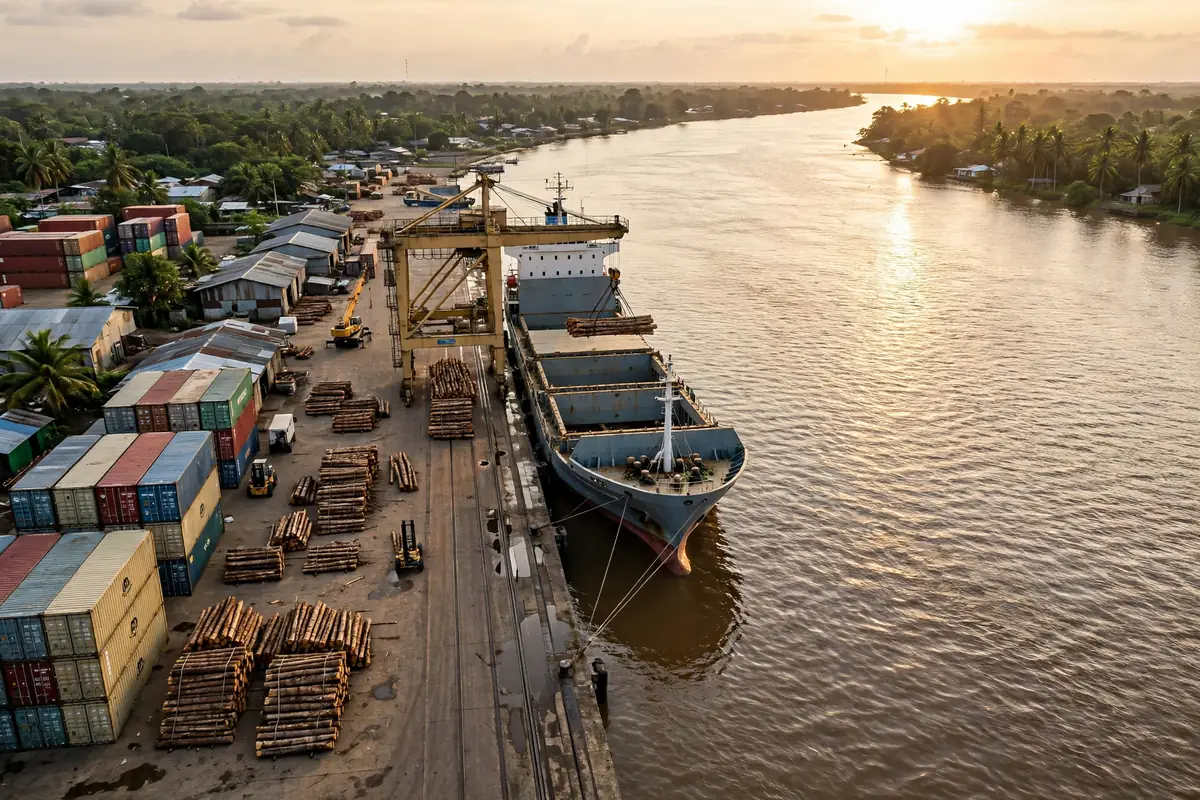
Here is my conclusion up front on Suriname Paramaribo port warehouse logistics: the port of Paramaribo is a small port, but it is a small port with a clear system. It handles about 100,000 TEU a year, roughly 50% of Suriname's seaborne trade. That number looks unimpressive on a global ranking, but for a country of under a million people, this port is the lifeline. Put simply, when you judge whether a port can handle your cargo, do not start with how big it is. Start with how clearly it divides the work. On that measure, Paramaribo outperforms plenty of bigger ports.
There are two sides to this. On one side, the hard limits of a small port: at low tide the water is only 7 meters deep, so large mainline vessels cannot call, and most cargo transships through a Caribbean hub. On the other side, the small port's way of surviving: the port, the terminals, and the warehouses each do their own job, and oil, gold, timber, rice, and fish each move on their own track, without getting in each other's way. That division of labor is the whole game of Suriname Paramaribo port warehouse logistics.
Suriname Paramaribo Port Warehouse Logistics: How the Port and Warehouses Divide the Work
The heart of the port is the Dr. Jules Sedney Harbour: 18 hectares, a 600-meter general cargo quay along the river, and 19 international carriers calling. This is the port's general yard — containers, breakbulk, and general cargo all move through here. The DP World Paramaribo terminal has an annual capacity of 130,000 TEU and handles more than 8,000 reefer TEU a year. That reefer capacity is the port's real strength. Fish and agricultural exports depend on it entirely.
But if you only look at the main port, you miss a critical piece: the La Vigilantia specialist terminal. It has a 73-meter concrete river quay and a 21,000-square-meter yard, and it can take vessels up to 200 meters long. It handles heavy cargo and project cargo. Oversized oil equipment and mining machinery do not go through the general berths of the main port — they go here. That is the value of the division of labor: the main port protects volume, the specialist terminal protects special cargo, and neither crowds out the other.
The warehouse side is layered the same way. CCA Suriname's warehouse is a good example: 700 square meters of covered warehouse plus 1,500 square meters of open yard. Covered space holds cargo that cannot get wet; the open yard holds timber and other cargo that can take the weather. Put simply, a small port's warehouse logic is to put its best resources where they matter most — covered space is precious, and only cargo that truly needs it gets it.
I have seen too many people run a South America lane by staring at the main port's throughput number, only to arrive and discover their cargo should never have gone through the main port at all. Heavy cargo sent to the wrong terminal waits a week for a berth. Moisture-sensitive cargo left in an open yard gets ruined by one rainstorm. A small port is not the problem. Mismatching cargo to terminal is the problem.
Take timber. A load of logs arrives from the interior forests, sits in the 21,000-square-meter yard at La Vigilantia, and waits until the 40-foot containers and the vessel schedule line up. The yard is the warehouse, so storage costs almost nothing — the real costs are inland transport and waiting for the sailing. Rice works the opposite way. Rice cannot get wet, so it goes straight into the 700 square meters of covered warehouse and stays dry all the way into a 20-foot container. Same port, two cargoes, two completely different cost structures. Get that calculation wrong and your whole quotation is wrong.
Oil, Gold, Timber, Rice, and Fish: Five Cargoes, Five Routes
Suriname's export mix is interesting because its five main cargoes each follow a different logistics route.
Timber is the big export, moving in 40-foot containers. Logs and sawn timber travel from the interior to Paramaribo, sit in the open yard, and get stuffed when the vessel is ready. Timber does not mind sun or rain, so the yard is its warehouse, and that keeps storage costs low. It is one reason a small port can make the timber business work at all.
Rice moves in 20-foot containers, and it is the mirror image of timber: it fears moisture, so it needs covered storage from intake to stuffing, never seeing rain. That is why 700 square meters of covered warehouse — a figure that looks trivial — is a fought-over resource locally.
Fish moves on the cold chain. The DP World terminal's capacity of more than 8,000 reefer TEU a year exists largely for fish and farm produce. A reefer container goes from the terminal's reefer yard straight onto the vessel, and the shorter the break in the cold chain, the better. The small port's advantage is a short process: the whole port area is only 18 hectares, so the reefer yard sits close to the berth, and cargo goes from plugged-in to loaded in one smooth movement. People in the fish export business know this well: the cold chain does not fear expensive freight, it fears extra handlings. Every extra restuff is another chance for the chain to break. On this point, Paramaribo's small size works in its favor.
Oil and gold are a different matter. Both are high value-density cargoes, and security and compliance matter more than freight cost. Oil equipment mostly moves through a specialist terminal like La Vigilantia. Gold moves in small, high-security, paperwork-first shipments. If you approach high-value cargo with a "small port means cheap" mindset, you will pay for it eventually. For these cargoes, safety and compliance come first, and logistics cost is never the first consideration.
Imports are simpler: mostly consumer goods. Suriname has limited local manufacturing, so daily consumer goods, building materials, and machinery mostly arrive by import, and Paramaribo is the country's intake point. If you run import distribution, watching the vessel schedule and the customs rhythm matters far more than watching the warehouse rate.
Paramaribo Port Logistics in Practice: Three Accounts for Chinese Sellers
The first account is the sailing schedule. Nineteen international carriers calling sounds like plenty, but the 7-meter low-tide depth means large vessels cannot enter, and most cargo transships through a Caribbean hub. Your delivery promise has to include that transshipment time. Do not promise customers direct-service transit times.
The second account is warehousing. Covered warehouse space is scarce, so book it before the peak season, not after your cargo arrives. Cargo that can sit outdoors, like timber, should not compete for covered space — winning that space is just wasted money.
The third account is compliance. Suriname's customs and inspection rhythm is its own, and incomplete paperwork means your cargo does not ship. And one thing to get straight: the deep-water Port Boskamp is still in planning. Do not write it into your logistics plan. What exists today is the Jules Sedney Harbour system. Do not count on a port that has not been built to solve your problem.
One last piece of advice: do not apply your Southeast Asia or Brazil playbook directly to Suriname. A 100,000-TEU port has its own temperament. Follow its division of labor and your cargo moves smoothly; fight it and every step is a trap. Before you ship, answer one question: should your cargo go through the main port, the specialist terminal, or the reefer yard? Get that answer right first.
By Lao Mi, Supply Chain Veteran (20 yrs)