Spain olive oil export warehouse storage is a ledger most people read wrong. They add up freight and tariffs and call it the cost of the business, while the profit quietly leaks away in the warehouse, through three things you cannot see on an invoice: light, temperature, and time. The International Olive Council puts Spanish production for the 2024/25 crop year at roughly 1.42 million tonnes, about 40 percent of world output, which leaves Spain's position as the world's largest producer beyond dispute; Andalusia alone accounts for more than 70 percent of that Spanish total, and the province of Jaen by itself produces close to a third of the country's oil. Volumes on this scale cannot be pressed and sold in the same season, so storage is the reservoir of the whole industry, and every small leak in the reservoir comes straight out of the industry's margin.
The shape of Spain olive oil export warehouse storage
Before judging the warehousing, it helps to see the scale and the volatility it has to absorb. World olive oil production in 2024/25 was about 3.57 million tonnes, and Spain's 1.42 million tonnes was roughly 40 percent of it, more than the next several producers combined. Yet just one crop year earlier, in 2023/24, Spanish output was only about 854,500 tonnes, after drought cut production by roughly 40 percent. The gap between those two seasons is nearly 570,000 tonnes, and that swing decides what storage is for in any given year: in a bumper year the question is whether there is enough tank capacity and where the oil goes, while in a short year the question is how long the stocks in the tanks can last and whether to hold them back.
The export side moves just as sharply. Data from Spain's Ministry of Agriculture show exports topping 1.03 million tonnes in 2024/25, the first time above a million tonnes since 2021/22, while export value came to only about 5.05 billion euros, down 17 percent year on year, with the average export price per kilo falling by nearly 40 percent. Volume up, value down: the oil moved, but each tonne earned considerably less. Italy remained the leading destination, with shipments there rising 69 percent, and volumes to the United States, Portugal, and France also grew. Behind those figures sits a structure that is often overlooked. A large share of Spanish oil leaves the country in bulk, is bottled in Italy, and reaches world markets under someone else's label, which means the brand premium stays with the bottler while Spain earns on scale and turnover.
That volatility and that structure define what warehousing actually does in this chain. It is not simply a place to put oil. It is the mechanism that smooths fat years against lean ones, protects the grade, and decides whether a seller earns a bulk price or a brand price. Oil that goes into the tank in a bumper year and comes out downgraded sells at a discount even as bulk; oil held carefully through a short year is itself a bargaining chip.
Light, oxygen, and temperature: the three things oil cannot forgive
Unlike wine, olive oil does not improve with age. From the moment it leaves the press, its quality moves in one direction only, and light, oxygen, and temperature decide how fast. Warehousing, at its core, is the discipline of holding all three down at the same time.
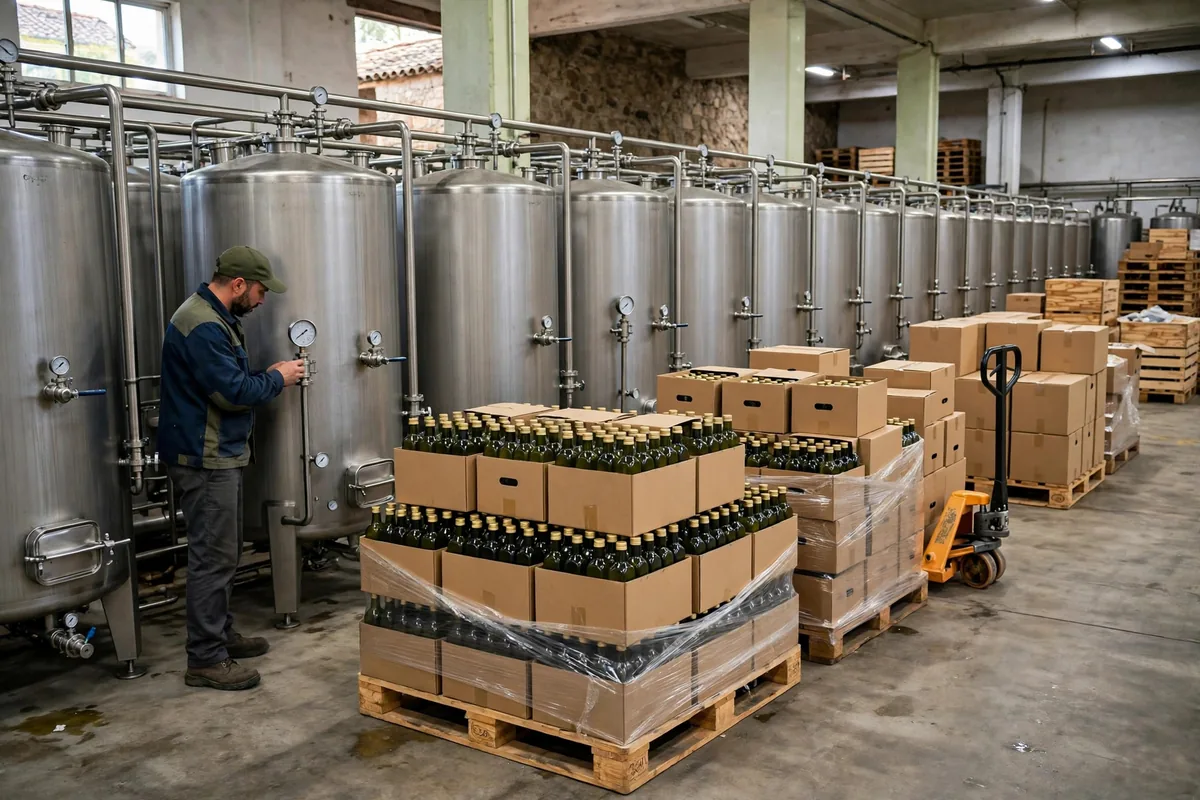
Temperature is the one most easily underestimated. The accepted storage range in the industry is roughly 14 to 18 degrees Celsius, in stainless steel tanks, under a nitrogen blanket, kept out of the light. A study of extra virgin olive oil storage makes the point with unusual clarity. Samples of one batch, starting at free acidity near 0.7 percent, were kept at 20 degrees Celsius under different conditions, in darkness or under inert gas, and within four months their acidity had passed the 0.8 percent ceiling for extra virgin grade, so they lost the grade altogether; only the samples held at low temperature still qualified as extra virgin after 16 months. A few degrees of temperature, in other words, can cost months of grade life, and that is a laboratory measurement, not a metaphor.
So when judging whether an oil warehouse is professional, skip the decoration and look at three things: whether the tanks are stainless steel, whether there is nitrogen protection at the top of the tank, and whether the warehouse temperature can be held below 18 degrees. Many small mills press excellent oil and lose the grade in storage: the oil sits in an ordinary tank, the warehouse hits 30 degrees or more in summer, and after a few months the fresh fruitiness is gone and the lab report comes back over the line. The threshold for extra virgin is free acidity of no more than 0.8 percent, and that line is the pass mark for storage. Fail it, and all the work in the grove and the mill is wasted.
There is also a counterintuitive point worth stating plainly: for olive oil, having too much storage capacity can be more dangerous than having too little. Big capacity invites the temptation to hold oil and wait for prices to rise, yet every extra month in the tank adds downgrade risk. The 2024/25 season proved the point, with export unit values falling by nearly 40 percent while holders waited. The quality curve and the price curve often move in opposite directions: the price rise you are waiting for may never come, and the grade slips first. Storage here tests not how many tanks you own, but how honest your judgment about time is.
Bulk or bottled: the grading ledger in Spain olive oil export warehouse storage
Once oil leaves the mill and enters the warehouse, the next decision is the form in which it ships, and that decision shapes the warehouse itself. The workhorses of bulk export are flexitanks and ISO tank containers. A flexitank fitted into a standard 20-foot container holds about 24,000 litres, roughly 22 tonnes of oil; an ISO tank holds a similar volume but adds temperature control and reusability, which suits premium and certified oils on established routes; for short hauls between mill and refiner, stainless steel road tankers of 20 to 30 tonnes do the job. Bottled export follows a different logic: the same 20-foot container holds about 15,000 one-litre bottles, under 14 tonnes in total, so the freight cost per unit of weight is far higher, and what it buys is brand and margin.
The table below compares the three export formats. The figures are an illustrative scenario for comparing structures, not quotations; actual rates should be checked against the latest official policies.
| Export format | Rough load per container | What storage has to manage | Who it suits |
|---|---|---|---|
| Flexitank, bulk | About 22 tonnes | Tank inspection before loading, nitrogen cover, temperature control; single-use | Large-volume standard grades, where turnover is the game |
| ISO tank, bulk | About 22 tonnes | Temperature control, cleaning, repositioning; lease and empty-return costs | Premium or certified oils on fixed, long-term routes |
| Bottled export | Under 14 tonnes | Bottles, cartons, pallets, labelling, and keeping grades separate at filling | Sellers with a brand and a channel, earning on margin |
Behind the table sits a trade-off. Bulk pushes logistics cost to the floor but hands pricing power to the buyer; bottled keeps pricing power at home but multiplies the complexity of storage and filling. Spain exports large volumes with relatively thin brand premiums, and the root of that lies here: most of the oil leaves in bulk, so every cent saved in the warehouse can end up conceded at the negotiating table. Conversely, a seller willing to invest in graded storage and bottling is no longer selling the same product.
For anyone running export storage, three practices are worth pinning to the wall. Test every lot on arrival and store grades in separate tanks, never mixing them; ship first-in, first-out, so the oldest oil leaves before it downgrades; and keep a sealed retention sample of every lot, because when a quality dispute arises, the sample is the evidence. What is expensive is the grade difference you pay when they are skipped.
The International Olive Council estimates Spanish production for 2025/26 at about 1.37 million tonnes, still roughly 40 percent of world output, so supply looks comfortable while prices are in no hurry to recover. If the next price rise does arrive, the question will come back to the warehouse all the same: will the oil in your tanks still deserve the name extra virgin on that day? There is no standard answer, but the answer will not be found on a quotation. It will be in the temperature log, the nitrogen gauge, and the lab report.
By Dr. Chen, Supply Chain Researcher