South Africa wine export warehousing landed in our lap last year more or less by accident. We run a small warehouse, about 3,000 square meters, and a friend of a friend at a small Stellenbosch winery asked whether we could hold a few dozen pallets of red wine for a while and then send them on to a warehouse near Cape Town port. My first reaction was honest: there is no way our little operation can afford that kind of money. A proper temperature-controlled wine cellar sounds like something for the big players, not for us. Then he said something that stopped me: they did not need a cellar, just somewhere stable, cool, and low-drama. That, I figured, we could think about. So we took the job, and it taught me fast that wine and tea are completely different animals. Whatever logic you use for tea will get you into trouble with wine sooner or later.
South Africa Wine Export Warehousing: What Wine Is Actually Afraid Of
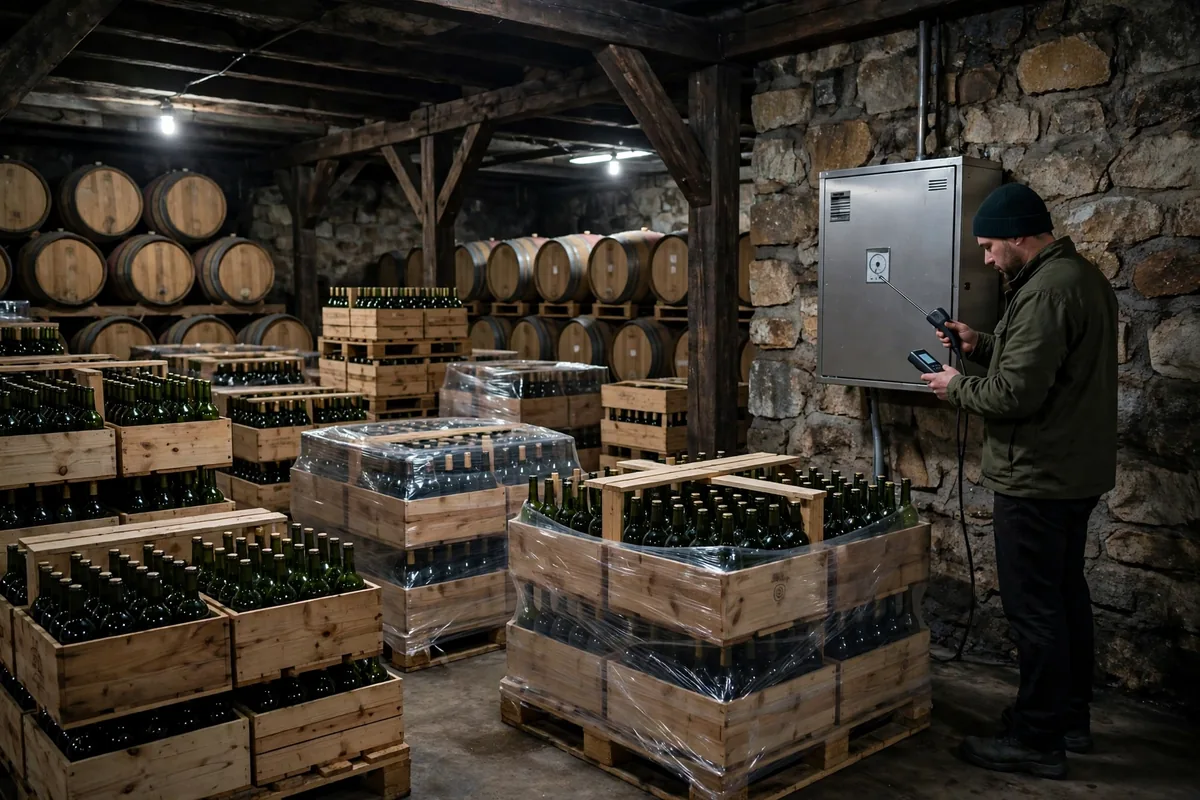
The first thing to get straight is that wine is not afraid of distance. It is afraid of being knocked around. A bottle can sit quietly in a winery cellar for years, but once it leaves, a hot afternoon, a cold blast, and then a stuffy truck in between will do more damage than a long voyage ever could. The temperature logic for South Africa wine export warehousing boils down to one rule: hold it steady in the mid-teens and do not let it swing. Every winery has its own storage and transport requirements, so get those in writing before you accept the job and put them on the handover sheet, rather than guessing a temperature yourself. Our low-budget version is a shady corner of the warehouse, far from the main door, with a thermometer checked twice a day and written down in a notebook. If the reading jumps, we look for the cause right away instead of waiting for the customer to ask.
Light comes second. Long exposure to strong light, especially sunlight, is bad news for wine, and that includes the big warehouse lamps left on all day and the sun coming straight through the loading door. Our fix is gloriously low-tech: a shade curtain across the wine area, an opaque cover over each pallet, and loading scheduled to dodge the midday sun. Third is shock. Wine hates rough handling after a long bumpy ride, so pallets get stacked tight, wrapped properly, and the forklift driver gets a heads-up before touching them: this one is wine, take it slow. Fourth is batch discipline. Wine is identified by vintage, winery, and batch number, and one pallet mixing two vintages becomes a mess at the port warehouse. We insist on one code per pallet, a handwritten batch card hanging on it, and two people counting it in.
From the Winery Warehouse to the Port Warehouse: Where It Usually Goes Wrong
The part that really made me sweat was the handover on our first shipment. It was summer in South Africa, the wine came out of the winery warehouse, spent one night with us, and was due at the port warehouse the next morning. But the port warehouse's dock was backed up, and the truck sat in an open yard all afternoon with the sun beating on one side of the trailer. The driver rang me asking whether to unload anyway. I told him to wait until a shaded slot opened up. I spent that whole afternoon on the phone, and in the end the pallets went into a cool area in the evening with no big jump on the temperature log. Lucky, but also a lesson: from then on, our handover sheet includes an agreed time window and a shade requirement, booked with the port warehouse in advance. If there is no shaded spot, we wait. We do not unload into the sun just to keep things moving.
The second shipment went wrong on batches instead. The winery warehouse's list had one digit wrong in a batch number, we received against the list, and the port warehouse checked against the original order and could not match it. The only reason that did not turn into days of arguing is that we had kept a photo of each pallet and the handwritten batch card from receiving, so matching the right pallet took minutes. On export paperwork and compliance, the rules change and differ by market, so always go by the latest official policy. Our warehouse rule is simpler and non-negotiable: if the paperwork, the batch, and the physical goods do not all agree, the shipment does not move. Slow beats wrong.
| What wine fears | What a big warehouse does | What our small warehouse does |
|---|---|---|
| Temperature swings | Full climate-controlled cellar with automatic alarms | Cool corner, temperature written down twice a day, investigate any jump |
| Light | Light-proof storage rooms | Shade curtain plus pallet covers, no midday loading |
| Shock | Specialist wine pallets and cushioning | Stack tight, wrap well, warn the forklift driver first |
| Mixed batches | System batch tracking | One code per pallet, batch card plus a pallet photo |
A Small Warehouse Checklist Before Taking a Wine Export Job
Here is the counterintuitive bit, and it is worth saying plainly: most people assume taking on wine means spending big on a climate-controlled room first. In practice the expensive room is not what saves you. What ruins wine is the half hour at the dock in the sun and the few temperature swings nobody noticed. A climate-controlled room means nothing if the pallets bake during loading. A small warehouse cannot out-equip the big players, but it can out-care them: somebody writes the temperature down, somebody checks the batch, somebody watches the handover. Get those three right and wineries will happily hand you the awkward small lots the big warehouses do not want to fuss over.
Before I accept a job now, I ask myself four questions. First, is there a genuinely stable, cool spot, not somewhere that is cool today and sunny tomorrow? Second, can we do one code per pallet, with batch cards and photos kept on file? Third, will the handover come with a written temperature record and a signed checklist from both sides? Fourth, if something goes wrong, who pays and how, and is it written in the contract? If two or more of those answers are no, I turn the job down. A small warehouse has its own way of surviving. You do not take every dollar on the table; you take the dollars you can actually stand behind.
By Xiao Ma, Small Warehouse Owner