Let me be blunt: I used to think South Africa rooibos export warehouse storage was easy. Dry the tea, seal the bag, wait for the ship. What could go wrong?
My first container answered that question. Not at sea. In a warehouse.
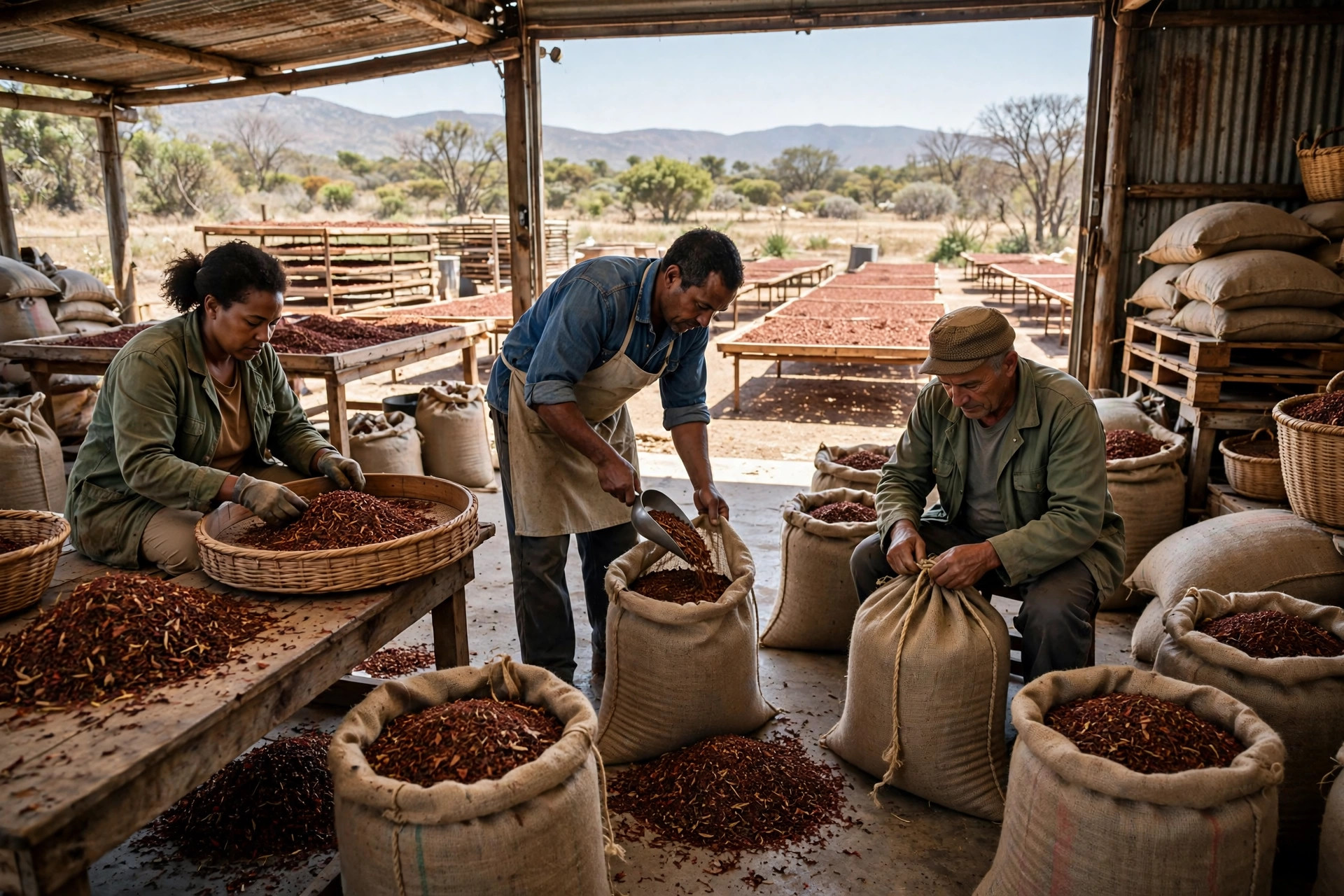
Rooibos looks tough. It comes out of the Western Cape sun-dried, fermented until it turns red, and the aroma finally sets. But set does not mean locked in. A little damp air, a little stray smell, and the tea drinks it all back up. The classic rookie mistake is treating "dried" as "stored." They are not the same thing.
Moisture and Smell: The First Gate
My first container taught me this on the leg between the tea court and the port warehouse. The tea was good. The bags were new. The problem was a corner of a transit warehouse that had previously held spices. The smell had mostly faded. A human nose could barely catch it. The tea could.
On inspection day, the buyer picked up a handful, smelled it, and frowned. Not moldy. Not damp. Just a faint, wrong note that should not have been there. The container was not rejected outright, but it was downgraded a grade, and the price followed it down. The freight, of course, did not come down one cent. That is when I learned the real lesson: in South Africa rooibos export warehouse storage, the first enemy is not rain. It is anything that smells nice.
After that, I set three hard rules for every warehouse I use. First, tea gets a dedicated zone. No sharing space with spices, coffee, soap, or anything with a strong smell, even for a few days. Second, every sealed bag gets a hand check. If a seal is uneven, we rebag on the spot. We do not hope the port warehouse will fix it later. Third, I smell the warehouse before I smell the tea. If the room carries any odd smell, we switch rooms before unloading, not after.
My Four-Step Play for South Africa Rooibos Storage, From Tea Court to Cape Town Port
From my second container on, I have run the same four steps, and I still run them today.
Step one: grade at the tea court. Do not leave all the grading to the port warehouse. The workers at the court know this lot best. They sort it there by leaf and cleanliness, label each bag with its batch and grade, and the port warehouse only rechecks. Every time you open a bag again, you give moisture and stray smells another chance to get in.
Step two: on the road, I only accept one standard, cool, dry, dark, and odor-free, with the exact temperature and humidity set by the buyer's latest spec. I do not invent numbers. My floor is simpler: the truck must not carry the smell of its last load, it must be aired out before loading, and the floor must show no sign of standing water. If a driver wants to mix in another load to save a trip, I would rather wait for the next truck.
Step three: watch the first few days in the port warehouse like a hawk. Those first days are when small problems are still cheap. I have the warehouse open a few bags every day: check for crushed or torn bags, smell for contamination, feel the bag walls for any dampness. Catch it in the first few days and you can still act. Catch it the day before loading and nobody can save it.
Step four: keep a retention sample from every batch. One small bag, batch and date written on it. I keep one, and I send one to the buyer if they ask. If a dispute comes up at arrival, the sample speaks. Without a sample, a dispute is just two people arguing, and the seller always loses that argument.
| Stage | Where it usually goes wrong | What I do instead |
|---|---|---|
| Grading at the court | Mixed grades shipped, reworked at the port | Grade and label on site, port only rechecks |
| Transit warehouse | Shared space, loose seals | Dedicated zone, every seal hand-checked |
| Port holding | Nobody watches the first few days | Daily sample checks for smell, dampness, damage |
| Shipping out | No evidence if a dispute lands | Retention sample per batch, batch and date marked |
Two Grades, Two Storage Calls for South Africa Rooibos
Here is the case that made the money logic click for me. One buyer ordered two grades in a single shipment: high-grade whole leaf for brewing, and lower-grade broken leaf for tea bags. The warehouse wanted to save effort and store both grades in the same zone, separated by a single row of pallets. Their argument was that it was all rooibos anyway, so how bad could the cross-talk be?
I said no. This was not me being picky. Whole leaf carries the premium, and one stray note wipes that premium out. Broken leaf has more surface area, so it picks up moisture and smell even faster than whole leaf. Storing them together means letting the two most sensitive products drag each other down. In the end I insisted on separate zones, separate pallets, and different bag-seal colors, so any worker could tell the grades apart at a glance without checking paperwork.
The first few days proved the point. The broken-leaf bags started to feel slightly damp on the walls first. The team moved those pallets to a better-ventilated spot the same day and added an extra moisture barrier underneath. The whole leaf, never opened and never moved, passed arrival inspection in one go. Same shipment, two storage choices, a full grade apart in outcome. That is the clearest South Africa rooibos export warehouse storage calculation I have got.
| Grade | How I store it | What I watch |
|---|---|---|
| Whole leaf, high grade | Its own zone, small bags, never mixed on a pallet | Daily smell and touch checks in the first days, as few bag openings as possible |
| Broken leaf, tea-bag grade | Its own zone, seal color coded, moisture barrier under the pallets | Dampness first, move the pallet before the whole zone is affected |
| Mixed tail lots | Never in the high-grade zone, labeled as tail lots | Rechecked separately before shipping, never topped up into high grade at the last minute |
The rule in that table is my floor: different grades, different storage. Mixing grades to save half a day of warehouse labor is how you trade a small saving for a whole shipment's price.
The Counterintuitive Bit: Dry Tea Is Not Afraid of Heat
Here is the part most sellers get backwards. People think dry tea can sit anywhere, so warehouse spending is the first thing to cut. Half true. Rooibos is not racing a clock the way fresh produce is. But it is punished by every corner you cut.
Skip the dedicated zone, skip the seal checks, skip the first-days watch, and the line item looks smaller. Then one downgrade wipes out the warehouse savings from several containers at once. Saving a little and losing a grade is the dumbest saving in this business. And bigger bags are not automatically cheaper either. One giant bag for dozens of cartons means one opening exposes the whole lot to air. Smaller bags cost a bit more per bag, but opening one bag only affects that bag. I pack to the buyer's single-use quantity, not to the cheapest bag count.
Three more warnings before I finish. First, write "odor-free storage" into the warehouse contract, not just "dry warehouse," so you have something to point to when things go wrong. Second, when you switch warehouses or carriers, watch the first shipment yourself. A good old relationship is not a quality check. Third, if any storage condition is unclear, ask the buyer for the latest spec, subject to the buyer's latest spec, and do not take a middleman's verbal promise.
This method is not fancy. No high tech, no buzzwords. Grade early, treat smell as the enemy, and watch the first few days hard. Container by container, buyer inspections got smoother, and my dispute calls got shorter. That is the whole South Africa rooibos export warehouse storage bet in one line: spend the effort where the grade is decided, not where the invoice looks cheapest.
This one I have actually tested, and it works.
By Ah K, E-commerce Seller (5 yrs)