Let me tell you something after all these years on the road: in the south africa avocado export warehouse cold chain, the saddest cargo I have ever seen was not smashed. It was suffocated. Years ago at the port of Durban I watched a reefer open up — the cartons looked fine from the outside, but inside, the flesh had gone black. The whole container was written off. The shipper stood on the quay for a long time without saying a word. Those avocados had been picked in Limpopo, sailed for more than three weeks toward Rotterdam, and were supposed to land in supermarkets. They ended up in the bin. The whole loss came down to one word: heat. The fruit comes off the tree carrying field heat, and if you do not pull that heat out properly, every dollar you spend afterwards is wasted.
South Africa Avocado Export Warehouse Cold Chain: The Fruit Fears Swings, Not Cold
First, the baseline numbers. South Africa's avocado season runs from February to October, peaking from March to September, with production concentrated in Limpopo and Mpumalanga. In 2024 the country produced 157,590 tonnes of avocados and exported 82,787 tonnes worth about USD 204 million — more than half the crop sold abroad. The market is concentrated: the European Union took about 76% of export revenue, the United Kingdom 13%, and the Netherlands alone received 58,023 tonnes. Put plainly, this chain is a lane to Europe — load at Durban, discharge at Rotterdam, about 24 days northbound. Exports slipped to about 76,000 tonnes in 2025, and the industry expects a rebound to 88,000 tonnes in 2026 as newly planted orchards come into bearing. Volumes are heading up.
An avocado is not like beef. Beef has clear limits — too warm is bad, too cold is bad. An avocado is alive. After picking it keeps breathing, keeps releasing ethylene, keeps ripening on its own. Leave it at ambient temperature and it ripens itself into mush. Chill it too hard and it suffers chilling injury — the flesh turns black and bitter. So the enemy on this lane is not one temperature point. It is temperature swings along the way. Fruit held steady at 5 degrees Celsius all the way arrives green. Fruit swung hot and cold three times arrives half black. Any driver knows this in his bones: a reefer, like a person, hates being jerked around.
Pre-Cooling: Eight to Twelve Hours That Decide a Container
After all these years, I have one rule: in the south africa avocado export warehouse cold chain, pre-cooling is the most important step — and the easiest one to skip.
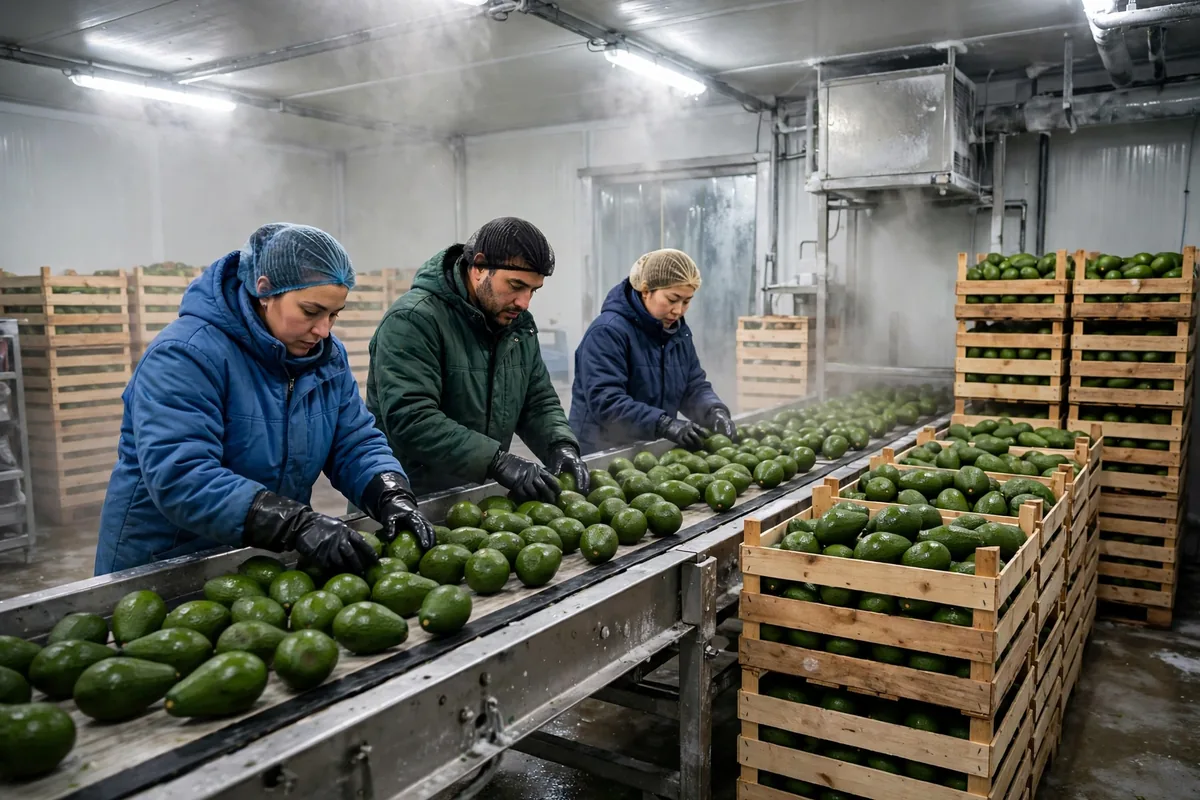
Fruit comes off the tree carrying field heat. The rule is to pack and cool within 24 hours of harvest, the sooner the better. The method is forced-air cooling: fans pull cold air hard through the cartons until the pulp temperature comes down. Hass needs to reach 5 degrees Celsius, green-skinned Fuerte 6 to 8 degrees, at 90 to 95% relative humidity. The whole job usually takes 8 to 12 hours, and the fan size and airflow pattern matter.
Here is the plain truth people keep getting wrong: a reefer can only maintain temperature. It cannot cool warm fruit down. That is the most misunderstood sentence in the cold chain. Trucks and containers are built to hold temperature, not to pull heat out of a hot load. Fruit loaded at 26 degrees pulp temperature will never cool through at the center of the pallet — those middle cartons keep generating heat and ripening themselves all the way to port, and they arrive black. The Australian avocado transport guide says it straight: do not load fruit at 7 degrees pulp temperature or above, unless the trip is short. Probe the pulp temperature pallet by pallet before stuffing, and only seal the container when the numbers check out. Ten minutes of probing can save a whole container.
One more thing: picking maturity. Avocados do not ripen on the tree; they ripen after picking. Pick too early and the fruit arrives hard with no flavor. Pick too late and it over-ripens at sea. Export fruit is judged on dry matter — Kenya's 2026 practical floor for the EU is 22%, and South African exporters use a similar number as their reference. Fruit picked under-mature cannot be saved by the best cold chain in the world. Half its fate is decided the moment it leaves the tree.
Controlled Atmosphere and Durban: Surviving Three Weeks at Sea
Once the fruit is in the box, the sea voyage is still long. Durban to Rotterdam runs about 24 days northbound, and when the Red Sea route is disrupted and vessels go around the Cape of Good Hope, it gets longer. For three weeks the fruit keeps breathing — consuming oxygen, releasing carbon dioxide and ethylene. A standard reefer only controls temperature. A controlled-atmosphere reefer drops oxygen to 2 to 5% and raises carbon dioxide to 3 to 10%, pressing the brakes on respiration so ripening slows down. Hass held at 4 to 5 degrees Celsius generally keeps about four weeks; with controlled atmosphere it can stretch to six. That is why most long-haul containers to Europe run CA: without it, time is the enemy; with it, time becomes a friend.
But CA is no magic cure. I have seen shippers skip the CA reefer to save money and run a standard box on a long voyage — half the fruit arrived soft. I have also seen people copy somebody else's CA settings, wrong variety, wrong season, and end up with chilling injury and black flesh. Hass set points should shift slightly between early and late season. Anyone running one copied table all season will pay for it eventually. CA settings follow the variety, the maturity, and the voyage length. Confirm them with the carrier and the receiver before stuffing, and write them on the loading sheet. Do not trust memory.
The Durban leg needs attention too. In peak season the boxes queue, vessels run tight, and reefers sit plugged in at the terminal. Plugged in is fine. What scares me is the unplugged move, the loose plug nobody notices. My advice to shippers is one line: before the vessel sails, check three things — the temperature logger is running, the CA settings are right, and the seal number matches the documents. All three correct, then release. Once the ship sails, it is too late.
South Africa Avocado Export Warehouse Cold Chain: Running the Numbers
Here is the costing framework I worked out with friends running the South Africa lane. The figures are an illustrative example — check actual quotes and the latest official policy before using them:
| Leg | Where the money goes | Illustrative example |
|---|---|---|
| Picking and field transfer | Pick today, pack today, never overnight in the field | about USD 120 per tonne |
| Packing and forced-air cooling | 8 to 12 hours to pull pulp to 5 degrees Celsius | about USD 90 per tonne |
| CA reefer ocean freight | Durban to Rotterdam, oxygen 2 to 5% | about USD 4,200 per container |
| Port and documents | Phytosanitary certificate, origin documents, cold chain records | about USD 600 per lot |
| Loss reserve | Black and soft fruit discounted at destination | 4% of cargo value |
See it now? That USD 90 for pre-cooling is the cheapest line in the whole table — and the most valuable. Skip pre-cooling and you are gambling a USD 4,200 ocean freight bill on the fruit's luck. The counterintuitive truth is this: in the avocado export cold chain, the most expensive thing is not the ocean freight. It is the step you thought you saved money on and ended up paying for twice over. Shippers love haggling over the visible freight rate while quietly cutting the invisible pre-cooling. That math is backwards.
There is an old saying among drivers: slow is fast. Twelve extra hours in the packhouse doing pre-cooling properly buys two extra weeks of shelf life in Rotterdam. Rushing to stuff half a day early and arriving with half the fruit black wastes everything before it. The south africa avocado export warehouse cold chain, when you strip it down, is one sentence: pull the heat out, hold the temperature steady, set the atmosphere right, and let the ocean do the rest.
Next time you ship a container, ask the packhouse one question first: what is the pulp temperature of this lot, really?
By Shifu Zhao, Trucking Veteran (15 yrs)