For a used forklift buying inspection small warehouse owners can actually afford, I learned the hard way: not buying new does not mean buying blind. Our place is 3,000 square meters; one truck down means the whole crew works past midnight. This is how a small warehouse checks a truck and does the math.
Why a Used Forklift Buying Inspection Small Warehouse Style Is Different
Before peak season last year, I found a shiny truck showing only 2,800 hours. The seller swore it had never worked hard, and I nearly paid a deposit. Luckily I brought an old mechanic friend. He ignored the paint, checked the chains, lifted a full pallet to maximum height, and listened. Then he said, "If that hour meter is honest, I'll eat my wrench."
He was right. Chain stretch was beyond the limit, mast rollers wobbled like a loose tooth, and once raised, one fork slowly sank — hydraulics losing pressure. The "never worked hard" story was written all over the truck, in a language I could not read yet.
Chen, who runs a 2,000-square-meter warehouse, bought a cheap electric truck without testing the battery. By week two it ran hot while charging and died at 3 p.m. daily, so workers pushed it to the charger like a dead scooter. Battery replacement plus two days of disruption cost more than the pricier, healthy truck he had passed on. One bad buy eats half a month's profit.
Counterintuitive, but true: the prettier the hour reading, the more suspicious you should be. A higher-hour truck with full records and steady work is often safer than a low-hour mystery truck "stored for years." Machines suffer most from doctored meters, neglect, and a quick cosmetic makeover.
Used Forklift Inspection Checklist: Five Places to Look Before You Talk Price
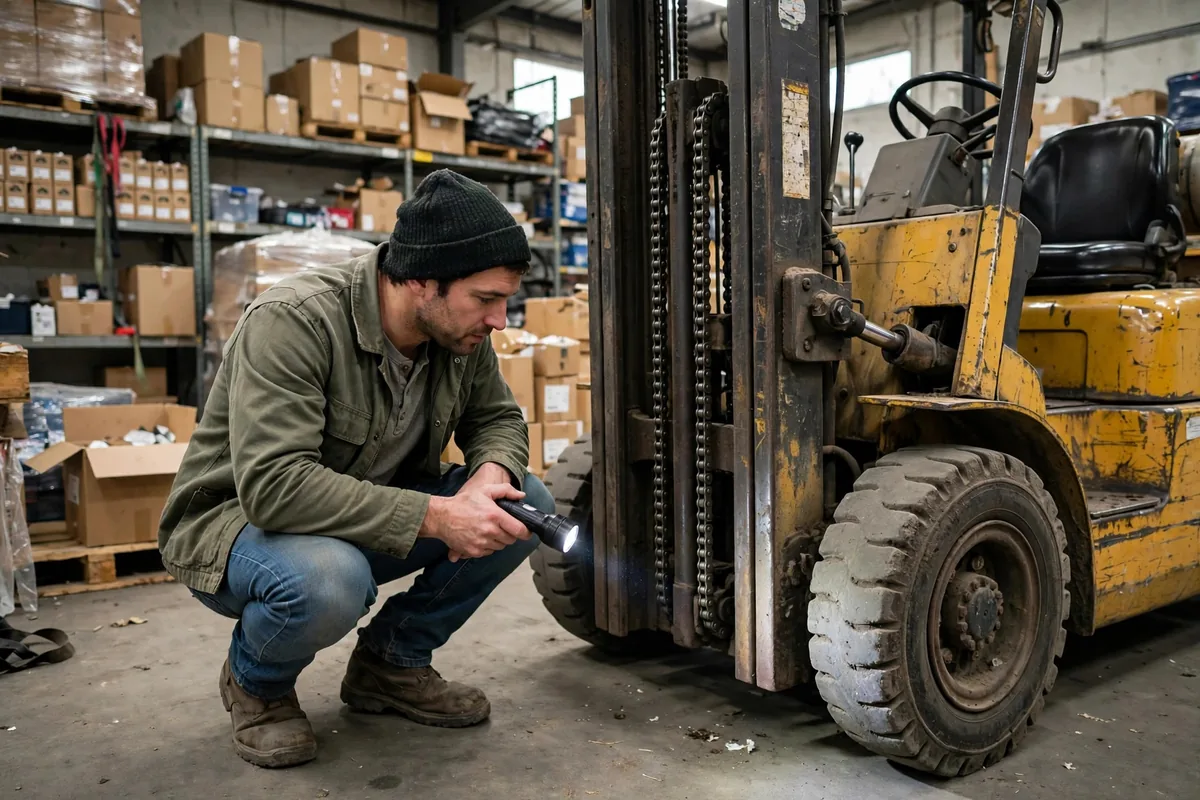
I bring three things: a flashlight, a tape measure, and white paper. Plus one rule: inspect it cold, test it loaded, hold it at full height. If the seller rushes you, smile. Half an hour will not kill the deal.
1. The hour meter: do not stare at the number
The meter is the easiest trap in any used forklift buying inspection small warehouse buyers do. Look for pry marks and digits that do not line up. Then check whether wear matches the hours: polished steering wheel, worn pedal rubber, sagging seat, sloppy levers. If everything looks like 8,000 hours but the meter says 2,000, trust the truck, not the dial.
Then ask for records. Service notes, parts invoices, even chat screenshots with a technician beat a verbal "always maintained." No records does not kill a deal, but price it as unknown history, not premium.
2. Mast and chains: judge it raised, not parked
The mast is the truck's spine. Raise and lower it empty, listening for sticking or grinding. Then lift a pallet at your normal weight to full height, switch off, and wait three to five minutes for fork drift. Measure a fixed number of chain links and compare with new-chain spec. Excess stretch means the chain's life is spent — and chains are safety, not cosmetics.
Crude test: push the mast sideways by hand. Obvious wobble means worn rollers and channels. Fine at low height, scary raised high in a turn.
3. Battery health: the electric truck's expensive heart
On an electric truck, ignore a dashboard saying "full." Have it charged before you arrive, check its condition indicators, then test-drive loaded for twenty minutes. Watch for uneven charge drop or soft acceleration. Afterwards feel the battery and connectors: unusual heat or white corrosion is a warning.
One truck cruised empty with stable charge, then its voltage fell off a cliff lifting a heavy pallet. "Fake fit" — cells inside were done. We priced that in hard or walked. The battery is the most expensive organ in a used electric truck; being polite to it is cruel to your wallet.
4. Tires, hydraulics, and leaks: white paper tells the truth
Check tires for wear, uneven wear, and chunking on solid tires. Uneven wear often points to axle or alignment trouble.
For leaks, park on clean ground, work lift and tilt repeatedly, then slide white paper under cylinders and fittings. Ten minutes later the stains show where oil escapes. Cracked hoses and weeping fittings are bargaining chips — and your first jobs back home.
5. The test drive: do not just circle an empty yard
Drive it like your warehouse will: forward, reverse, hard stop, turn in place, move slowly with a load raised, cross a ramp, back up and check visibility. Listen for whining, smell for burning, feel whether brakes bite promptly. Our aisles are narrow, so I find the tightest turn available. A bargain that cannot enter your aisles is furniture.
The Math: New vs. Used vs. Rental for a Small Warehouse
Full disclosure: every number below is a hypothetical example for illustration only, not a real quote from any brand or dealer. Your local prices will differ. Steal the formula, not the figures.
Assume one common-capacity truck, compared over a three-year horizon:
| Option | Hypothetical upfront cost (example) | Hypothetical 3-year repairs/consumables (example) | Hypothetical residual value (example) | Hypothetical 3-year net cost (example) | Best for |
|---|---|---|---|---|---|
| Buy new | Assume $20,000 | Assume $1,500 | Assume $12,000 | Assume $9,500 | Stable volume, wants peace of mind |
| Buy used | Assume $9,000 | Assume $4,000 | Assume $4,500 | Assume $8,500 | Tight cash, willing to inspect properly |
| Long-term rental | Assume $0 purchase | Assume $11,000 total rent over 3 years, maintenance included | $0 | Assume $11,000 | Uncertain seasons, fears downtime |
Do not read that table as "used always wins." If the used truck needs a battery or major hydraulic work in year two — assume another $3,500, again purely hypothetical — its net cost jumps past new instantly. Inspection is not where you save money. Inspection decides whether used saves money at all.
My framework is three questions. One: after buying, can cash still cover three months of wages? Two: can customers tolerate three days down? Three: do you have a trustworthy local mechanic, or will you wait in a dealer queue? If you cannot answer two of three, lean toward renting or a pricier used truck with transparent history.
What You Must Not Cheap Out On
Small owners love haggling thousands off the price, then flinch at a modest inspection fee. Backwards. A third-party inspection, or an independent mechanic you pay yourself, costs little and buys the confidence to spend a lot — or walk away. Pick someone with no tie to the seller.
Back home, replace the first consumables without delay: hydraulic oil, filters, brake parts, aged hoses, any chain at its limit. Skipping them bets your goods and people. Sort out insurance and local inspection requirements directly, not via a seller's "none of that matters."
When negotiating, I sort findings into three buckets. Safety: seller fixes it or cuts the full cost. Life: price by remaining life. Cosmetics: ignore. A small warehouse unloads with a truck that lifts, stops, and works — not with good looks.
Small warehouses have their own way of living. We cannot afford buying new, but we can inspect until trouble has nowhere to hide, run the math three years out, and spend what must be spent. Buy right, and the truck is a partner that earns. Buy wrong, and it is an expensive pet that needs feeding weekly. Your choice.
By Xiao Ma, Small Warehouse Owner