They call it "how to slot a small warehouse" in the trade press. Last summer, my strongest picker, Old Chen, cornered me and said: "Boss, at this rate my legs are going to retire before I do."
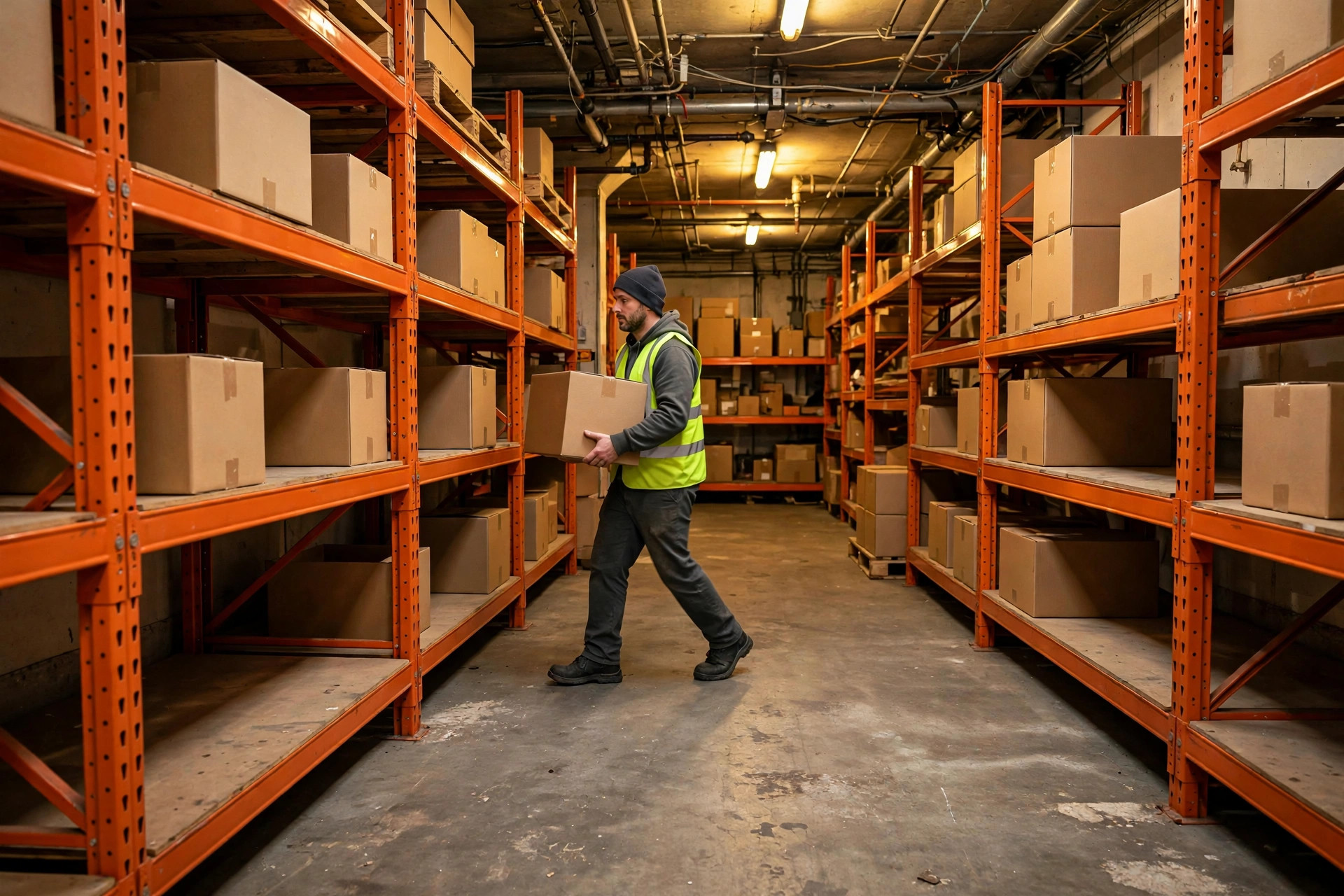
He wasn't exaggerating. Our warehouse is 3,000 square meters, around 800 SKUs, six pickers. Our best-selling laundry detergent — dozens of cases a day — sat on the farthest rack, deepest in the building. Meanwhile, Christmas decorations that barely moved all year hogged the prime spots by the packing bench. Picking felt like running a marathon; on peak days everyone logged over 20,000 steps.
I'd thought about buying my way out. Big warehouses all run slotting modules in their WMS that compute optimal locations automatically. I asked for a quote — the implementation fee alone would cover half a year of payroll, before annual maintenance. We small warehouses can't burn that kind of money. Hard pass.
But ignoring it wasn't an option either. Picking is the most labor-hungry job in any warehouse, and every meter and every second saved is real money. So we went the scrappy route — Excel, a tape measure, and two legs — and got slotting done. Here's the small-warehouse version of how to slot a small warehouse that actually works. The big-company playbook isn't for us. This one you can start tonight.
How to Slot a Small Warehouse on a Budget: Start With Data, Not Muscle
The biggest mistake is rolling up your sleeves and moving boxes on day one. First: do you know which SKUs shipped most over the last two months? If not, don't touch anything.
Our method is low-tech: export 60 days of outbound order lines, throw them into an Excel pivot table — one column for SKU, one for shipped units — sort descending. Done. Then slice it by the 80/20 rule:
- A movers: roughly 20% of SKUs driving roughly 80% of outbound volume — these pay your rent
- B movers: the middle 30% or so, shipping occasionally
- C movers: the remaining 50%, basically zombies
Out of our 800-odd SKUs, only about 150 landed in A. Translation: get those 150 locations right and you've optimized 80% of your picking workload. Suddenly the job looks manageable — forget all 800, fix the 150.
One warning: don't pull just 30 days of data. Our first attempt caught the Mid-Autumn rush; mooncake gift boxes shot into A, we hauled them into prime spots — and a month later they were zombies again. Wasted weekend. Sixty days minimum, and seasonal items get their own review. Learned that one the hard way.
The Golden Zone Lives at Waist Height
With data in hand, step two is defining your "golden zone." Big warehouses talk algorithms; we talk anatomy. The band between 1.2 and 1.6 meters — waist to chest — is where humans grab things without bending or stretching. That shelf level is our golden pick zone.
The layout rules are dead simple:
- A movers go on the golden level, on racks closest to the packing bench
- B movers go one level up or down, or on adjacent racks
- C movers go top level, corners, the back of the building — wherever
And one iron rule: heavy stuff stays below the waist. A 20-kilo case of cat litter at 1.5 meters, lifted dozens of times daily, will destroy a picker's back. We learned this in late 2024 when we stashed heavy cases on an empty top level to save time — pickers climbing up and down, one near-miss with a falling case. Since then: anything over 15 kilos per unit goes below waist height no matter how fast it sells. Safety outranks speed.

Take our laundry detergent: it used to live at the far end of the building on the bottom shelf — a 40-plus-meter walk and a deep bend every pick. We moved it to the golden level on the rack nearest packing. Pick time per unit for that SKU fell from nearly a minute to just over 20 seconds. At 80-plus units a day, that one SKU saves us nearly an hour daily.
Put Your Winners Near the Packing Bench: Draw a Dirt-Cheap Heat Map
ABC alone isn't enough — you need flow. Our zero-cost trick: have pickers run phone step counters for a week, then mark the zones walked most on a floor plan. Darker means more traffic — that's our heat map.
The two racks to the right of the entrance glowed darkest — closest to packing, everyone drifts there. So we ranked A movers by outbound volume and lined them up: fastest mover nearest the bench, on down the line. Average travel per order dropped from nearly 200 meters to about 120.
Here's the counterintuitive part: don't chase the theoretical optimum — chase stability. Big-warehouse slotting models re-compute weekly. We can't afford that chaos. With a small crew, pickers build muscle memory — Old Chen knows the fast movers' locations blindfolded. Re-slot to "optimal" this week and again next week, and your crew spends forever relearning the building. Our rule now: major re-slots at most twice a year, and nobody touches A-mover locations on a whim. Stability is its own kind of efficiency.
How Often Should a Small Warehouse Re-Slot? Less Than You Think
Data's ready, locations are set — now the rhythm. Ours: two major re-slots a year (March, and September before peak season), plus one light monthly touch-up that only moves volatile B and C items.
Why not do it all at once? Because re-slotting itself is expensive. Our first big re-slot took six people two full weekends — while orders kept flowing through a half-moved warehouse. Total cost: roughly 190 labor hours, and pick speed dipped for two weeks in the mess.
So we barely touch C movers. Do the math: a C SKU shipping 20 units a year, each pick walking an extra 50 meters — that's 1 kilometer a year, maybe 10 minutes. Spending 30 minutes relocating it to save 10 minutes is just theater. The re-slot iron rule: move the A items, eyeball the B items, and leave the C items alone — for their sake and yours. Anyone can read about how to slot a small warehouse in a textbook; the real skill is knowing what not to touch.
Seasonal items get special handling. Our summer fans move from the back corner to the edge of the golden zone in March, then back again after peak season. Two small moves buy a whole summer of smooth picking.
The Math: What This Actually Saved Us
Results first, then the ledger. We ship about 600 orders a day:
| Metric | Before | After |
|---|---|---|
| Avg. pick time per order | ~4.5 min | ~3 min |
| Picks per picker-hour | ~13 | ~20 |
| Daily steps per picker | ~16,000 | ~11,000 |
| Team picking hours/day | ~45 | ~30 |
Fifteen labor hours saved daily — about 375 a month on a 25-day schedule. The re-slot cost us around 190 hours across two weekends, so payback landed in under two weeks. And Old Chen's legs survived — he now tells everyone the job went from "marathon" to "stroll."
Caveat: these are our numbers — your SKU mix will shift them. But the direction holds: A movers at waist height near packing, and pick efficiency goes up.
Three Pieces of Advice for Fellow Small-Warehouse Owners
First, don't wait until you can afford it. Big systems are nice, but "no system, no improvement" is the real trap. One afternoon pulling data, one morning with a tape measure, two weekends moving boxes — payback in weeks. The barrier isn't money; it's willingness to start.
Second, lock it in before you optimize further. Print the slot map, tape it to the rack, and let nobody move things on gut feeling. Hold steady for three months, let the data talk, then decide what the next round changes. A small warehouse's biggest strength is flexibility — and our biggest disease is flexibility with no rules.
Third, listen to your pickers. They walk ten times the ground you do. They know which location is awkward and which SKU begs to move. Before every re-slot we hold a 15-minute huddle and let pickers vote on their "top three SKUs to relocate" — eight times out of ten it matches the data. People are the best sensors.
Slotting, in the end: big warehouses have algorithms; we have common sense plus follow-through. No slotting module — we have Excel. No simulation software — we have phone step counters. No consultants — we have Old Chen's legs. Scrappy, sure. But every dollar saved is profit.
Small warehouses have their own way of surviving.
By Xiao Ma, Small Warehouse Owner