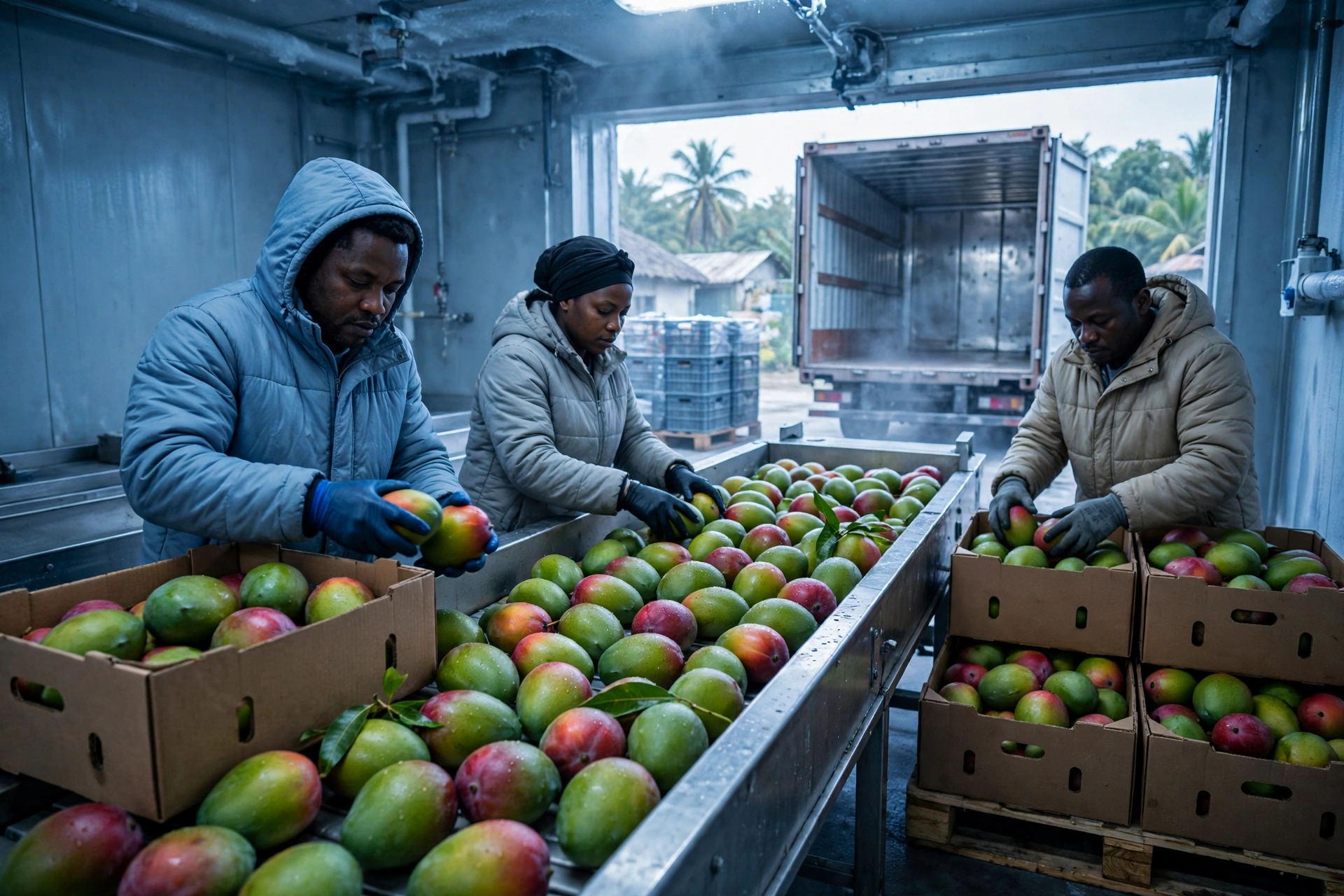
Let me tell you something. After all these years on the road, there are two kinds of cargo I dread: the kind that hates heat, and the kind that hates waiting. Senegalese mangoes are both. Every year around June, when the Niayes orchards ripen, the trucks, the cold stores, and the port all have to move with the season. One slow link and the fruit rots on the way. Senegal mango export warehouse cold chain comes down to beating the heat against the clock.
Here is a story I heard from the trade. Last season, a packhouse in the Niayes picked two truckloads of Kent mangoes on the same day. One load went straight into pre-cooling. The other sat in the sun for most of the afternoon because the cold store gate was jammed with waiting trucks. At packing time the two loads looked the same. By the time they reached the buyer in Europe, they were not: the pre-cooled load held up well, while the other had far more soft fruit and black spots, and the buyer docked the payment. Fruit cannot talk, but it remembers every hot hour.
The volumes are not small. World Bank trade data shows Senegal exported about 13,525 tonnes of mangoes worth roughly 10.5 million dollars in 2024, with France taking about 1,955 tonnes and the Netherlands about 1,699 tonnes, plus sizeable volumes to Morocco and Ghana. Trade press reports that in the 2026 season, Senegal's exports to Europe passed 19,000 tonnes, with the industry aiming for 30,000 tonnes. The more volume grows, the more a weak cold chain costs.
The Senegal Mango Export Warehouse Cold Chain Starts the Moment the Fruit Leaves the Tree
The Niayes is Senegal's main mango belt, a coastal strip north of Dakar, and Kent is the export variety. The season usually opens in late May, with the south and centre picking first and the Niayes harvest following in the second week of June. In the 2026 season, phytosanitary certificates were issued from June 2, the first containers reached Europe around June 15, and the whole export campaign ran about 10 to 11 weeks. That is the whole window. Miss it and it is gone.
The first job after picking is pre-cooling, not packing. A mango comes off the tree carrying field heat, its core warm and its respiration running fast. Left sitting, it ripens itself. University of California Davis postharvest guidance gives the numbers plainly: the best storage temperature is 13 degrees Celsius for mature-green mangoes and 10 degrees for partially ripe and ripe fruit, at 90 to 95 percent relative humidity, with a storage life of about 2 to 4 weeks at 13 degrees. Too cold and the fruit suffers chilling injury; too warm and it ripens too fast. Pre-cooling is the job of pulling the fruit down to that range as quickly as possible.
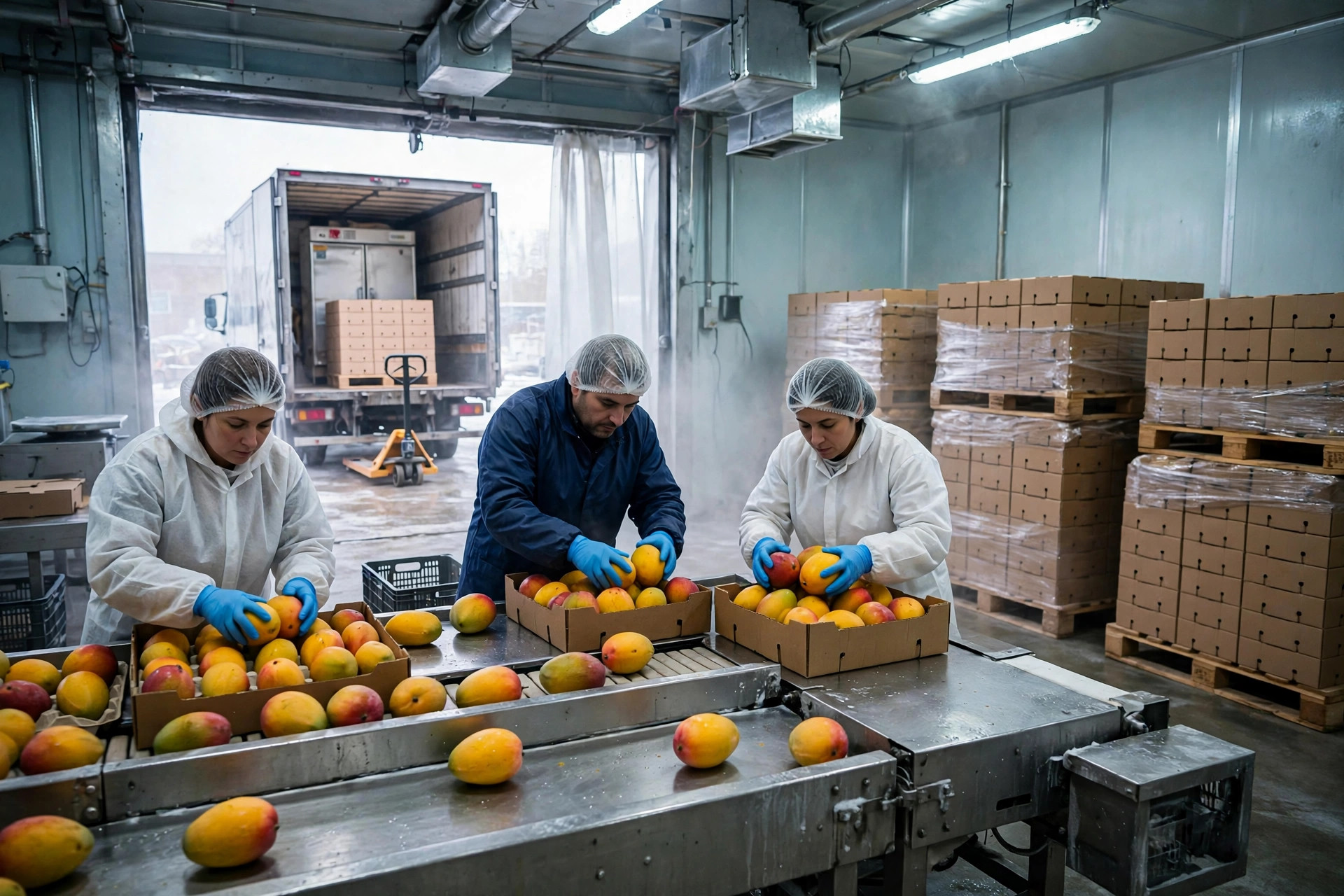
I have seen plenty of packhouses treat pre-cooling as decoration. Fruit comes in, gets stacked in a shed, and waits until there is a full truckload before it goes into the cold store. Two hours in the sun can push the pulp temperature up several degrees, and no amount of cooling afterwards makes that right. The way that works is to line up picking and pre-cooling on the same schedule: fruit picked in the morning must be in pre-cooling by midday, with truck bays kept clear at the cold store door and no crates left baking in the open. Washing, grading, and packing all happen at cold-store temperature, and the fruit goes straight from the cold store into the reefer, with no waiting around on a warm loading dock.
Fruit Fly Is Scarier Than Temperature
Anyone who runs a cold chain knows the biggest risk for Senegalese mango exports is not temperature. It is fruit fly. The fruit fly is a quarantine pest in the European Union, and if it is found in a shipment the whole container can be held. Before the 2026 season, Senegal's agriculture ministry and the mango interprofession set the rule plainly: any exporter whose shipments are intercepted twice is barred from further exports. Two strikes and you are out. No exceptions.
So the packhouse job is not only cooling. It is keeping infested fruit out. Suspect fruit gets picked out in the orchard, the packing line sorts it again, and the paperwork travels with the cargo, one certificate per container. That is why Senegal mango export warehouse cold chain discipline has to cover paperwork as well as temperature. If the documents are short, the container waits at the European port, and every extra day in port adds reefer charges and fruit losses.
There is another trap people miss: do not consolidate mangoes with just anything. A shared reefer must hold cargo with similar temperature needs. Mangoes run at about 13 degrees. Share the box with cargo that needs deep freezing and the temperature compromise hurts both sides. Before consolidating, ask what else is in the box and what setpoint it needs, and keep the temperature logger running for the whole trip so you can read the temperature curve before you inspect the fruit at arrival.
| Stage | Key action | Number to watch |
|---|---|---|
| Picking | Reject suspect and infested fruit; morning pick into pre-cooling by midday | Field to pre-cooling within a few hours |
| Pre-cooling and cold store | Pull down to storage temperature fast; keep the chain unbroken | 13 C for mature-green fruit, 90 to 95% humidity |
| Grading and packing | Work inside the cold store; load straight into the reefer | No waiting on a warm dock |
| Reefer sea freight | Check the setpoint, keep the logger running | Dakar to Rotterdam about 12 to 13 days |
| Arrival checks | Read the temperature curve first, then inspect the fruit | 2 to 4 weeks of life at 13 C |
The Numbers Inside the Container: Senegal Mango Export Warehouse Cold Chain at Sea
The sea leg is written plainly in the sailing schedules. Carrier schedules show Dakar to Rotterdam at about 12 to 13 days, usually with one transshipment stop. For those 12 to 13 days the reefer is a moving cold store, and setpoint, ventilation, and humidity all have to hold. The reefer must be pre-cooled to its setpoint before loading. Load warm fruit into a warm empty box and the fruit ends up cooling the box itself, which is when the first two days go wrong.
Here is a hypothetical example that shows what the cold chain is worth. Take a 40-foot reefer holding 20 tonnes of mangoes worth about 20,000 dollars. Pre-cooling, cold storage, temperature loggers, and phytosanitary paperwork cost a few hundred dollars per container. Break the chain and lose 30 percent of the fruit to softening and rot at arrival, and that is about 6,000 dollars gone, before buyer deductions and lost orders. A few hundred dollars protecting 6,000 dollars is a calculation anyone who has driven freight for years can do in their head.
Here is the counterintuitive part: most people think mango export is won in the orchard and the variety. In practice it is won by organising the season window. Senegal's export season lasts only 10 to 11 weeks, the fruit ripens fast and waits for nobody, and whoever lines up picking, pre-cooling, stuffing, and booking tightest sells the most weeks at high prices. The best orchard in the country still loses if trucks queue half a day at the cold store door and reefer slots are booked out. In this business, the contest is not which piece of equipment is newest. It is whether every link follows the same timetable.
The old saying holds: keep the cold chain unbroken and the fruit stays sound. The road from the Niayes to Europe is not long, 12 to 13 days at sea against 2 to 4 weeks of storage life, so the time is there. Whether it is enough depends entirely on those first few hours at origin, getting the temperature down. So ask yourself about your own container: how long after picking did your mangoes reach pre-cooling? If you cannot answer that, nothing else matters.
By Shifu Zhao, Trucking Veteran (15 yrs)