Let me tell you how I first heard about Santa Marta Colombia port warehouse logistics. It was from a buddy who runs the Caribbean lanes. Two winters ago he was stuck waiting for a vessel in Panama, and he called me to complain: he'd hauled a reefer full of bananas to Santa Marta, the reefer plugs at the port were all taken, and his truck sat outside the gate for most of the day while the temperature alarm in the container kept going off. That story stuck with me. One port handling bananas and coal side by side, reefer boxes and bulk carriers sharing the same gate road — it sounds like a mess. But it works, and Santa Marta has become Colombia's number one reefer export port. This is my breakdown, done the way a trucker does the math.
Why the banana boxes love Santa Marta's cold chain
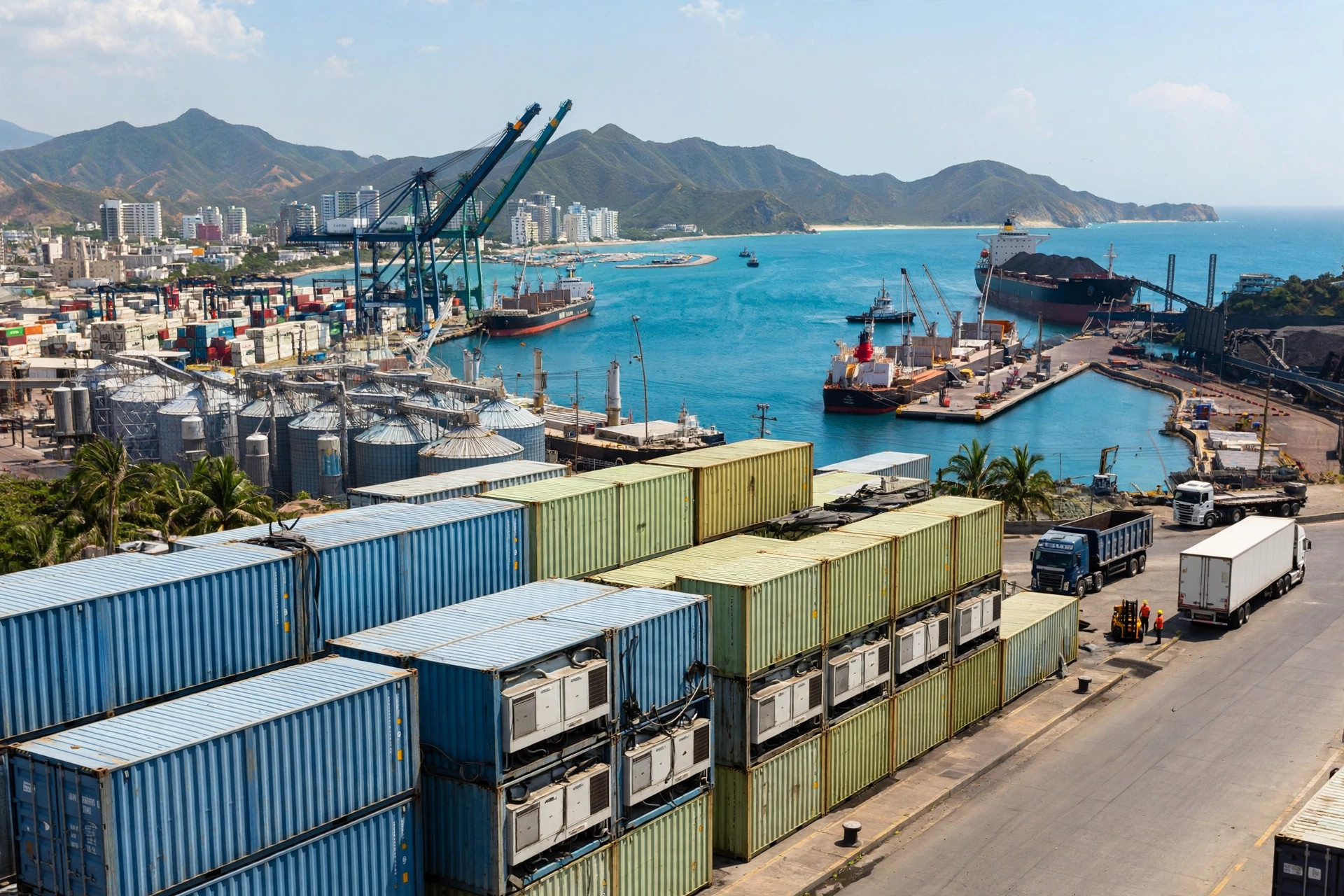
Santa Marta sits on Colombia's Caribbean coast, with the Sierra Nevada mountains behind it and the Caribbean Sea in front. It is a multipurpose port: containers, coal, solid bulk, liquid bulk, general cargo, all of it. The container terminal is run by Smitco, and it is built around one thing — refrigerated cargo. The operator's own figures say it all: about 48,000 reefer export containers a year, against only around 5,500 dry boxes. Nine out of ten containers through this port are reefers. You don't see that often on the Caribbean coast.
Bananas are the headline act. The operator reports roughly 40,000 banana containers a year. Flowers run about 2,000 containers, roughly 70% of Colombia's seaborne flower market. Avocados are the rising star: more than 1,500 containers between January and October 2024, and about 35% of Colombia's avocado exports move through this port. Look at a single month — October 2024 saw 257 avocado containers, nearly double the 132 shipped in the same month a year earlier. When the cargo is there, the shipping lines call, and the reefer plugs follow: the port has nearly 1,500 reefer connections, and its cold storage rooms doubled from four to eight in January 2025.
Fifteen years on the road has taught me one thing: for reefer cargo, what matters is not how big the port is, but whether there are enough plugs, whether the cold store is close, and whether somebody is watching when the power trips. Santa Marta ranks fourth in Colombia for container volume, but second for total tonnage. That mismatch is the whole story — the big ports chase box counts, this one chases cold chain.
Flowers prove the point. Roughly 70% of Colombia's seaborne flowers move through Santa Marta, about 2,000 containers a year. Flowers are even more delicate than bananas, and a day late on the sailing means they arrive in Europe half-wilted. A port that takes on flower cargo is a port whose cold chain is real, not a brochure claim. When you pick a port, don't just look at the rate sheet. Ask how many reefer boxes it moves a year, how many plugs it has, how many cold rooms. That tells you more than any discount.
How the coal side works: trucks, yards, and shiploaders
Separated from the reefer terminal is the coal terminal, run by Carbosan. The figures are public: a 250,000-tonne coal storage yard, a ship loader rated at 34,000 tonnes a day, truck receiving capacity of 38 trucks an hour, a 47-foot-deep harbour, and annual handling capacity of 6 million tonnes. Coal volumes have swung in recent years — about 1.07 million tonnes in 2023, about 730,000 tonnes in 2024, still below pre-pandemic levels — but the terminal keeps running.
My buddy told me about the queue on the coal side, too. The moment a bulk carrier berths, the trucks start rolling into the yard one after another — gate, weighbridge, tip, out. If you're hauling a reefer, whatever you do, don't join the coal convoy's gate hours: the road is worst in the morning when the bulk vessels are working.
That's the most interesting thing about this port: bananas and coal look like they should never share a postcode, but they work because they are kept apart and each runs on its own rhythm. The danger is never sharing a port. The danger is sharing a port with no separation and nobody managing the gate.
My buddy also mentioned one detail I liked: the coal terminal can receive 38 trucks an hour. That doesn't sound like a big number, but it's an honest number — trucks it can actually take, not trucks it can queue. When a bulk carrier berths, dispatch schedules the trucks against the vessel schedule: weigh, tip, out, all timed. What a trucker fears most is not waiting. It's waiting without knowing how long. At Santa Marta's coal terminal, the vessel schedule is the timetable, and a driver knows his place in line when he arrives.
Santa Marta Colombia port warehouse logistics: port-side warehouse or inland warehouse?
Cargo owners keep asking me the same question: once the cargo lands at Santa Marta, do you store it at the port or haul it to an inland warehouse for distribution? Here's a worked example — these are illustrative scenario figures, and actual rates should be checked against the latest published tariffs from the port and warehouse operators.
| Option | Best for | Advantage | Risk |
|---|---|---|---|
| Port-side cold store | Bananas, avocados, flowers, other reefer exports | Closest to the plugs and the ship, smallest risk of a broken cold chain | Tight space in peak season, prices move with the vessel schedule |
| Port-side general warehouse | Palm oil and other liquid bulk, general cargo | Fast handling, one less short-haul leg | Mixed cargo types, risk of odour transfer and mixed stowage |
| Inland warehouse | Cargo bound for distribution inside Colombia | Cheaper rent, flexible distribution | One extra line-haul leg, and one more cold-chain risk for reefer cargo |
My judgement is simple: don't save money on the port-side warehouse for reefer exports. One break in temperature control between the farm and the ship, and the whole container loses value — the warehouse rent you saved won't cover a single claim. And here is the counterintuitive part: Santa Marta ranks fourth in Colombia for containers, which sounds small, but if you move reefer cargo, it beats the bigger ports. The big ports take everything, so reefer boxes queue for plugs. This smaller port specialises in reefer cargo, and the plugs, the cold stores, and the vessel schedules are all built around it.
Then there's a cost most people forget: missing the sailing. A reefer box that misses its vessel doesn't just wait for the next one — it has to stay plugged in and re-cooled, the booking has to be changed with the line, and the harvest plan back at the farm has to change too. Two extra days in the port, and the storage, plug fees, and rebooking charges add up to several containers' worth of warehouse savings. I've always told cargo owners: don't price reefer cargo by the cost per box of storage. Price it by what one missed sailing costs you.
Moving cargo onward across the Caribbean
Cargo leaves Santa Marta on two main lanes. Reefer cargo sails to the US East Coast and Europe — avocados take 11 to 18 days to reach Europe, so the vessel schedule has to work backwards from picking and stuffing dates. Bulk cargo like coal and palm oil follows the bulk vessel schedule, where the game is yard turnaround and truck rhythm. The key to Santa Marta Colombia port warehouse logistics distribution is this: don't run reefer cargo on a dry cargo timetable, and don't run bulk on a reefer timetable. Two systems, two schedules.
Three practical words for cargo owners and warehouse operators. First, for reefer cargo, ask about the plugs before you book the sailing: a confirmed vessel doesn't count until the plug is reserved, and in peak season, lock in warehouse space and plugs two weeks ahead. Second, for coal and bulk, watch the vessel schedule, not the calendar: the moment a ship berths, the trucks, the yard, and the shiploader all run at full speed, and arriving off-peak can save you half a day. Third, don't treat Santa Marta as a cheaper Cartagena.
Fifteen years on the road, and I believe one thing: a port isn't good because it's big. It's good because it looks after a certain kind of cargo properly. Santa Marta looks after reefer cargo and coal properly, and once that's settled, the rest of the math is easy. Next time somebody tells you small ports have no future, ask them one question: how many reefer boxes does this port move a year, and are there enough plugs? If they can't answer, they've probably never waited outside a gate.
By Shifu Zhao, Trucking Veteran (15 yrs)