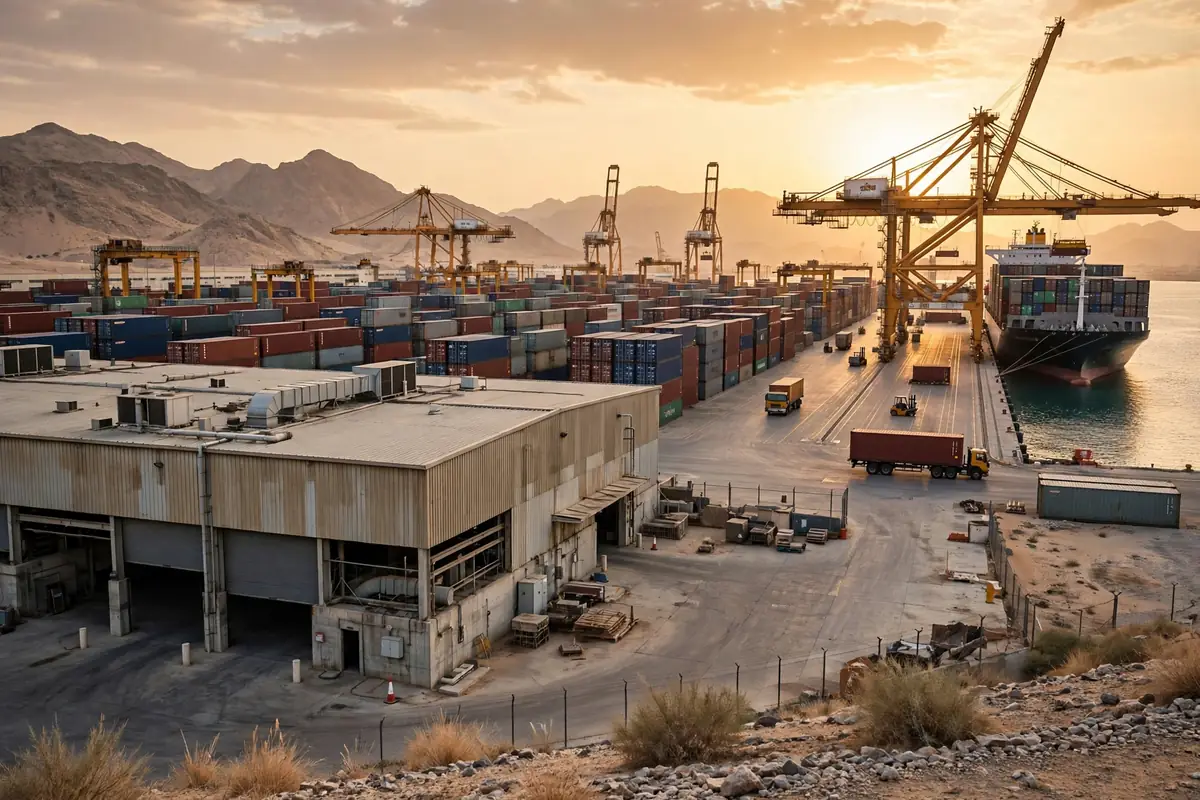
Bottom line first: the warehouse business at Salalah Port is not about storing containers. It is about moving them. The port handled 3,304,735 TEU in 2024, and roughly 90% of that was transshipment cargo — boxes that switch from one vessel to another and never touch your warehouse floor. If you lease a big shed next to the Salalah port expecting transshipment boxes to roll in, you will pay a round of rent first and a round of tuition second. The warehousing that actually makes money here is deconsolidation, break-bulk yard operations, and a handful of light-asset jobs inside the free zone. I have watched this exact mistake three times now, and every time the spreadsheet looked the same: someone took total port volume, multiplied it by a small percentage, and called the result warehouse demand.
Why lead with that warning? Because Salalah's numbers look like a gateway port's numbers, and that is exactly what misleads people. According to the port's official statistics, container volume was 3,304,735 TEU in 2024, down 13% year on year. The two prior years were 3.794 million TEU in 2023 and 4.504 million TEU in 2022. In the World Bank and S&P Global Container Port Performance Index, Salalah ranked second in the world in 2023. A $300 million terminal upgrade was completed in 2025, lifting annual handling capacity to 6 million TEU. Read cold, that reads like a booming gateway port with warehouse demand to match. Then one number rewrites the whole calculation: about 90% transshipment means nine out of ten boxes never land. Your addressable customer pool is the one in ten that does.
Map the cargo flows before you talk about square meters
In every warehousing plan I have worked on, step one is drawing the cargo flows. Talking about warehouse size before you have drawn the flows is guesswork with a floor plan attached. Salalah's cargo moves on three lines, and only the last two hold warehouse opportunity.
The first line is vessel-to-vessel transshipment, and it is the big one. Large vessels on the East-West trunk route exchange boxes here; a container moves from one ship's deck to another's, and its time in the yard is measured in hours and days. You will never touch this cargo. Do not build a business plan around it.
The second line is general cargo. In 2024 the port handled 22.6 million tonnes of general cargo, up 10%, driven mainly by limestone and gypsum. This is where the real yard and warehouse work lives: bulk cargo needs stockpiling, sorting, and loading, and yard plus simple shed turnover is genuine, billable work. The contrast in 2024 — containers down, general cargo up — tells you where the port's warehousing center of gravity has been shifting.
The third line is the free zone and local processing: companies doing processing, assembly, and re-export inside the Salalah Free Zone. The volumes are smaller, but the value per box is higher, and this is the meat a small warehouse operator can actually eat.
Take a hypothetical scenario: a client leases an 8,000-square-meter warehouse beside the port to do transshipment box storage and distribution. On the go-live eve checklist, one item I insist on changing: strike "transshipment storage" from the core business and replace it with deconsolidation and consolidation for free-zone customers. In this scenario he pushes back — with more than 4 million TEU moving through the terminal, surely 1% leaking down would be enough. Then, following the scenario through, the Red Sea crisis hits in 2024, vessels divert around the Cape of Good Hope, Salalah's box volume falls 13%, and his warehouse runs below 40% occupancy for the first three months. Only after he pivots to bulk-cargo storage support and free-zone consolidation does the rent start paying for itself. I have seen this pitfall three times, and the arithmetic is always the same: total TEU times a percentage, forgetting that transshipment cargo never lands.
The Red Sea crisis deserves its own paragraph, because it was the main cause of the 2024 volume decline — not anything Salalah did wrong. When ships rerouted around the Cape, the whole transshipment network redrew itself, and call volumes followed. The good news is that 2025 already bounced back: full-year volume recovered 31% to 4.325 million TEU, and September 2025 set a monthly record of 511,209 TEU. The Gemini alliance of Maersk and Hapag-Lloyd began calling from the first quarter of 2025, giving the port a new trunk-service backbone. Judge this port by the rebound, not just by the 2024 dip — the data says it bounced back.
Three calculations before you set up warehousing at Salalah port
First, who exactly is your customer? Do not write "serving transshipment cargo owners." Write names and cargo types. Transshipment cargo owners' boxes never land, so your customers can only be three groups: freight forwarders doing deconsolidation, traders handling break-bulk cargo, and processing companies inside the free zone. Each needs a different warehouse: deconsolidation needs a high-spec shed with docks and a sorting area, break-bulk needs yard space plus a dust shelter, free-zone customers need bonded status and room for labelling and repacking. If the customer list is not settled, the warehouse positioning is fiction.
Second, how do rent and turnover fit together? Here is a worked example, clearly labelled as a hypothetical scenario: take a 5,000-square-meter deconsolidation warehouse, assume local rent levels, assume 800 boxes deconsolidated per month with an average dwell of three days, and check whether revenue covers rent, labor, and equipment depreciation. Every number in that example is hypothetical — a real project must be recalculated with live local quotes. But the method cannot be skipped: in a transshipment port, a warehouse earns on turnover, not on hoarding. Every extra day of dwell thins the margin. A gateway warehouse can live on storage rent; a transshipment warehouse lives on how fast boxes turn.
Third, the volatility reserve. Salalah fell 13% in 2024 and rose 31% in 2025 — a swing of roughly a million TEU within a year. With that kind of volatility, never sign a rigid warehouse contract: keep lease terms flexible, keep space expandable and shrinkable, mix outsourced and in-house labor. Alliances change, the Red Sea situation changes, call volumes change on short notice. A warehousing plan with no volatility playbook is running naked.
Go-live eve checklist: tick every box before signing a lease at Salalah port
This is the checklist I use for every transshipment-port warehousing plan. Do not sign until every box is ticked.
One, verify the cargo flows: do you have actual volumes and customer names for each of the three lines — transshipment, general cargo, free zone — and do the numbers come from the port's official statistics or a second-hand source? One second-hand source claims 2024 was 4.5 million TEU, up 10.8%, which directly contradicts the port's official 3.305 million TEU, down 13%. Use the official figure. Do not use 4.5 million TEU anywhere in your analysis or calculations. Get the total wrong and everything downstream is wrong.
Two, match yard and warehouse type: bulk customers need yards, deconsolidation customers need docks and sorting areas, free-zone customers need bonded operating space. Do not price three different needs as one warehouse.
Three, contract flexibility: do lease term, area, and labor all have room to flex when a 13% drop like 2024 arrives? Can your warehouse shrink?
Four, compliance and free-zone policy: check the latest official policy for the Oman free zone — entry, bonded status, re-export rules — item by item before signing. Follow the latest official policy, and do not rely on a broker's verbal promises.
Five, plan B: if vessel calls shift again, can your customers move from transshipment cargo to general cargo and free-zone work? Does your warehouse have a second way to make a living?
Salalah is not a bad port — quite the opposite. It is one of the few transshipment hubs in the Middle East with world-class efficiency, a terminal upgraded to 6 million TEU of capacity, and a monthly record set in 2025. Its warehousing business just looks different from a gateway port's. Do not drool over total TEU. Watch the one in ten boxes that actually lands, and the 22.6 million tonnes of general cargo sitting in the yards. Get the customer list, the turnover math, and the volatility plan right first, and only then talk about leasing space.
By Lin Xiao, WMS Implementation Consultant