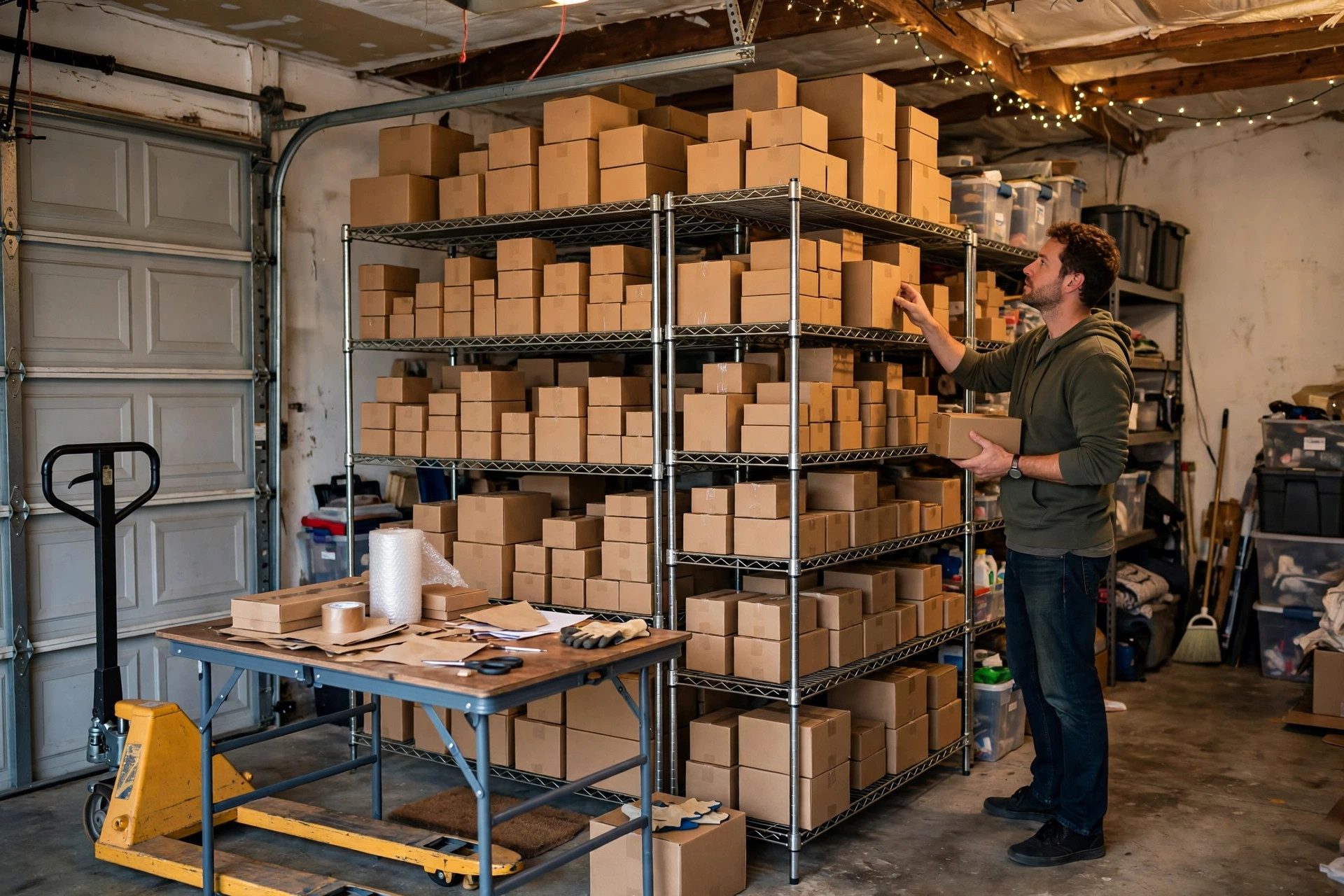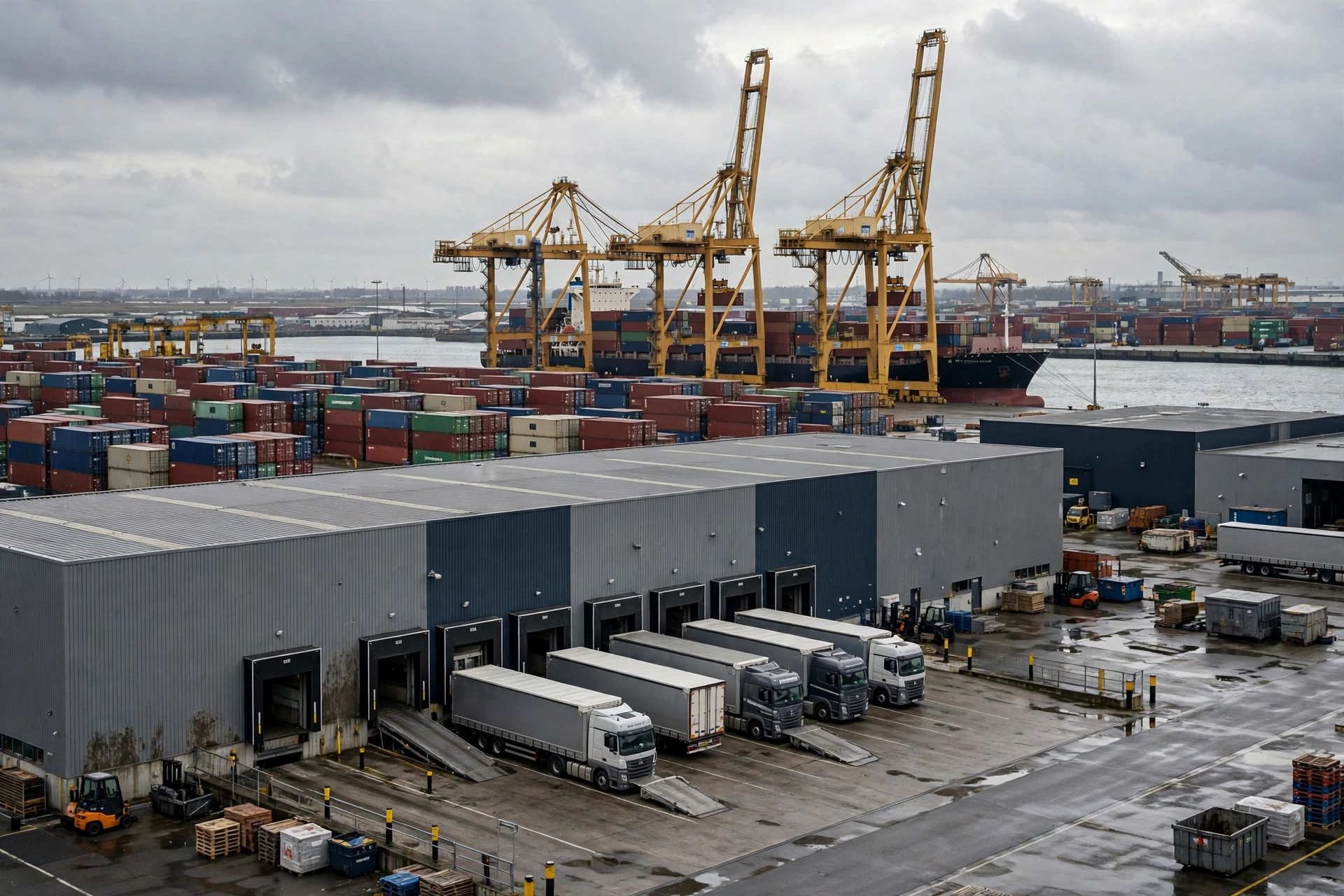
Let me be honest up front: my warehouse is 3,000 square meters, three people, and one very old forklift. Rotterdam port warehouse distribution logistics was never supposed to be our business. We are the kind of small warehouse that survives on local sellers and tight margins, not the kind that rents space next to Europe's biggest port. But our customers do not care how big our warehouse is. Their cargo lands in Rotterdam, it needs to reach buyers across Europe, and somebody has to handle it. So we figured out how to play a big-port game on a small-warehouse budget.
Our First Rotterdam Job Nearly Scared Us Off for Good
It was October 2025. A customer selling small home appliances came to us with a straightforward-sounding job: one 40-foot container landing at Rotterdam, a little over 2,000 units inside, to be split up and delivered to more than a dozen small buyers in the Netherlands, Germany, and Belgium. Three days from vessel arrival to deconsolidation, labeling, and dispatch. Easy, I thought. We do this every day.
The first surprise was the rent. Warehouse space near the port cost several times what we pay, and every operator we called had a minimum lease size bigger than our entire warehouse. The second surprise was the schedule. The vessel arrived on October 12, but the trucking slot we booked was not available until October 15. For three days, that container just sat in the port, and every extra day past the free storage period added charges. The exact rates change all the time — check the latest published tariffs before you quote anything — but the numbers climbing on that bill made me lose sleep.
Those three days I started every morning by calling the shipping line and the trucking company, asking where the ship was and where our truck was in the queue. We eventually got the container out, but the distribution was a mess. Orders for a dozen buyers were mixed in one container, we had to bring in two extra hands on the spot, labeling ran past midnight, and three shipments still went to the wrong addresses. It took us a week to chase them down. We did not lose money on that job, but we did not make any either. It was tuition.
The lesson I took away was simple: a small warehouse should not try to match the port's pace head-on. Port-side rents, port timelines, and vessel schedule changes are all designed for players with scale. When a small warehouse bets its own cash flow against a vessel schedule, winning buys you a thin margin, and losing wipes out three months of profit. We cannot afford to burn money like that.
Rotterdam Port Warehouse Distribution: Closer to the Port Isn't Always Cheaper
Here is the counterintuitive part, and it is the most important thing in this whole piece: in Rotterdam port warehouse distribution logistics, putting your warehouse closer to the port does not always save you money.
The obvious logic says a port-side warehouse means faster pickup and lower trucking costs, so it must be cheaper. That is not how the math works. Port-side space is expensive for more than rent — there are minimum lease sizes, long-term contracts, and peak-season surcharges hiding underneath. If you only have a handful of Rotterdam shipments a year, you are paying year-round rent to serve a few jobs, and the empty space in the slow season costs you just as much as the busy weeks.
After a year of trial and error, this is roughly how the three options stack up for a warehouse our size:
| Option | Best for | Where the money goes | Biggest trap |
|---|---|---|---|
| Renting port-side yourself | Big players with containers arriving every day | High rent plus a long-term lease | Empty space in slow season, rent still due |
| Partnering with a warehouse near Rotterdam | Small warehouses with irregular, per-shipment volume | Per-shipment handling fees | Peak-season queues, hard to add rush orders |
| Inland distribution warehouse | Cargo already cleared, bound for buyers across Europe | Trucking plus one extra transfer | One more handoff, 1–2 days slower |
We picked the middle option. We do not rent port-side space at all. Instead, we partner with a mid-sized warehouse near Rotterdam and pay per shipment. They handle pickup, deconsolidation, and the first rough sort. We take over the detailed labeling and final distribution. On paper it looks like an extra step. In practice it saves us real money, because we carry none of the fixed cost of port-side rent, and our partner has far more flexibility than we would if we leased the space ourselves.
There is a price, of course. Partnering means giving up control. In peak season, their own customers come first, and our cargo waits in line. We learned that in March 2026, when a partner's warehouse overflowed and our deconsolidation slipped by two days, nearly leaving our customer out of stock. Since then, every Rotterdam job carries two extra buffer days, and we quote customers a conservative delivery time up front.
How We Run It Now: Share, Shift, and Borrow
Enough about our problems. Here is what actually works for us now — three unglamorous tricks that big companies would probably laugh at, but that keep a small warehouse alive.
First, share the container. One small customer's volume never fills a container or justifies a dedicated pickup. So we combine two or three customers whose cargo is heading in roughly the same direction into a single shipment. In May 2026, we did exactly that: one customer's goods bound for Germany, another's for Belgium, one 40-foot container, one deconsolidation, and each order went its own way afterward. Splitting the pickup and deconsolidation cost between two customers cut each one's share nearly in half. The catch is coordination. Two customers' vessel schedules have to line up, and you need to agree in writing, before anything ships, who is responsible if something goes wrong. Otherwise every dollar you save gets spent arguing about it later.
Second, shift the timing. Congestion at Rotterdam follows a pattern. The weeks before holidays and major sales events, the port and the trucking companies are all booked solid. Our advice to customers is blunt: if you can ship early, do not squeeze into the peak. One customer was planning spring inventory for late March 2026; we talked them into moving it to early March instead. The vessel arrived on schedule, pickup was fast, and distribution took two days. The same volume in peak season would have cost us two or three extra days just waiting for a truck. There is nothing clever about this. It is the oldest advice there is: do not all try to board the same train.
Third, borrow warehouse space. Besides our partner near Rotterdam, we keep a small inland warehouse as a backup. Distribution jobs that are small and not time-critical go straight there, where rent is cheap and there is room to work. The port-side operation only does what has to be done at the port: pickup, deconsolidation, and customs coordination. Everything that can be moved later gets moved to the cheaper location. The principle is simple: buy as little time as possible at the expensive place, and do as much work as possible at the cheap one.
Put together, these three tricks work well for us. That chaotic job from October 2025 — the one that took five days and a midnight labeling session — would take us under three days now, without emergency extra hands. That is our own experience, though. Different scale, different volume, different results. Do not copy the recipe blindly.
A few honest suggestions for other small warehouses in the same position. First, before you even think about renting near the port, count how many Rotterdam shipments you actually handle in a year. If the volume cannot cover a fixed cost, do not touch it. Second, when you pick a partner warehouse, do not just compare the price. Ask whether your cargo can actually get a slot in peak season, and who takes responsibility when things go wrong. Those answers matter more than the unit rate. Third, always build buffer days into your delivery promises. A vessel schedule belongs to nobody's guarantee, and two extra days make you look reliable instead of late.
A small warehouse has its own way of surviving. The rules of a big port are written for big players, but that does not mean small warehouses cannot play. Share the container, shift the timing, borrow the space. That is Rotterdam port warehouse distribution logistics on a small-warehouse budget. It sounds rough around the edges, and it is. But if the cargo reaches the customer on time and the numbers add up, it is a good method — and that is all a small warehouse needs.
By Xiao Ma, Small Warehouse Owner