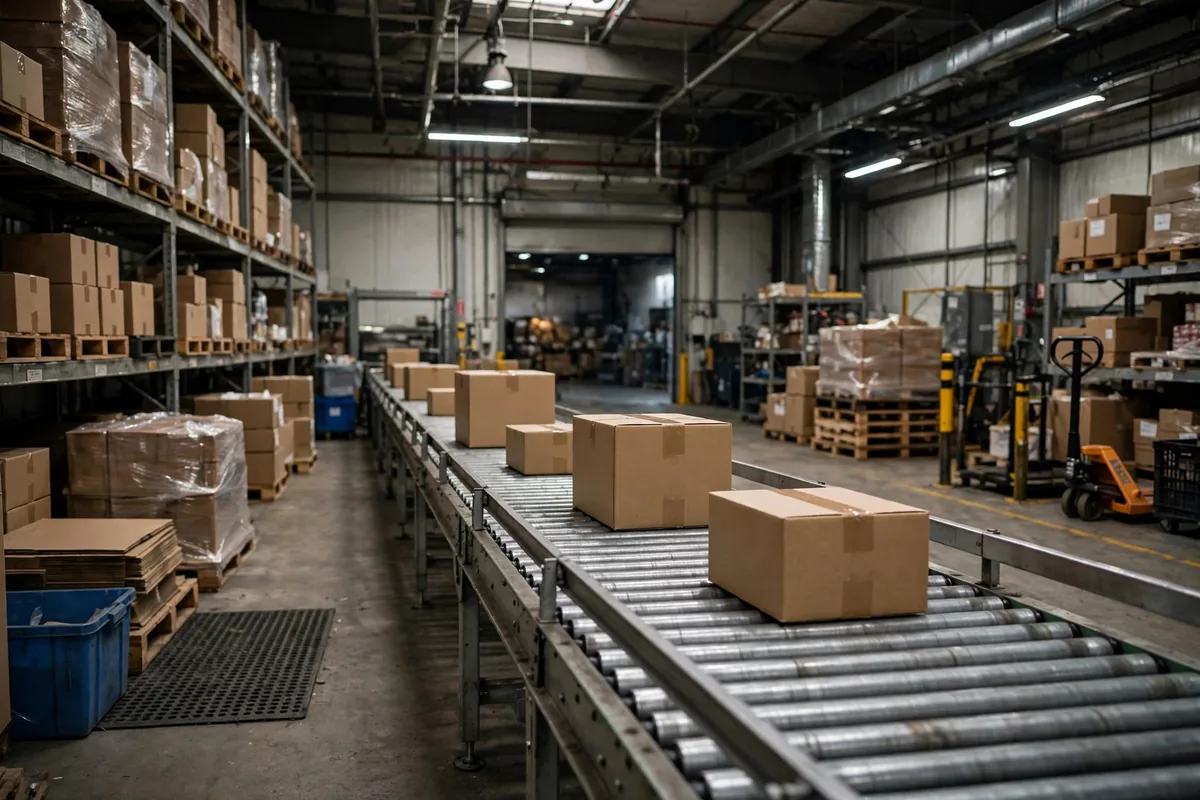
Roller conveyor selection is one of those decisions where the wrong choice costs more than no choice at all. I have seen warehouses spend serious money on a powered line that ran worse than the manual pushing it replaced. I have also seen small operations buy a gravity line to save money, then watch the whole line jam the moment peak season arrived. The line between powered and gravity is not on the price list. It is in how your cartons actually move.
Think of it this way: a gravity line is a downhill slide, and the carton moves because gravity pulls it. A powered line is a road with an engine under every stretch, pushing each carton along. One depends on physics and luck. The other depends on electricity and control. Once you see that, half the selection work is done.
The rollers themselves matter too — think of them as the texture of the road. Common diameters are 50 and 60 millimeters, and roller pitch should run about a third of your smallest carton's shortest side; pitch it too wide and a small carton drops between two rollers and stalls. Chain drive pulls hard and suits heavy freight, while belt drive runs quiet and suits light or fragile goods. Measure your smallest carton before you set the pitch. Get that order backwards and you will be rebuilding the line.
Roller Conveyor Selection Starts With Three Dividing Lines
The first dividing line is takt time. A gravity roller conveyor runs on slope, so the speed of each carton is decided by its weight, the slope, and friction — not by you. Light cartons crawl, heavy ones race, and when a slow carton sits ahead of a fast one, they collide. A powered line holds a set speed on every zone, so spacing stays even. Take a sortation spur that must clear 800 cartons an hour with 30 centimeters between cartons: gravity cannot promise that rhythm, while a powered line set at 18 meters per minute can.
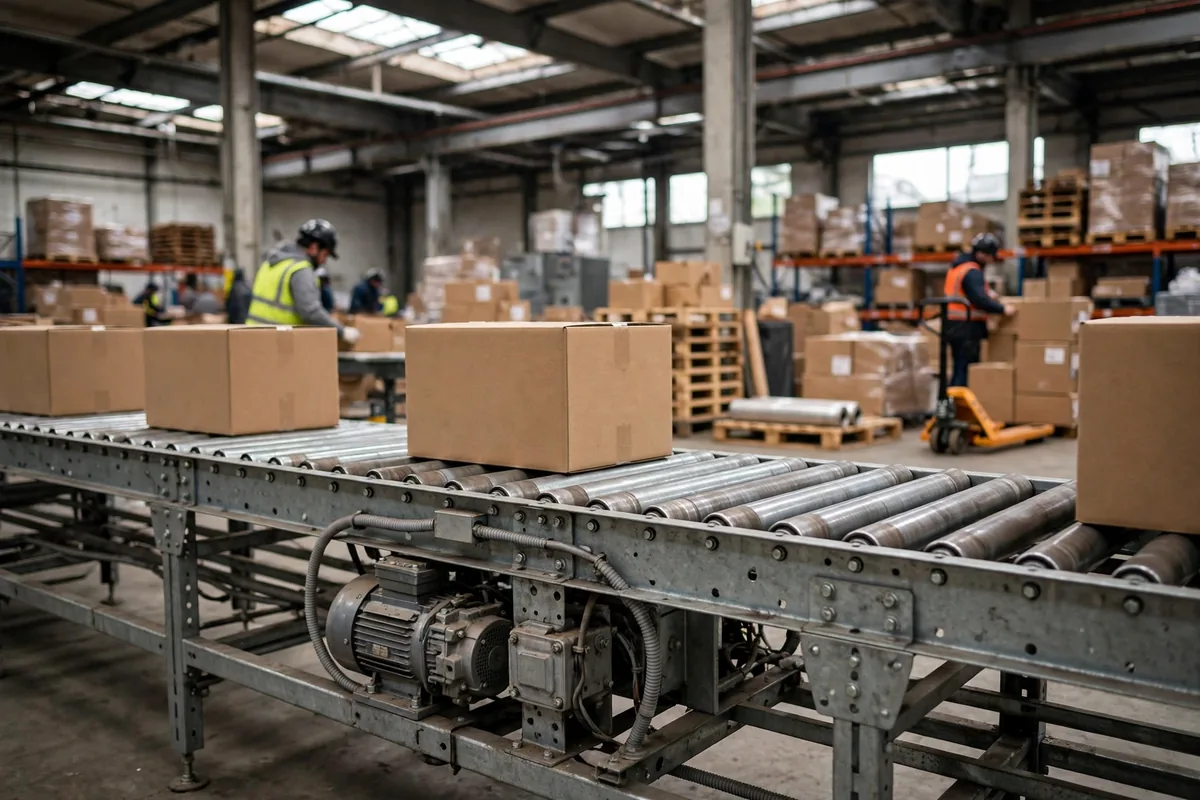
The second dividing line is the route. Gravity only goes downhill. It cannot climb, cannot take a sharp turn, and cannot stop mid-route to wait for a system decision. A powered line climbs, turns, starts and stops zone by zone, and talks to scanners, scales, and labelers. If your route runs straight from high to low with no decisions on the way, gravity is enough. The moment the line needs a divert, a merge, or a hold for the system, powered is the only honest answer.
The third dividing line is the character of the freight. Gravity is picky: cartons that are too light stall, cartons that are too heavy rush, and soft parcels or odd shapes jam. A powered line tolerates all of that — soft bags, irregular parts, light cartons — and charges you for the tolerance in electricity and maintenance.
Roller Conveyor Selection: Two Sites, Two Lessons
In the fall of 2023, I worked on a retrofit at an e-commerce warehouse in eastern China. Its gravity line ran 42 meters with a 1.8-meter drop. At peak, more than 600 cartons an hour rushed downhill. Light cartons stalled halfway, heavy ones slammed into them from behind, and over 20 cartons a day came out damaged. The fix was restrained: we replaced only the last 12 meters with a powered section and added speed-control wheels, keeping the gravity section in front. Damage fell back to its old level, and the bill came to less than a third of a full powered replacement. The lesson is that the dividing line can sit in the middle of the line — you do not have to pick one type for the whole run.
The opposite mistake showed up in early 2024 at an auto-parts warehouse in northern China. The site installed a 60-meter powered line for fewer than 300 cartons a day, with heavy, irregular freight. Motors, gearboxes, and a control cabinet ran all day for a line working at under a third of its capacity, and the yearly power and maintenance bill ran well above what a gravity line would have cost. That is a textbook false requirement: freight that is not urgent, volume that is not high, and a straight route. The site later converted half the powered sections back to gravity, and the money saved would cover a picker for a year.
Roller Conveyor Selection Math: Three Tables Decide It
Never judge on purchase price alone. Fill in this table for a 30-meter line running 8 hours a day, 300 days a year:
| Item | Gravity | Powered | | Purchase cost | Low, about a third of powered | High, motors and controls dominate | | Running cost | Almost zero | Power plus maintenance, every year | | Takt stability | Volatile, depends on freight | Stable, programmable | | Sensible volume | Under 300 cartons per hour | Over 500 cartons per hour |
The decision framework is three questions: does volume pass 500 cartons an hour? Does the route need a divert, a climb, or a wait? Is the freight mixed in weight, with uneven carton bottoms? Two yes answers point to powered; three no answers mean gravity is enough. If you land in between, copy the first case and build a hybrid line, putting powered sections only where jams happen.
Here is the counterintuitive part: many owners treat powered as advanced and gravity as backward, and that is only half true. A gravity line has no motor, which means no motor can break. In my experience, a gravity line needs less than a tenth of the maintenance time of a powered line, and unplanned stops are close to zero. For a warehouse without high volume, one fewer failure point is worth more than one extra feature. One more detail that gets underestimated: a powered line should run zone by zone, switching motors on only where cartons are present — a motor spinning on an empty zone is burning money. Before signing, ask whether the supplier supports zone start-stop; if they cannot answer, do not rush to sign no matter how low the quote is.
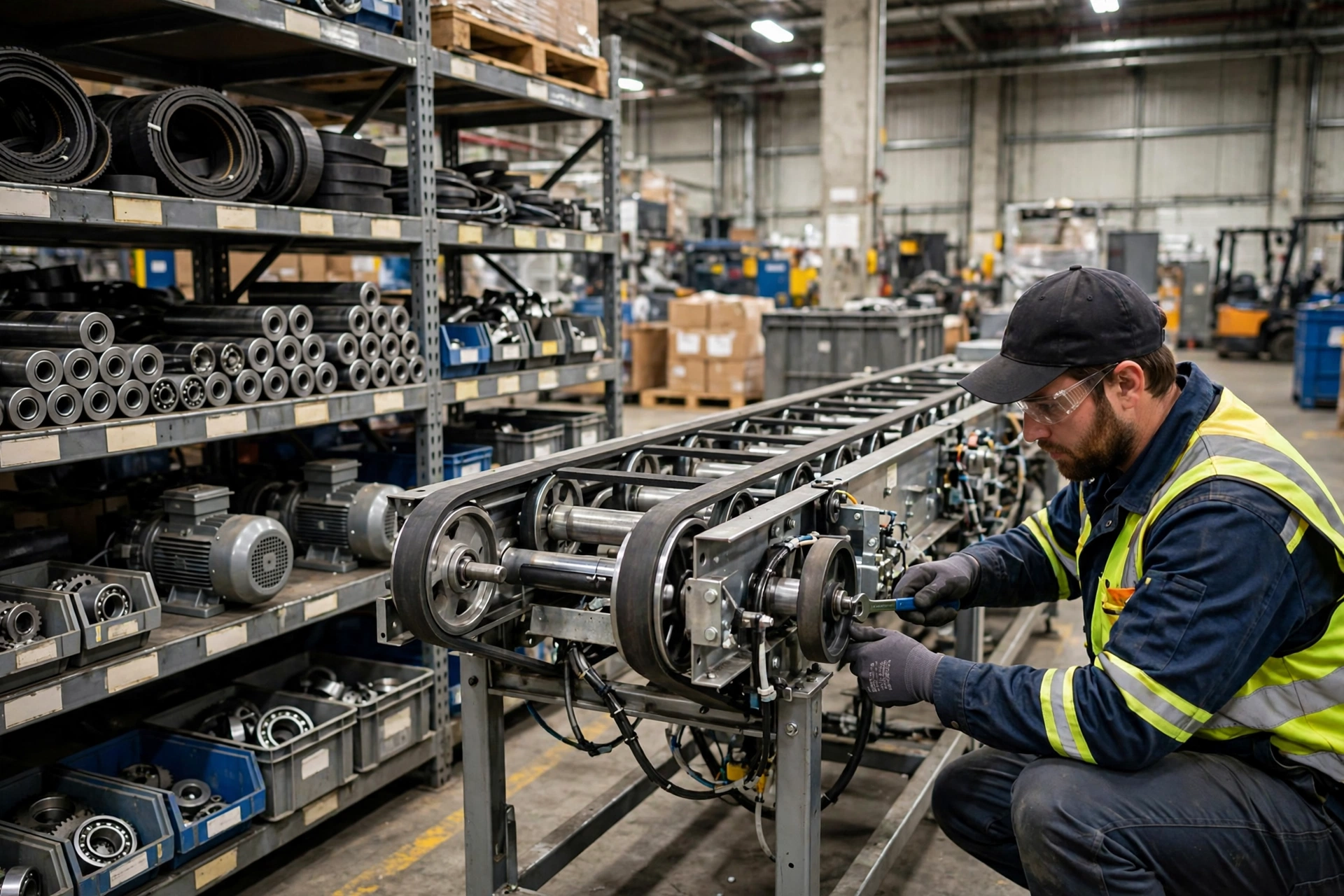
Maintenance traps deserve a mention too. Powered lines suffer most from two things: dust on rollers causing slip, and motors overheating. Skip cleaning for a month and cartons spin in place while the takt falls apart; let paper dust block a motor vent in summer and the thermal cutout stops a whole zone after hours of continuous running. I put roller cleaning on a fixed weekly routine — fifteen minutes, done before slip shows up. Gravity lines suffer from one thing: a slope that someone moved. Floor settlement or a loose support changes the grade by a degree, and the slide speed changes with it — check it with a level before every peak season, and check the speed-control wheels for wear while you are there, because worn wheels cannot hold back a heavy carton and collisions start there. One more spot people miss: the joint where a powered section meets a gravity section. If the roller heights differ by more than three millimeters at that joint, light cartons hesitate, and a few thousand hesitations a day turn into damage and jams. Measure every joint with a level at handover; never trust your eyes.
Five Questions Before You Sign
A roller conveyor is not a one-off purchase, and five items in the contract deserve line-by-line questions. Does the warranty cover motors and gearboxes, for how many years, and what response time is written down? What do wear parts — rollers and belts — cost, are they in stock or made to order, and how many weeks would a stockout last? Is the control system open-protocol, so a future WMS connection plugs straight in, or must you buy the vendor's gateway? Does installation include level checks and a loaded test run, rather than one empty lap that counts as acceptance? And does the spares list cover the models you actually run, with substitutes if one is discontinued? Ask those five and you will know whether the supplier is solid. Treat a quote that lists only a total price with care — I have seen the low-bid, high-maintenance routine more than once. the true cartons-per-hour at your sortation point. Below 400 an hour for the long term, a powered line is decoration. Above 500 an hour, trying to hold the line with gravity will let jams and damage do the accounting for you.
By Da Liu, Automation Engineer