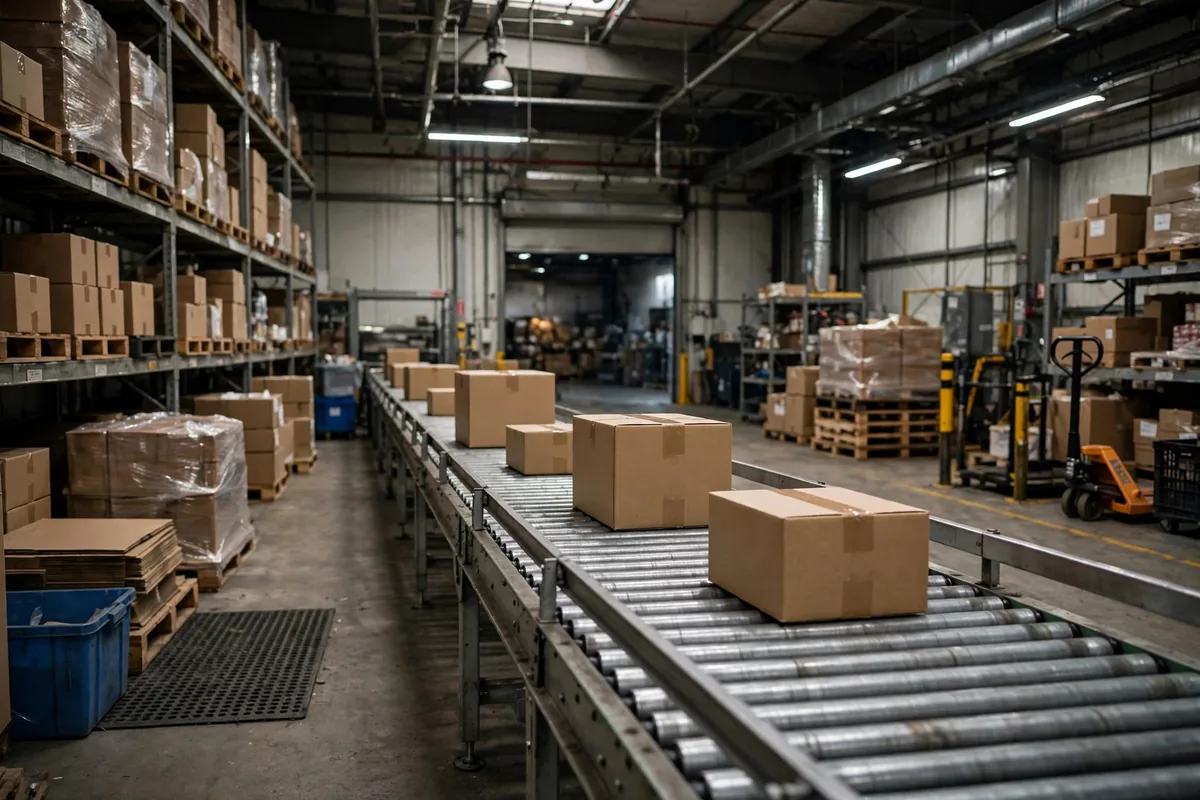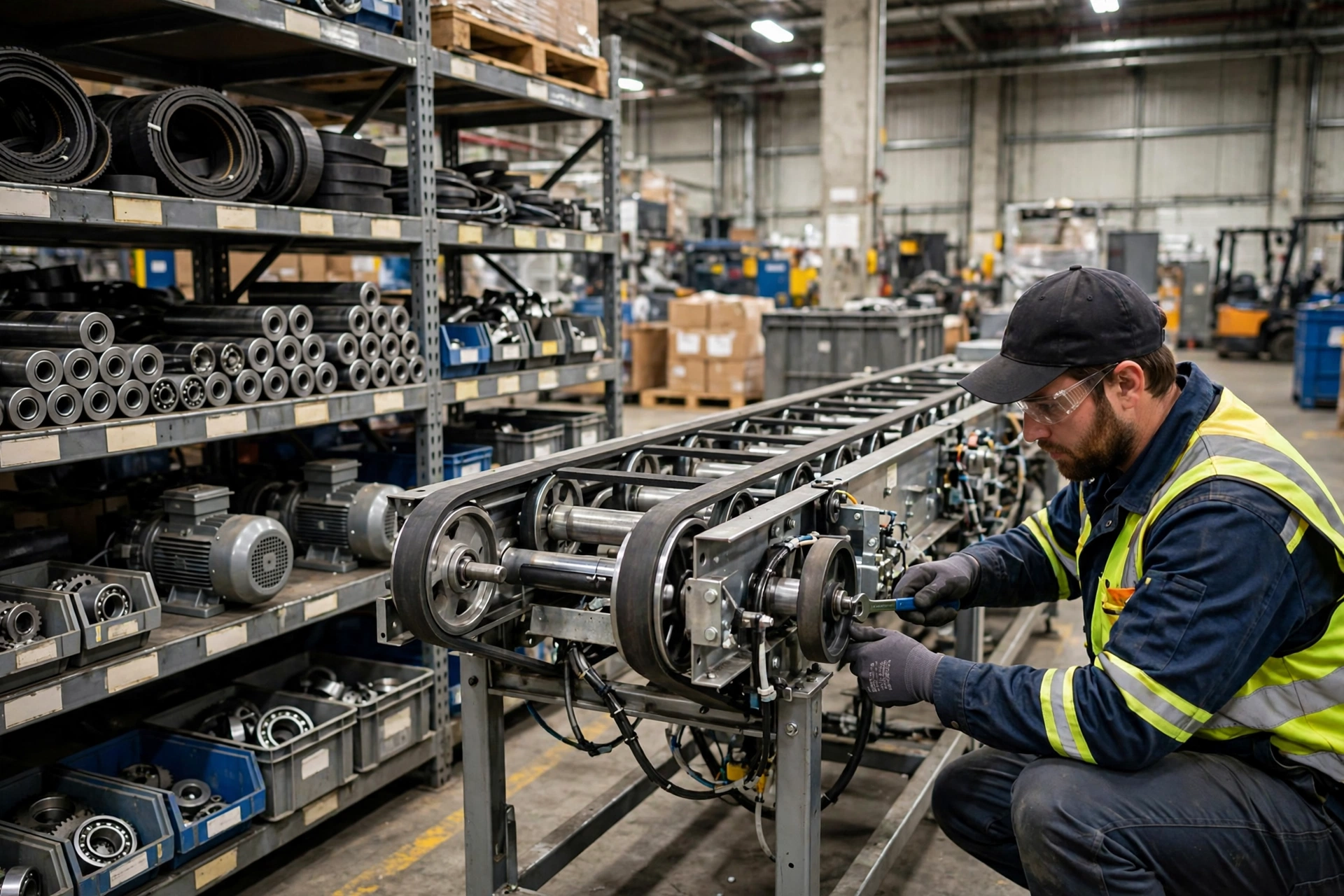
Here is my conclusion up front: for a small warehouse doing 3,000 orders a day like ours, a crossbelt sorter is a way to set money on fire. That is not sour grapes. I worked it out on a calculator. Last month a sales rep came by with a glossy pitch: install the system and two people could do the work of ten. I poured him a cup of tea and showed him the door. Our whole warehouse has nine people. Where would the work of ten people come from?
Our warehouse sits in Dongguan: 3,000 square metres, 3,000 orders a day in peak season, around 1,500 on a normal day. Every afternoon at four, six of us gather around a row of cages and sort by hand until eight in the evening, eyes tired, hands sore, mistakes creeping in. During Singles' Day week last year, we mis-sorted more than 40 orders in a single day. A dozen of them went to the wrong city, and we only found out when customers signed for them. Sending them back cost another round of freight, a couple of thousand yuan gone in both directions. That was the week I started seriously looking into sorters.
Crossbelt Sorter: What Is This Thing, Really?
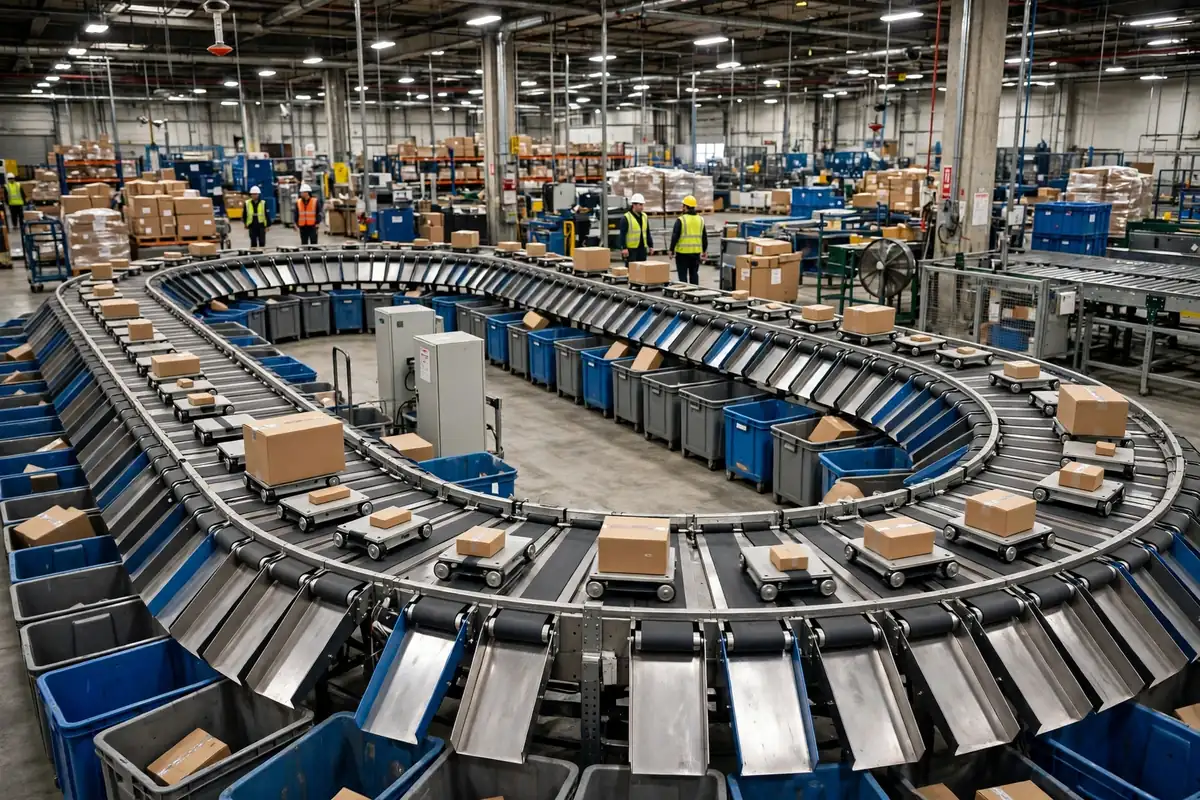
Put simply, it is a loop of track with a chain of small carriers, each carrying its own short belt. Every parcel gets its own carrier. The parcel rides up, passes a scanner, the system works out which chute it belongs to, and when the carrier reaches that chute, its little belt spins sideways and slides the parcel off. Induction, identification, and diversion all happen without a human hand touching the parcel. The carriers hum along quietly, but the drive and control system underneath the track is another story: one stop means the whole loop stops, and a jammed parcel means someone has to climb in and dig it out. A big loop sorts 10,000 to more than 40,000 parcels an hour, hits accuracy above 99.99 percent, and serves 200 to 400 chutes. Sounds beautiful. It is beautiful. It is also expensive — and the expensive parts are the ones you cannot see on the brochure.
Why Our Small Warehouse Cannot Touch a Crossbelt Sorter
The numbers below are an illustrative example, so do not treat them as a quotation. We do 3,000 parcels a day, 6,000 at peak. A loop rated at 10,000 parcels an hour would chew through our entire day's volume in one hour, then spend the other seven staring at the ceiling. Depreciation, floor work, maintenance, and electricity do not take days off. Roughly speaking, six people sorting by hand cost us a bit over 40,000 yuan a month in wages and social insurance. With a loop, equipment amortization plus maintenance plus electricity would cost more each month — and we would still need two extra people just to feed parcels onto the belt. The faster the machine runs, the faster the bottleneck moves upstream to the induction table. A labor-saving machine that needs more labor to feed it: that is the counterintuitive part nobody puts in the sales deck.
Floor space is another trap. A loop needs a whole section of floor, and if the ceiling is too low you are rebuilding. In our 3,000-square-metre warehouse, carving out space for it would cut our storage slots by a third. A chute fills up and nobody clears it, the loop jams anyway. An oversized or overweight parcel cannot ride a carrier, so someone has to pull it out and walk it over by hand. Last year I visited a friend's e-commerce warehouse in Guangzhou doing well over a hundred thousand parcels a day. Their loop was verified by the vendor at more than 20,000 parcels an hour, with over 300 chutes and two dozen people running induction and clearing chutes, busy from the moment the shift started. At that volume, the machine finally eats its fill. My friend was honest with me too: the first three months after go-live were spent tuning the induction rhythm alone — scanner angles, parcel spacing, chute allocation, all learned with real money.
So who actually deserves one? I draw the line here: more than 50,000 parcels a day, more than 100 destinations, a messy SKU mix, and batch waves piling up, with manual mis-sort costs already hurting. At that scale, a loop finally pays its way. Below that scale, however sweet the sales pitch sounds, you are paying for the rep's commission.
| Manual sorting | Crossbelt | |
|---|---|---|
| Daily ceiling | Around 6,000 orders for us | 10,000 to 40,000+ parcels an hour |
| Monthly cost | Six people, a bit over 40,000 yuan | Amortization plus maintenance plus power — more, not less |
| Errors | Caught by a checking step | Accuracy above 99.99% |
| Flexibility | Change the rules today, run them tomorrow | Changing chutes or routes means stopping the line |
| Floor space | A row of cages | A full loop plus a chute field |
Read that table and the picture is plain: the machine wins on ceiling and accuracy, and loses on the entry ticket and flexibility. Our daily volume is ten times below what the machine needs to break even. Buying one would be paying big money for a decoration we then have to serve every day.
If you still want a taste of automation, there are cheaper ways in: outsource the peak-season overflow to a third-party sorting point nearby and pay per parcel, or split a swing-arm sorter with two neighboring small warehouses and share it in shifts. A swing-arm machine sorts far fewer parcels than a loop, but it is cheap, small, and easy to fix — a much better fit for our scale. Automation is like buying shoes: fit matters more than looks. The finest running shoes are still a misery if you wear them to work a field.
The Low-Tech Fix Works Just Fine
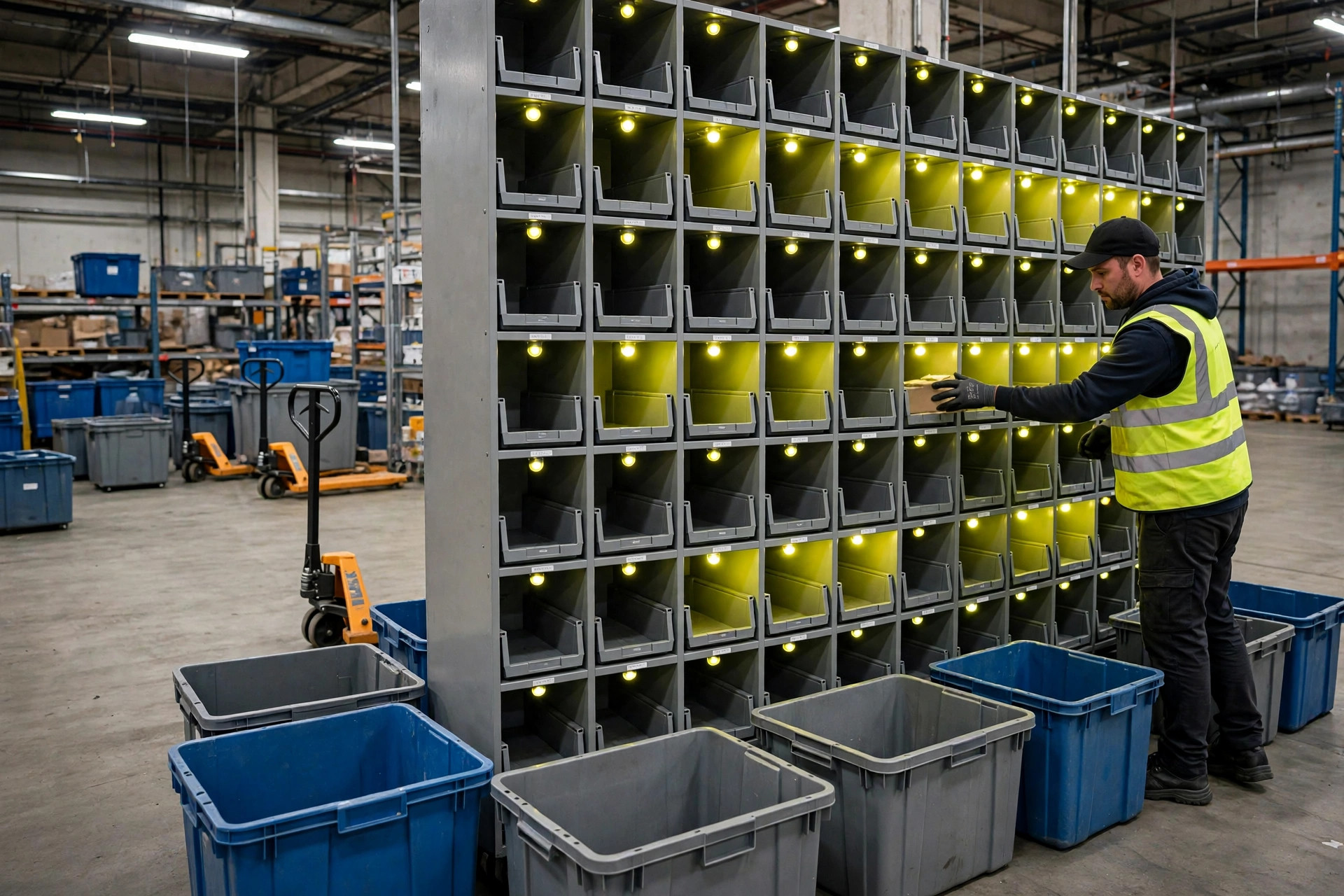
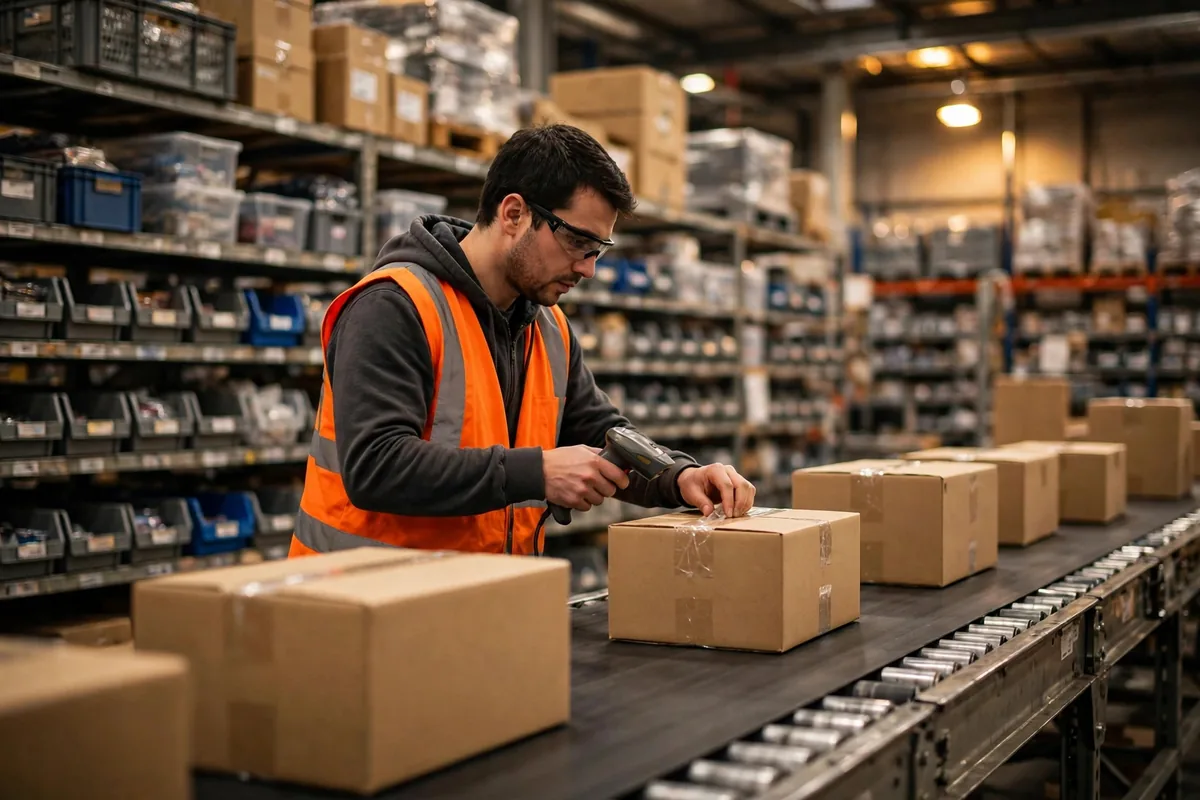
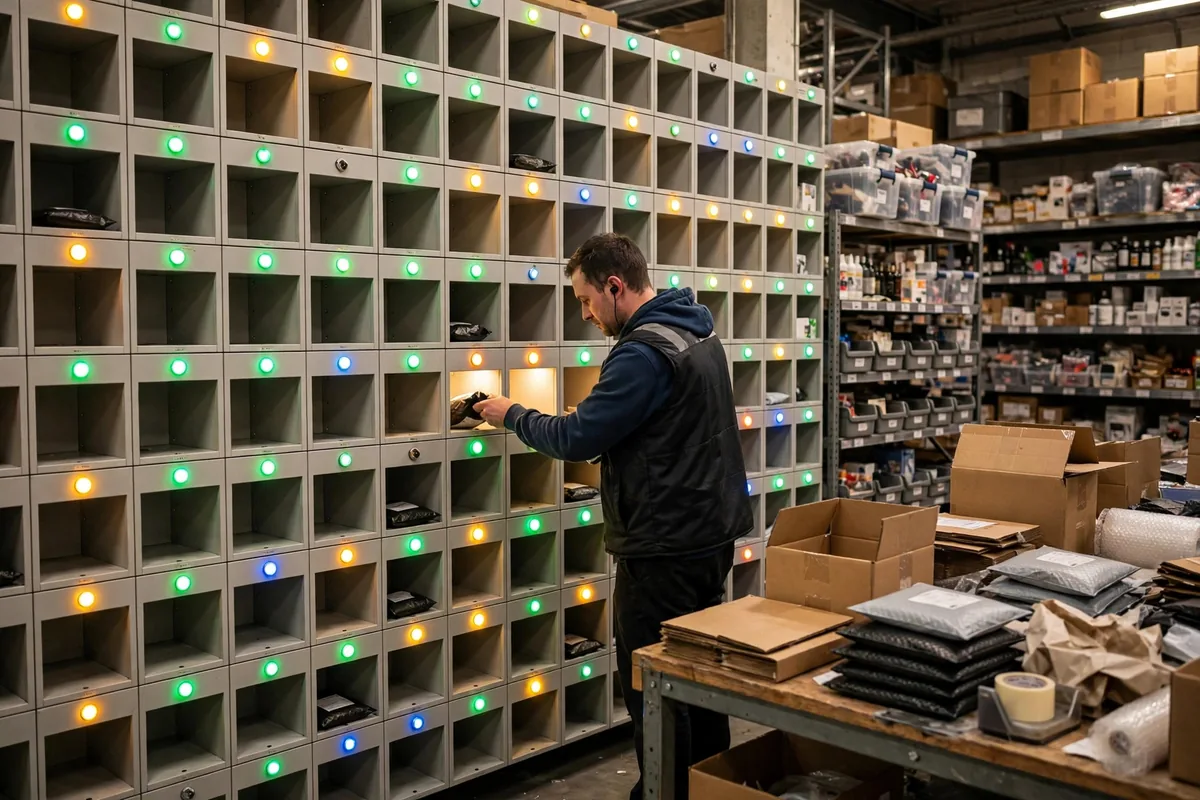
In the end we skipped the machine and fixed our manual process. Sort by carrier first, then by region into small bays. The bay wall is covered in color-coded labels, every bay carries the day's pick list, and we tick a bay off when it is done — anyone can see at a glance who still has orders left. A new hire can learn the colors in three days. We sort in waves of 200 orders at a time. Six people, fixed assignments, the same bays every day, and a mis-sort can be traced to a person on the spot. Before dispatch we added one checking step: the packer scans the label, the system matches it against the order, and anything that does not match gets stopped. That check costs half an hour a day, and the wrong orders it catches are worth far more than half an hour. Now we clear 6,000 peak-season orders in four hours with a much lower error rate than last year. What did it cost? A few hundred totes and two rolls of color labels — less than one month of electricity for a sorting loop.
Small warehouses have their own way of surviving. The day we pass 20,000 orders a day, I will be the first one calling about a crossbelt sorter. Until that day comes, every sales rep gets the same answer from me: let us get these 3,000 orders sorted properly first.
By Xiao Ma, Small Warehouse Owner