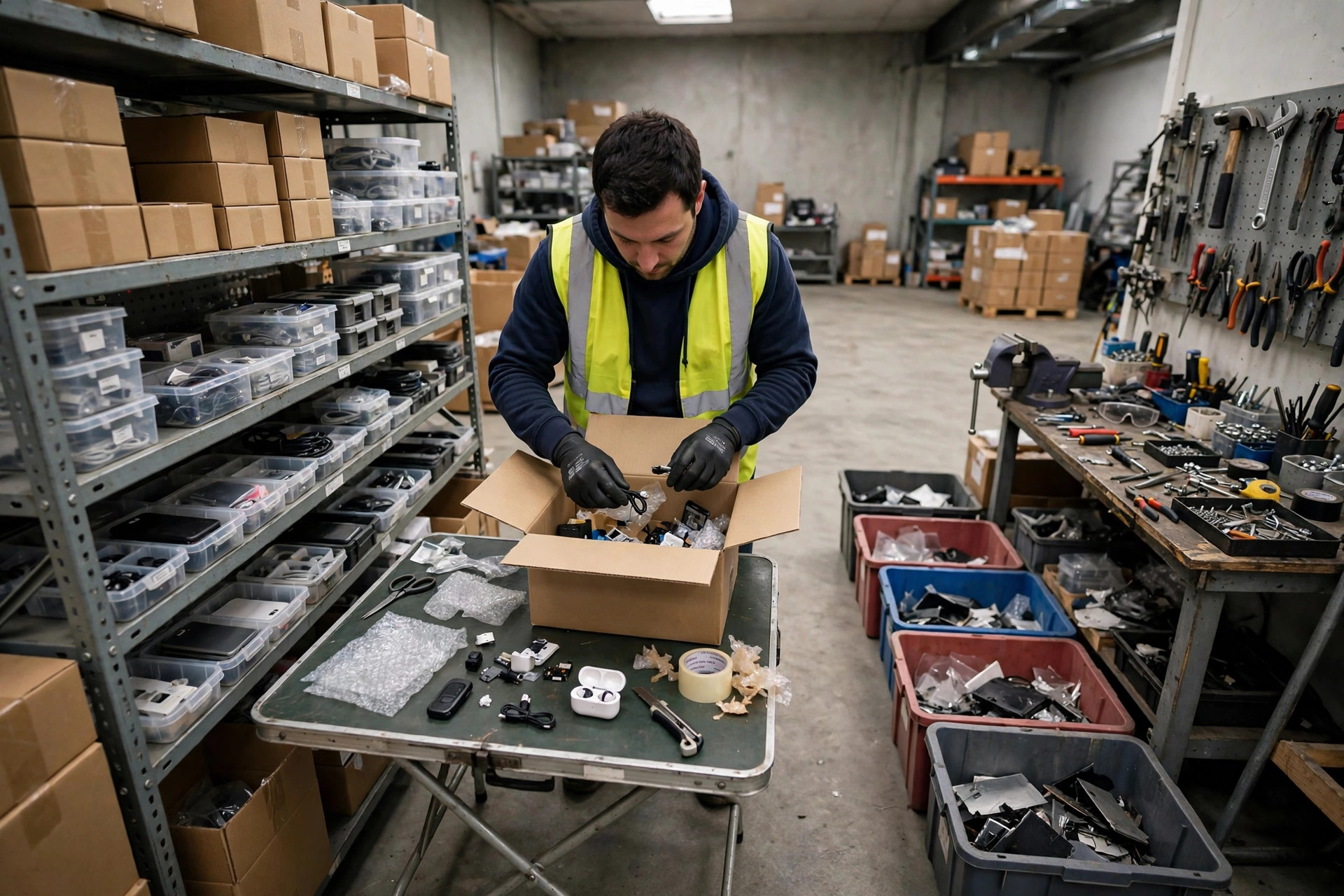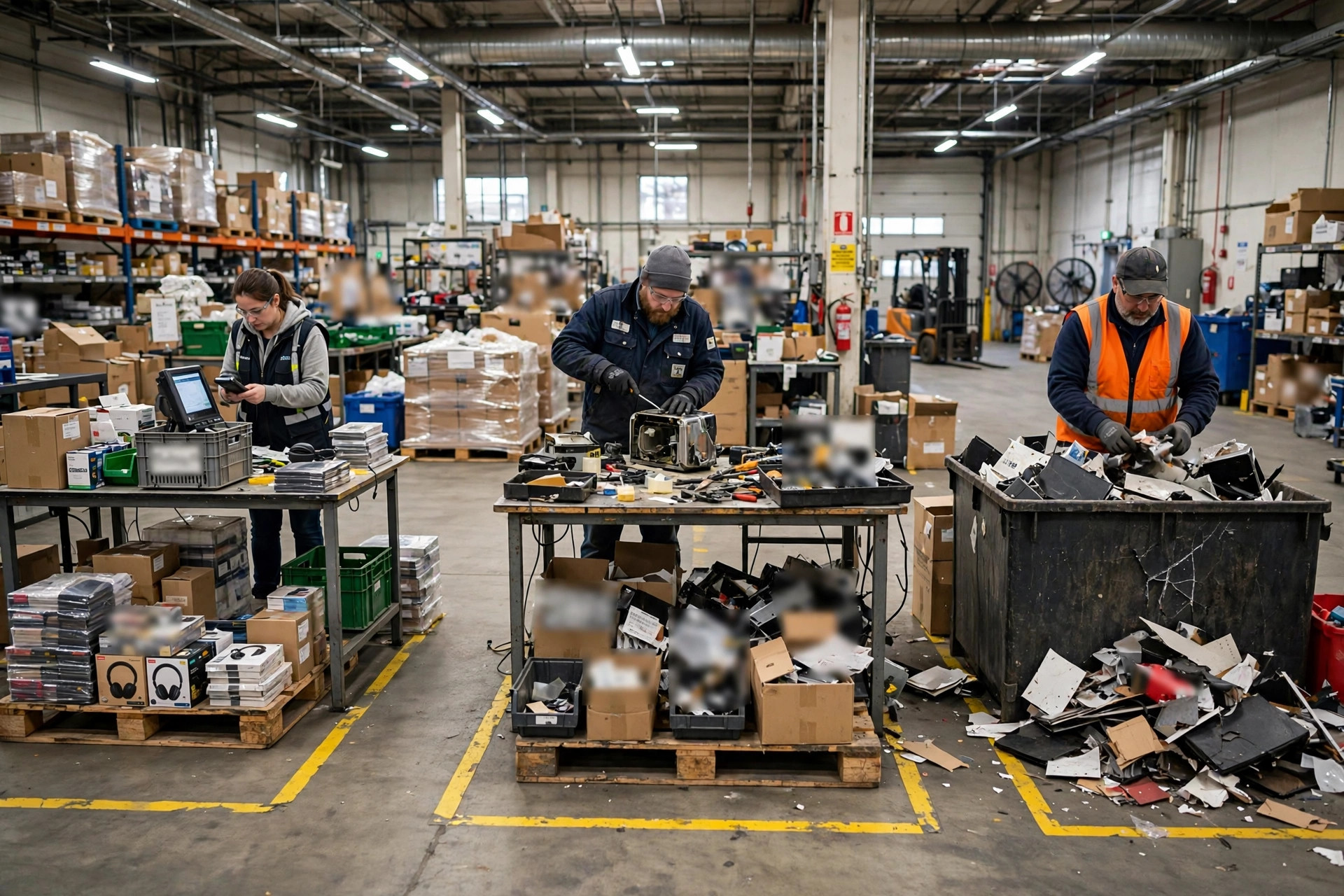
Here's the verdict: a returns QC hold area needs three physically separated zones — pass, repair, and scrap — with three matching location statuses in the WMS, and nothing sits in hold longer than 48 hours. Miss any one of those three and the hold area eventually becomes a no-go zone that nobody dares touch and nobody can clear out.
Why three zones? Because returned goods have three completely different destinies. Pass items go back to sellable stock fast. Repair items need work orders. Scrap needs financial write-off and disposal. Pile them together under one "available" status and your pickers will walk into the hold area with a pick task and grab something broken. I've seen this exact failure three times, and every post-mortem landed in the same place: it wasn't the people, it was the zone design and the status configuration.
The Three-Zone Checklist for a Returns QC Hold Area
How to draw the zones — the physical side and the system side must mirror each other. One without the other is decoration.
| Dimension | Pass Zone | Repair Zone | Scrap Zone |
|---|---|---|---|
| Physical separation | Floor markings + guardrails, set apart | Separate room or fenced area, next to repair benches | Locked fenced area, keys held by one person |
| WMS location status | hold, flipped to available after QC pass | hold (locked, never allocated) | damaged (locked, never allocated) |
| Labeling | Green tags, location IDs starting with P | Yellow tags, location IDs starting with R | Red tags, location IDs starting with S |
| Turnaround rule | Back to stock or sellable within 48 hours | Work order raised within 72 hours | Weekly consolidated write-off and disposal |
| Cost of a mix-up | Low (one extra move at most) | High (defective units can ship) | Extreme (shipping scrap means claims and refunds) |
Note the location-ID prefixes. P/R/S isn't cosmetic — it lets a forklift driver tell at a glance, from 10 meters away, which zone he's driving into. On my go-live-night checklist there's always this line: pick 5 random locations, ask the driver "can this ship?" — one wrong answer and we don't go live.
Building the Hold Area, Step by Step
Step 1: Size it before you tape it. Reserve hold-area space at 1.5x your average daily return volume. Simple math: 200 returns a day, roughly 0.3 square meters per unit under inspection (aisles included), means at least 90 square meters. Split the three zones by your historical mix — most warehouses land around 60% pass, 25% repair, 15% scrap. Not sure? Start there and tune after a month. Keep the scrap zone small on purpose; it forces the weekly clear-out. And don't undersize repair — one bad week of repair backlog spills straight into the pass zone.
Step 2: Configure the WMS location statuses. Skip nothing. Create three location groups with bound statuses: Pass group = hold (flipped to available only after QC sign-off), Repair group = hold (flipped after repair completion), Scrap group = damaged. Two settings matter most. First, exclude hold and damaged locations entirely from allocation logic — wave planning, replenishment, and cycle counts must never touch them. Second, status flips require an approval trail: the QC inspector scans to confirm, and the system logs who flipped it and when. I've watched too many warehouses where the QC tech says "this batch is fine" verbally and someone bulk-flips statuses in the system. Three months later nobody knows who released what.
Step 3: Write the inbound flow in stone. No "just put it here for now." Returns arrive, get scanned at receiving, and the system suggests a zone based on the SKU's return-reason history (say a small appliance model runs 40% functional failures — suggest the repair zone). Then putaway into that zone, then QC. The suggestion is only a suggestion; the inspector confirms. But there is no fourth destination. Every "just put it here for now" unit becomes a permanent resident of the no-go zone.
Step 4: Enforce the 48-hour clear-out with the system, not with nagging. Every morning at 8, the WMS auto-generates an overage report: everything sitting in hold past 48 hours without a status flip, listed by location, SKU, and owner. Two consecutive appearances escalate to the operations director. It sounds harsh, but the numbers back it: units held past 48 hours cost 2–3x more to process downstream — pass items miss their sales window, small repair issues grow into big ones, and scrap just sits there consuming space and capital.
Step 5: Audit for mix-ups weekly. Fifteen minutes. Pull 20 random locations and check that the physical tag color, the location-ID prefix, and the system status all agree. Log every mismatch; any zone with three or more findings gets a corrective action from its owner. Those 15 minutes are the fuse that keeps the whole three-zone system from rotting.
Two War Stories
September 2023, a home-goods 3PL in Ontario, California called me in for a rescue. Their hold area was one 300-square-meter open floor — pass, repair, and scrap all mixed, every location showing available in the system. A week before peak season, a batch of air fryers with faulty heating elements (repair-bound) got allocated by a wave and shipped. Thirty-seven units went out, 21 complaints came back, over $40,000 in refunds and chargebacks, and they lost a major client. The fix followed the five steps above: tape the floors, configure the statuses, write the flow, turn on the 48-hour report. Three months later, average return processing time dropped from 6.2 days to 1.8, and mis-ship complaints from the hold area hit zero. The warehouse manager told me he wished he hadn't skipped those two weeks of implementation work.
May 2024, a beauty e-commerce warehouse in the Dallas-Fort Worth area — the mirror image. The physical zones looked gorgeous, crisp green-yellow-red floor lines, but the WMS cut corners: every hold location was configured as available. So the system assigned pick tasks into the hold area all day, pickers had to ask the lead "can I pick this one?" for every order, and the lead had to dig through paper QC sheets. At 12,000 orders a day in peak season, that confirmation step burned 40+ labor hours daily. The fix touched only the system: three days to reconfigure statuses and add the exclusion rules. Nothing physical changed. That project convinced me for good: in zone design, system status matters ten times more than physical barriers — barriers stop people from walking into the wrong place, statuses stop the wrong product from shipping, and a mis-ship costs a hundred times more than a wrong turn.
Where It Breaks: I've Seen This Three Times
Break #1: Repair inventory piles up until the repair zone becomes a second no-go zone. The root cause is always repair capacity lagging behind. The fix: auto-alert when repair-zone occupancy passes 80%, and the repair schedule must clear the backlog within a week. Can't fix it in-house? Outsource the repair or downgrade to scrap. "We'll fix it when we have time" never happens — a warehouse never has spare time.
Break #2: Scrap has no outbound process. Many warehouses need finance, legal, and operations signatures to scrap anything — a month-long chain. The scrap sits in damaged status, locked, consuming space and working capital. The fix: pre-write-off. The day QC calls it scrap, the system writes it off on the books; the physical units leave in a weekly consolidated disposal run. Clear the books first, move the pallets later. Locations don't wait for signatures.
Break #3: Pass items return to stock too slowly and miss the sales window. A lot of returns are buyer's-remorse units — pristine, original packaging intact, fully sellable. But some warehouses require the QC supervisor's countersignature before anything flips back to available, so units queue for three to five days and hot SKUs miss their replenishment cycle. The fix: tiered QC. Visually perfect, unopened units go through a fast lane — the inspector's first check flips them straight back to stock, no countersignature. Clear 80% of the easy units first, take your time on the remaining 20%.
One counterintuitive truth to close: the biggest waste in a hold area isn't space — it's time. People think the hold area should be thorough, that every unit deserves a deep inspection. The data says otherwise: units sitting in hold past 48 hours end up in low-value channels more than nine times out of ten — marked down, liquidated, or scrapped. Speed is value. Get the goods moving first, then argue about how thorough the inspection should be.
By Lin Xiao, WMS Implementation Consultant