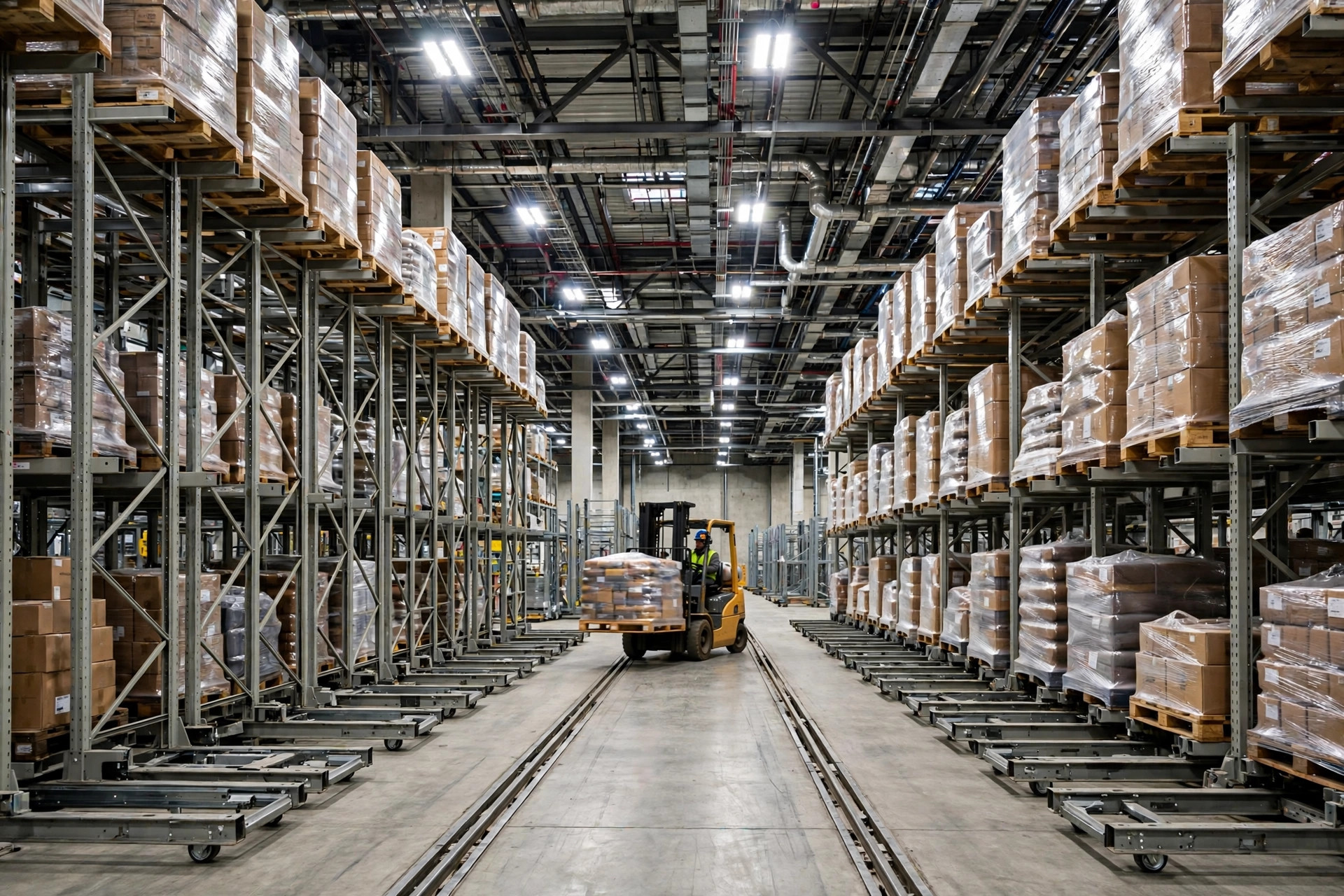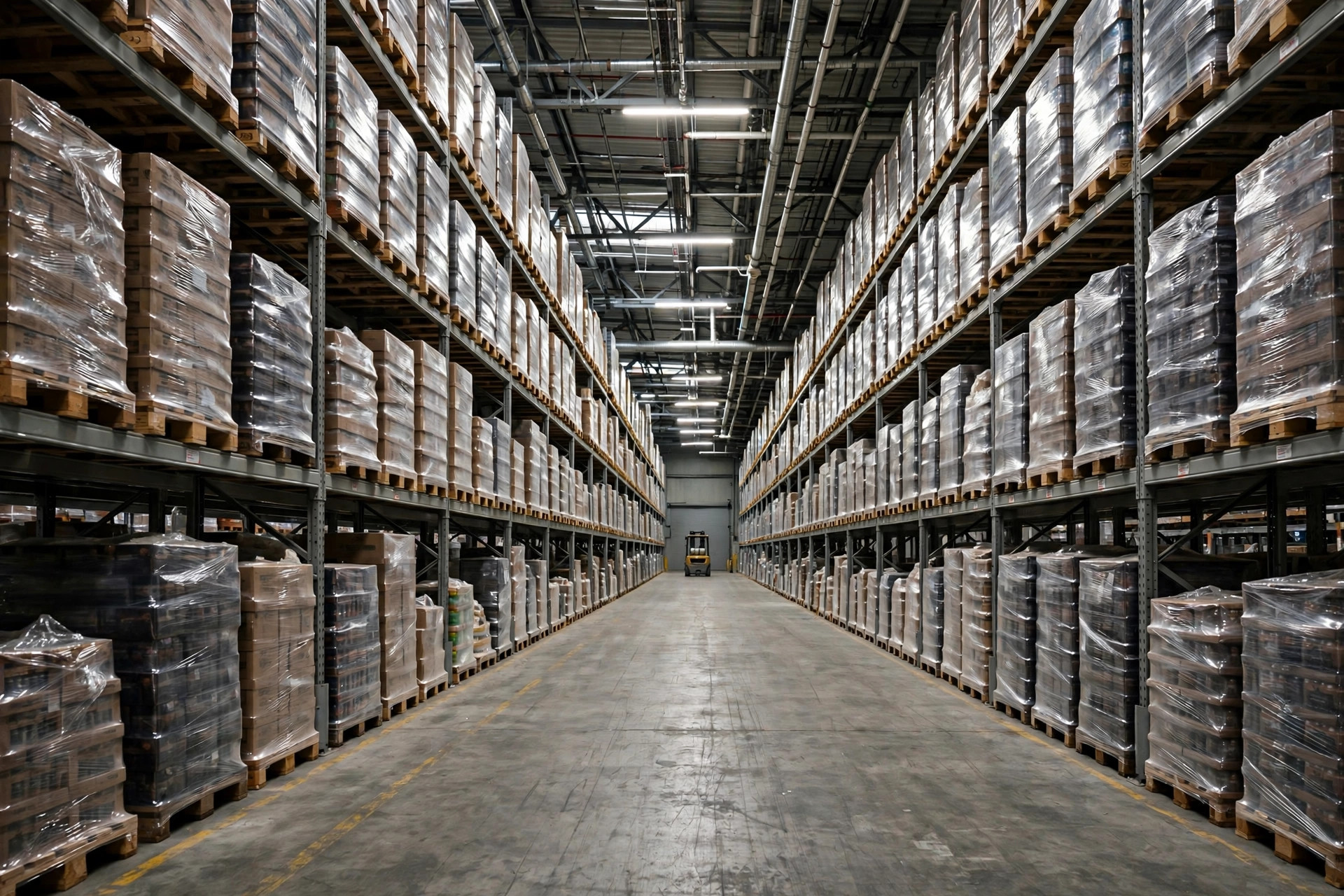
Look, guys, first week of peak season this year, 6 AM shift handover, and our slot map lit up red again.
The boss said one sentence: "The neighbor just leased 5,000 square feet of new space. Maybe we should convert our drive-in section entirely. Save some rent."
I told him straight: with racking, denser is not automatically better. We converted part of our warehouse in 2023, fine-tuned it again in 2024, and both rounds hurt the wallet. So here's the inside story on push-back racking vs drive-in racking — how we tested both.
What actually separates the two
One sentence each.
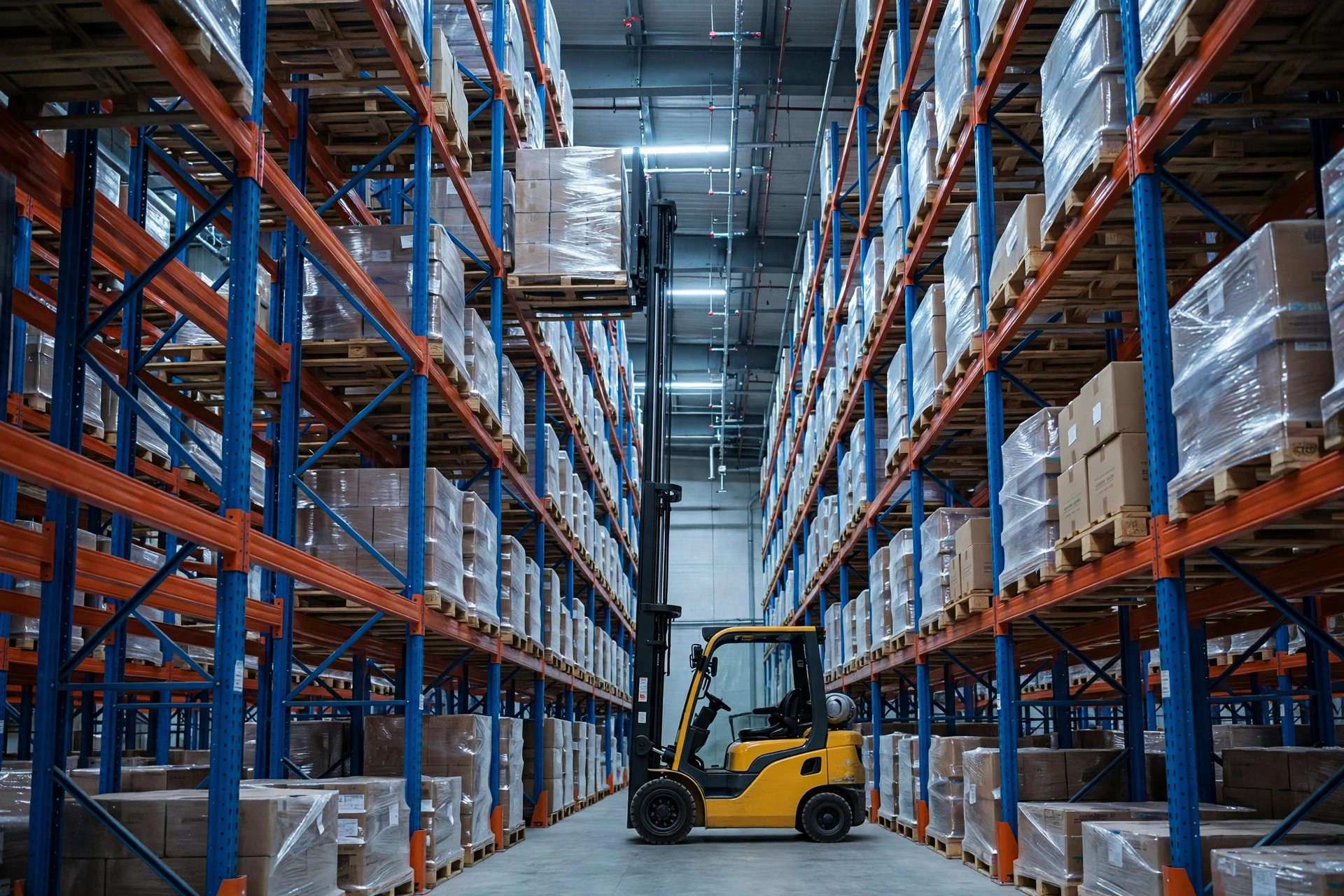
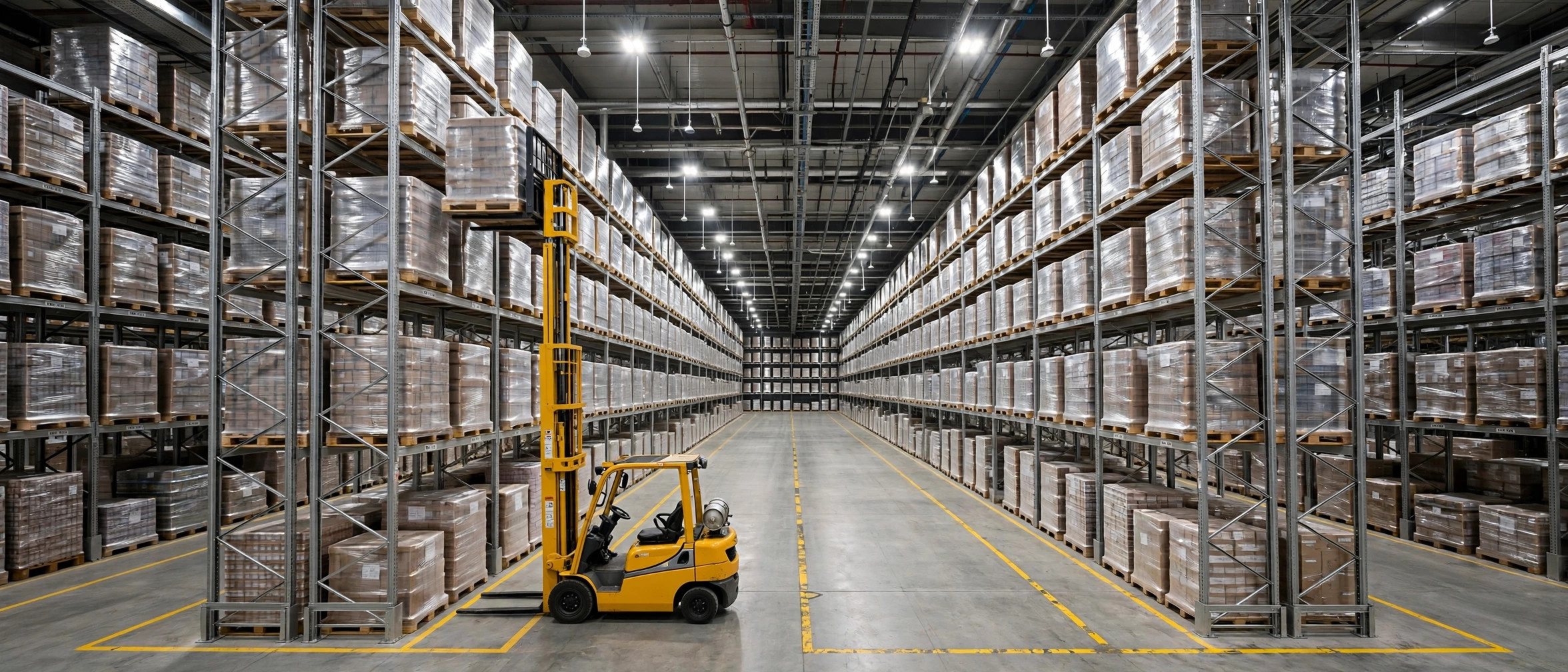
Drive-in racking: the forklift drives straight into the rack lane and stacks pallets one after another, typically 2 to 8 pallets deep, sometimes 10 or more. Last in, first out. You keep just one aisle, so you save aisle space — but every putaway and retrieval means digging into the lane. It's slow.
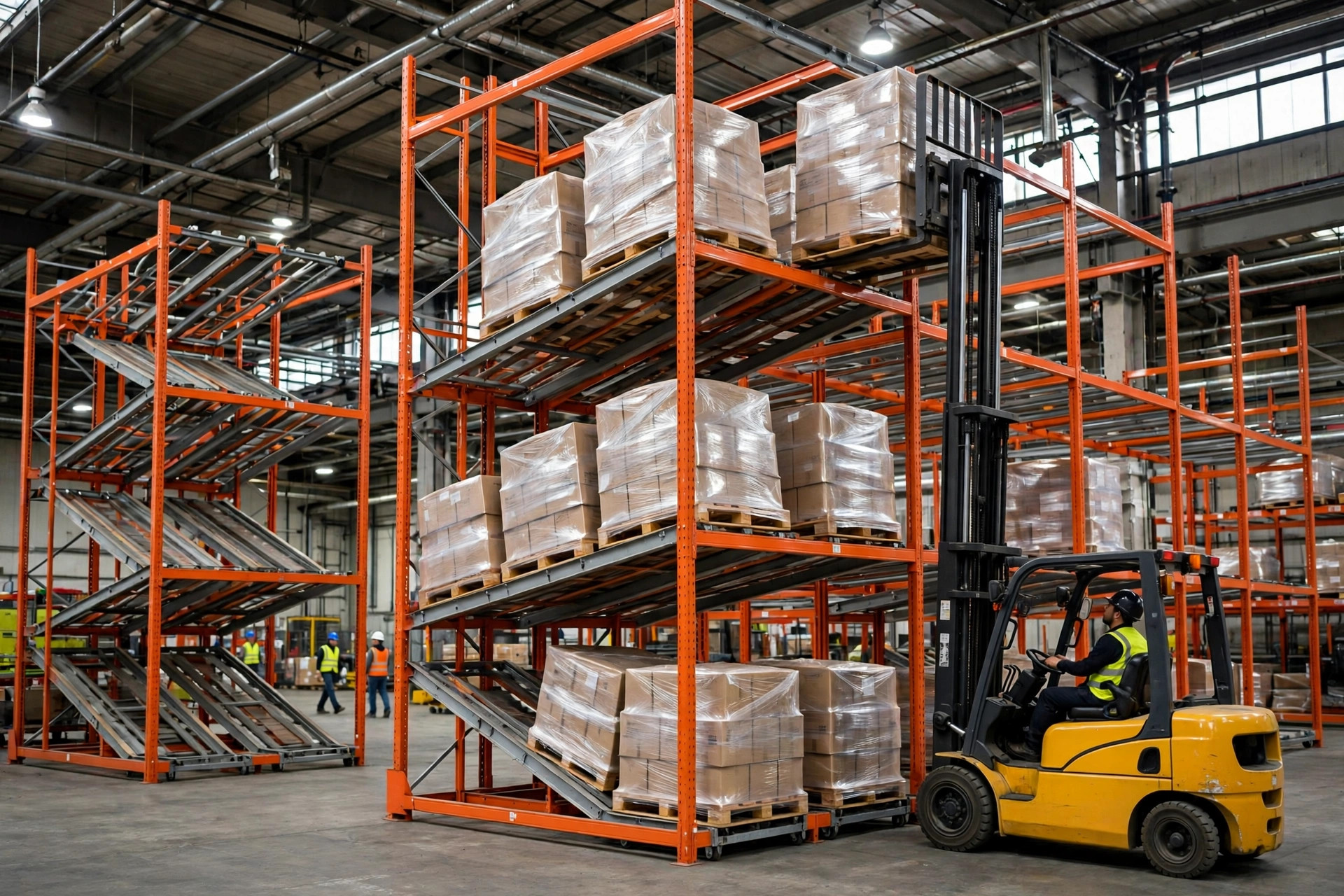
Push-back racking: the rack carries a nest of carts on slightly inclined rails. The forklift sets the first pallet on the top cart at the aisle; the next pallet pushes it back down the lane. When you pull the front pallet, the ones behind roll forward by gravity. Usually 2 to 6 pallets deep, 2 to 4 being the most common. Also LIFO — but the forklift never enters the rack; it works from the aisle.
The difference in one line: drive-in saves aisle space by driving the forklift inside; push-back saves aisle space by building carts inside. One saves floor space, the other saves forklift cycle time. Same family of high-density storage, completely different math.
Our 2023 push-back vs drive-in conversion, measured
We had a drive-in section installed in 2021, holding seasonal buffer stock with not many SKUs. In 2023 our business changed — SKUs jumped from 120 to over 300 — and the drive-in section started acting weird:
Every lane can only hold one SKU to its full depth. With more SKUs, lanes never filled up. The back half of half the lanes stood empty. An empty pallet position isn't storage. It's waste.
That September we converted half the section to push-back, three deep. After the conversion we measured two numbers.
First, pallet positions. Same 1,200 square meters: the drive-in layout held 880 positions, push-back held 960. Push-back gives up a little height to the cart rails, yet single-level utilization came out roughly 10% higher.
Second, cycle time. We timed a full putaway-and-retrieval cycle per pallet: drive-in, with the forklift driving in and out of the lane, averaged 95 seconds. Push-back, working from the aisle, averaged 55 seconds. At 600 pallets moved a day in peak season, that's over 6 hours of forklift time saved daily.
To be honest, the conversion wasn't cheap. Push-back costs more than drive-in — industry reference data puts it around $275 per pallet position versus about $200 for drive-in (Apex racking system comparison matrix), roughly 30% more. But we counted what four months of peak season would save in overtime and forklift shifts, and the payback came in at about 10 months. Racking decisions shouldn't compare equipment price; they should compare full-year operating cost.
The cold-storage warehouse next door: a counterexample
Let me share a counterexample so you don't think I'm biased.
The frozen-food warehouse next to us leased a new building in 2024. Only about 40 SKUs, all full-pallet in and out — and they chose drive-in, six deep. Why? In a freezer, every cubic meter costs electricity. Density is king. Their SKU list is so short that every lane fills up solid, and LIFO is no problem for them — frozen product has long shelf life and loose batch-rotation requirements.
After that project, their rent cost per pallet position came out about 40% lower than with conventional selective racking. Honestly, in that scenario push-back would have been money thrown at carts they never needed. A loss.
So the rule is simple: few SKUs, high volume, loose batch requirements — go drive-in. Moderate SKUs, regular turns, need throughput — go push-back. Neither is better. Only matched or mismatched.
Push-back vs drive-in racking: head-to-head
| Factor | Push-Back Racking | Drive-In Racking |
|---|---|---|
| How it works | Push from the aisle; carts auto-replenish | Forklift drives into the lane, digs out pallets |
| Rotation | LIFO | LIFO (drive-through variant gives FIFO) |
| Typical depth | 2–6 pallets, usually 2–4 | 2–8 pallets, up to 10+ |
| Positions vs selective racking | ~40–60% more positions | Densest option, fewest aisles |
| SKU flexibility | Medium — covers several times more SKUs than drive-in | Low — mixed SKUs guarantee honeycombing |
| Forklift productivity | High — never enters the rack | Low — in-and-out lane travel every cycle |
| Impact damage risk | Low | High — trucks live inside the rack |
| Cost per position | Higher (reference: ~$275) | Lower (reference: ~$200) |
Data note: depths and costs reference published racking selection guides (SourceBySpec racking guide, Apex system comparison matrix, MHL industry publications). Manufacturers differ by design; have your supplier re-verify against your pallet size and load ratings before signing.
The math: how a wrong pick costs six figures a year
Here's the calculation for a 4,000-position warehouse with 300 active SKUs. I'll state the assumptions up front — no tricks.
If this warehouse picked drive-in:
Line one: honeycombing. With 300 SKUs spread across six-deep lanes, lanes never fill. Multi-SKU warehouses running drive-in routinely see 25% empty positions. That's 1,000 dead positions. At $8 per position per month in rent, that's $96,000 a year — straight waste. And low utilization eventually forces you to lease more space on top.
Line two: damage and repair. Forklifts driving into the rack means uprights and rails get hit constantly. Two minor repairs and one major one a year — parts plus downtime — runs $20,000 to $30,000. With push-back the forklift never enters, so most of that disappears.
Line three: cycle time. We measured a 40-second gap per pallet. An 800-pallet day in peak season means 8.9 extra forklift hours daily; four months of peak at $35 an hour adds about $37,000 in labor.
Add it up: $150,000–$160,000 a year burned by the wrong rack. The "six figures" in the headline is the conservative version.
Flip it around: if you only have 50 SKUs and you picked push-back, the $75-per-position equipment premium on 2,000 positions is $150,000 of capital spent once — and the return is faster forklifts in a warehouse that never needed the flexibility. Drive-in lanes would have filled up fine. That's buying a feature you never use.
A push-back vs drive-in selection rule we use now
Before any racking decision, we pull two numbers from the WMS:
Number one: average inventory depth per SKU. Total pallet count divided by active SKU count. If the result is 4 pallets or more per SKU, drive-in is worth discussing. If it's 3 or fewer, push-back fits better. If you're running a thousand SKUs averaging 1–2 pallets each, forget high-density entirely and stick with selective racking.
Number two: batch-rotation requirements. Food, pharma, chemicals that need FIFO batch control — drive-in is out (unless you go drive-through, which is a different invoice). Push-back is LIFO too, so it only suits industries with loose batch discipline.
And here's the counterintuitive one most bosses trip on: the denser the storage, the less flexible the picking. High density means pallets go in easily and come out slowly. Peak-season surges, return waves, rush inserts — the moments that kill you are won on per-pallet retrieval speed, not total position count. Our 2023 conversion happened precisely because our drive-in section had "positions but no throughput," and we spent three days of peak season getting yelled at by drivers stuck at the gate. Guys, remember: a warehouse at 95% utilization isn't necessarily a good warehouse. It might be one that can't move.
One last tip for fellow operators: before signing a racking quote, pull 12 months of active SKU count and average inventory depth from your WMS. Those two numbers settle 80% of the decision. Don't let the supplier pick for you with a pretty rendering — they sell racks; you need turns.
By Chen Feng, Warehouse Operations Manager