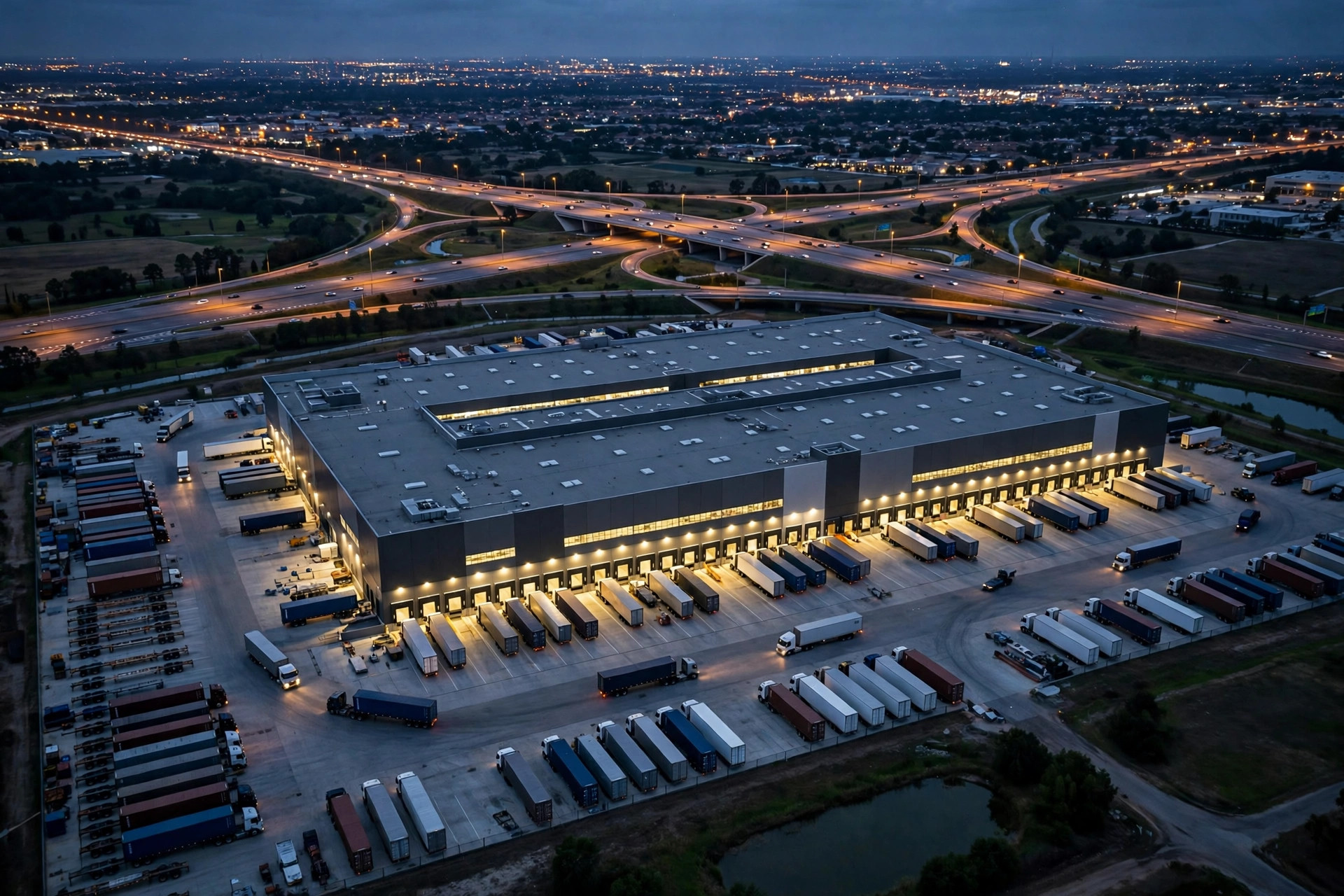
We have a client, a home-goods DTC brand, that did something big last year: a warehouse consolidation, merging three warehouses in Los Angeles, Dallas, and Atlanta into one big Dallas facility.
On signing day their CEO told me, "Susan, three warehouses cost us nearly $90,000 a month in rent combined. One building runs just over $40,000. That's over half a million a year in rent savings. This deal pencils itself." A year later I asked if he regretted it. He laughed: "The rent savings are real. But shipping to both coasts went up nearly 30 percent. Year one was basically a wash."
That's the truth about warehouse consolidation: the money you save and the money you spend don't come out of the same pocket. Let's work through the real decision math, all of it, in one sitting.
Why Clients Merge Warehouses: The Three Kinds of Savings
Clients consolidate for three reasons, and each one is real money.
First: rent and headcount. Three small warehouses always rent at a higher per-foot rate than one big one. There's an open secret in the US warehouse market: a 100,000-square-foot full-building lease prices 20 to 30 percent cheaper per foot than a 30,000-square-foot space. Then there's staffing: three buildings means three crews, three receiving teams, three cycle-count routines. Merge into one and headcount drops by a third or more. Our home-goods client went from 40-plus people across three sites to 25 in one building, and the operation actually ran smoother.
Second: safety stock. This is the most underrated line in the consolidation math. Three warehouses each carry their own safety stock against their own stockouts. One warehouse carries one pool of safety stock for the whole country. The rule of thumb: merging n sites into one cuts safety stock to roughly 1/√n of the original. Three into one means about 40 percent less safety stock. For our client that freed up hundreds of thousands of dollars in inventory capital. It never shows up as a line item, but the CFO loves it more than anything.
Third: management complexity. Three buildings means three system integrations, three count cadences, three customer service scripts. One mistake takes three investigations. One building, and the operations director sleeps at night. You can't put a precise number on it, but anyone who has run three sites knows exactly what it costs.
The Warehouse Consolidation Decision Framework: Five Questions Before You Move
That's the savings side. Now the spending side. I walk clients through these five questions, and if they can't answer all five, they don't move.
Question one: how much does transportation go up? This is consolidation's biggest cost. LA covered the West Coast, Atlanta covered the East, both short-haul. Merged into Dallas, both coasts become long-haul. Under US parcel zone pricing, more zones mean more money. Our home-goods client measured it: average cost per order went from just over $7 to nearly $10. The bigger your volume, the more this line hurts.
Question two: can your delivery SLA survive? Both coasts used to get two-day delivery. Out of Dallas, some ZIP codes on each coast slip to three or four days. A DTC brand lives on repeat purchases, and a one-tier drop in speed moves conversion and return rates. Before signing, run your historical order ZIP distribution: what share of orders drops from two-day to three-day-plus? Over 30 percent, think twice.
Question three: does your SKU profile fit consolidation? The more SKUs and the more spread out they are, the weaker the inventory-pooling effect. Concentrated, fast-turning SKUs consolidate beautifully. Our home-goods client had under 800 SKUs with bestsellers driving 60 percent of sales, and replenishment actually got easier. But another client of mine in auto parts, with over 10,000 SKUs and a heavy long tail, watched transportation eat every dollar of rent savings. Six months later they reopened the East Coast building. The move-back cost nearly a million.
Question four: how fast does the one-time move pay back? Moving isn't just loading trucks. There's the new building's systems integration, slotting, early-termination penalties on the old leases, double rent during transition, and shrink in transit. Here's the table I use:
| Cost line | Direction | How to estimate |
|---|---|---|
| Annual rent savings | Save | Old combined annual rent − new annual rent |
| Annual headcount savings | Save | Positions eliminated × fully loaded cost per head |
| Safety stock release | Save | One-time, roughly 40% of original safety stock |
| Annual transportation increase | Spend | Per-order freight increase × annual order volume |
| One-time move cost | Spend | Systems + penalties + double rent + shrink |
Payback period = one-time move cost ÷ (annual savings − annual freight increase). Anything over 18 months, I usually talk the client out of it.
Question five: do your customer contracts allow it? Plenty of brand agreements with platforms and key accounts specify ship times and ship-from locations. A consolidation that drops a service tier can trigger penalties before the first rent check clears. Read the big customers' SLA clauses before you sign anything. Don't discover the penalty is bigger than the rent savings after the move.
The Four Traps That Wreck a Warehouse Closure Transition
The math checks out, you've decided to move. The transition still has four traps waiting:
One: move sequence. Slow movers first, bestsellers second, promo SKUs last. Reverse it and your hero products sit on a moving truck for three days while the storefront goes out of stock and ad spend burns. We recommend three waves with a week of buffer between them: switch the inventory in the system first, let the physical goods catch up.
Two: old-lease penalties. I've seen clients with beautiful consolidation math discover an old lease still has 14 months left, with an early-exit penalty worth half a year's rent. Before talking consolidation, lay out all three old leases' end dates and termination clauses. Penalties go into the payback formula.
Three: dual-system order routing. During the switch weeks, both old and new buildings hold inventory. Order routing rules must be airtight: which ZIP goes to which building, in what priority. Get it wrong and the same order ships from both buildings, and returns and complaints arrive together.
Four: notify customers and platforms. Ship-from locations change, platform delivery estimates need updating, key accounts' EDI ship-from addresses need switching. Don't underestimate this one. If the platform still calculates transit time from the old address, late-shipment penalties stack up fast.
Next Time You Talk Consolidation, Ask These Three Questions
After years in 3PL sales, I've watched at least twenty consolidation projects. The winners and losers differed not in ambition but in how carefully they did the math. Here's the counterintuitive part: half the money consolidation saves is invisible money (safety stock, management overhead), while every dollar it costs is visible money (freight per order). Most failed projects didn't die from bad math. They died because finance only saw freight going up and never saw inventory and headcount going down. Translating invisible savings into numbers finance understands, that's the 3PL's real job.
Next time consolidation comes up, whether you're the shipper or the provider, ask these three questions:
One: "Transportation goes up by how much? Per-order increase times annual volume, what's the yearly number?" Two: "What share of orders drops a service tier, and do the key accounts' SLAs survive it?" Three: "What are the old-lease penalties, and how many months until the total move cost pays back?"
Three questions, and the consolidation math is transparent. Merging warehouses isn't swapping three keys for one key. It's swapping three sets of books for one harder set of books. Do the math before you move. Moving back is the most expensive trip of all.
By Susan, 3PL Sales Director