We have a client in Portugal port wine export warehouse logistics, a mid-sized Port house in the Douro Valley, who shipped a container to the US East Coast last summer. The cartons arrived, not a single bottle broken, and the buyer rejected the whole lot. The container had sat in a transshipment port for days, and by the time it landed, the wine had cooked. The aroma was gone, the fruit flattened. Three months of claims later, the house ate half the loss itself. The buyer's line stuck with me: unbroken bottles do not mean undamaged wine.
That is the uncomfortable truth of this trade. Breakage is low-probability, paid per bottle, with a claims process everyone understands. Heat is high-probability, invisible from the outside, and the moment you claim for it you discover the contract never said whose temperature problem it was. Before arguing about freight rates, settle temperature and breakage liability. That is where Portugal port wine export warehouse logistics is actually won or lost.
The First Hurdle in Portugal Port Wine Export Warehouse Logistics: Get the Cellar Right
Start with the market, because it sets the stakes. According to the IVDP, the official Douro and Port wine institute, Port wine sales reached 7,011,873 nine-litre cases in 2024, down 2.7 percent year on year. The 2025 production allowance, the benefício, was tightened to 75,000 pipes of 550 litres each, 15,000 fewer than in 2024 and the lowest figure this century. Global demand for Port has fallen roughly 32 percent since 2000. This is a shrinking market. Every container a house ships is worth more than it used to be, and it can afford neither to lose one nor to cook one.
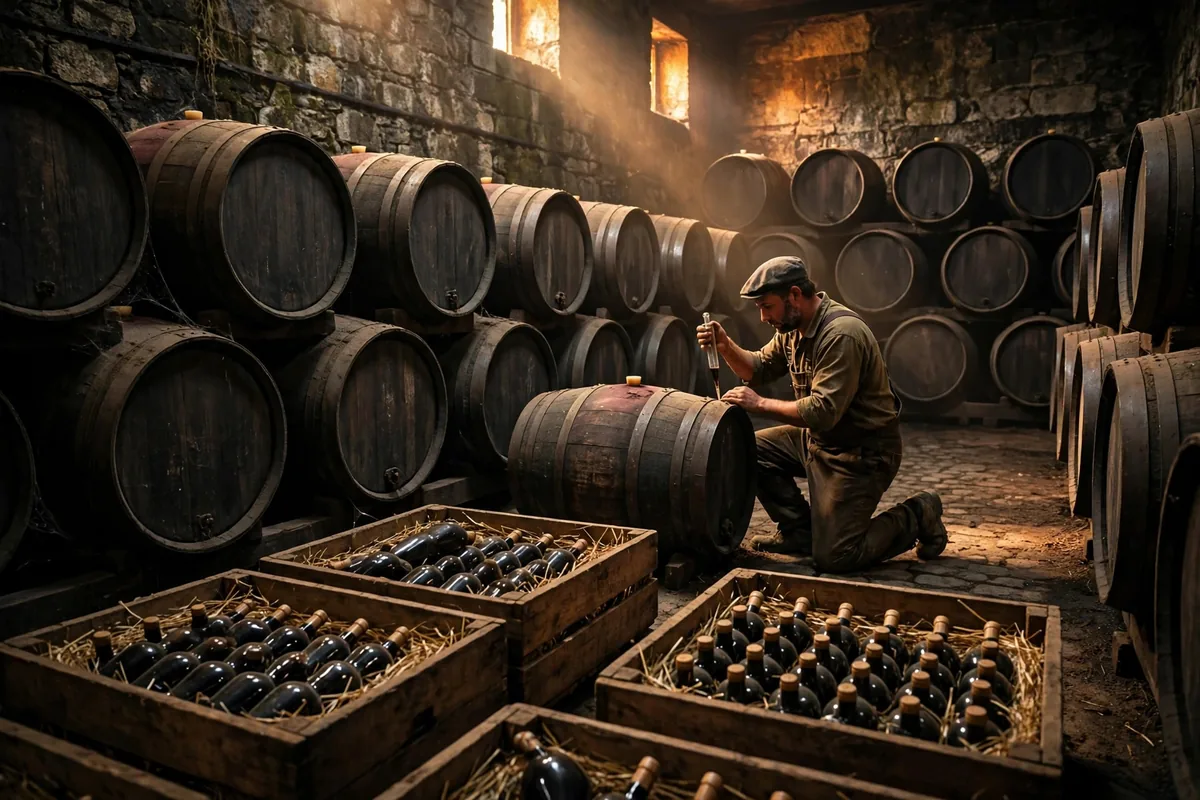
Port is made in the Douro Valley and aged across the river in Vila Nova de Gaia. Grapes grow on the valley's terraced slopes, the wine is fermented and fortified upriver, and the barrels travel down to Gaia, where the lodges have aged them for centuries. Gaia won that job on geography: Atlantic humidity and thick stone walls keep the old lodges cool and damp without trying very hard. The standard storage guidance in the Portuguese trade is about 14 degrees Celsius and 65 to 75 percent humidity, with bottles lying flat so the wine keeps the cork wet. Vintage Port is usually quoted at 12 to 16 degrees. The numbers sound gentle; the real discipline is the word steady. A degree up or down, the wine copes, but swinging hot and cold in a single day makes the cork breathe in and out, and the wine starts to fade.
So the first hurdle sits in the cellar, not the port. The best-run houses we work with do one unglamorous thing before dispatch: they staple the batch number to the cellar's temperature and humidity log and let that record travel with the goods. At destination, the receiver's first job is matching that record, not counting bottles. On an ordinary day the paperwork looks like overkill. On the day something goes wrong, it is the opening line of your claim. A shipment with no cellar record has no provable temperature story at all, and the insurer's first question will be one you cannot answer: show me where exactly this wine got hot.
Here is the counterintuitive part. People assume fortified wine is tough. It is not. It is patient, not heat-proof. A Tawny aged ten or twenty years in a Gaia lodge owes everything to slow, steady maturation in a cool, damp room. Put that wine in a sun-baked container and you compress two decades of slow work into a few days of fast-forward. The aromatic structure falls apart, and no one can put it back.
From the Douro Valley to Leixões: Four Legs of Port Wine Export Logistics
A container of Port normally travels four legs: out of the estate cellar, bottling and consolidation in Gaia, inland haulage to Leixões, and the ocean leg. Each leg has its own way of hurting you.
Bottling in Gaia is where breakage is decided, and it is the leg people underrate. Dividers between bottles, bottle orientation, how tight the pallet wrap is, all of it shows up later as a damage rate. Our rule of thumb: dividers plus air-column bags cost almost nothing per container, while skipping them buys you three months of claims correspondence. Printing "this way up" and "fragile" on the carton does almost nothing for the people handling it. What works is writing the stacking method into the packing list, so the liability lands on paper.
The inland leg runs from Gaia to the Port of Leixões in Matosinhos, about five kilometres from the mouth of the Douro. Leixões is northern Portugal's main maritime gateway. Public port figures put its 2024 throughput at 14.38 million tonnes of cargo and 715,061 TEU, with 2,343 vessel arrivals. Two container terminals offer combined annual capacity of 770,000 TEU, with 72 reefer plugs at the North terminal and 544 at the South. That sounds like plenty until peak season, when reefer plugs must be booked ahead like anything else. The classic mistake on this leg is a winery saving money on a temperature-controlled truck and hauling wine at noon in summer on a standard lorry. Wine that sat happily at 14 degrees in the cellar gets two hours of sun, and all the earlier temperature control was wasted.
At the port, Port wine ships in a reefer, with the set point matched to the style, generally in the mid-teens Celsius. Three things to confirm at booking: the container was pre-cooled before loading, the yard power supply is reliable, and the line will actually hand over the temperature record. A reefer that was not pre-cooled makes the wine cool itself down inside the box, and the first twenty-four hours of the temperature curve look the worst.
The ocean leg and customs close the chain. IVDP certification and origin documents are the baseline. The US market deserves special attention: according to ViniPortugal, the United States was Portugal's second-largest wine export market in 2024, worth over 100 million euros, while US sales were already down 9.7 percent year on year by May 2025. Tariffs and rules are moving, so treat any specific rate as subject to the latest official policy, and write into the contract who bears a tariff change. Finding out at arrival that nobody owns that cost is a conversation you do not want.
Running the Numbers: What a Reefer Really Costs
| Cost item | Dry container (assumed) | Reefer (assumed) | Note |
|---|---|---|---|
| Temperature-controlled inland haulage | 0 | about 8% of total cost | A summer midday haul undoes cellar control |
| Breakage-proof packing | about 3% of total cost | about 4% of total cost | Dividers plus air-column bags |
| Port reefer surcharges | 0 | about 6% of total cost | Pre-cooling and yard power |
| Ocean freight | baseline | roughly 15% to 25% higher | Varies by route and season |
| Cargo insurance, temperature clause included | baseline | roughly 10% higher | Without the clause, the cover is hollow |
| Total | 100 | about 118 to 130 | What it buys is the cargo's value |
The conclusion is blunt. A reefer costs twenty to thirty percent more than a dry box, but a container of Port is typically worth several times the freight. The saving you make by going dry does not cover one cooked container. The cost worth cutting is duplication nobody reads: the estate, the forwarder and the line each producing their own temperature record, none of which agree with each other. Merge them into a single temperature file that travels with the goods. It costs less, and it is far stronger when you claim.
Insurance deserves its own paragraph. A standard cargo policy covers breakage and loss. Heat damage often needs a separate temperature clause, so ask before you sign: how does the policy define a temperature deviation, how many degrees over set point, for how many hours, before it counts as a claim?
Next Time You Negotiate, Ask These Three Questions
Port wine export is not a contest over who quotes the lowest freight. It is a contest over who writes "unbroken and uncooked" into the contract. Look back at our client's summer container: the failure was never one leg of the journey. It was the gaps between the legs. The cellar said the wine left in good shape, the forwarder said it was loaded in good shape, the line said the temperature record looked normal, and nobody owned the days it baked in a transshipment yard.
So next time you negotiate, ask three questions. First, who owns temperature liability, from cellar door to destination unboxing, with no gaps? Second, who pays when a transshipment delay or a sun-baked yard cooks the wine, and how much? Third, is breakage paid per bottle or per container, and what exactly counts as heat damage? Ask those three and the other side knows you have shipped wine before.
By Susan, 3PL Sales Director