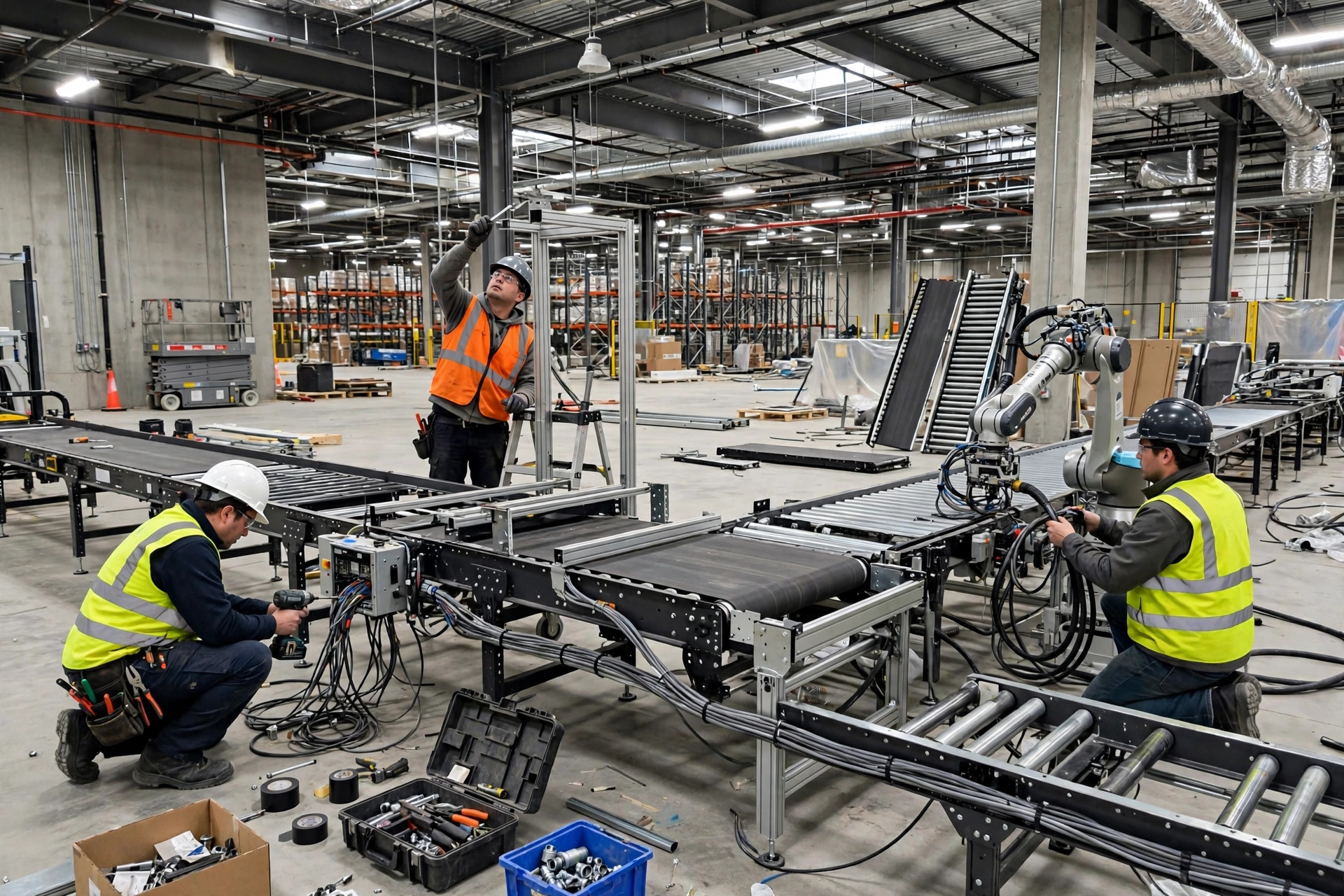
Every e-commerce warehouse manager I know has asked me some version of this question: should we buy a piece picking robot? My answer is always the same annoying one — it depends. But not on what you think it depends on. It doesn't depend on the robot. It depends on your cartons, your SKUs, and whether your operation is standardized enough to deserve a piece picking robot warehouse deployment.
Let me walk you through the math the way I do it for clients, starting with what the machine actually does.
What a Piece Picking Robot Actually Replaces
Think of it this way: a piece picking robot is a tireless vision-guided sorter with one very steady hand. That's it. It's not magic, and it's not a person.
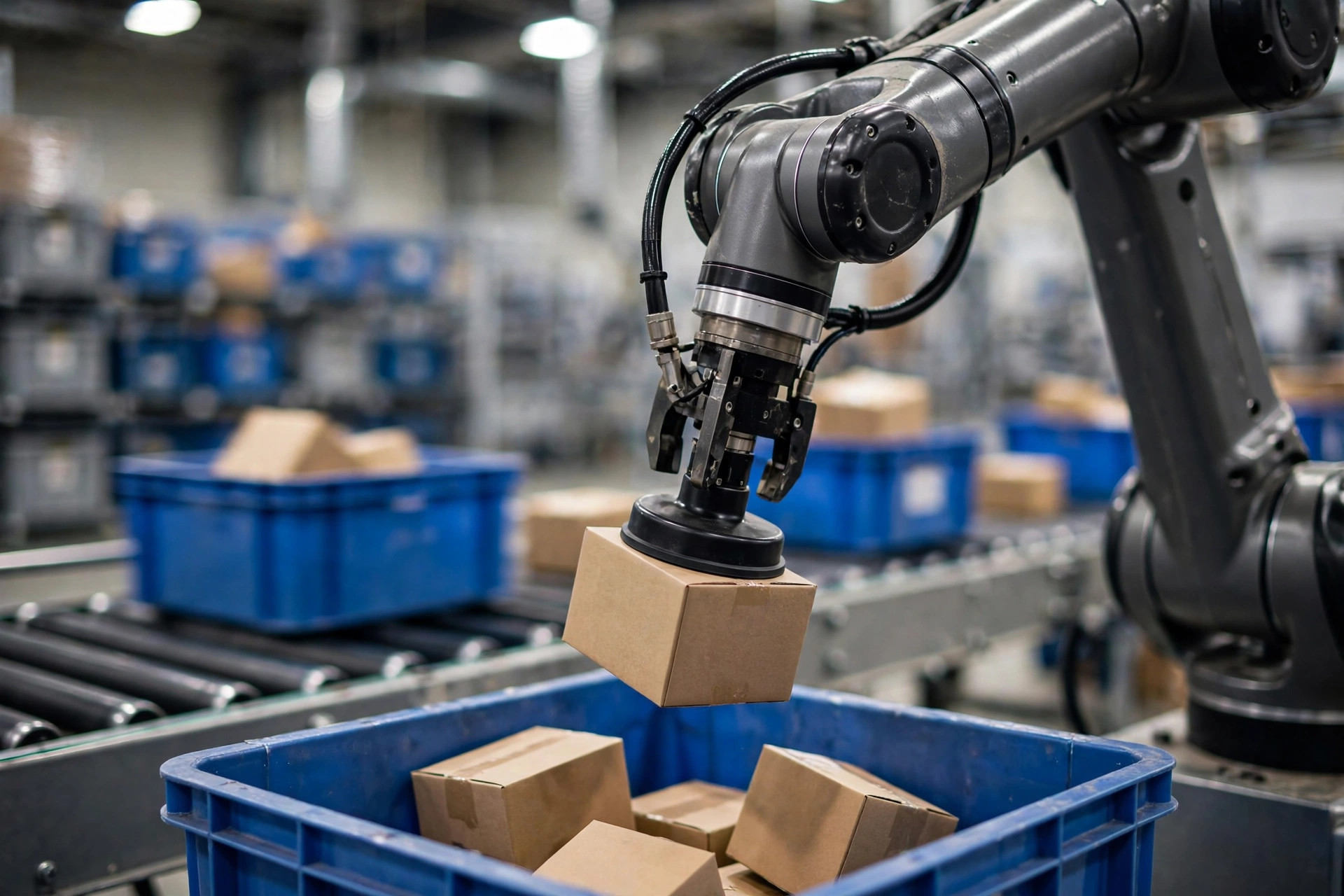
The cycle breaks into four steps. First, a 3D vision system looks into the source tote and decides which item to grab next. Second, the software plans a grasp point and a motion path. Third, the arm — with a vacuum gripper or clamp — picks it up. Fourth, it places the item into the target tote or put wall. Here's the part vendors don't emphasize: the vision step eats most of the cycle time. The arm itself is fast. It's like driving — reading the map takes longer than pressing the gas pedal.
Published benchmarks exist. Dematic's robotic piece picking module is publicly rated at 600-1,200 items per hour. Industry coverage of fixed-station cells reports sustained rates above 1,000 units per hour in ideal continuous operation — tote to adjacent tote, one item at a time. Those are real numbers, but read the fine print: ideal conditions.
Compare that to humans. In e-commerce piece picking, a skilled operator does 120-150 units per hour on easy items like folded apparel; on small 3C accessories, 80-100 is realistic. So the robot is 4-8x faster on paper. Sounds like a no-brainer. Now let's do the part that actually matters.
The Breakeven Math: Three Scenarios
Scenario one — where the math works. An apparel fulfillment center I advised in 2025 was pushing 90,000 orders a day during peak season: only 400 SKUs, all garments folded and bagged, standardized totes. They ran 20 people across two shifts for piece picking at roughly 130 UPH each. After installing four fixed-station picking cells, each cell sustained 550-650 pieces per hour — four cells replaced about 16 workers. At roughly 8,000 yuan per worker per month, that's over 1.5 million yuan a year in labor saved against about 2 million in total equipment and integration cost. Payback: around 14 months. The math holds.
Scenario two — where it doesn't. A 3C accessories warehouse: 180,000 SKUs, transparent anti-static bags that confuse vision systems, bare devices with no graspable surface, oddly shaped chargers. The vendor demo showed 95% grasp success. Sounds fine — until you do the arithmetic. At 600 picks an hour, a 5% failure rate means 30 exceptions an hour: drops, double-picks, missed grasps. Every exception needs a human to reset, re-pick, or handle the anomaly. Effective throughput fell under 400 pieces an hour, and they had to station one person full-time just to babysit the robot. Headcount didn't drop. Money was spent. KPIs got worse.
Here's my framework for the three realistic piece picking robot warehouse options:
| Option | Sustained rate | Labor economics | Investment scale | Fits who |
|---|---|---|---|---|
| Manual picking | 80-150 UPH | ~8,000 yuan/worker/month | Near zero | Messy SKUs, under 5,000 orders/day, big peaks |
| Fixed-station picking arm | 600-1,200 pcs/hr (ideal) | One cell replaces 4-8 workers | Tens to hundreds of thousands of dollars per cell — check latest vendor quotes | Under 1,000 SKUs, regular item shapes, over 30,000 orders/day |
| Mobile picking (AMR + arm, e.g. Brightpick) | 70-80 picks/hr (published, near human speed) | Replaces ~1 worker, runs 24/7 | RaaS from ~$1,900/month (published pricing) | Flexible tasks, multi-use robots |
And now the part where I get blunt — because a piece picking robot warehouse project lives or dies on the table above, not on the demo video: if your warehouse has tens of thousands of SKUs, chaotic packaging, and totes that look like trash bins — and a salesperson tells you their AI vision can grasp anything — ask them to sign a penalty clause: refund if production grasp success falls below 98%. I've never met one who would sign.
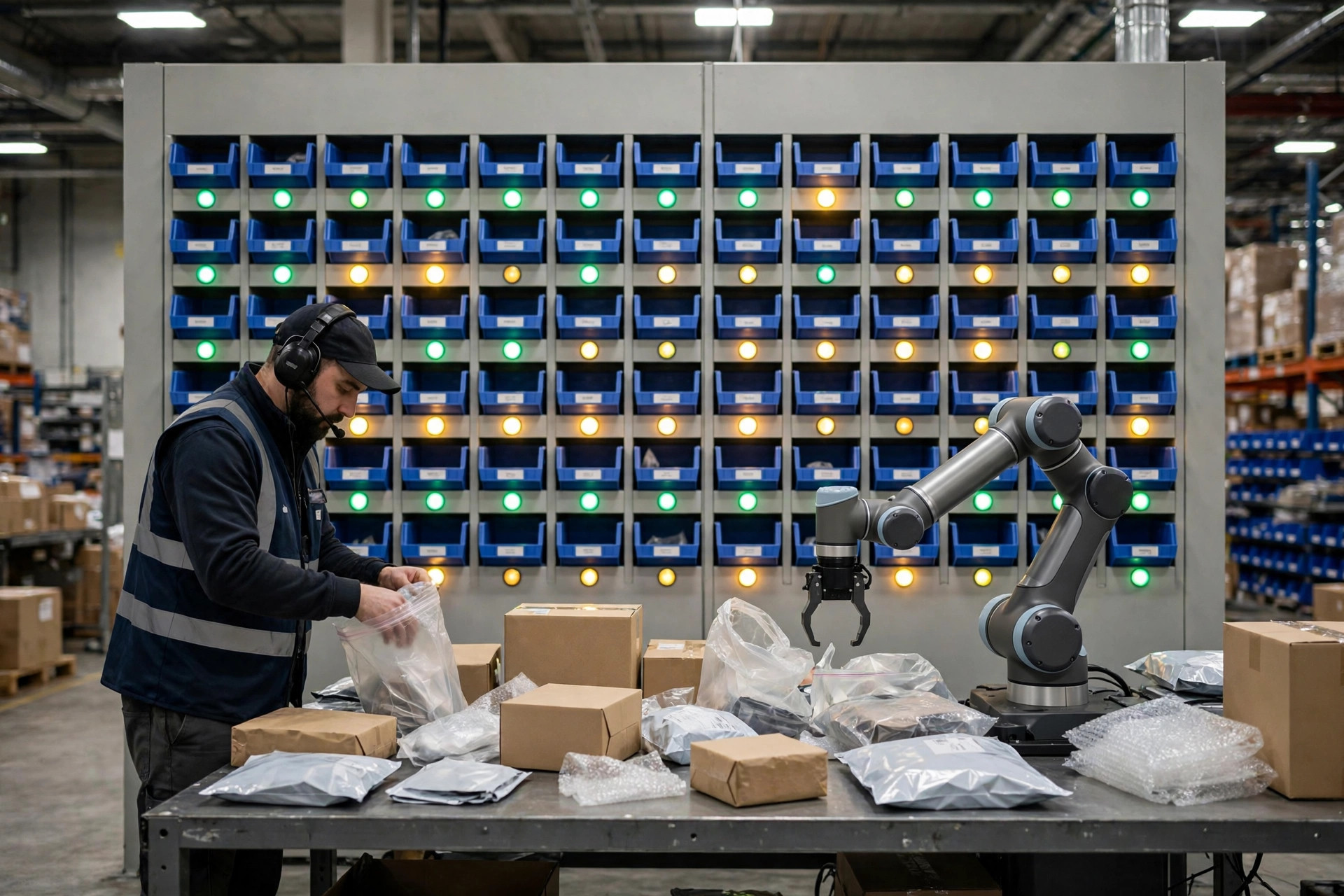
The Counterintuitive Rule: Messy SKUs Kill the ROI
This might be the most important sentence in this piece: a piece picking robot doesn't monetize labor replacement. It monetizes standardization.
Think of it as a brilliant exam-taker. The more standardized the test, the higher the score. The more open-ended the items, the more the human wins — human hand-eye coordination is millions of years of evolution. A transparent bag, an odd-shaped cable, tangled earbuds: solved by a glance and a flick of the wrist, while the robot needs three months of parameter tuning.
Second counterintuitive point: the spikier your peaks, the worse a buy-it-outright robot looks. If peak season triples your volume for three months and the machine sits idle the other nine, your peak is holding your capital hostage. Warehouses like that should rent (RaaS exists precisely for this) or stick with temp labor plus put walls. Buying a bus just for the holiday rush is bad math.
Third: the difference between 99% and 95% grasp success isn't four points — it's the stability of your entire line. At 95%, every 20th pick throws an exception, and exception-handling costs scale exponentially: resets, searches, re-picks, customer complaints. Below 98% real-world grasp success, you've bought an expensive exception generator.
The Maintenance Traps Nobody Puts in the Brochure
One: vision recalibration. New season, new SKUs — the vision model needs retraining, usually as a paid service, unless you keep an algorithm engineer on staff. Two: suction cups are consumables. Vacuum cups last two to three months; gripper pads too. Nobody's system is maintenance-free. Three: MTBF and spares. The arm itself often exceeds 20,000 hours MTBF, but cameras and vacuum generators are the weak links — keep spares locally, because one hour of downtime during peak costs real orders. Four: changeover tuning. Switching from T-shirts to hoodies means re-tuning suction force, grasp points, and placement force — half a day minimum. In warehouses with fast SKU churn, this hidden cost eats up to 20% of the ROI.
The One Number That Decides Everything
The formula is simple: payback (months) = total equipment investment / (monthly labor cost replaced − monthly maintenance and consumables).
- Under 18 months: buy it — provided your SKUs are genuinely standardized.
- 18-30 months: negotiable. Push for RaaS terms and a performance guarantee.
- Over 30 months: don't. Spend the money on tote standardization, SKU rationalization, and wave optimization instead. The ROI is higher.
One last piece of engineer-grade honesty: robots don't fix management problems; they amplify management quality. In a well-run warehouse, a piece picking robot is a money printer. In a chaotic one, it's a money shredder. Tidy up your totes first — then we'll talk robots.
By Da Liu, Automation Engineer