Here's the bottom line: nearly all parcel shipping overcharges leak through three gaps. One, the weight on the label doesn't match what the DWS measured, so the carrier bills an adjustment. Two, the DWS weighed the parcel but the data never made it into your system, so you have nothing to dispute with. Three, nobody reconciles the invoice line by line, so the adjustments get paid silently. Close those three gaps and the savings are real money. The only method that works: match every parcel's DWS record against the carrier invoice, tracking number by tracking number.
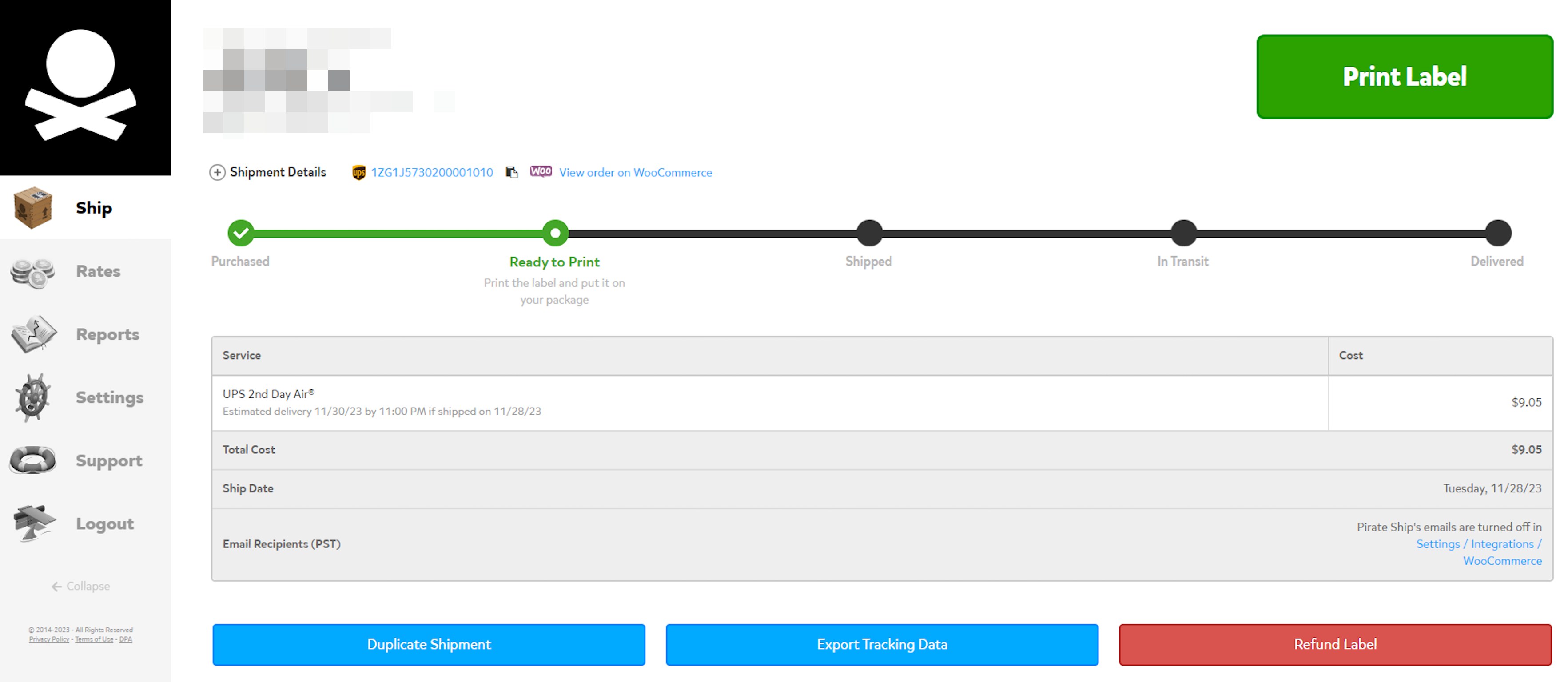
Pirate Ship's shipment detail page: service, cost, and label printing in one place. The cost is calculated from your declared weight — if the carrier's reweigh disagrees, an adjustment follows. (Rates per each platform's current published policy.)
Where the money actually leaks
A quick primer: DWS means dimensioning, weighing, and scanning in one pass. The parcel goes through once and you get weight, length, width, height, and the label barcode tied together. Carriers don't bill what you declared — they bill what they measured, using billable weight (the greater of actual and dimensional weight). Small parcels bill by the ounce; a single ounce can push a parcel into the next bracket.
Leak one: declared weight below measured weight. The classic trigger is a new box supplier — same SKU, box half an inch bigger, dimensional weight tips into the next bracket. Or a packer grabs a bigger box "just in case." The system still shows the old weight; the carrier reweighs and adjusts the whole batch upward. In fall 2024, a pet-supply e-commerce warehouse in Los Angeles shipping roughly 20,000 parcels a month ran its first invoice reconciliation three months after going live on DWS — and found three straight weeks of carrier adjustments. Pulling the DWS data showed over 2,000 parcels with declared weight below measured. All of it traced back to a box change nobody had told the system about.
Leak two: weighed but never recorded. Across 30+ WMS implementations, I've seen this in at least half the warehouses: DWS data lives on the device and never lands in the WMS. When the adjustment invoice arrives and you want to dispute it, the carrier asks for timestamped weighing records. You don't have them. You pay. I've watched this exact failure three times now, same ending every time.
Leak three: invoices nobody reads. Pirate Ship and Shippo both export line-item invoices, with adjustment charges on their own line. Plenty of small warehouses never look at that line. The money leaves every month, quietly.
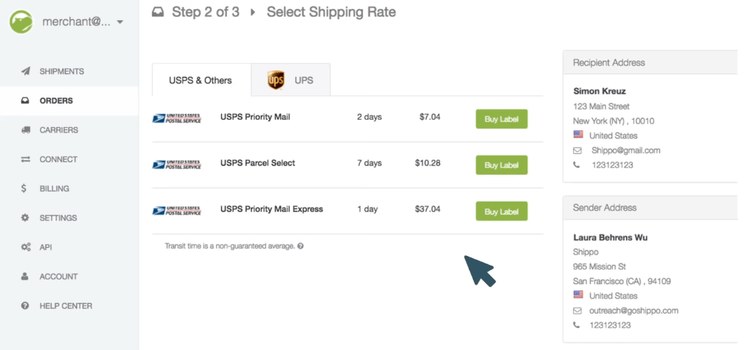
Shippo's rate shopping screen: the same parcel prices out very differently across services. Picking the right service at buy time saves money; catching adjustments at audit time stops the bleeding. Do both. (Rates per each platform's current published policy.)
Four steps to turn scale data into dispute evidence
Step 1: give every parcel a birth certificate. Five fields from the DWS, no exceptions: tracking number, measured weight (to the ounce), length, width, height, plus a timestamp. All five must land in the WMS parcel table, one-to-one with the tracking number. The acceptance test is simple: pull 20 random parcels — every one must show a DWS timestamp in the WMS. If not, this step isn't done.
Step 2: pull the carrier invoice weekly. Pirate Ship's Reports and Shippo's Billing both export details — join them to your WMS records on tracking number. One alignment trap: carrier invoices lag by a few days, so reconcile on ship date, not invoice date, or nothing will ever match.
Step 3: build three discrepancy lists. List A: carrier-adjusted parcels — read the adjustment reason code on each one. List B: the DWS has a record but the invoice shows a higher weight — the carrier's measurement is suspect, so dispute these. List C: shipped but no DWS record — missed weighs or missed scans, which means your process has a bypass.
Step 4: close the loop on disputes and root causes. For List B, file disputes with the DWS timestamp and weight screenshot attached — and watch each platform's dispute deadline, because they expire. For List C, walk the floor: are oversized parcels bypassing the DWS at a manual station? Is night shift skipping scans to save time? Fix the process; List C should be zero next week.
Three failures I've seen three times each
Failure one: the scale hasn't been calibrated in six months. One warehouse never touched its DWS after go-live, and the scale drifted two ounces. They shipped light parcels billed by the ounce — an entire bracket of 1–2 oz parcels got bumped up a tier. The audit caught it; after calibration the adjustments dropped to zero. Put calibration in the SOP: monthly, logged, one named owner.
Failure two: weighing without dimensioning. Plenty of warehouses leave the dimensioning function idle — "our products aren't that big." Then a lightweight, bulky SKU arrives, dimensional weight exceeds actual weight, the declaration only shows actual weight, and the carrier adjusts on dim weight. The three DWS functions are a package; using one is like buying a full system to use as a bathroom scale.
Failure three: unit mismatch. The DWS outputs pounds, the WMS stores ounces, and a conversion in the middle rounds everything. Half-ounce mystery differences everywhere, reconciliation impossible. Decide the unit at implementation: ounces end to end, one decimal place, written into the interface spec.
The math: is auditing worth it?
Simple formula: monthly recovered amount = monthly parcel count × adjustment rate × average adjustment per parcel. All three numbers are yours — plug them in.
Worked example (illustrative — substitute your own numbers): 20,000 parcels a month, 2% adjusted, $1.50 average per adjustment. That's $600 a month, $7,200 a year — before counting successful disputes. Compare that against a year of DWS maintenance. The math is easy.
The counterintuitive part: the most expensive failure isn't mis-weighing, it's not weighing at all. A wrong weight still gives you data to reconcile, dispute, and trace back to a batch. An unweighed parcel gets billed at declared weight and you have zero evidence. A DWS's real value isn't accuracy — it's evidence.
One trade-off: 100% parcel-level audit versus sampling. A few hundred parcels a day? A weekly 10% manual sample is enough. Tens of thousands a day? Automate it, or spreadsheets will eat your team alive. And don't skip the DWS to "save money" with manual weighing — manual error plus missed entries will cost you the price of the device in three months, then keep costing you.
Three things you can do this week: 1) export last month's invoice from Pirate Ship or Shippo and look at the adjustment line; 2) pull 20 random parcels and check for DWS timestamps in your WMS — if they're missing, fix the data link first; 3) calibrate the DWS scale and log it. Next month's invoice will tell you exactly what those three things were worth.
By Lin Xiao, WMS Implementation Consultant