Shipping insurance is a scam — right up until your $1,180 package disappears. Then it's the smartest money you never spent.
Last Black Friday taught me that lesson the expensive way. Today I'm breaking the whole thing down: how declared value actually works at each carrier, whether the insurance fee is worth it, what to declare, and how to actually get paid when a package goes missing.
The Tuition I Paid
Late November 2025. Black Friday. One order: a Bluetooth speaker, $1,180 in goods, going UPS Ground to California.
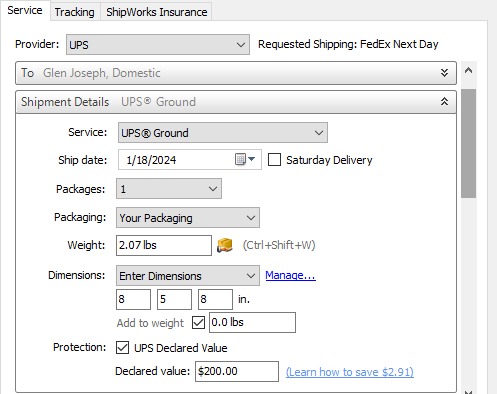
When I printed the label, I left the declared value field at its default — $100. Don't ask me why. Ask Black Friday me, who was sleeping four hours a night and printing labels on muscle memory.
The package vanished. Tracking sat at a transit hub for six days, then: lost. I filed a claim, confidently demanding $1,180. The rep was very polite: "Sir, your declared value was $100. We pay out on declared value."
I got $100. I ate the other $1,080 myself.
That night I did the math: $1,080 would have bought insurance on that shipment a thousand times over. The lesson is one sentence long — what you declare is what you get back when things go wrong. That's not advice. That's the rule.
Declared Value Rules, All in One Table
After that disaster, I dug through every carrier's fine print. The headline: UPS, FedEx, and USPS "free coverage" typically only covers $100 of declared value. Anything above that costs extra, and the rates are subject to each carrier's latest official policy.
| Carrier | Included coverage | Extra coverage | Declared value cap |
|---|---|---|---|
| UPS | Usually $100 included | Per official rate schedule | Usually $50,000, subject to official policy |
| FedEx | Usually $100 included | Per official rate schedule | Usually $50,000, subject to official policy |
| USPS (Priority services) | Usually $100 included | Additional insurance available | Subject to official policy |
| Pirate Ship / ShipStation (third-party) | None by default | Select at label time, roughly $1 per $100 of coverage, subject to the platform's current quote | Per underwriter terms |
Three things that matter:
First, carrier-direct insurance rates are not cheap, and the rules are buried. Check the official rate pages yourself — don't trust secondhand summaries, including mine, for exact numbers.
Second, third-party insurance is the real deal. The third-party coverage built into Pirate Ship and ShipStation runs about $1 per $100 of declared value (subject to the platform's current quote) — dramatically cheaper than going through the carrier. Every high-value label I print now goes through third-party.
Third, insurance doesn't cover delays. A lot of sellers don't know this: your package arrives a week late, the customer refunds, insurance pays zero. It covers loss and damage. Nothing else. Don't mix that up.
My own workflow now: I never compare shipping rates on postage alone — I compare total cost including insurance. Same $500 shipment: $18 postage plus carrier insurance on UPS's site, versus $14 postage plus $5 third-party insurance on Pirate Ship. The second option is $3 cheaper with better coverage. Three bucks sounds like nothing. Across ~150 high-value labels a month, that's $450 a month, $5,400 a year. That pays for testing two new products. Comparing rates without total cost is comparing nothing.
Declare High or Low? Do the Math First
Declaring low saves on fees. Declaring high costs more. Which is right? I ran my own numbers.
We ship about 2,000 parcels a month. Over the past year, our loss/damage rate ran about 0.4% — roughly 8 problem shipments a month. Average goods value: $60. Expected loss = 2,000 × 0.4% × $60 = $480/month.
Insuring every label at third-party rates (~$1 per $100 of coverage; a $60 item rounds to $100 of coverage = $1/label) would cost 2,000 × $1 = $2,000/month.
Paying $2,000 in premiums to hedge $480 of expected loss? That's a terrible trade. So here's the counterintuitive conclusion: most low-value shipments aren't worth insuring at all.
My rule is a bright line: insure it only if the goods are worth more than $100. Everything below that, self-insure. Of those 8 monthly problem shipments, usually only 2 are over $100 — expected loss around $300/month. And I only need to insure ~150 labels a month, costing roughly $200/month. $200 in premiums against $300 of expected loss. Now the math works.
And about declaring high — a common misconception: declare a bigger number, get a bigger payout? Nope.
| Approach | Upside | Downside |
|---|---|---|
| Declare accurately | Paid on actual value, zero compliance risk | Slightly higher premium |
| Declare low / $0 | Save on premiums | Paid on declared value when lost (ask 2025 me how that feels) |
| Inflate the value | There is none | Claims require invoice proof; anything above real value isn't paid, and it smells like fraud |
The ceiling on your declared value is your supplier invoice, not your imagination.
One more, for international sellers especially: the declared value for insurance and the declared value for customs are two different things. Don't conflate them. Customs value drives duties; insurance value drives payouts. Handle them separately.
There's also a pricing angle: insurance is a cost, and costs belong in your price. Our high-value SKUs carry about $1.20 per order in insurance cost on average. I folded that into pricing — raised prices $2, customers didn't blink, I keep the extra $0.80. Don't quietly absorb insurance costs. You're running a business, not a charity.
The Claim That Worked, and the Pitfall List
February this year: an $800 shipment arrived with a cracked screen. Third-party insurance, selected on Pirate Ship at label time. My playbook:
- The day the customer sent photos, I told the warehouse to keep the original packaging. Don't throw it out.
- Filed the claim online within 48 hours — uploaded the label, invoice, damage photos, packaging photos.
- Day 9: $800 landed in my account.
Nine days, $800 back. That's why I recommend third-party insurance to everyone. And remember: you must select it when you print the label. You can't add it after the fact. That one has burned plenty of sellers.
The cautionary tale: a buddy selling auto parts had a $600 shipment arrive smashed last year. At claim time, no packaging photos — the warehouse had tossed the box. The carrier's entire response: "cannot verify packaging compliance." Denied. He learned: his warehouse now keeps a corner where problem-shipment packaging sits for 30 days before disposal. Your evidence chain is money: label, invoice, pre-shipment photos, packaging photos, damage photos. Missing one can mean a wasted claim.
Final pitfall list, every item bought with real money:
- Claims have deadlines. They vary by carrier — some are just weeks. Miss it and you're done. Check the latest official policy; don't dawdle.
- Non-compliant packaging gets claims denied. Original packaging plus damage photos are the baseline. Photograph expensive items yourself before they ship.
- Categories like jewelry and cash have limited coverage. Read the exclusions before you ship, per the official terms.
- Insurance covers loss and damage only — not delays, not customer refusals.
- Keep your supplier invoices. Payouts cap at the value you can prove, not the number you typed.
That declared value field is either a shield or a placebo — your call. Tonight, do one thing: go set your label templates to auto-select insurance on every SKU worth over $100. This one I've personally tested, and it works.
By Ah K, E-commerce Seller (5 yrs)