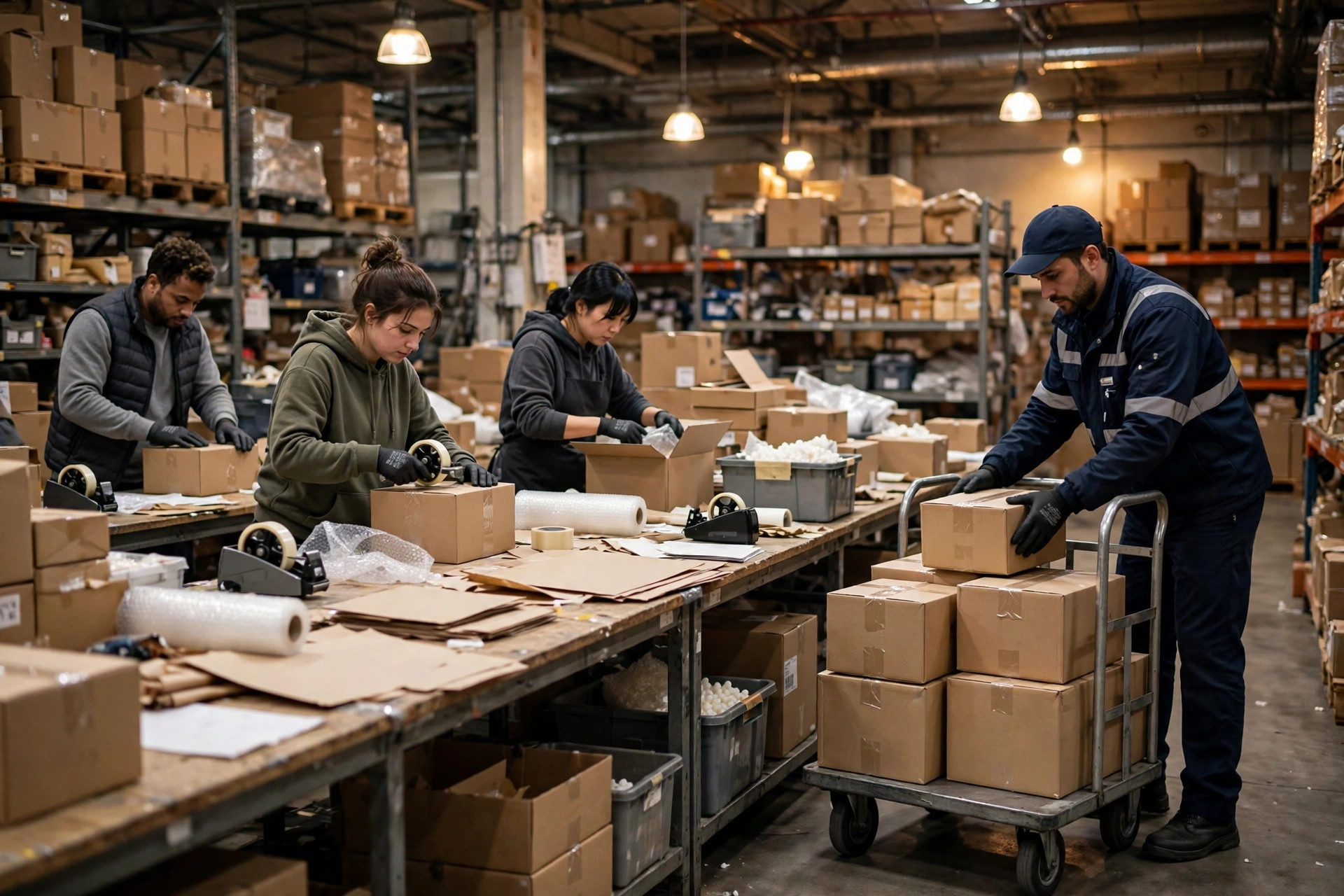
We had a client — a Shenzhen seller of Bluetooth speakers — who took a brutal hit right before last year's Black Friday. He shipped everything via cross-border direct line small parcels. A 2kg parcel to the US cost him roughly half what international express would. The math looked beautiful. Then, at the end of October, his goods sat in a Dongguan consolidation warehouse for nine straight days. The line operator called it "warehouse queuing." Translation: they were over capacity, and his freight was in line. He missed Black Friday traffic entirely — over 4,000 orders, and his refund rate shot to 18%. He told me afterward: if only he'd shifted part of the volume to express in October, even at a higher price.
That's the most honest lesson in small-parcel export: choosing a channel isn't about picking the cheapest option — it's about picking the one that won't fail you. Cross-border direct lines, international express, and postal parcels — I've walked clients through these three roads for over a decade. Let's settle the math once and for all.
Cross-Border Direct Lines: Cheap, but Cheap Has a Price
Everyone in the trade knows what a direct line is: domestic pickup in China, trunk haul (air or sea) across the border, last-mile delivery by a local partner. One selling point: price. A 2kg parcel to the US on a direct line typically costs around 60% of a discounted international express rate.
But the real cost is buried in the fine print. A direct line's transit time is a range, not a promise. Off-season, 8–12 days; peak season, 15–25 days is considered normal. Note the word — "normal," not "delayed." Why? Direct-line operators run on consolidation. Your parcels wait until there's enough volume heading the same direction to fill a pallet or container. Two departures a week off-season; peak season, queuing starts at a week.
Here's the insider detail only the sell side knows: the "first scan time" and the "delivery time" are two different clocks. Many rate cards advertise "US direct line, 8–12 days" — counted from the first tracking scan. The 5–9 days your goods spent traveling from the Shenzhen factory to the Dongguan hub and waiting in the queue? Not counted. In peak season, those 5–9 days are routine. So the first question to ask any line operator: which day does the clock start on? After how many days of queuing does it count as a delay, and what do you pay me? Ask that, and they know they're dealing with a professional.
Lost-parcel claims are another trap. Standard direct-line compensation is 2–3x the declared value, with a cap. But dare you declare a high value? Do that and you own the duty risk. In practice, what sellers actually recover from a lost direct-line parcel often doesn't cover half the product cost. Read the claims clause word by word before signing. It's tedious. Do it anyway.
International Express: Expensive, but Honestly So
DHL, UPS, FedEx — genuinely expensive, but they offer three things a direct line can't: certain transit times, certain tracking, and a claims process you can actually follow.
The price structure is where negotiations are won or lost. Most people think the express bill is the base rate on the quote. Wrong. The real bill is: base rate + fuel surcharge + remote-area surcharge + peak-season surcharge. The fuel surcharge floats monthly with oil prices — low 20s percent off-season, 30% plus when oil spikes. That "50% discount" you negotiated? It's 50% off the base rate, not 50% off the total. The oldest sales trick in the book is to squeeze the base rate razor-thin while giving nothing on surcharges — because surcharges are set by headquarters and the salesperson couldn't move them anyway. They just won't volunteer that.
A Hangzhou client of ours sells small home goods — 8,000 parcels a month, all on a discounted international express account. He figured a big brand meant reliability. I helped him audit a full year of invoices: the remote-area surcharge alone cost him an extra 110,000 yuan. Thirty percent of his volume goes to small towns in the US Midwest — all on the remote postcode list. He switched to a mix — direct line as the backbone, express only for time-sensitive orders, direct line again for remote postcodes — and his total logistics cost dropped 22%. That 22% isn't my invention; his finance team calculated it at year-end.
So the right way to use international express: as a scalpel, not a hammer. High-ticket items, time-sensitive orders, first-batch test listings go express. Regular replenishment and thin-margin SKUs go direct line. Anyone running everything through express is just working for the courier.
The Math: Direct Line vs Express vs Postal on the Same Parcel
The table below uses an illustrative example — a 2kg parcel to the US. Actual rates move with each carrier's latest published policy, so treat the figures as structure, not gospel. But the structure is real, and structure matters more than numbers:
| Cross-Border Direct Line | International Express (discounted account) | Postal Parcel | |
|---|---|---|---|
| Transit, off-season / peak | 8–12 days / 15–25 days | 3–5 days / 4–7 days | 15–30 days / 30+ days |
| Freight level (illustrative) | ★ lowest | ★★★ highest | ★★ lower |
| Fuel surcharge | Usually baked into the quote | Floats monthly, billed separately | None |
| Remote-area surcharge | Mostly none | Per parcel, not trivial | None |
| Delivery success (illustrative) | ~95% | 99%+ | ~90% |
| Lost-parcel claim | 2–3x declared value, capped | Actual loss, proper process | Treaty-based, minimal |
| Biggest trap | Peak-season queuing meltdown | Surcharges eating your margin | Slow; returns basically mean abandonment |

And here's the counterintuitive takeaway: for most small-parcel sellers, the most expensive channel isn't international express — it's the parcel you're forced to switch from direct line to express mid-peak-season. The direct line was humming along at a nice low rate; then the backlog hits, customers complain, the platform penalizes you, and you're forced onto express at the last minute — paying top dollar while still losing on time and reputation. Two forced switches a year, and every yuan you saved on the direct line is gone, with losses to spare. Real savings come from negotiating your peak-season channel mix in the off-season and writing it into the contract.
Postal Parcels: Don't Cross Them Out Yet
Postal channels (ePacket-type products) get less buzz these days, but they own one niche nobody can take: for lightweight items under 0.5kg, postal is still the value king. And postal customs clearance runs through the UPU system, which is friendliest to low-value parcels.
But the weaknesses are fatal: transit time is a lottery, lost-parcel compensation follows the treaty and is effectively nothing, and returns? Forget it — the return freight costs more than the goods, so the industry default is "a return equals abandonment." Postal fits exactly one kind of product: low-ticket, lightweight traffic-driver SKUs you can afford to lose. Shipping high-ticket products by post is gambling.
Next Time You Negotiate a Contract, Ask These Three Questions
After all these years on the sell side, I've learned that buyers lose negotiations for one reason: they ask the wrong questions. Before signing with any line operator or express agent, get these three out:
One: which day does the transit clock start on, and after how many days of queuing does it count as a delay — with what compensation? Negotiate "first scan" and "delivery" separately. Write peak-season queuing compensation into an addendum. If they hedge, walk away.
Two: which surcharges are included in the quote, and which month's index does the fuel surcharge follow? Make them list base rate, fuel, remote-area, and peak surcharges on one sheet. A quote that can't be itemized is a con.
Three: what's the claims threshold and cap for lost parcels, and what evidence do I need to file? Focus on the evidence part — many claims clauses look generous until you learn they require a purchase invoice, a payment record, and a platform order screenshot, and one missing document kills the claim. Ask now so you're not scrambling later.
No channel is perfect; there's only the right fit. The small-parcel export math was never just about the freight rate — it's the sum of four things: transit certainty, delivery success, claims, and peak-season flexibility. Next time someone tells you "we have the lowest direct-line rate on the market," smile, and ask them those three questions.
By Susan, 3PL Sales Director