Last November, a client who fulfills power banks for Amazon sellers called me, furious. Same product, same battery, same box. FedEx rejected it three times. On the fourth attempt, he changed the service type and two words on the paperwork — and it sailed through. What changed was two letters: UN3480, corrected from UN3481.
Shipping a lithium battery is, at its core, shipping a small fire. Think fireworks — loose firecrackers get a very different look from the inspector than assembled shells. Get one character of the UN number wrong, and the system treats you as a misdeclarer.
Here's the short version: loose lithium batteries (UN3480/UN3090) must go through each carrier's "special channel." Batteries installed in equipment (UN3481/UN3091) get a much easier ride. Counterintuitively, shipping a battery inside its device is often faster, cheaper, and rejected less often than shipping the same battery alone — the regulations are designed that way.
(All carrier rules below are per each carrier's official website, checked on October 18, 2026. Carrier policies change fast — always re-check the current version before you book.)
First, the Four Numbers: UN3480, UN3481, UN3090, UN3091
These four numbers are the foundation of everything — roughly 90% of rejections trace back to them:
| Number | Battery type | Condition | Plain English |
|---|---|---|---|
| UN3480 | Lithium-ion (rechargeable) | Standalone, not in equipment | Loose power banks, spare batteries |
| UN3481 | Lithium-ion (rechargeable) | In equipment, or packed with equipment | Laptops, phones (battery installed) |
| UN3090 | Lithium metal (single-use) | Standalone | Coin cells, disposable lithium batteries |
| UN3091 | Lithium metal (single-use) | In equipment, or packed with equipment | Watches with coin cells, remote controls |
Carriers treat naked batteries as an order of magnitude more dangerous — one loose power bank can mean more paperwork than a whole laptop.
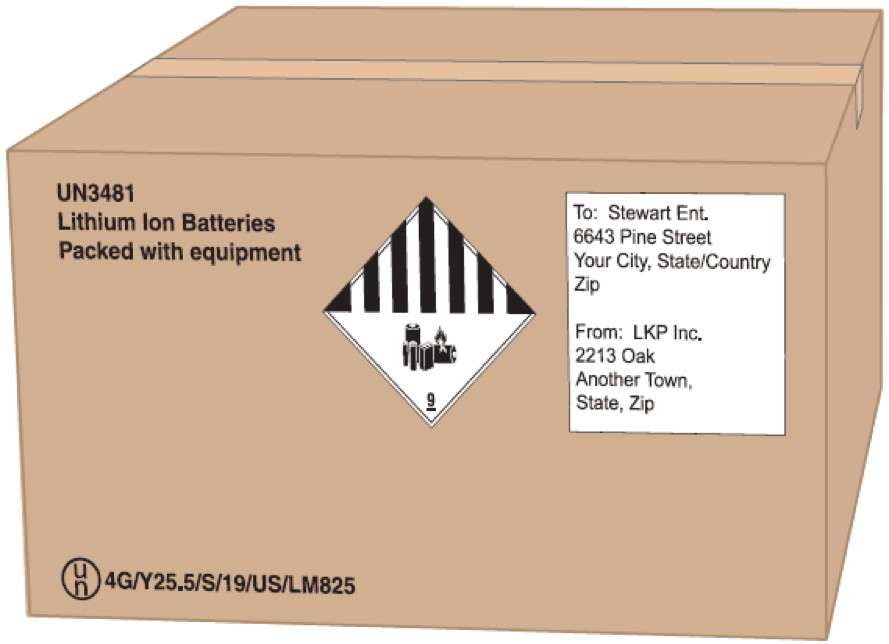
One trap: people confuse "packed with equipment" with "contained in equipment." Both fall under 3481/3091, but a battery riding alongside a device needs insulation and immobilization so it can't touch metal parts. Pick the wrong option in your shipping system and the label won't match the contents. Rejected.
Carrier-by-Carrier Rules: USPS, UPS, and FedEx Each Have Their Own Temperament
How to Ship Lithium Batteries via USPS: Cheapest, and Strictest
USPS rules live in Publication 52, Packaging Instruction 9D:
- Standalone lithium-ion (UN3480): domestic surface only. Air is off the table. The package must carry a DOT-approved lithium battery mark specifying UN3480, plus this exact text: "Surface Mail Only, Lithium-ion Batteries — Forbidden for Transportation Aboard Passenger Aircraft."
- Batteries in or with equipment (UN3481): can go by air or surface, mark specifies UN3481.
- Used, damaged, or defective devices with batteries: a November 2025 Pub 52 revision added a requirement — the address side must read "Restricted Electronic Device" and "Surface Mail Only," and the piece travels surface only.
- International: USPS restricts lithium mailings heavily; most standalone batteries can't leave the US by mail.
My take: USPS is cheap but rule-heavy. Ground Advantage is inexpensive — but standalone batteries are surface-only, 2–5 business days, and savings on postage can evaporate into "where is my package" tickets.
How to Ship Lithium Batteries via UPS: Sign the Contract, or Stay Away from Air
UPS's Hazardous Materials Guide boils down to two points:
- UN3480/UN3090 by air: must be tendered as fully regulated hazardous materials — shipper's declaration for dangerous goods, UN specification packaging, every required label.
- Hazmat paperwork shipments: UPS accepts these only from contract hazmat shippers. No dangerous-goods contract on your account, your shipment doesn't even get into the system. UPS's own words: certain lithium batteries may not qualify for UPS service at all.
In plain English: UPS ground is accommodating for small excepted shipments, but flying a standalone battery means a dangerous-goods contract plus job-specific hazmat training for your staff. That's federal law, not a UPS quirk.
How to Ship Lithium Batteries via FedEx: Pre-Approval First, Most Process-Driven
FedEx is the most process-driven of the three:
- Pre-approval: lithium batteries under IATA Special Provisions A88 or A99 must be pre-approved by FedEx's Dangerous Goods Administration first — email A88A99approvalrequest@fedex.com, allow two business days. UN3090 (standalone lithium metal) requires pre-approval, with a dedicated pre-approved shipper list.
- UN3480 by air: cargo aircraft only (CAO label required), SoC no more than 30% of rated capacity, shipper's declaration for dangerous goods mandatory, dangerous-goods surcharge applies. Per FedEx's job aid, Section IB covers cells ≤20Wh and batteries ≤100Wh, with per-package limits (10 kg net).
- Eligible services: UN3480/UN3090 can only move on FedEx Express options supporting Inaccessible Dangerous Goods (IDG), with an IDG surcharge.
- Hard red lines: damaged batteries, waste batteries, and batteries for recycling/disposal are prohibited outright.
The SoC ≤30% rule is the tightened 2026 IATA line — build a discharge step into your warehouse flow, or this one rule holds you up for two weeks.
The Three-Way Comparison
| Dimension | USPS | UPS | FedEx |
|---|---|---|---|
| Standalone Li-ion UN3480 | Domestic surface only | Air = fully regulated + DG contract | Air = pre-approval + cargo aircraft only + SoC ≤30% |
| In equipment UN3481 | Air or surface | Flexible (excepted) | Flexible (excepted) |
| Pre-approval / contract bar | None (follow Pub 52) | Contract hazmat shipper for air | Pre-approval for A88/A99 and UN3090 |
| Key markings | UN3480/3481 mark + "Surface Mail Only…" | Hazmat labels + shipping papers | CAO label + Class 9 label + DG declaration |
| Surcharges | None | DG surcharge | DG surcharge + IDG surcharge |
| Worst fit | Standalone batteries on a deadline | Air without a DG contract | Damaged/waste batteries (banned) |
The 5 Reasons Shipments Get Rejected
1. Wrong UN number (3480 filed as 3481) The most common, by a mile. Paperwork says UN3481 (in equipment); the box holds a standalone battery. To the carrier that's a misdeclaration, not a typo. Make "standalone" and "in-equipment" two separate product types in your shipping system, with a field in SKU master data. Don't let packers pick from memory.
2. A standalone battery tendered on an air service USPS Priority Mail rides the air network — a UN3480 piece dropped in gets returned. On FedEx, non-IDG services can't even rate a UN3480 shipment. Before picking a service, ask: does it accept my UN number?
3. Missing or misplaced labels The DOT lithium battery mark must go on the address side — UN number, shipper/consignee info, and a phone number where required. I once saw a shipment bounced with everything present except the phone number. One line of text, three days lost.
4. No UN38.3 test summary Air-shipped batteries must pass UN38.3 testing (altitude, thermal, vibration, shock, short-circuit, overcharge), and the test summary must travel with the shipment. Suppliers who can't produce one haven't cleared step one of compliance.
5. Tendering fully regulated shipments without pre-approval UN3480 by air on UPS with no dangerous-goods contract, or A88/A99 batteries on FedEx with no pre-approval — stopped at the hub, returned to sender, possibly with a warning letter. Worse: UPS and FedEx can fine you and suspend your DG privileges. Whatever you "saved" skipping paperwork won't cover a fraction of one penalty.
The Seller's Pre-Shipment Checklist: 10 Items
- Identify the battery (ion or metal? standalone or in equipment?) → lock in the UN number
- Verify your UN number + service combination is accepted on the carrier's site (re-check on shipping day)
- Confirm watt-hours (FedEx Section IB: cells ≤20Wh, batteries ≤100Wh — check current figures)
- Have the UN38.3 test summary ready (get it from your supplier)
- Air shipments: discharge to 30% SoC or below (FedEx hard requirement)
- Pick the right packaging: UN spec packaging for fully regulated; sturdy outer + short-circuit-proof inner for excepted
- Label correctly: DOT mark with UN number on the address side; Class 9 label where required; CAO label for FedEx air
- USPS pieces: print "Surface Mail Only, Lithium-ion Batteries — Forbidden for Transportation Aboard Passenger Aircraft"
- Prepare the shipper's DG declaration where required; confirm your account's DG contract / pre-approval
- Used or returned devices: mark "Restricted Electronic Device" + "Surface Mail Only," surface only
Whether the Money Is Worth It Comes Down to This One Number
A roll of compliant labels costs a few dollars. One rejected shipment? Return freight, re-labeling labor, and 3–5 days of delay that turn into refunds and one-star reviews — more than a year's supply of labels.
My verdict as an engineer: compliance is the cheapest line item and rejection the most expensive. Don't economize on labels. Whether this money was well spent shows up in one number: how many shipments you had returned this year. Zero returns means it paid off.
By Da Liu, Automation Engineer