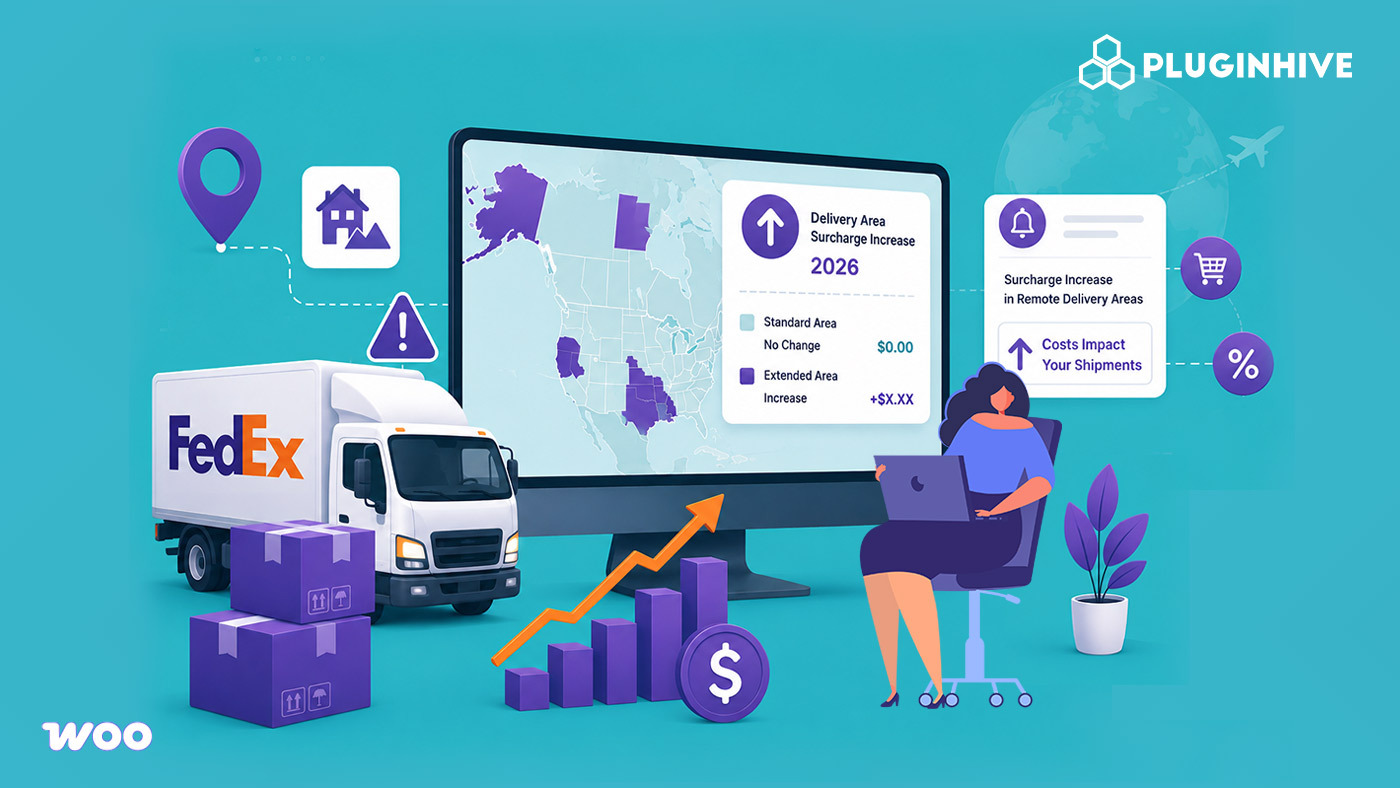
We had a client, a pet supplies e-commerce brand out of San Diego, shipping about 40,000 parcels a month, nearly all of it on UPS. When their November peak-season invoice landed, the CFO called me in and pointed at two lines: "Susan, what is this $7,900 in address correction fees and $12,000-plus in remote area surcharges? None of this was in the rate quote we signed."
She was right. It wasn't in the quote. These two lines only ever show up on the invoice.
I've signed over a hundred warehouse and carrier contracts in my career, and I'll say this plainly: the two most unfair lines on any parcel invoice are the address correction fee and the delivery area surcharge. Unfair because nobody mentions them during quoting, because they're nearly impossible to dodge once they hit, and because most companies pay them for months before anyone notices. Let me pull back the curtain on both.
Address Correction: A $25 Lesson Per Package
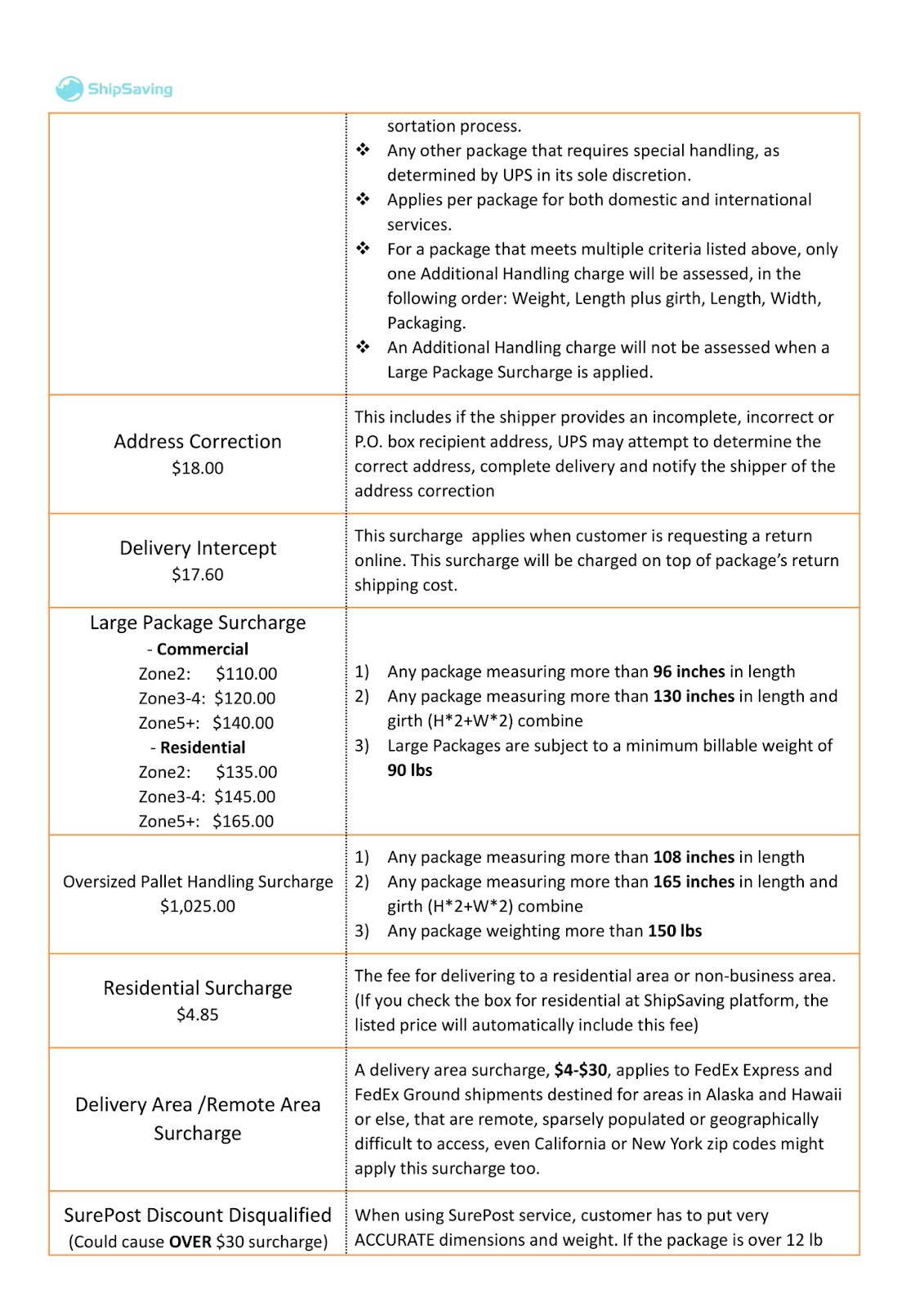
Another client of ours, an outdoor gear brand, had customer service reps who figured "123 Main St" was good enough without the apartment number. They printed the label and shipped it anyway. UPS figured out the unit number at delivery and delivered it fine, then billed $25.25 for the privilege of correcting the address. FedEx charges $25.50 for the same thing. And it is per package — one bad address, one fee, every time.
Here's where the three big carriers stand in 2026:
| Carrier | Address Correction Fee (2026) | Notes |
|---|---|---|
| UPS | $25.25 per package | Charged when the carrier corrects an incomplete, incorrect, or P.O. box address |
| FedEx | $25.50 per package | Same trigger; was $24.00 in 2025 and climbs every year |
| USPS | None | Undeliverable items are returned at the original postage, no extra fee |
(Rates adjust each January; check the carrier's current rate guide for the latest.)
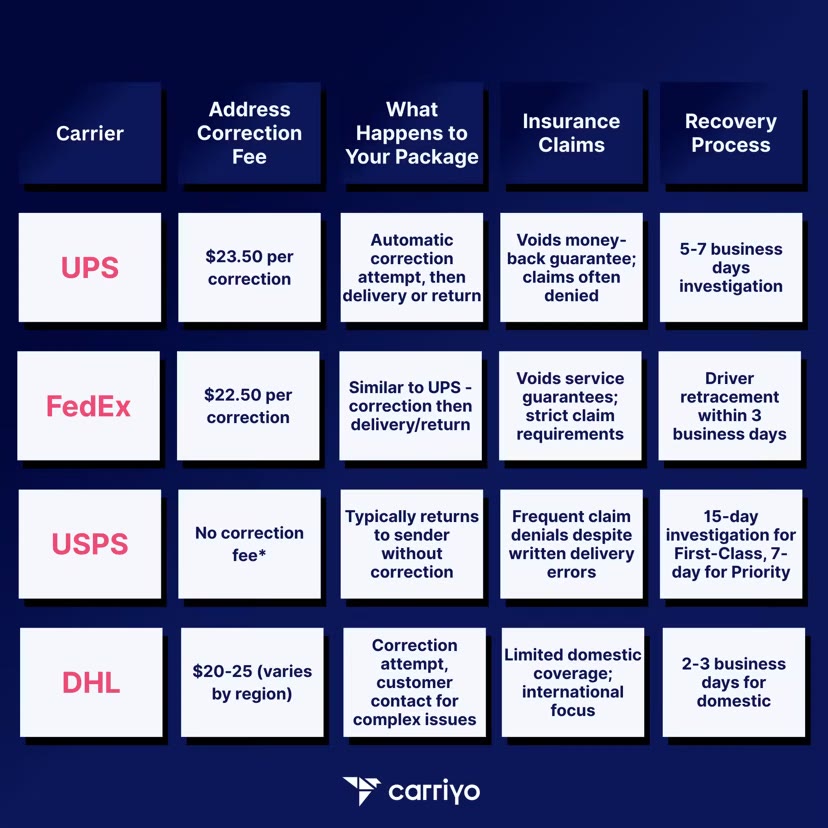 Carrier address-correction policies compared (older fee levels shown); see the table above for 2026 rates.
The usual triggers will sound familiar: missing apartment or suite number, a transposed ZIP code, a non-standard state abbreviation, or an address you swore was commercial that the carrier's database classifies as residential. That last one stings the most, because the carrier decides what counts as residential, not you. Overriding it to "commercial" in your shipping software doesn't help; the carrier's address verification runs at label creation and again at first scan, and your manual override does not stick.
But here's the insider part most shippers never hear: the $25 fee isn't the worst of it. The moment a package gets an address correction, its on-time delivery guarantee is voided. So if the package then arrives late, you can't file a service failure claim either. It's a double hit. I've watched operations managers discover this clause only after losing peak-season refund claims.
Let's do the math on this "small" line item. Say you ship 50,000 parcels a month with a 0.3% correction rate — that's already a well-managed address file. That's 150 corrections × $25.50 ≈ $3,825 a month, or $45,900 a year. An address validation API call costs a few cents. I'll let you finish that ROI calculation yourself.
The Remote Surcharge: Missing From the Quote, Present on the Invoice
The delivery area surcharge (DAS) is the other invisible tax. Carriers tier every U.S. ZIP code by remoteness, and the more remote the destination, the higher the fee. The 2026 tiers look roughly like this:
| Carrier | Standard DAS | Extended DAS | Alaska / Hawaii |
|---|---|---|---|
| UPS | $4.50 commercial / $6.55 residential | $8.50–$13.00 | $46.25 Alaska, $16.50 Hawaii |
| FedEx | $4.45 commercial / $4.45–$6.60 range | about $8.80 extended residential | Per current rate guide |
| USPS | None | None | None |
(Rates adjust annually; confirm against the carrier's current rate guide.)
That outdoor gear brand I mentioned? They have a loyal following in Alaska and Hawaii. A single parcel to Anchorage carried a $46.25 remote surcharge — more than the base shipping rate itself. They were effectively losing money on every Alaska order for the better part of a year before finance caught it during reconciliation. The founder was furious: "Why didn't sales flag these ZIP codes during quoting?" I told him the DAS table was on page 14 of the appendix. In small print.
Three traps here, each one expensive:
First, the DAS ZIP code list is refreshed every January. A ZIP code that was surcharge-free in December can pick up the fee in the new year. Nobody notifies you. The invoice notifies you.
Second, residential versus commercial classification is again the carrier's call. A small business in a suburban standalone building will almost always be classified residential, and the residential tier costs meaningfully more than the commercial one.
Third, and this is the counterintuitive one: the rate your quoting software shows does not include the delivery area surcharge. You set your free-shipping threshold and your product pricing off the quoted rate, and the invoice quietly eats the difference. I've seen DTC brands leak margin this way for two straight years.
Four Moves to Cut These Lines Down or Get Them Back
Enough diagnosis. Here's what actually works at the negotiating table.
Move one: validate addresses before the label prints. Highest ROI move on this list. Validate at checkout against USPS-standard formatting. Turn on the address validation switch in your shipping platform — ShipStation, Pirate Ship, and the like all have one — and set it to enforced, not suggested. Add one more validation pass inside your WMS or OMS. A few cents per validation versus $25.50 per correction; clients of ours who take validation seriously drive correction rates from 0.5% down below 0.1%.
Move two: route remote parcels through USPS. Export every ZIP code that triggered a DAS charge over the last three months and build a "remote parcel" routing rule: remote-ZIP orders ship USPS, which charges no delivery area surcharge and no residential surcharge — saving $6 to $46-plus per parcel. The trade-off, stated honestly: USPS is cheaper but a tier below on speed and tracking. So the standard playbook is low-value, lightweight remote parcels go USPS; high-value or time-sensitive remote parcels stay on UPS or FedEx, but you build the surcharge into the pricing. Stop subsidizing it yourself.
Move three: negotiate with data, not with wishes. Insider truth: the address correction fee is the toughest nut in the accessorial list, and carrier reps almost never discount it. So negotiate differently — "Our correction rate over the last 12 months is 0.12%, well below average. Can we get a monthly waiver allowance?" A clean track record is worth ten times more than an empty discount ask. The delivery area surcharge has more give, especially if your remote-parcel share is high and your volume is real — ask for repricing based on your actual remote mix instead of the standard rate card. And don't forget to negotiate a fuel surcharge cap; in peak season, fuel compounds on top of everything else.
Move four: dispute what deserves disputing. These almost always come back if you push: an address that was actually correct and got "corrected" by mistake; a duplicate correction charge on the same parcel; a DAS charge on a ZIP code that was within the carrier's coverage area that year. The path is your carrier sales rep, with invoice screenshots and label data attached — expect a result in two to four weeks. One of our clients recovers over $30,000 a year just by auditing the invoice quarterly. Unglamorous work. Real money.
One last honest word. Carriers will never proactively warn you about either of these lines, and sales reps would frankly prefer you never notice them. A contract is negotiated, not just signed.
Next time you're at the table, ask these three questions:
- "Can we get a monthly waiver allowance on address correction fees? With a correction rate this low, there should be some recognition."
- "Can the delivery area surcharge be repriced on our actual remote-parcel mix instead of the standard rate card?"
- "Can we cap the fuel surcharge? Above what level does it stop climbing?"
Ask those three, and you'll have actually read the contract.
By Susan, 3PL Sales Director