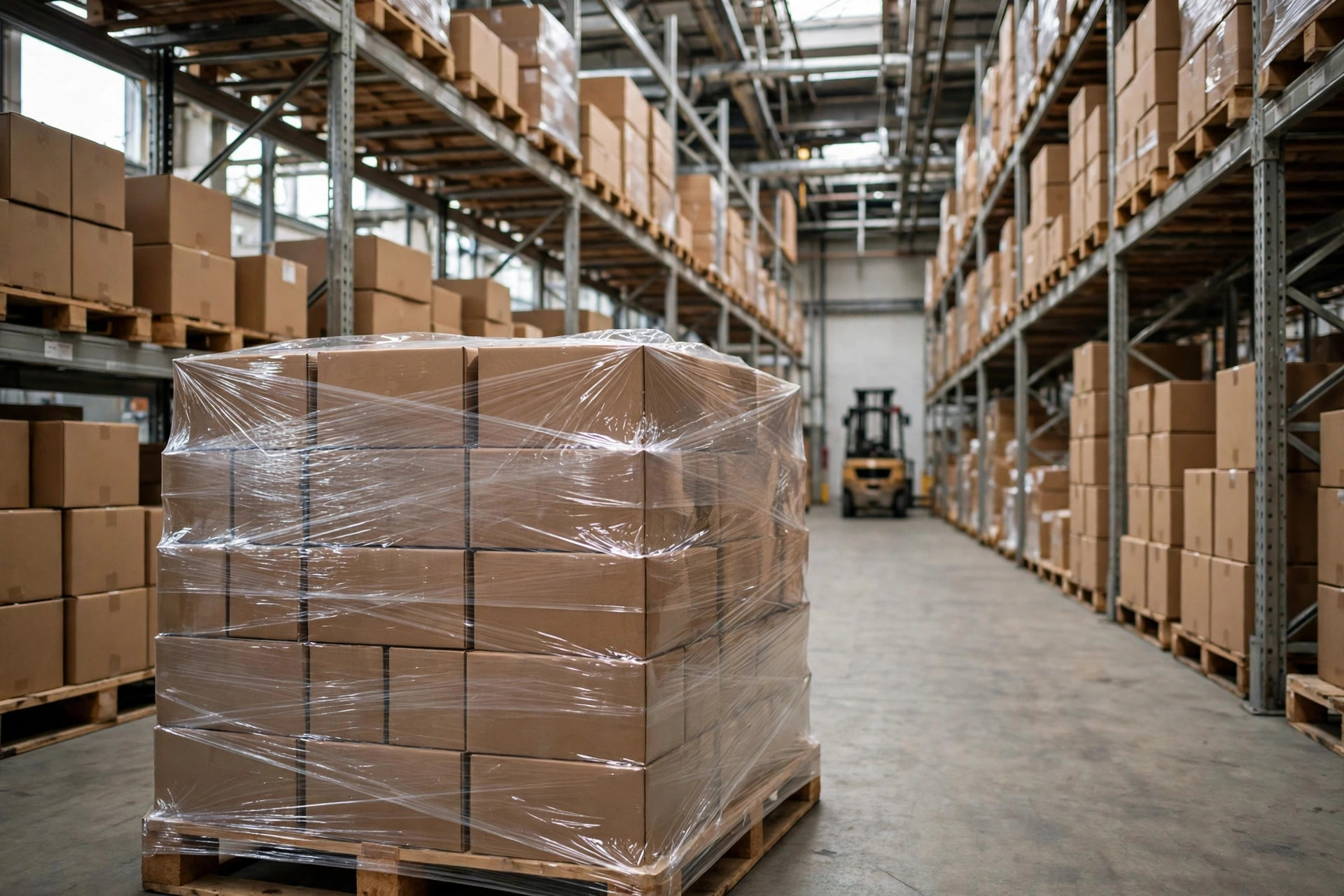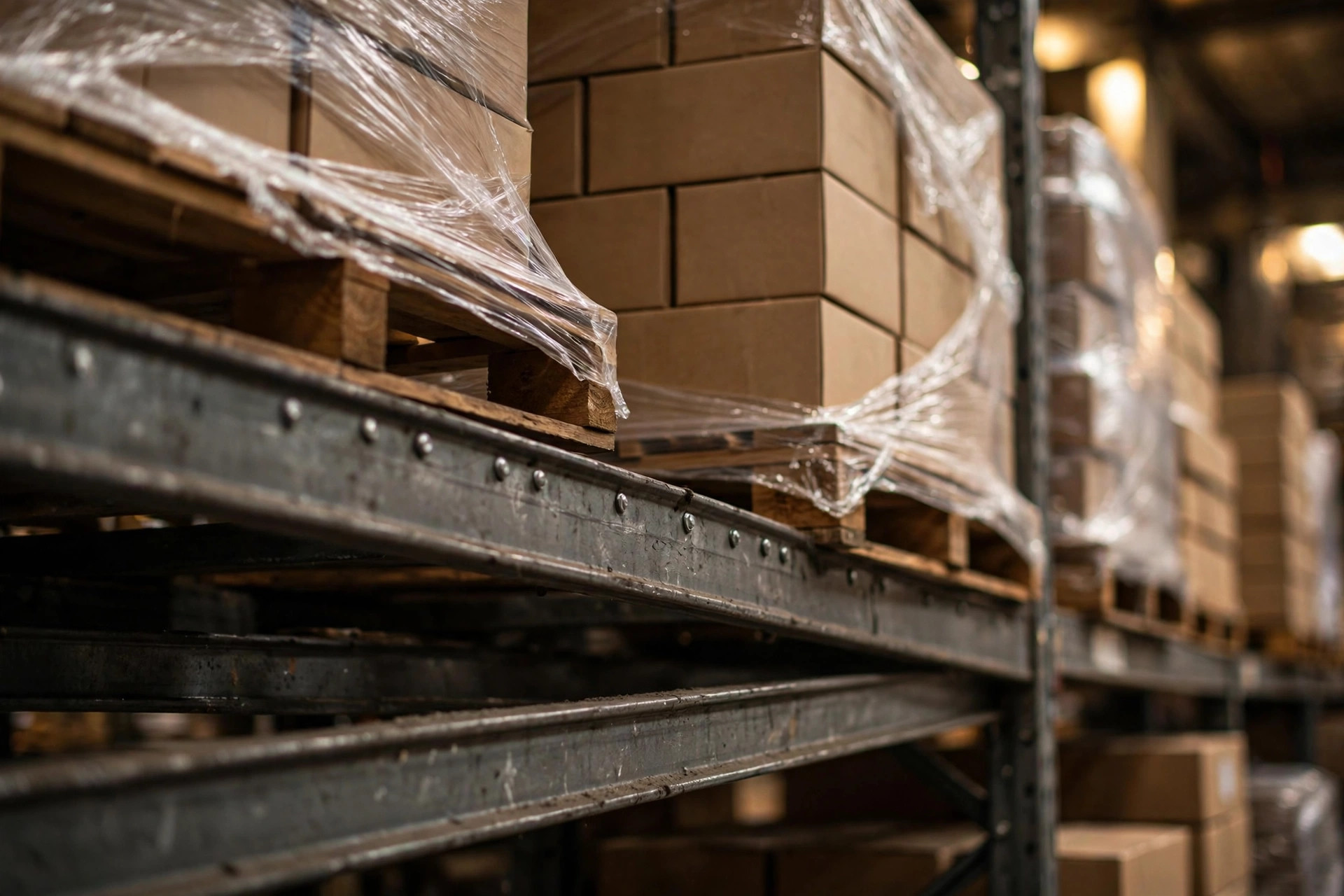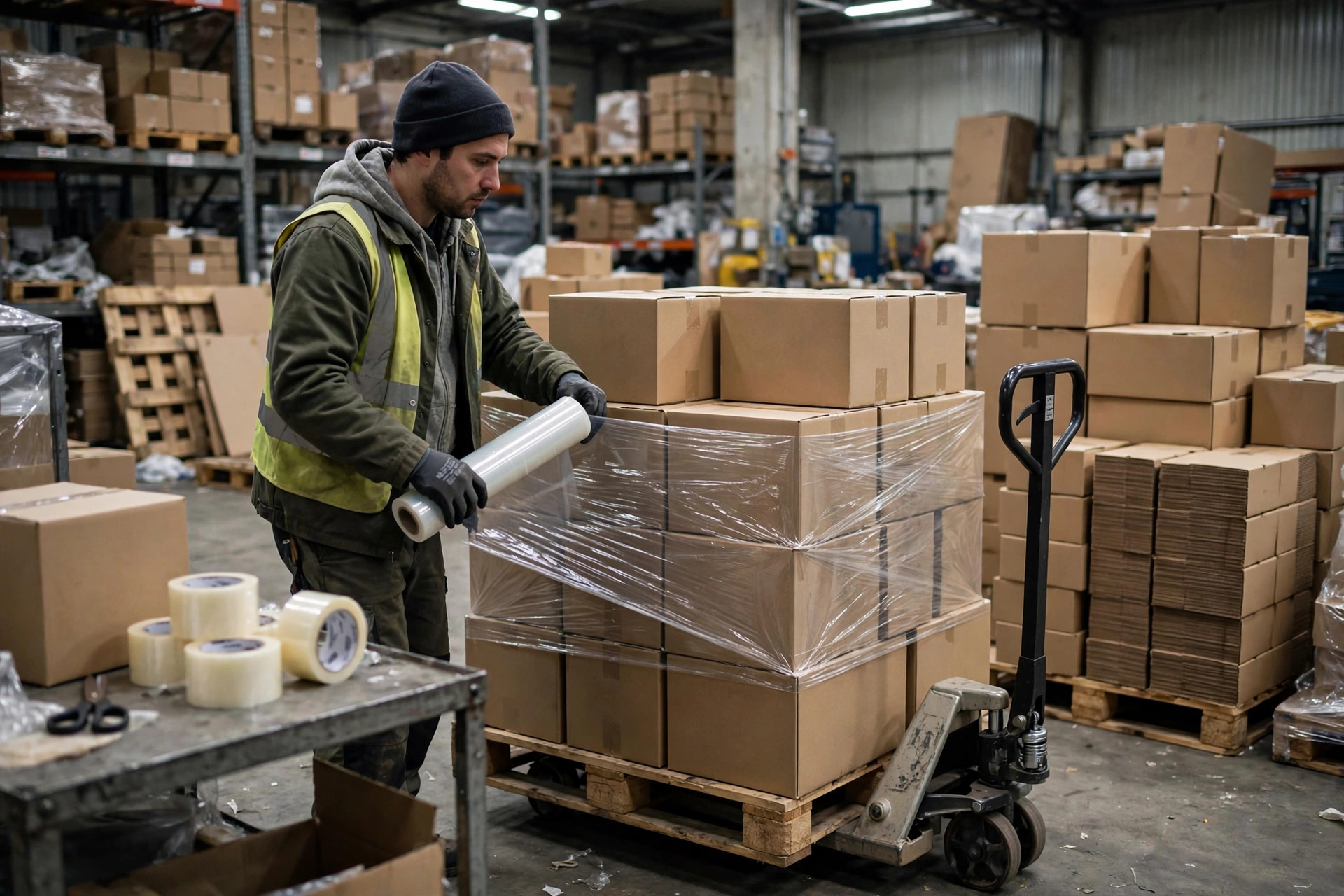
Let me open with a number: a mid-size warehouse shipping 200 pallets and sealing 3,000 cartons a day burns through more than $60,000 a year on stretch film and packing tape alone.
That number is your stretch film cost per pallet — and almost nobody I meet can tell me theirs. Procurement teams obsess over price per roll. But price per roll is what you pay the supplier; stretch film cost per pallet is what shows up on the P&L. Between those two numbers sit three variables, and in most warehouses I audit, at least two of them are leaking money.
How to Calculate Stretch Film Cost Per Pallet in 4 Steps
The formula fits on one line:
Cost per pallet = (film feet per pallet ÷ (roll length × (1 + stretch rate))) × roll price
Step one, get your roll price. Public retail benchmarks: hand film, 80 gauge, 18" × 1,500 ft, runs $12–$16 a roll; machine film, 80 gauge, 20" × 5,000 ft, runs $100–$120 a roll. (Always confirm against your supplier's latest quote — resin prices move.)
Step two, measure your real stretch rate. Film is sold at its unstretched length and used at its stretched length. Hand application typically achieves 50%–100% stretch depending on the operator and film quality; a powered pre-stretch wrapper runs 200% or more. A 1,500-foot roll at 75% stretch yields 2,625 usable feet. The same roll in a rookie's hands and a veteran's hands can wrap a third more — or fewer — pallets.
Step three, count your revolutions. A 48" × 48" pallet is 16 feet around per revolution. Three wraps at the base, five up the body, two at the top: 10 revolutions, 160 feet of film. But walk any packing floor and you'll see one operator doing 8 revolutions and the next doing 15, both convinced theirs is "about right."
Step four, run the math. Hand film at $15 a roll, 75% stretch, 10 revolutions (160 feet) per pallet → 16.4 pallets per roll → $0.91 per pallet. At 50,000 pallets a year (200 a day × 250 days), that's $45,500 a year in film. One line item, hiding in plain sight.
Here is the counterintuitive part: the expensive roll is often the cheaper film. A $15 roll and an $18 pre-stretched roll differ 20% on price per roll — but if the better film lets your crew drop three revolutions and holds stretch more consistently, cost per pallet falls 30%. Anyone benchmarking on roll price alone is optimizing the wrong number. That money is spent in vain.
Stretch Film Cost Per Pallet: Three Scenarios Compared
In 2024 I audited a 3PL in Rancho Cucamonga. Same packing area, same film roll: one operator wrapped 8 revolutions, another wrapped 15. We had the lead wrap a "normal" pallet, peeled the film off, and weighed it. Cost per pallet differed by nearly 2×. No standard is the most expensive standard.
Using the 50,000-pallets-a-year baseline, here is how three approaches compare:
| A: Hand wrap, as-is | B: Hand wrap, optimized | C: Semi-auto turntable | |
|---|---|---|---|
| Film | Hand 80ga 18"×1,500' | Hand 80ga 18"×1,500' | Machine 80ga 20"×5,000' |
| Roll price | $15 | $15 | $110 |
| Stretch rate | 75% | 75% | 200% (pre-stretch) |
| Revolutions/pallet | 10 | 7 (standardized) | 12 (machine cycle) |
| Film per pallet | 160 ft | 112 ft | 64 ft (unstretched equiv.) |
| Cost per pallet | $0.91 | $0.64 | $0.47 |
| Annual film cost | $45,500 | $32,000 | $23,500 |
| Annual savings vs A | — | $13,500 (−30%) | $22,000 (−48%) |
Scenario B costs almost nothing to implement: set a revolution standard, train once, save $13,500. Scenario C needs a semi-automatic turntable wrapper — publicly listed in the low thousands to low tens of thousands of dollars (check the latest official pricing) — and at $22,000 a year in savings it pays back in 5–8 months. Above about 200 pallets a day, the machine math almost always works. Below ~50 a day, nail scenario B first.
This is not theory. A published case in WRAP's 2020 technical report on pallet-wrap optimization: a UK food manufacturer wrapping 94,000 pallets a year raised its wrapper's pre-stretch ratio from 100% to 250%. Film per pallet fell from 242g to 138g, annual consumption from 22.8 tonnes to 13.1 tonnes, and film spend dropped 33%. Same machine. One parameter changed.
Where the Real Leverage Is
Ranked by return on effort:
First, buy a scale. A $30 kitchen scale is the highest-ROI instrument in packaging. Wrap a normal pallet, peel the film, weigh it. Do 20 pallets and you have your true grams-per-pallet. Every optimization starts here — without that number, everything else is "feels about right," and I have an allergy to that phrase.
Second, standardize revolutions. Write it down by load type: 7 revolutions for uniform loads, 9 for irregular, plus one reinforcing wrap top and bottom. Post it on the packing wall. Have the lead spot-check weekly. Scenario B's $13,500 comes from exactly this.
Third, switch to pre-stretched hand film. Mill-stretched film cuts operator technique out of the equation. Higher price per roll, lower cost per pallet — run the formula from part one and see for yourself.
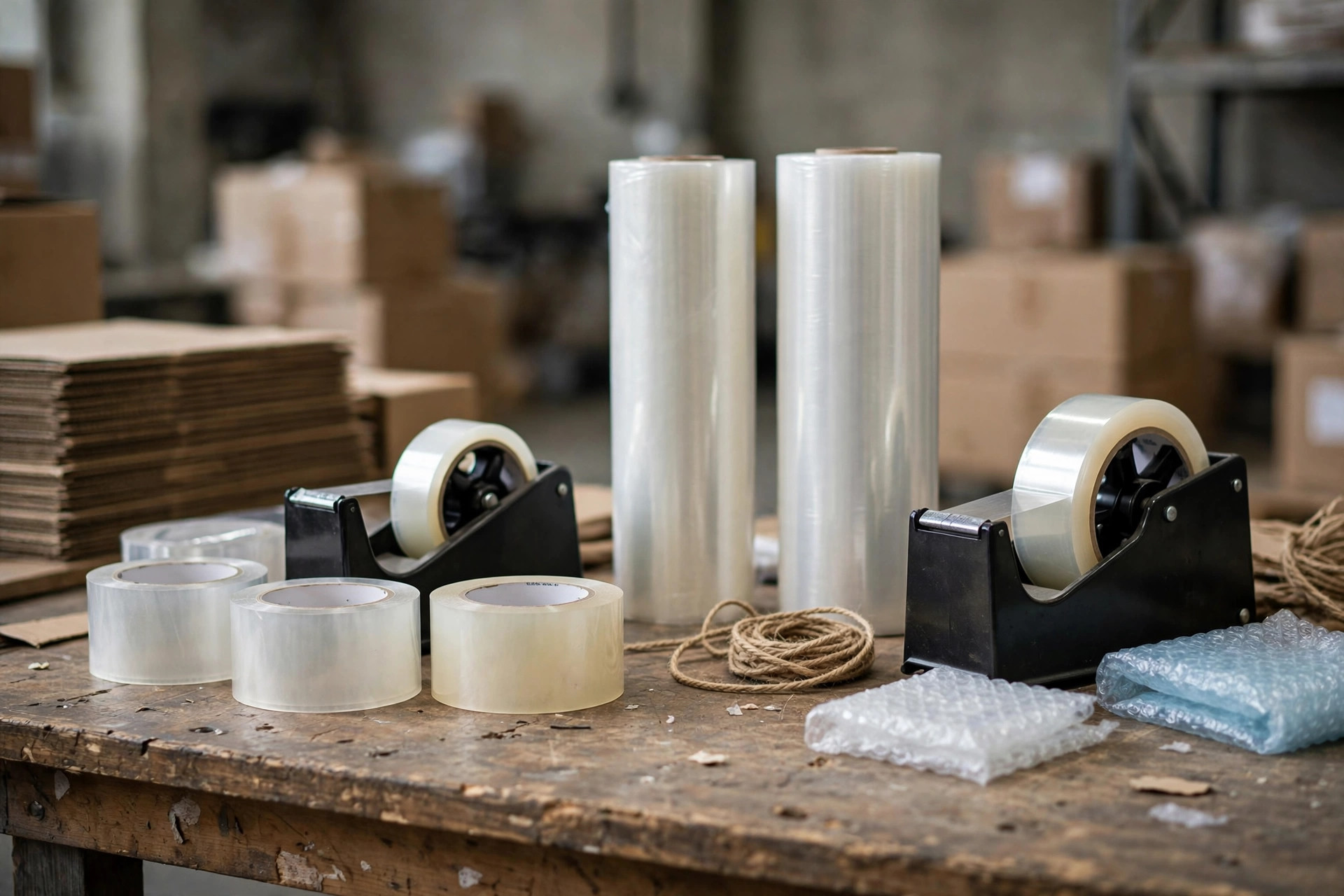
Fourth, watch the tape. Packing tape, 2" × 110 yd, retails around $1.75–$2.32 a roll (confirm with your supplier's latest quote); call it $2. One carton takes roughly 4 feet of tape for top and bottom seals, so a 330-foot roll seals about 82 cartons — $0.024 per carton. At 3,000 cartons a day that's $73 a day, $18,250 a year over 250 days. The biggest tape waste is not the unit price — it is the habit of "one more pass for safety." An extra 25% of tape is $4,500 a year, burned for peace of mind. Set the tape gun tension properly and train the sealing motion once.
One trade-off before anyone overdoes the reduction: cutting film 30% feels great until damage claims rise. A single $200–$300 freight damage claim wipes out the film saved on several hundred pallets. The floor for reduction is a transit test — push the wrapped pallet; if the top boxes don't shift, it passes. The goal is "just secure enough," not "as little as possible."
The calculable conclusion: have your packing lead weigh film from 20 pallets this week and compute your true stretch film cost per pallet. Above $0.70, standardize revolutions first. Below $0.70 with 200+ pallets a day, get a quote on a turntable wrapper — payback will very likely land under a year. And don't rush to switch suppliers before you do the math. Half the time the problem isn't the film. It's the hands.
By Lao Zhou, Logistics Cost Analyst