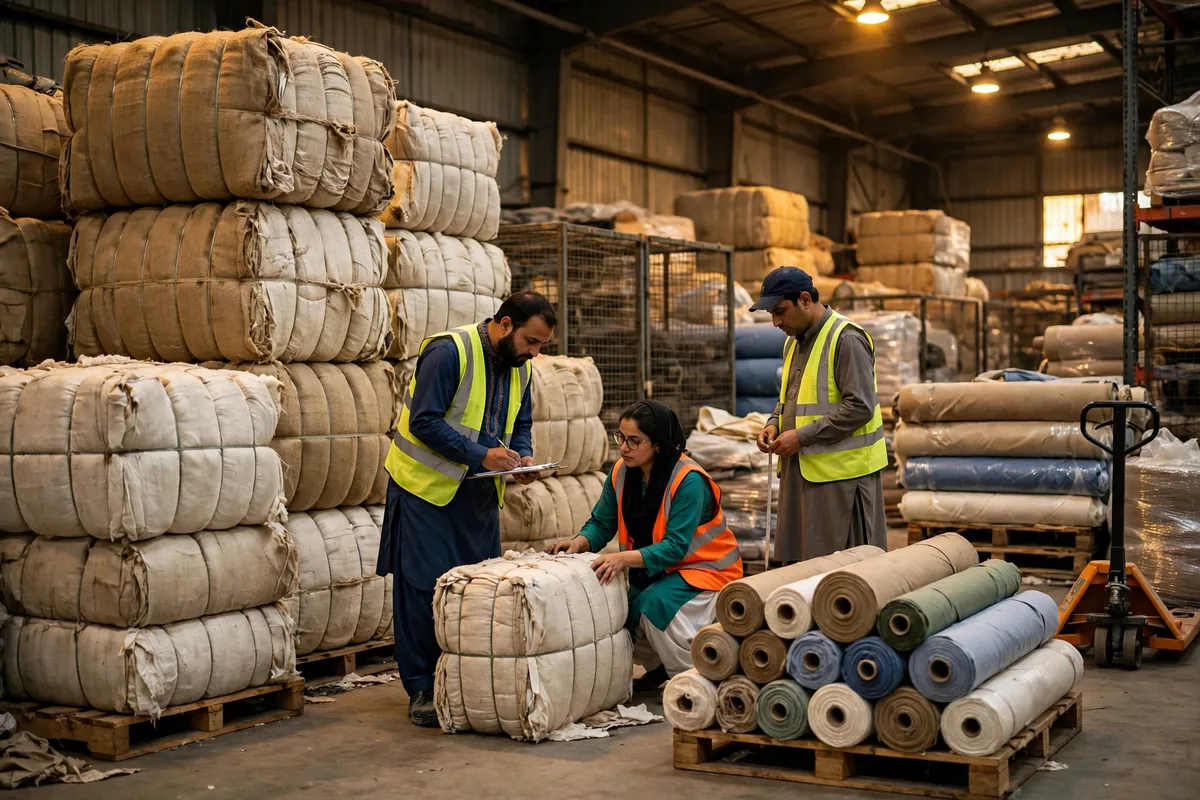
Here is the verdict up front: in Pakistan textile export warehouse logistics, rent is the cheapest line on the bill. Pakistan exported $17.88 billion worth of textiles in fiscal year 2024-25, more than half of everything the country sells abroad. The goods roll out of factories in Faisalabad, travel roughly 1,150 kilometers by road to Karachi Port, and the margin does not die in the warehouse rent. It dies in damp, mold, and one badly consolidated container. I have watched too many factory owners quote prices down to the second decimal, then get knocked flat by an inspection report a week before sailing.
During the 2024 monsoon, a home-textile factory in Faisalabad learned this the hard way. Three thousand bed linen sets were packed and stacked in the factory warehouse, waiting for a sailing. The inspector pulled samples and found mold spots along the edges of the two bottom pallets. The whole shipment stopped. Unpack, rewash, re-press, repack. The round took 11 days, the sailing changed twice, and the buyer held back the balance payment for the season's order. The goods were fine. The warehouse was not. The ground floor had no damp-proof layer, the walls sweated in the monsoon, and pallets sat flush against the wall, so the bottom two pallets were effectively sitting in moisture. The owner told me later that he meant to fix the damp-proofing every year, and every year he decided the rain would not be that bad.
Pakistan Textile Export Warehouse Logistics Starts With Moisture Control
Look at this from two sides. On one side sits the climate. Monsoon humidity in Faisalabad and Karachi climbs fast, and cotton goods soak it up. They do not just grow mold, they discolor and pick up a smell, and inspection standards for home textiles and apparel allow zero mold. On the other side sits habit. Plenty of factory finished-goods warehouses are just an extension of the production floor. Goods get stacked wherever there is space, and moisture mats, dehumidifiers, and temperature-humidity logs are treated as optional decoration. My view is that damp-proofing is not an equipment problem. It is a process problem. Test moisture content before goods enter finished storage, keep pallets at least a fist's width from the wall, raise the bottom layer 15 centimeters off the floor, log temperature and humidity twice a day in monsoon season, and switch the dehumidifiers on the moment a reading goes over the line. For a mid-sized finished-goods warehouse, that routine costs a few hundred dollars a month in power and labor. One reworked container costs a hundred times more.
I have seen the same mistake near Karachi Port. In 2024 an exporter stored eight containers' worth of knitwear in a cheap temporary warehouse near the port while waiting to consolidate. The roof leaked, two containers' worth of outer cartons went soft and buckled, and the inner packaging took on damp. The owner filed an insurance claim, and the insurer looked at the empty storage-condition records and cut the payout. The lesson is plain: a port warehouse is not better for being cheaper. Roof, drainage, and floor height are three things you check with your own eyes before the goods go in. Do not trust the photos the broker sent.
Consolidation Is Where Pakistan Textile Export Warehouse Logistics Breaks Down
Consolidation has two faces. The upside is real. Small orders do not fill a container on their own, and sharing a box spreads the ocean freight. Mixing home textiles, towels, and apparel in one container is daily routine for small and mid-sized exporters. The downside is equally real. Different buyers' goods in one box means weight, volume, marks, and customs paperwork all have to line up. One mismatch and the whole container can sit held for inspection at destination. I have seen too many people count what consolidation saved and never count what one failed consolidation costs.
The table below is a scenario illustration, using a common 40-foot container moving from Faisalabad to Karachi and onward by sea:
| Item | Full container load | Consolidated (two shipments) |
|---|---|---|
| Road haul to port | One full truckload | Split two ways, roughly 40% cheaper |
| Port warehouse wait | 2 days | 5 days, three extra days |
| Documents and inspection | One round | Two rounds, one error holds the whole box |
| Cost of one failure | Low | Rework plus rescheduling, about 3x the freight saved |
The figures are illustrative, but the conclusion is not. Consolidation saves visible freight and gambles on invisible coordination cost. My rule is to consolidate only three kinds of cargo together: the same destination port, the same broad material family, and similar inspection standards. Bed linen and towels can share a box. Apparel and rugs should not, because lint and color-bleed disputes will drag both shippers down. Before a shared container is booked, nail down three things in writing: whose goods sit on top, whose goods come out first, and whether a problem is split by volume or by cargo value. Put it in an email, not just in a phone call.
At the Karachi Port Gate, Time Costs More Than Rent
Karachi Port handled 2.65 million TEUs in fiscal year 2024-25, a record. Volume went up, and the tempo around the port tightened with it. In my experience, the last mile of export warehousing is not inside a warehouse. It is on a timetable. With two sailings a week, missing one means waiting three or four extra days, port warehouse charges run by the day, and a week of idle cargo at the port wipes out whatever was saved on factory storage, plus a slice of the buyer's trust.
Three moves a small or mid-sized exporter can start tomorrow. First, run finished-goods storage and consolidation storage as two different jobs: the first manages moisture, the second manages completeness, and no cargo enters the consolidation area until the set is complete, so half a container never waits idle at the port. Second, plan production backward from the sailing date with a 10-day lead and a two-day buffer for inspection and documents, and treat the cut-off date as a deadline, never as the shipping day. Third, keep a full set of temperature-humidity logs and loading photos for every container. If something goes wrong, that is your evidence. If nothing goes wrong, it is still your leverage for the next price negotiation.
The Pakistan textile export trade is a genuine opportunity, and the traps are genuine too. Behind that $17.88 billion sits hundreds of small and mid-sized factories, competing on whose warehousing can survive a monsoon and a sailing schedule at the same time. So ask yourself one question: would your finished-goods warehouse survive this year's monsoon?
By Lao Mi, Supply Chain Veteran (20 yrs)