Short-shipment complaints follow a remarkably fixed rhythm — and weight verification is the last checkpoint that can catch them before the box seals. Three to five days after a peak sales event, customer-service tickets climb, and the keywords are always the same — "missing one item," "wrong quantity." Back at the warehouse, the investigation goes nowhere: the pick record says everything was picked, the QC record says everything was checked, and the parcel is already gone. No evidence survives.
Across the dozens of warehouses whose postmortems I have reviewed, the most punishing thing about short shipments is not that they are hard to fix — it is that they are hard to attribute. Once the box is in the customer's hands, every link in the chain can plausibly say "not me." The value of weight verification lies precisely in converting an after-the-fact argument into a before-the-fact interception: before the box seals, weight answers the simplest possible question — does what's inside match what should be inside?
The Data: Where Shortages Actually Leak Out
Trace a short-shipment complaint backward, link by link, and the causes converge on three sources. The proportions vary by facility, but the structure is strikingly consistent.
The first is picking misses, usually the largest share. After the 2025 mid-year sales event, an e-commerce warehouse in eastern China running roughly 20,000 orders a day conducted a focused review: about 40% of attributable short-shipment complaints traced back to picking. The classic scenario is the multi-line order — a picker grabs three units but only scans two barcodes, the third taken "by feel." The more units per order, and the hotter the SKU, the higher the miss probability; the relationship is nearly linear.
The second is QC slip-throughs. The pack-out QC station is meant to be a second line of defense, but QC is human too. The same facility's data showed that during peak, QC operators were clearing more than 300 parcels per hour each, with attention measurably degrading after about two hours of continuous work — and the miss rate climbing with it. QC catches "wrong item" reasonably well; it catches "missing item" poorly, because the operator scanning barcodes never realizes the missing unit was supposed to exist.
The third is the most insidious: inaccurate master weight data. Wrong or long-unmaintained product and packaging weights mean the system's "theoretical weight" is wrong to begin with. This class of problem stays quiet until a packaging change or supplier switch makes it erupt all at once. During its review, the warehouse above discovered that a batch of cartons had been upgraded to a heavier grade — about 80 grams more per box — without the theoretical weight being updated. Weight verification then spent three days flagging nearly everything. Which proved something worth remembering: what weight checks intercept is often not a shortage at all, but an error in the master data.
How Weight Verification Intercepts: Theory Against Actual
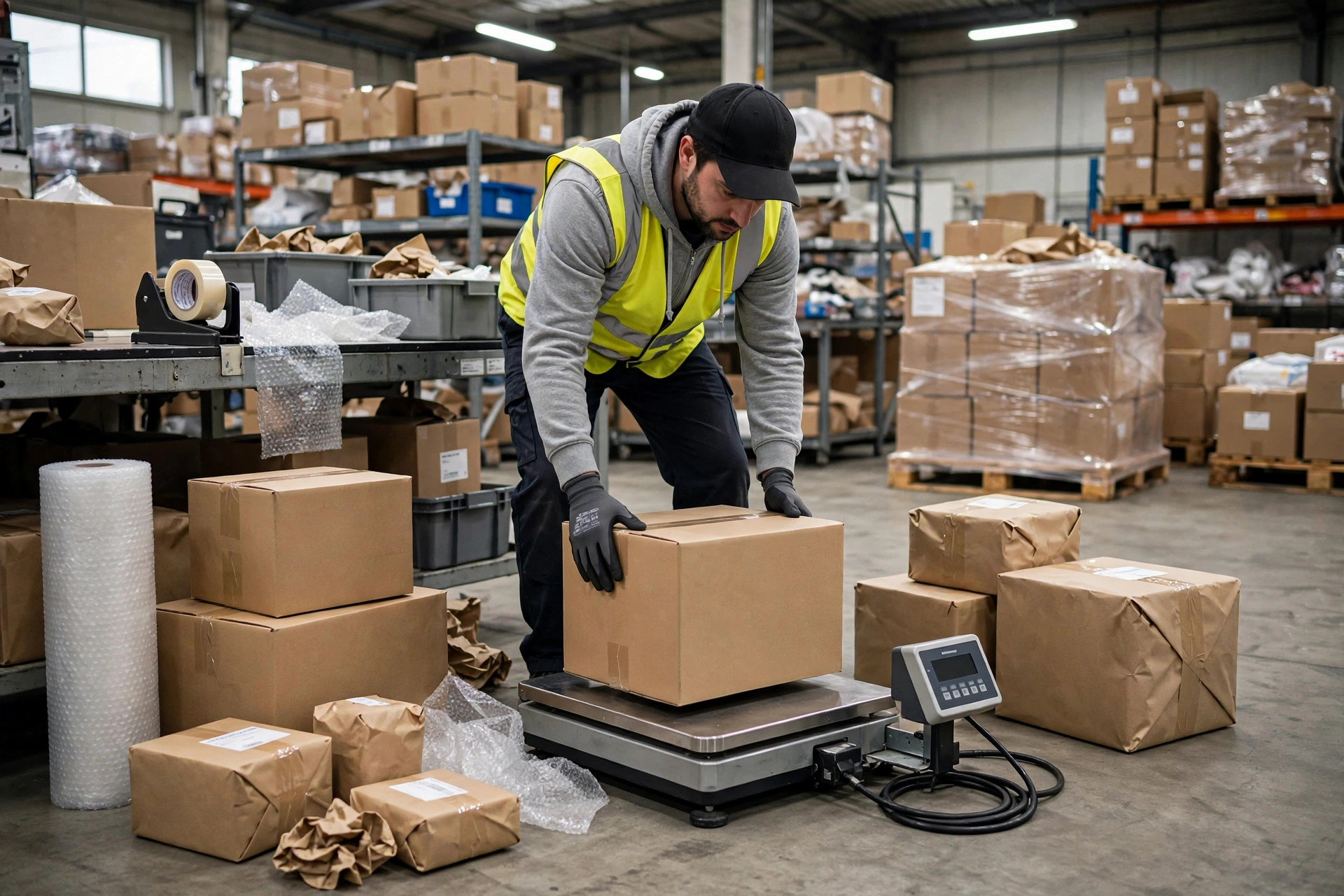
The principle is not complicated — think of it as a weight reconciliation: the system computes a theoretical weight from the order lines (sum of product weights plus packaging), the parcel goes on the scale, and any deviation outside the tolerance band gets intercepted for manual review.

But the logic only holds on three premises, all of them mandatory: product weight master data is accurate, packaging weight master data is accurate, and the scale itself is accurate. Of the three, the first two are management problems; only the third is an equipment problem. Many warehouses see disappointing results after installing scales, investigate, and find the scale was fine — the master data had been rotting unmaintained for years. Equipment cannot pay down management debt. That is the first iron rule of any weight verification project.
A Counterintuitive Judgment: Tighter Tolerance Is Not Better
Tolerance setting is where weight verification demands the most judgment, and it is a classic dilemma: set it too tight and false stops pile up — the pack line halts for re-checks, operators start "clearing by experience," and the system dies in name only. Set it too loose and genuine shortages sail through, and the scale becomes furniture.
The counterintuitive point is this: the width of the tolerance band measures not your pursuit of precision, but your honest assessment of your master data quality. The dirtier the data, the wider the band must be, or false stops will strangle throughput. One 3PL's experience is representative: they ran a week at a tight ±30-gram tolerance, hit a false-stop rate near 15%, and the pack stations revolted; then they went back, physically re-weighed every product, put packaging on per-batch records — and at the same ±30 grams, false stops fell under 2% while short-shipment complaints dropped by roughly 60%. The tolerance never changed. What changed was the data quality underneath it.
The economics make the point sharper: one false stop costs roughly one to two minutes of re-check labor, while one short-shipment complaint costs a replacement shipment plus second freight plus service time — typically dozens of times more. So the correct tolerance strategy runs tight first, then tighter: use a strict tolerance initially to force the master-data problems into the open and clean them up, then narrow the band to a level that genuinely intercepts shortages. Reverse the order and a strict tolerance only radicalizes your operators.
The Small Warehouse Workaround vs. Big Warehouse Automation
| Small warehouse workaround | Big warehouse automation | |
|---|---|---|
| Equipment | One bench scale wired to a PC serial port | Dynamic in-line scale tied to the seal line, auto-divert on deviation |
| Theoretical weight | Excel sheet, manually updated | WMS master data, packaging tracked per batch |
| Interception | Tolerance chart taped by the scale, human decides | System auto-intercepts, exceptions route to a re-check lane |
| Investment | A few thousand yuan | Hundreds of thousands and up |
| Fit | Under ~1,000 orders/day, stable SKU mix | 10,000+/day, high-mix high-velocity |
The small-warehouse workaround looks crude, but its logical core is identical: weight reconciliation. For modest volumes and a slow-changing SKU mix, one scale plus a taped-up tolerance chart catches most "whole unit missing" cases — and whole-unit misses are precisely the largest category of short-shipment complaints. Automation's real value is not "more accurate" but "fast enough": past ten thousand orders a day, no human can watch a scale, and dynamic weighing with automatic divert becomes the requirement.
Trend Assessment: Weight Verification Moves From Optional to Standard
Judging by project distribution over the last two years, weight verification is moving from "big-warehouse option" to "standard pack-out equipment." Three forces drive it: rising labor costs keep shrinking the QC headcount, so equipment must fill the defensive gap; complaint costs have become explicit — once the all-in cost of one shortage is calculated, a scale's payback is easy to justify; and the weight master data accumulates — warehouses that adopt verification are forced to get product and packaging weights right, and that dataset then pays dividends in freight estimation and packaging selection. One investment, several returns.
One question deserves long-term watching, though: as AI vision QC matures and "counting units" migrates to cameras, will weighing retreat to catching only weight anomalies — liquid leaks, missing accessories — and how will the division of labor between the two technologies ultimately settle? That may be the most interesting change to track at the pack station over the next two to three years.
By Dr. Chen, Supply Chain Researcher