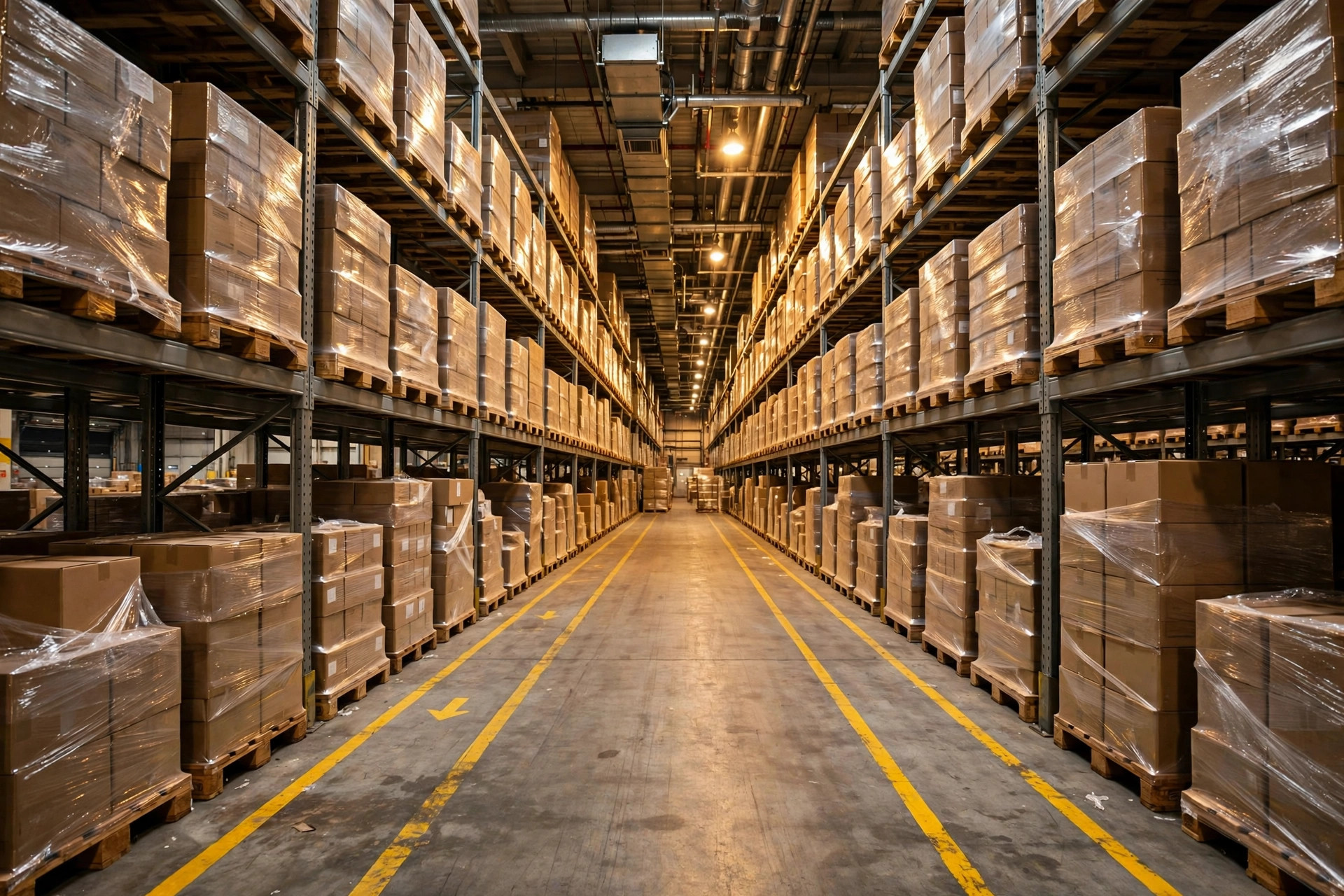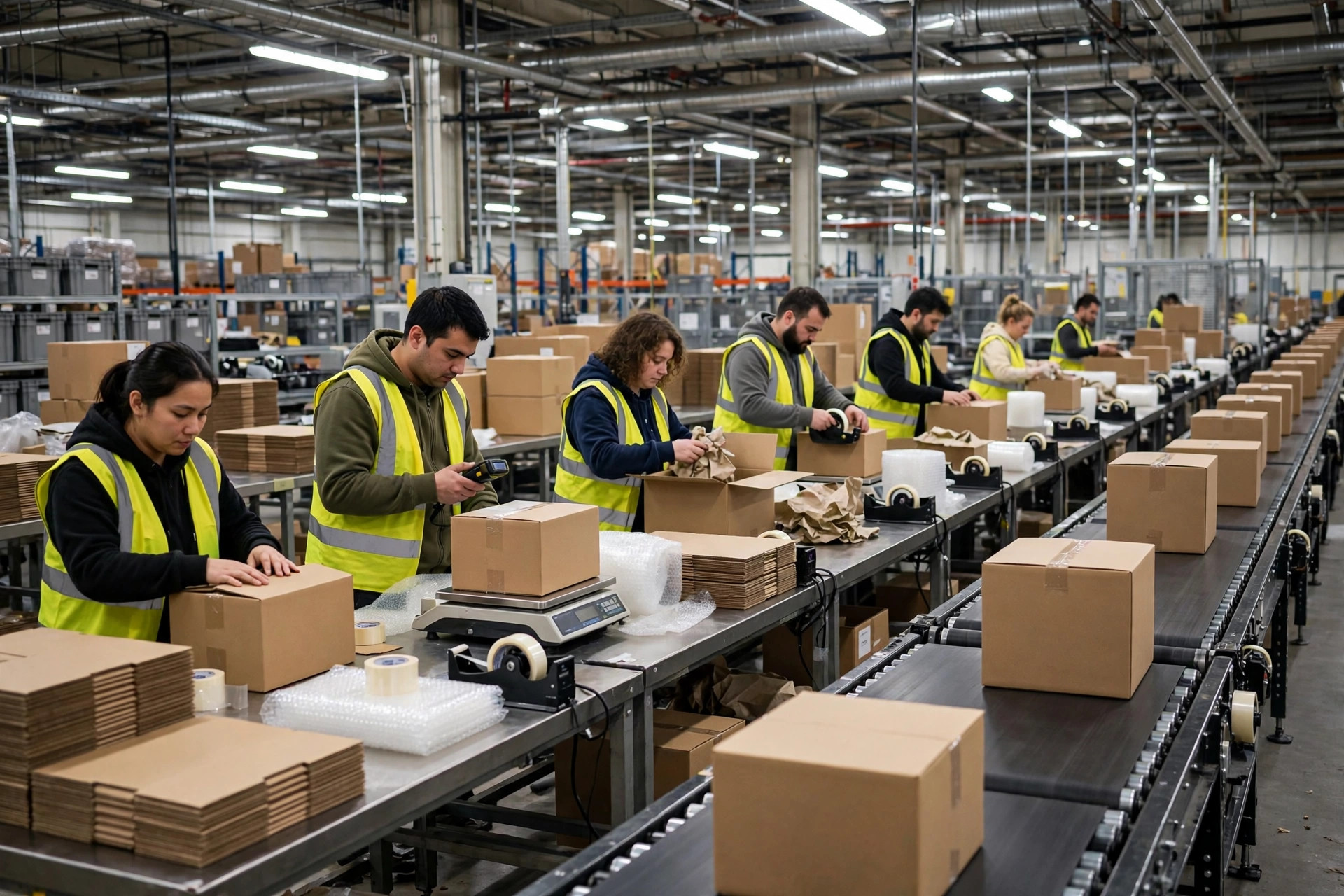
Last month I walked into a 3PL warehouse in Ontario, California — about 80,000 square feet — just as the November 2024 peak season was getting started. The owner told me his packing area was "always short-handed" and he wanted to hire four more packers. I didn't answer right away. I stood in the packing zone for half an hour with a click counter in my hand, shadowing one packer through 30 orders.
Here's what a single order looked like: pack the box at the bench, carry it five steps to the QC scan station, scan it, carry it four more steps to the floor scale, weigh it, then carry it six steps over to the label printer, slap the label on, and walk back to the bench. Fifteen steps. A lopsided little triangle. Over 30 orders I counted 400+ steps — more than half of them spent ferrying boxes between three stations that had no business being apart.
I told him to hold off on hiring. Merge those three points into one, then let's talk about headcount.
Packing is the most taken-for-granted step in the warehouse. Picking gets a WMS babysitting it. But check-weigh-label? Most operations end up with a bench here, a scale there, a printer wherever the outlet happened to be. Workers pivot, lift, and walk thousands of times a day. Every one of those steps is money — not as a metaphor. Literally.
Measure first: feet don't lie
The first step of a flow redesign isn't drawing. It's measuring. My kit is embarrassingly low-tech: a tape measure, a click counter, and the stopwatch on my phone.
Start with a spaghetti diagram. Sketch the packing area on a sheet of paper, shadow one packer for 20–30 orders, and draw a line for every segment walked. When you're done, the densest tangle on the page is your bottleneck. In that Ontario warehouse, the thickest knot sat between the QC station and the label printer — six steps of pure waste, drawn over and over until the ink bled through.
Then count steps. A healthy packer walks 8–12 steps per order. Past 15, something's wrong with the layout, not the person. Follow a complete order — from grabbing the empty carton to pushing the sealed, labeled box onto the conveyor. One or two orders won't cut it; people change their behavior when they know they're being watched. Twenty orders minimum, then average it out.
Then time the steps. In check-weigh-label, the real time sink is rarely the walking. It's the finding and the waiting: hunting for the right label roll, waiting four seconds for the printer to spit out a label, waiting three seconds for the scale to zero out. I've seen a warehouse burn seven seconds per order on waiting alone. Across 2,000 orders a day, that's nearly four hours gone to standing around.
Once you've measured, you actually know where the bottleneck lives: in the feet, the hands, or the equipment. Most managers guess. Don't guess.
Three steps, one motion: bring everything into arm's reach
The whole redesign boils down to one sentence: check, weigh, and label should all happen within a single pivot radius.
The practical version is a U-shaped packing bench. The packer stands in the middle of the U. Scan gun on a fixed mount to the left — no picking it up, no putting it down. A flush-mounted scale straight ahead, its surface level with the bench so cartons slide on instead of being lifted. Label printer at elbow height on the right, paper exit facing the operator so the label tears off and goes straight onto the box. The flow becomes: pack, slide the carton onto the scale and scan (the weight doubles as a check), tear and apply the label, push it out. Four motions. Feet barely move.
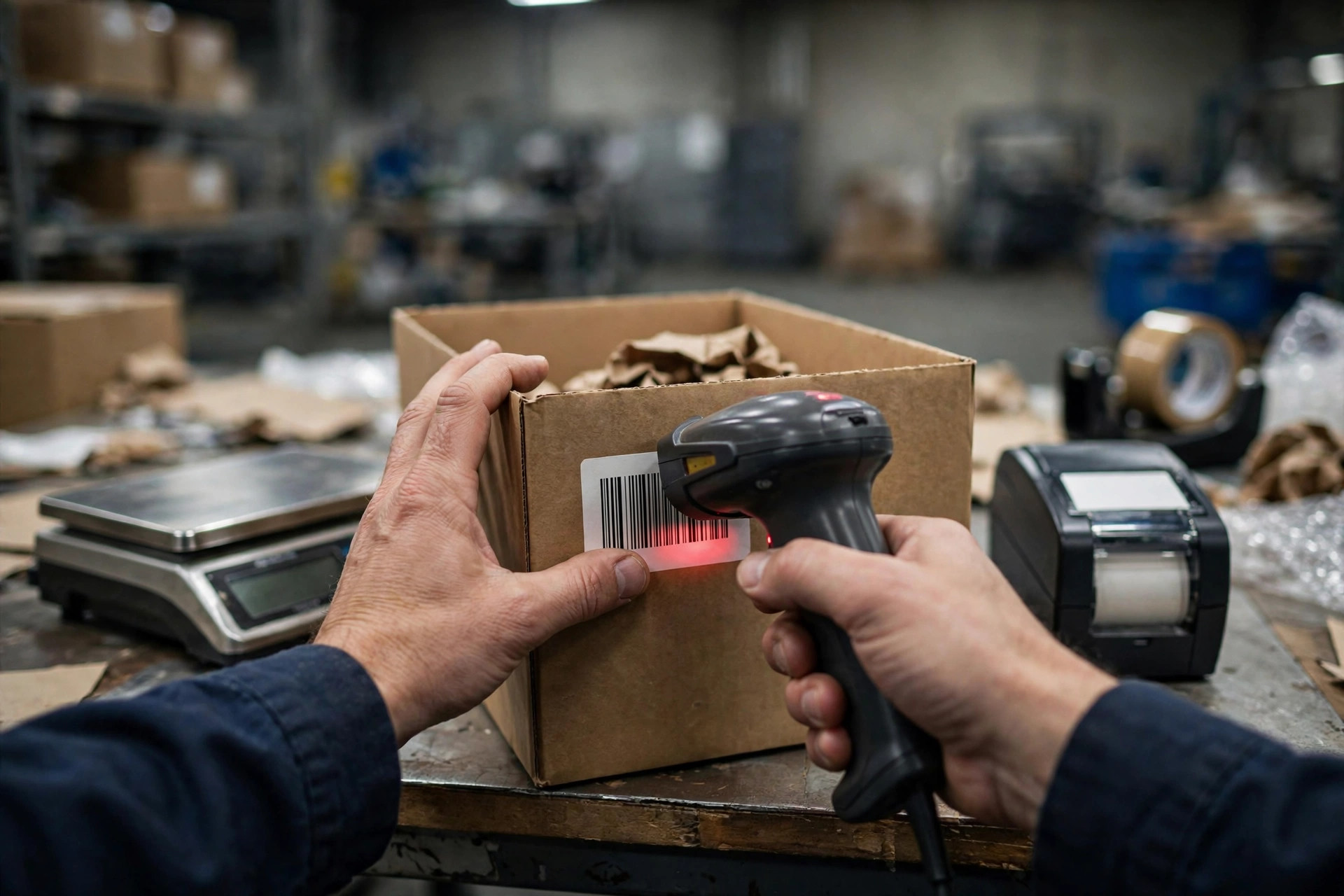
A few details make or break it:
The scale must come before the label. Never reverse the order — the weight printed on the label comes from the scale reading. Label first, weigh later, and every mismatch means rework. I once watched a warehouse put the printer ahead of the scale "for convenience" and eat dozens of weight-mismatch complaints during peak. Not worth it.
Printer exit at bench height or slightly below. Too high and wrists pay for it through thousands of tears a day; too low and backs go first. Elbow height — remember that phrase.
Consumables get their own lane. Label rolls, tape, and cartons must be replenished from outside the U, never by someone squeezing past the packer mid-stride. People lanes and material lanes stay separate — that's non-negotiable. In Ontario we added a replenishment aisle on the outside of the U; restockers loaded from out there while the packers inside never broke stride.
What did it cost? One flush-mount scale, some brackets, cable trunking, and rewiring — under five thousand dollars in materials. The expensive part is downtime: we did the work on a Sunday afternoon, half a day, and Monday morning ran normally. Never touch the packing area on a working weekday — an hour of downtime is an hour of orders you'll never get back.
Comparing before and after without fooling yourself
After a redesign, owners always ask how much productivity improved. My answer: compare labor-minutes per order, not orders per day. Daily volume swings too much to mean anything.
Take five consecutive working days before the change: total packing labor hours divided by total orders gives you minutes per order. Do the same five days after. Two conditions must hold: similar order mix (don't compare peak against off-season), and the same crew (a rookie and a veteran differ by a factor of two).
That Ontario site went from roughly 2 minutes 40 seconds per order to just over 2 minutes. At 1,500 orders a day, that's nearly 10 labor-hours saved daily — the equivalent of one and a half free headcount, before you even count fewer lifts and lower injury risk.
One honest caveat: this kind of redesign has a ceiling. It kills walking waste, not process waste. If your QC is still manual piece-by-piece scanning and weights are still copied by hand, the next bottleneck after the layout fix is the check step itself. Then it's time to talk scanner integration and automatic weight feed into the WMS — but that's another article.
One question to take home: before you leave today, check the step counter on your phone — yours, or your packers'. If the packing crew out-walks the pickers, the problem probably isn't the people. It's the flow diagram nobody ever measured.