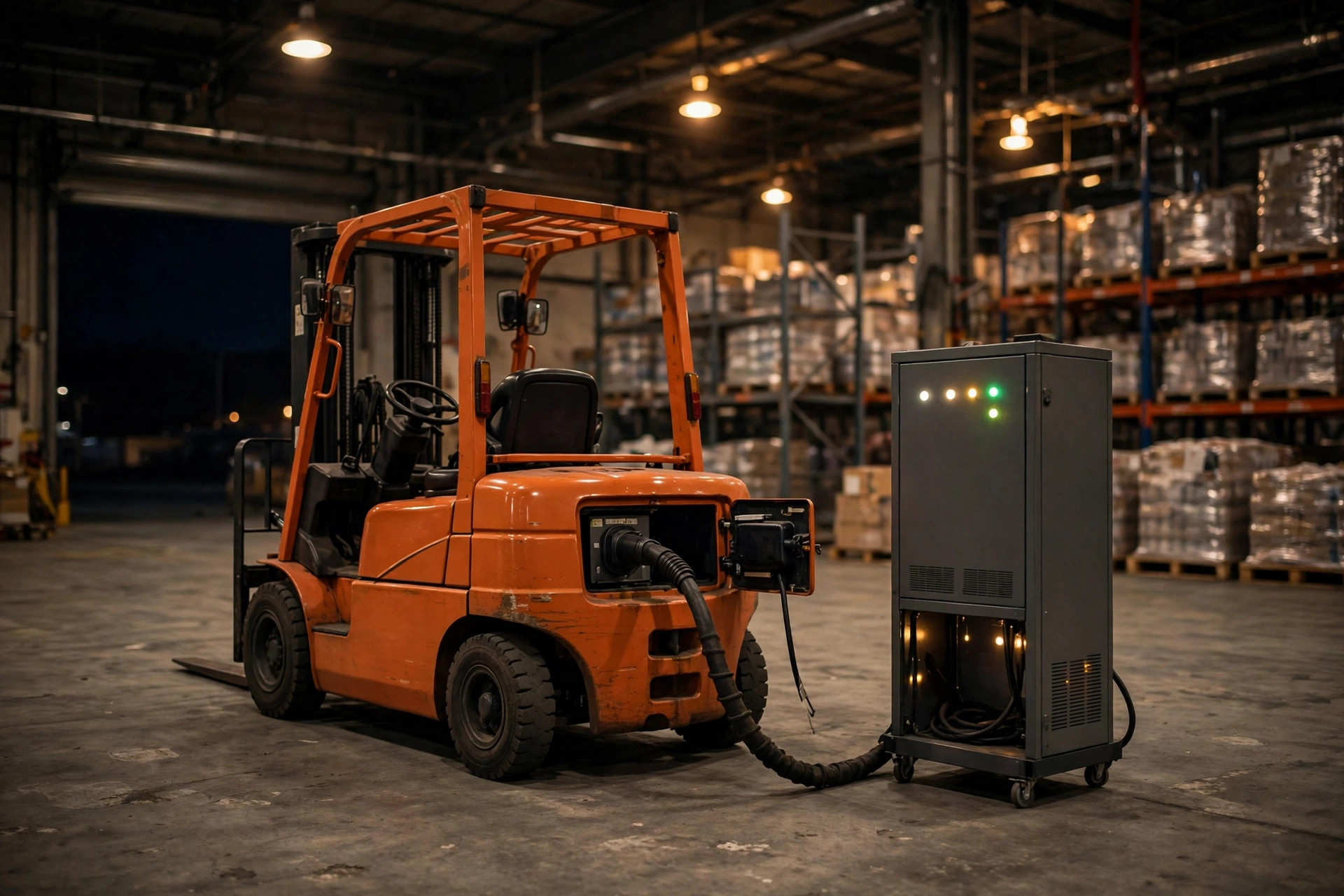
November 7th, last year. Peak season prep. I badged into the warehouse at 6:40 in the morning and my radio went off before I'd taken ten steps. The night-shift lead was yelling: "Boss, we've got a truck dead in aisle 3, and the container driver is waiting at the dock!"
I ran over. A 3-ton electric forklift sat sideways in the middle of the aisle, battery gauge empty, red light flashing. The lead-acid forklift battery charging schedule had slipped, and the night driver ran the pack past the warning line — the truck was completely dead. Old Zhang, twenty years behind the wheel, just squatted there smoking. "Too many orders last night," he said. "I figured I'd finish the batch, then charge. Then it just... died."
Three of us dragged it to the charging area with another truck. Lost over an hour. The container driver cursed us out at the dock and threatened detention fees.
That's the day lead-acid forklift battery charging became my personal project.
Where the problem came from
Peak season, we run two shifts back to back, and eight electric forklifts are never quite enough. After the aisle-3 incident, one of the younger drivers pitched me: "Boss, let's do what phones do — opportunity charging. Plug in at lunch for an hour, fifteen minutes at break. Truck never stops."
I'll be straight with you: I liked the sound of it. Opportunity charging — no downtime, no waiting, shifts run however you want.
But twenty years on the floor teaches you one thing: if it sounds too good, test it small before you roll it out.
Opportunity charging: can a lead-acid battery actually handle it?
March this year, slow season. We ran a three-month trial on two trucks: one hour at lunch, fifteen minutes at each break. Month one was great — drivers loved it. Month two, Lao Li, our charging guy, pulled me aside: "Boss, something's off with these two batteries. We're watering twice as often — used to be every two weeks, now it's weekly."
I put my hand on a battery case fresh off the charger. It was hot. My stomach dropped.
I called the battery manufacturer's tech and dug through the documentation until I had the full picture. Here's the counterintuitive part, and I want to be blunt about it: opportunity charging is a lithium playbook. Lead-acid plays by the opposite rules.
Lead-acid has three quirks, and they all cut against quick top-ups:
First, it hates heat. The industry data is unambiguous: for every 10°C above 25°C ambient, lead-acid battery life gets cut in half. A 15- or 30-minute opportunity charge pushes high current in a short burst, and the heat has nowhere to go. Do that every day and the battery runs a permanent low-grade fever.
Second, it hates being left half-done. What kills lead-acid isn't "not reaching 100%" — it's "unplugged halfway." Repeated shallow cycling grows lead sulfate crystals on the plates. The crystals thicken, capacity quietly bleeds away. The manufacturer's hard lines: don't discharge below 20%, a full charge takes about 8 hours, and the battery needs a cooldown rest afterward. The old-timers call it 8-8-8: eight hours working, eight hours charging, eight hours resting.
Third, it wants the full treatment, not snacks. Every dozen or so cycles, lead-acid needs an equalization charge to bring every cell back to the same voltage. Skip it and the cells drift apart — the weakest cell drags the whole pack down with it.
So our trial failed all three: heat, half-done charges, no equalization. The extra watering was the battery telling us it was running hot.
Does that mean opportunity charging is completely off the table for lead-acid? Not quite. The manufacturer's tech gave it to me straight: you can opportunity-charge lead-acid, but there are three non-negotiable rules — 15 to 30 minutes max, stop at 80%, and run a full equalization charge every week. Break any one of them and you're back to shortened life.
Overnight charging vs opportunity charging: the math on the table
Enough theory. Here's the ledger — three approaches, side by side:
| Overnight full charge | Opportunity charging (unmanaged) | The compromise (what we do now) | |
|---|---|---|---|
| Daily routine | Plug in at end of shift, ~8 hours charging plus cooldown, next shift takes a different truck | Plug in at lunch and breaks, truck never stops | Top up 30 minutes max at lunch, full charge overnight, equalize weekly |
| Battery life | Rated ~1,500 cycles at 80% depth of discharge; one cycle a day, ~250 working days a year — about 6 years | Lose ~30% of life with poor practice: barely 1,000+ cycles, replacement in just over 4 years | Close to full-charge life |
| The price | Need spare trucks to rotate, or run a single shift; need enough charging bays | You save "truck waiting on charge" time, but pay in battery replacements and watering labor — plus heat risk in summer | The shift lead has to own one more checklist, and someone has to mind the schedule |
I ran the numbers: losing 30% of battery life means roughly 40% more battery cost per truck per year. A traction battery pack isn't cheap, and across eight trucks that adds up fast. On the other hand, overnight charging costs you trucks — short on trucks, you buy trucks, and that's money too.
Honest answer: there's no universal right choice, only a trade-off. Are you short on trucks, or short on battery budget? Answer that first, then pick.
Our lead-acid forklift battery charging schedule today
We went with the compromise. The schedule is posted on the charging-room wall — four rules, every one earned the hard way:
One: plug in at end of shift, and it's on the handover checklist. Day shift ends, truck goes to the charging bay, plug in, shift lead signs the sheet. Night shift, same. When I rolled this out, drivers grumbled about the extra step. I walked them through November 7th again — one dead truck, one hour lost, detention fees, the whole schedule blown. Which costs more? Now it's on the handover checklist: no plug, no signature, shift isn't over. Nobody grumbles anymore. It's habit.
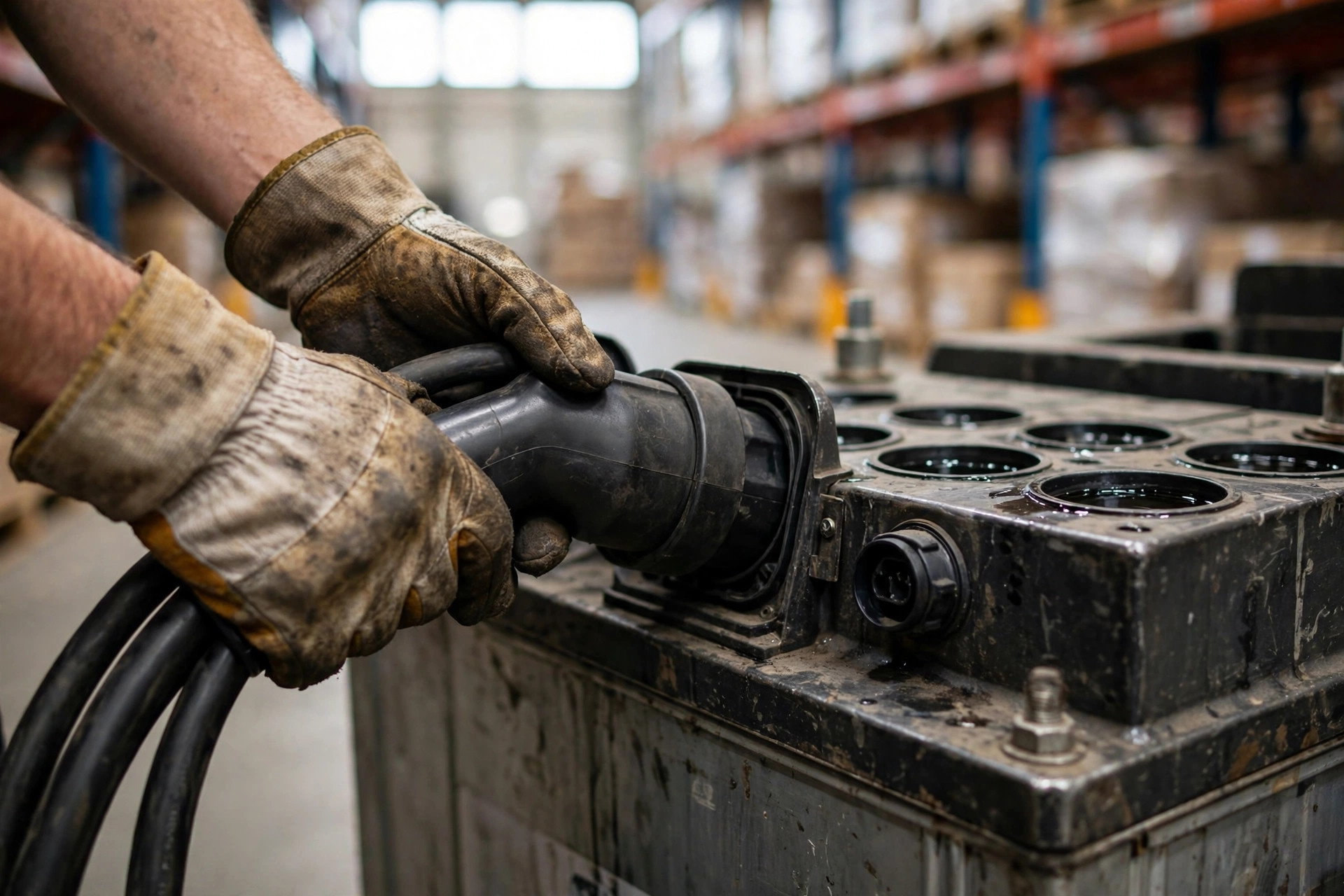
Two: lunch top-ups capped at 30 minutes. When peak season stretches us thin, lunch charging is allowed — but the hard rule is 30 minutes max, unplug around 80%. Why 30? The manufacturer's tech said it plain: fifteen to thirty minutes is the safe window. Longer than that, the heat wins.
Three: equalization charge every Friday night shift. This is the rule everyone forgets, so I gave it a fixed day: Friday. The night-shift lead owns it and checks it off on the sheet. Equalization is a reset for the battery — brings every cell back in line. With sulfation, prevention beats cure.
Four: cool the charging area in summer. Second counterintuitive point: everyone argues about charging methods, nobody looks at temperature. Our charging bay sits at the west end of the building — afternoon sun turns it into an oven in summer. Last year we put in two industrial fans and the temperature dropped noticeably. Remember the number: every 10°C over, life halves. Whatever charging method you pick, cooling the room does more for you.
Three things I'd tell anyone running a fleet:
First, don't copy lithium's "charge whenever" playbook onto lead-acid. Different animals, opposite rules.
Second, a lead-acid charging schedule isn't really about electricity — it's about people and habits. A sheet on the wall and a shift lead's signature beats any smart system. That's how we run a 200-person warehouse.
Third, when the battery runs hot and the watering interval shrinks, the battery is talking to you. Don't wait until it's dead in the middle of aisle 3 to start listening.
By Chen Feng, Warehouse Operations Manager