Last January, in the worst week of the post-holiday returns surge, I walked into the warehouse at 7 a.m. and found the returns inspection area stacked waist-high. Our rookie, Xiao Li, grabbed my arm. "Boss, this returns refurbishment work — are we fixing every single one?" I said, "Fix every one? I'll tell you straight: we'd lose money on nearly every unit. Believe me?" He didn't. Three months later, he did.
For years our warehouse had exactly one returns policy: take everything, fix everything. Sounds responsible, right? Until a Shenzhen small-appliance seller got his refurbishment invoice and went quiet — and we'd burned two weeks of labor for nothing.
That was the year before last. Two hundred-plus returned air fryers, reasons listed as "too noisy" and "heats unevenly." The seller, Mr. Chen, decided over the phone: "Refurbish all of them. Don't scrap a single one." Fine, the customer is king. We scheduled two weeks: teardown, decarbonizing, thermostat replacement, powered burn-in tests, fresh retail boxes — about 35 minutes a unit on average. When the invoice landed, per-unit refurbishment cost had climbed to nearly $30. The fryer sold for $79.99. Chen went silent for a long moment, then said, "Feng, why didn't you stop me earlier?" I said, "Chen, you were pounding the table. I didn't dare."
That one taught me the real lesson: returns refurbishment isn't about attitude. It's about arithmetic.
There's an even funnier one. A Bluetooth earbud seller insisted every return get a full power-on test plus brand-new packaging — brand image mattered, he said. Testing one unit takes 8 minutes minimum. Two people, one full day, fewer than 200 sellable units recovered, over $600 in labor burned. The earbuds sold for $25.99. He did the math himself on his calculator and changed his tune: "You guys decide. From now on, only save the Grade-A ones."
We tried the "fix everything" road: the refurbishment line ran at full roster, the crew was wiped out, and the seller's face went pale at the invoice. We tried the "scrap everything" road: the seller blew up — some units just had torn boxes, the products were perfectly fine, and he accused us of wasting his goods. We tried "let the seller decide": the seller sits in China, can't see or touch the goods, decides by gut feel, and loses money anyway. After walking all three roads, we finally got it: grading and costing have to happen together. Skip either one and it blows up.
Returns Refurbishment Step One: Grade First, Don't Touch a Screwdriver Yet
Our warehouse now runs a non-negotiable three-grade system:
Grade A: torn outer box, missing hang tag, "ordered the wrong one" no-reason returns — the product itself is fine. Wipe it down, swap the packaging, put it straight back on the shelf.
Grade B: needs real work — replacement parts, deep cleaning, retesting, new retail box. It goes to the refurbishment line, but only after the math checks out.
Grade C: dead on arrival. Water damage, cracked housings, missing core components — no rescue attempts. And one house rule: used personal-care items get scrapped no matter what. That's industry practice, and it keeps the seller out of trouble.
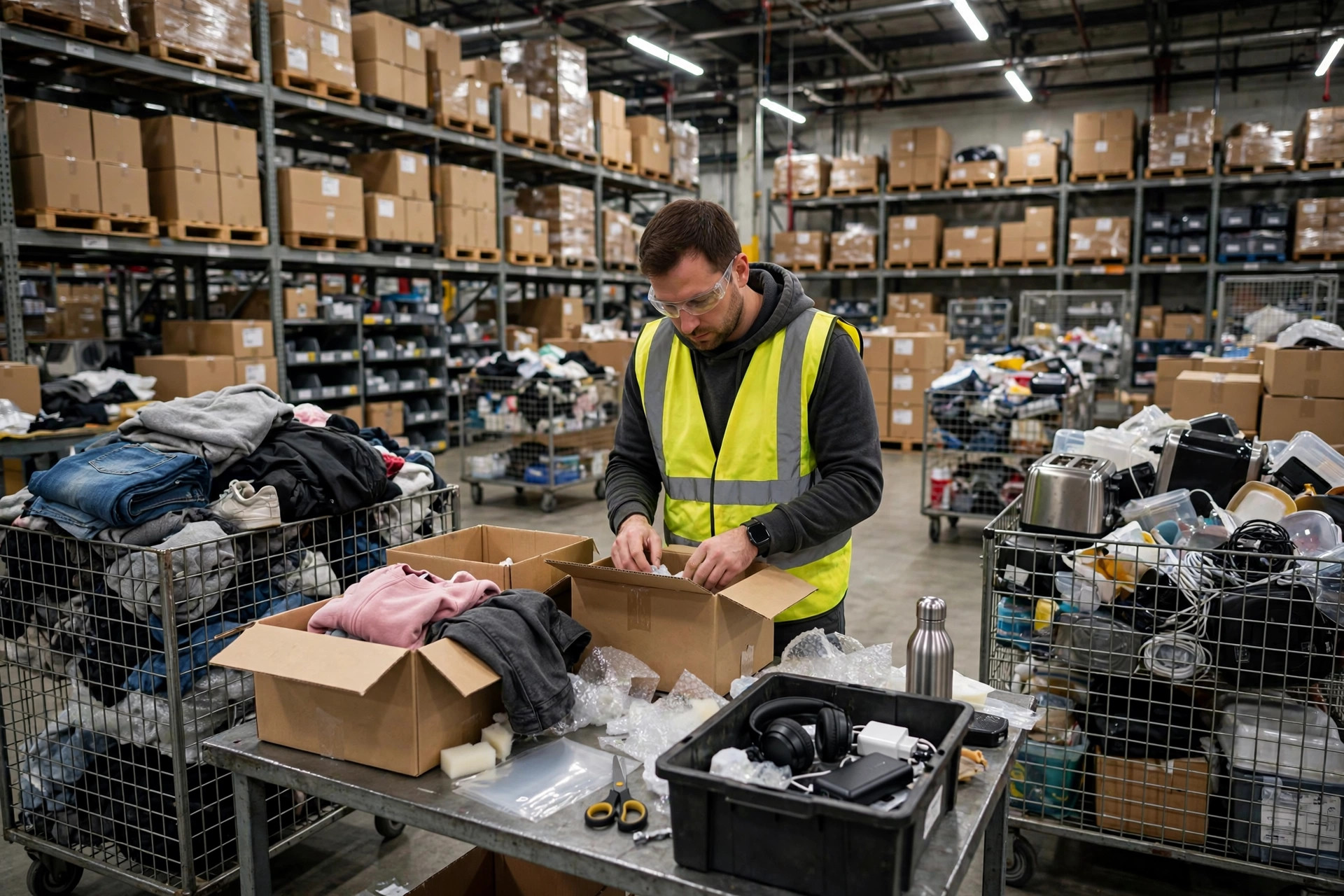
Inspection is a dedicated job here — two full-time inspectors. Our veteran, Wang Jie, trains every rookie with a seven-word mantra: "Look, sniff, power on." Check the appearance, sniff for mold or odd smells, power it on and test the functions. The classic rookie mistake is a soft heart — wanting to save everything. Wang Jie has one line that snaps them out of it: "You're not saving products. You're saving the seller's money. Save the wrong one and you're throwing it in the river."
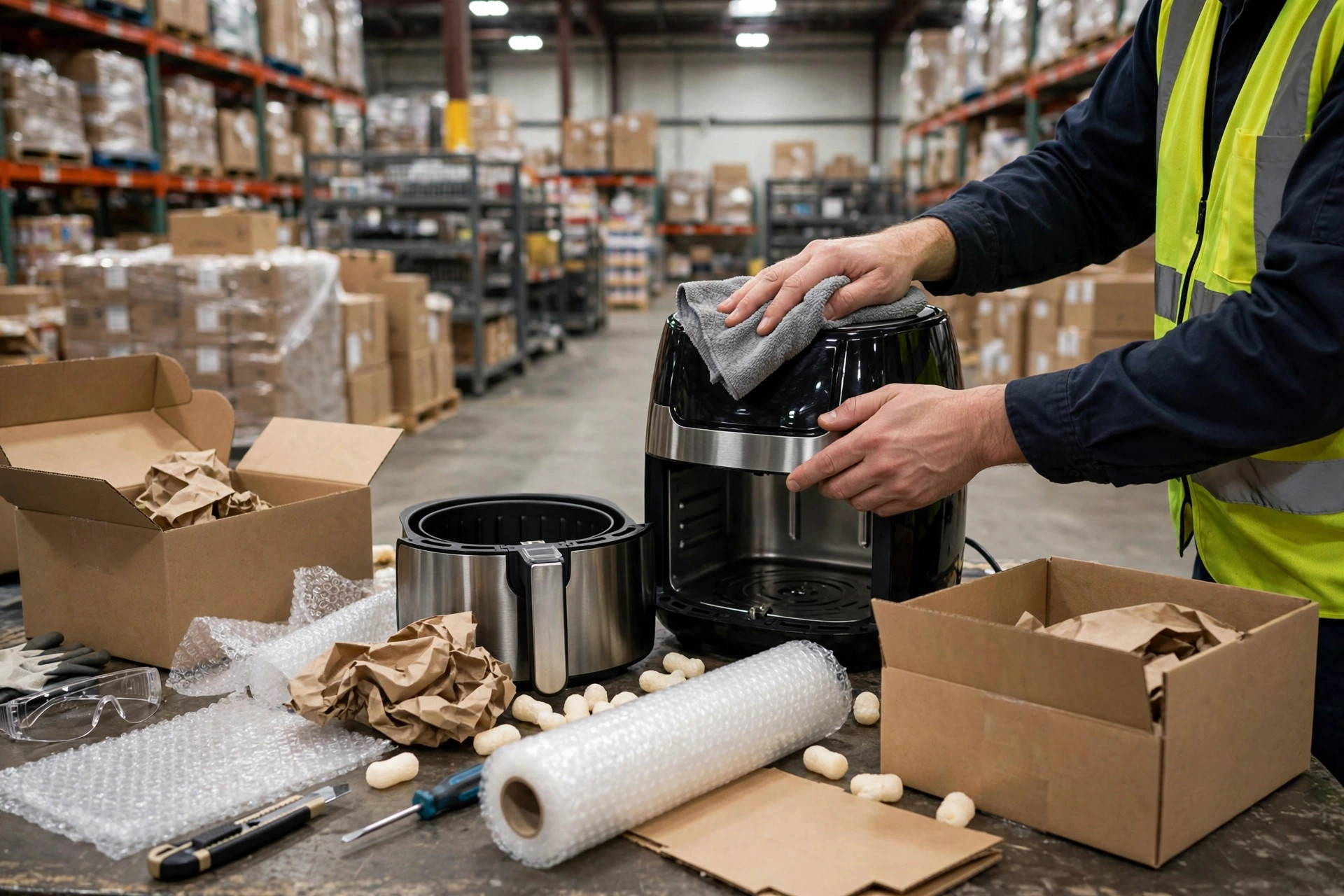
Returns Refurbishment Step Two: Run the Numbers, Line by Line
Our formula is posted on the refurbishment line wall:
Total refurbishment cost = inspection labor + refurbishment labor (hours × wage) + packaging + parts/testing + restock handling + second-return reserve
The decision line: item value minus total refurbishment cost must leave at least 30% of the item's value. Below that line, we tell the seller to scrap it, liquidate locally, or donate it.
(That 30% line is our warehouse's own rule, and every cost figure here reflects our actual operation. Cost structures differ from warehouse to warehouse — use your own numbers.)
Let's run a real example. Same $79.99 air fryer: inspection labor $1.50, refurbishment labor about 20 minutes ≈ $7, new retail box plus cushioning $3.20, power-on testing and cleaning $2, restocking $1, second-return reserve at 15% ≈ $12. Total: about $26.70. $79.99 minus $26.70 leaves $53.30 — way above the 30% line. Save it. Don't think twice.
Now a $12.99 phone case: inspection $1, repackaging $1.50, restocking $1. Just those three items total $3.50 — already 27% of the item's value. Add the second-return reserve and you're past 40%. Scrap it. Or batch them up for a local liquidator.
See the pattern? Low-value small items are structurally unprofitable to refurbish. That's not anyone's bad attitude. That's just math.
Two True Stories: One We Saved, One We Let Go
Last March, at our Los Angeles warehouse. A Dongguan lamp seller, Mr. Huang, had 200-plus returns — crushed lampshades from transit, scratched bases. Huang's first call: "Scrap them all. Out of sight, out of mind." I had Wang Jie pull 30 units for a sample check: every lamp body was perfect; only the fabric shades and outer boxes were damaged. I quoted Huang a price: new shade fabric plus fresh packaging, about $4.80 a unit. That lamp sold for $45.99. Huang hesitated for a day, then replied with two words: "Do it." We ended up saving more than 170 units, each netting back over $30 after refurbishment costs. Huang later insisted on taking us out to dinner. Said that dinner was non-negotiable.
The counter-example. After Black Friday 2024, a Christmas light-string seller sent back 800-plus units with every reason imaginable. The seller insisted: "Test them all, refurbish them all. They're seasonal — we can sell them again next year." I ran his numbers: 3 minutes to test one string, 800 strings equals 40 labor hours. At $18 an hour, that's $720 in labor alone — before packaging and storage. The strings sold for $16.99. The final deal: we saved only the 300 units with intact packaging — Grade A, straight back to the shelf — and sold the remaining 500 to a local discount liquidator at $2 a unit. Letting go recovered over $1,000 more than stubborn refurbishing would have, and freed up a month of storage and roster time. The seller later admitted: "Good thing you stopped me."
I'll Tell You Straight: Two Counter-Intuitive Calls
First: the biggest cost in refurbishment isn't labor. It's the second-return rate. Refurbished goods sold again get returned at a much higher rate than new goods. Our warehouse's observed figure: refurbished small appliances come back at roughly twice the rate of new ones (our own experience — take it as a reference, not gospel). Skip that reserve in your math and you're lying to yourself.
Second: scrap early. Delay is just burning money. Every day returns sit in the warehouse, storage fees and tied-up cash keep burning. Some sellers say "let me think about it," think for three months, then scrap anyway — three months of rent paid for nothing. Our rule now: Grade-C goods get palletized and wrapped the same day they're graded. Our truck driver, Old Mo, comes by and forks them straight out. He once argued with us about slow loading — turned out the Grade-C pallets hadn't been wrapped in advance. Since then: same-day palletizing, no exceptions.
Folks, returns refurbishment isn't about conscience. It's about the calculator. Grading is the conscience; the math is the calculator.
One more thing: whatever refurbishment plan you agree on with a seller, get it in writing in the contract — what each grade means, how it's handled, the per-unit price, who's signing. No verbal deals. Because when a fight breaks out, it's his word against yours, and the partnership is what gets hurt.
By Chen Feng, Warehouse Operations Manager