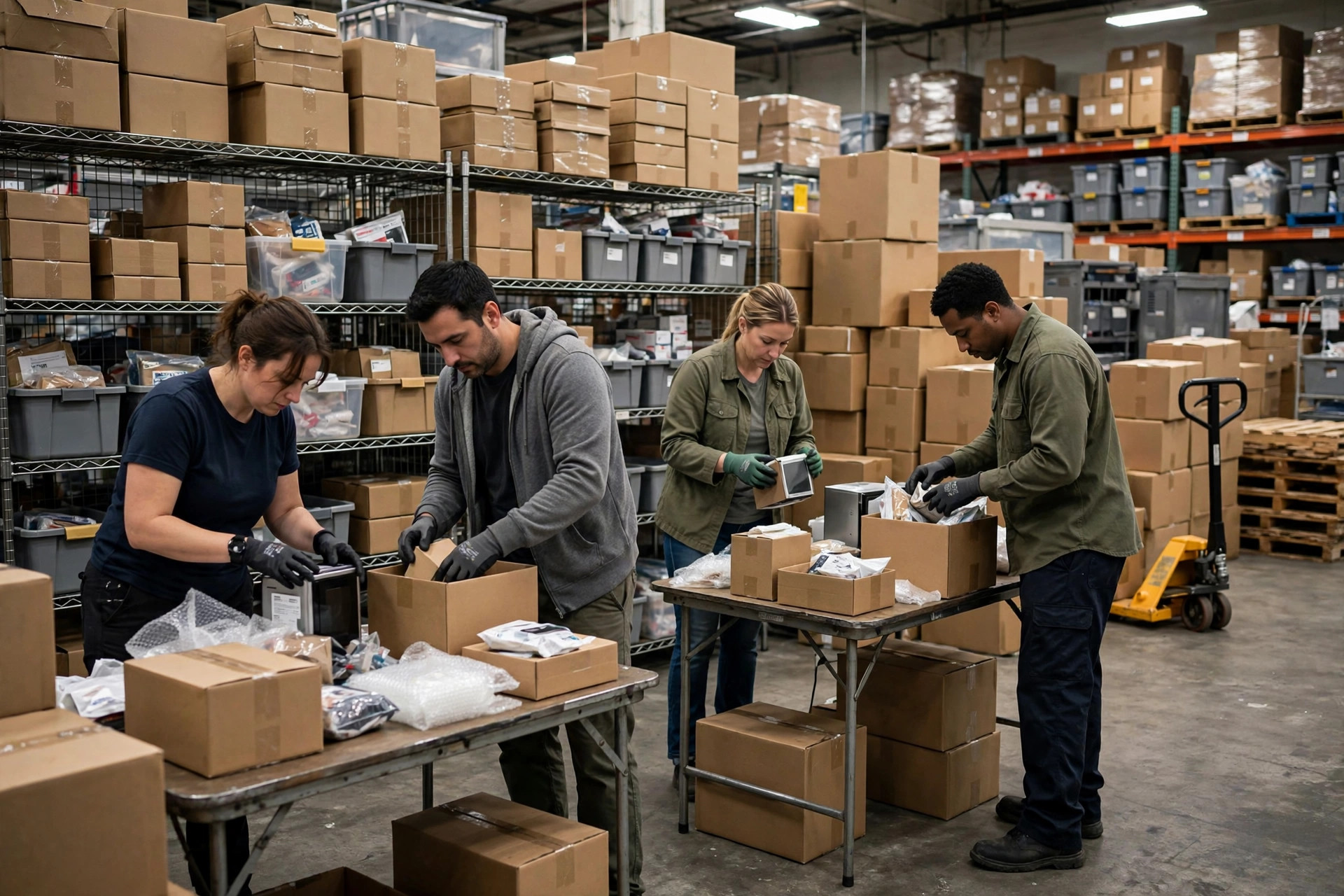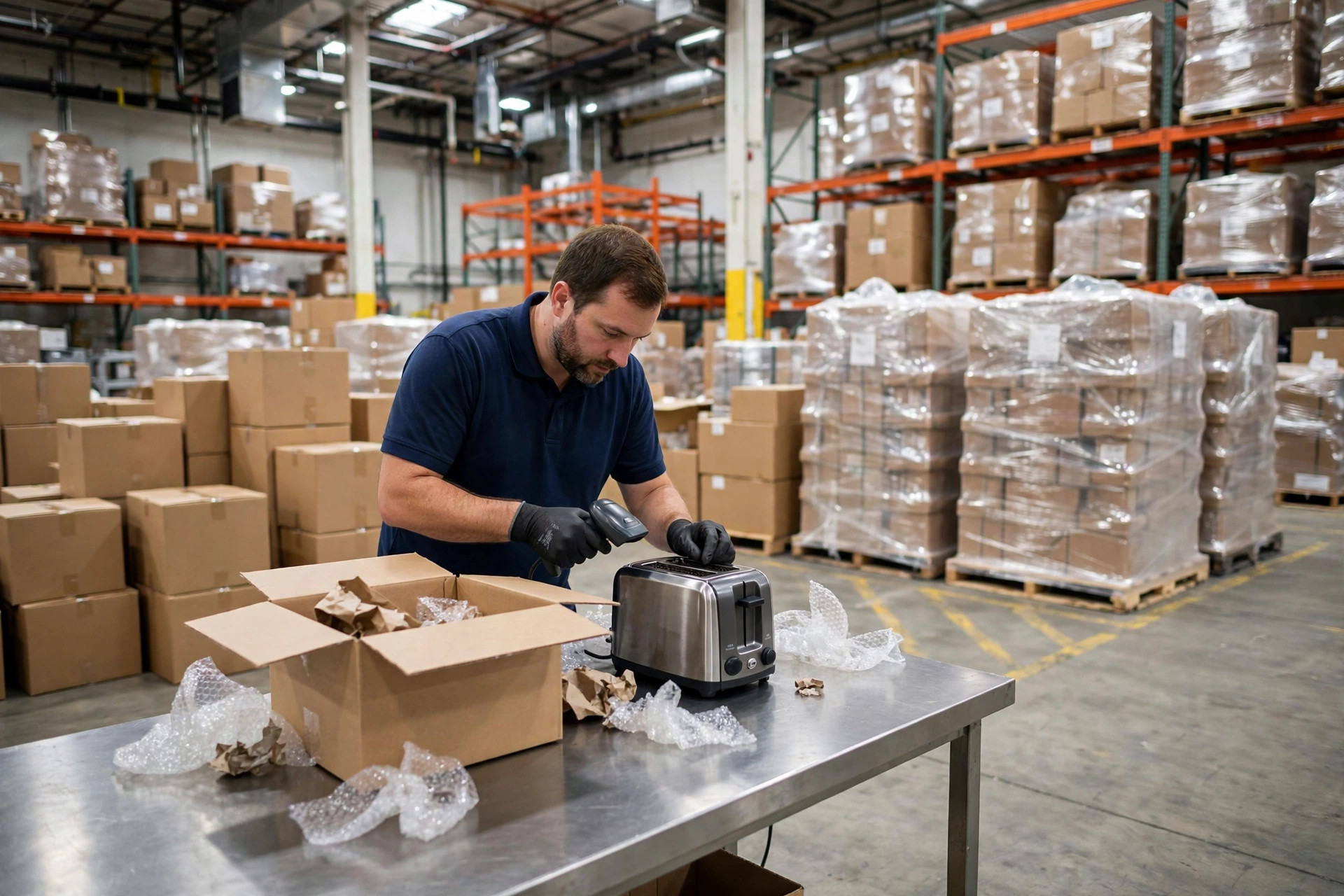
In the fall of 2023 I was walking a 120,000-square-foot 3PL in Fontana when the operations manager pulled me aside, half-proud and half-embarrassed. "Come see our returns program," he said. It was a cage in the corner of the building with four pallets of returned small appliances, a folding table, and one guy named Luis with a screwdriver and a roll of packing tape. Luis was doing everything — opening boxes, testing units, repacking, reshelving — and nobody had ever asked him what any of it cost. I asked the manager one question: how do you decide which of these get fixed and which go in the dumpster? He shrugged. "Luis knows."
That shrug is the most expensive thing in most overseas warehouses I visit. Returns refurbishment is not a technical problem. It is an arithmetic problem, and most operations are doing the math in someone's head.
Run the math before you touch a screwdriver
Start with the scale of what is coming back. The National Retail Federation puts U.S. e-commerce returns at 19.3% of online sales for 2025, worth $849.9 billion. Optoro, the returns-management firm, estimates it costs roughly 27% of an item's original price just to process the return. A $50 item costs about $13 to move backward through your building before you even talk about the refund. Every unit that lands in your returns cage is already a cost center. The only question is whether you can turn it back into revenue.
Here is the formula I use for refurbishment cost:
Refurbishment cost = inspection labor + testing labor + cleaning consumables + repack materials + restock labor
For labor, I anchor to Bureau of Labor Statistics 2025 data: median hourly wage of $22.06 for hand laborers and material movers, $22.42 for shipping and receiving clerks. That is before payroll taxes and benefits, so treat $22 an hour as the floor. Now let me walk a real unit through it — a $49.99 countertop toaster, the single most common return in that Fontana building:
Grade A, basically new: 8 minutes of inspection ($2.90) + replacement outer carton ($1.80) + poly bag ($0.40) + 5 minutes to restock ($1.80). Total: about $6.90. It goes back on the shelf at $49.99. Easy yes.
Grade B, open-box but working: add cleaning and retesting, labor stretches to 15 minutes, cost lands around $11. The box is shot so it cannot sell at full price; it goes to a secondary channel at $29.99. Net after cost: under $19. Thin, but it moves.
Grade C, intermittent heating element: 30 minutes of diagnostic teardown ($11) + replacement part ($6) + repack, pushing cost toward $19. A unit with a flaky element only sells on a liquidation pallet, roughly $10 a unit — about 20% of retail. That is a $9 loss. Fixing it is literally paying money to lose money.
The point: refurbishment cost is not one number. It jumps with the condition grade. And most warehouses only count "labor plus a box," missing testing time, rework, and dwell time — which is exactly where the losses hide.
Four grades. No more.
I rebuilt that Fontana cage with four grades, and I am strict about the number. More grades and the inspectors cannot keep the boundaries straight, which means the boundaries drift, which means money leaks.
Grade A, like-new resellable: no signs of use, all accessories present, passes full function test. New outer carton, relabel, back to the pick shelf at full price.
Grade B, open-box: works fine, but shows light wear or the packaging is destroyed. Must be listed as open-box at 60 to 70% of retail, with the flaw described honestly in the listing.
Grade C, repairable defect: fixable, but the fix has a real cost. These never go back to retail channels. They go to liquidation pallets or wholesale clearance.
Grade D, scrap: dead core components, missing critical parts that are unavailable or cost more than half the residual value, or any safety issue — swollen batteries, damaged power cords, gas-related products. Straight to scrap.
The inspection sequence is fixed at seven steps: scan and log, unbox, photograph three shots (exterior, all accessories laid out, serial number), cosmetic check, accessory check against the packing list, power-on function test, grade with a color sticker, route to one of four staging areas. The photos are non-negotiable. When a customer says "it was fine when I sent it back," photos are the only evidence that matters, and they settle grading disputes too.
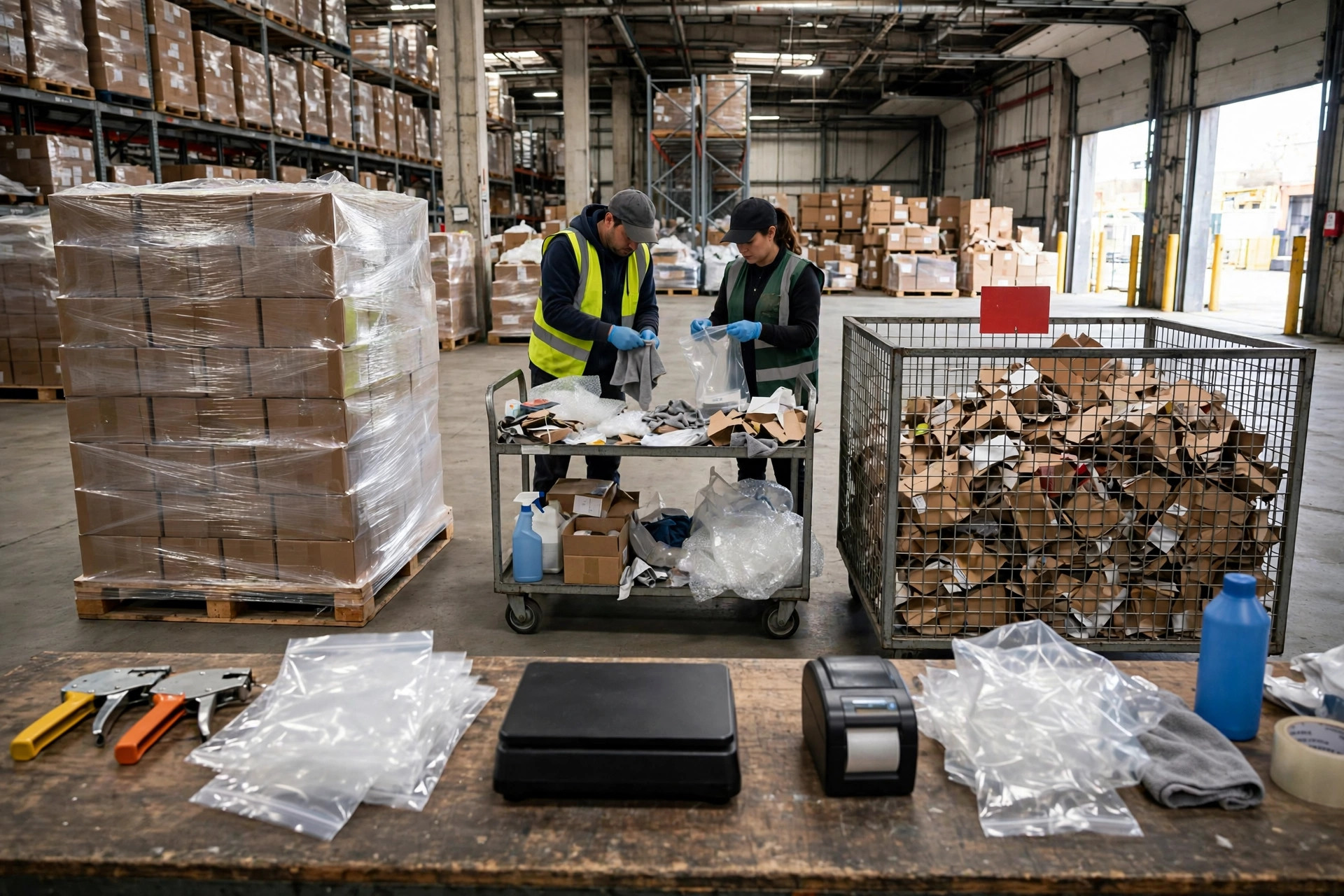
The grading standard goes into the SOP and gets taped to the front of the inspection table. The moment grading becomes "Luis knows," the line between A and B starts drifting within a week, and every drift is dollars.
Where to draw the scrap line
One decision formula:
Net recoverable value = expected sale price × (1 − marketplace commission) − refurbishment cost − outbound shipping cost − dwell/storage cost
My scrap threshold: if net recoverable value ≤ refurbishment cost × 1.2, it goes to scrap or liquidation. The 20% cushion is for "we fixed it and found another problem." Rework is the silent killer of returns economics — a unit repaired twice is a guaranteed loss, and that cushion is paid for in scars.
Then three hard lines that are not negotiable:
Safety items never get refurbished for direct resale. Batteries, power supplies, anything gas-related — even if you can fix it, you do not sell it as refurbished. That is a liability line, not a cost line.
Missing parts with no official replacement available, or a part that costs more than half the residual value, go straight to scrap. Do not set them aside "for later." Later is storage fees.
Anything sitting ungraded for more than 30 days gets automatically downgraded one grade. Time is the most expensive thing in a warehouse. A Grade B unit that sits in the corner for two months becomes a Grade C price.
Where the money actually leaks
Three leaks I have watched in person.
The first is grade inflation. Inspectors paid per piece naturally grade upward — calling something Grade A looks like good work; calling it Grade D looks like laziness. So Grade B units sneak into Grade A, customers receive open-box goods as new, leave bad reviews, and the unit comes back for a second round of refurbishment. One unit, two cost cycles. The fix is unglamorous: audit 5% of graded units weekly and tie misses to performance. Three months of that at the Fontana site and their Grade A resale return rate dropped visibly.
The second is scrap with no paper trail. Scrapping needs two signatures, photos on file, and a disposition log. This is not about distrusting your people — it is about the fact that "it was scrapped" is the easiest sentence in a warehouse. Without documentation, nobody can say whether a unit was truly destroyed or walked out the back door.
The third is no secondary channel lined up in advance. Grade A goes back to the original marketplace easily enough, but Grade B and C need their outlets arranged before you need them: Amazon Warehouse, eBay refurbished sections, your own clearance storefront, and B-Stock-style liquidation auctions for Grade C pallets (industry rule of thumb: pallets typically clear at 20 to 50% of retail). You negotiate channels before the cage is full. Once it is full, you have no leverage.
Returns refurbishment is a craft, but the craft is arithmetic: grading is the ruler, cost accounting is the scale, the scrap line is the knife. With all three, the returns cage stops being a cost black hole and starts being a margin source.
So here is my question for you: is your returns refurbishment actually making money, or has nobody ever run the numbers? If it is the latter, pull today's returns log tonight, pick one unit, and run it through the formula above by hand. The answer might make you redraw your scrap line.