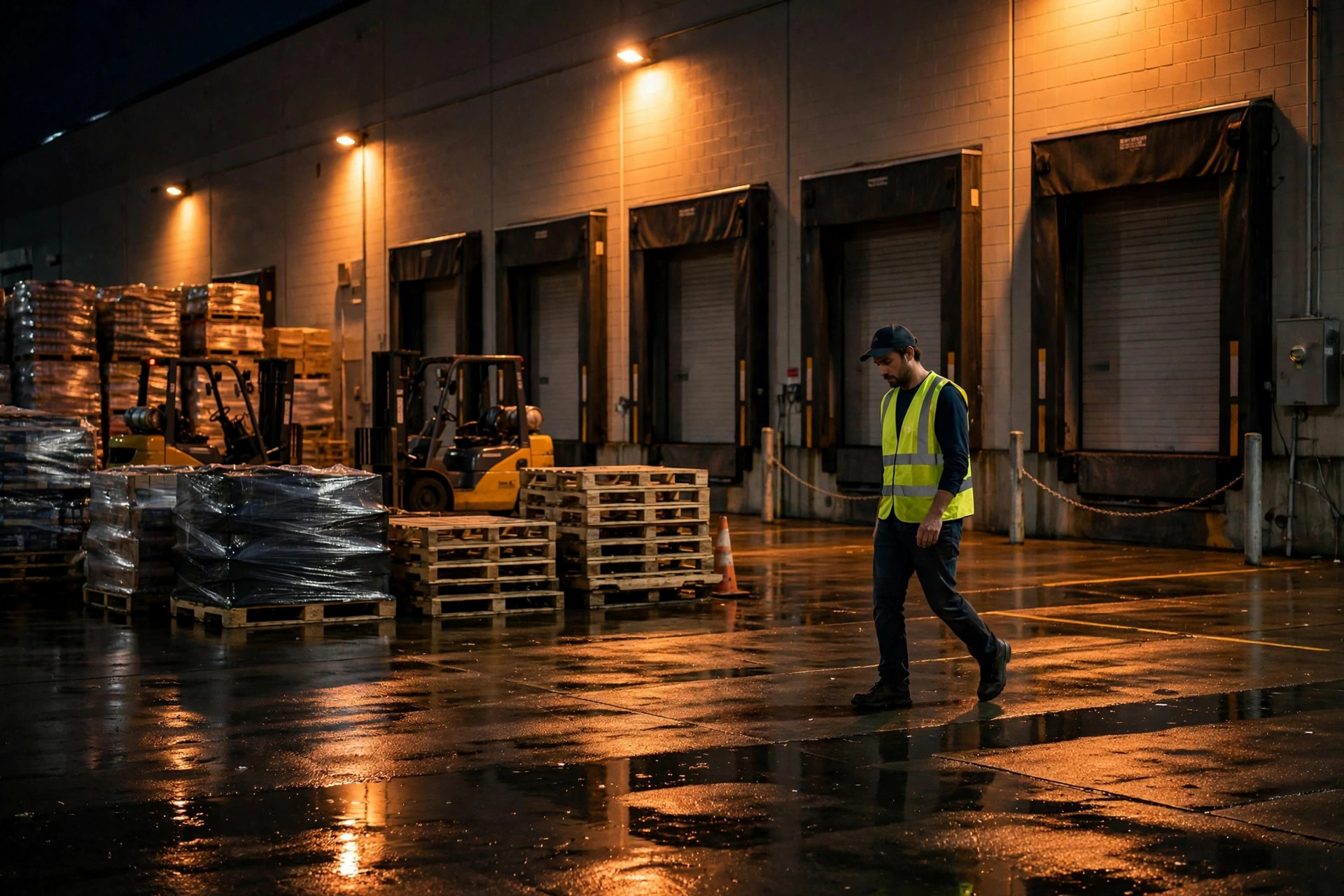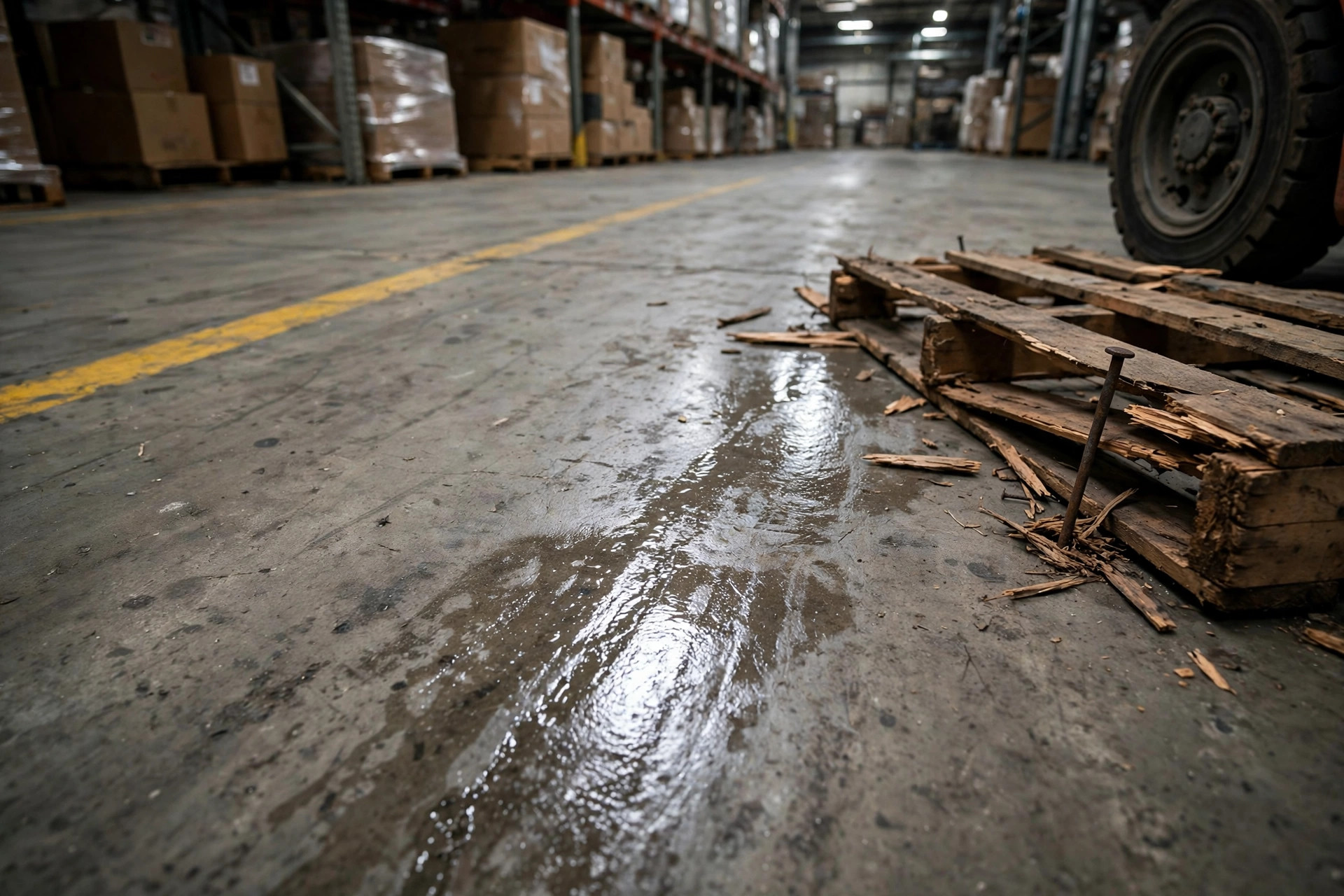
It was 6:30 in the morning, rainy season, night shift wrapping up. One of our guys, Zhao, walked in from the dock and stepped on a scrap of stretch film. Full split, right there on the concrete. His knee swelled up like a steamed bun. Hospital, incident report, OSHA visit. That scrap fell off a pallet two nights earlier during receiving. Somebody swept, but missed a corner. Listen — nine times out of ten, a slip-and-fall is not "bad luck." It is a floor nobody owns. OSHA's walking surfaces rule, 1910.22, exists for exactly this.
Here's the honest truth: in warehousing we treat forklifts and racking like the enemy — hard hats, speed limits, guard rails, the works. But what actually puts people in the hospital is the floor under their feet: oil stains, water, cables, pallet debris, popped nails. They don't make noise. They wait until you're rushing an order. When an OSHA inspector walks into a warehouse, 1910.22 is one of the first things on the list, because it is almost impossible to bluff — the rule goes down to the level of "is the floor dry, are there nails."
What OSHA's Walking Surfaces Rule 1910.22 Actually Says
29 CFR 1910.22, general requirements for walking-working surfaces, final rule from 2016. Here is the warehouse-relevant part in plain English:
- (a)(1): All workplaces, passageways, storerooms, and walking surfaces must be kept clean, orderly, and sanitary.
- (a)(2): Floors must be kept clean and, to the extent feasible, dry.
- (a)(3): Walking surfaces must be free of hazards like protruding nails, loose boards, corrosion, leaks, spills, snow, and ice.
- (b): Aisles and passageways must not be blocked, and floor load limits must be posted.
- (c): Openings in the floor (dock pits, maintenance holes) must have covers or guardrails.
- (d): Walking surfaces must be inspected, maintained, and repaired on a regular basis. Inspecting without fixing counts as nothing.
One-line version: floors dry, clean, unblocked, and not collapsing — with somebody checking them on a schedule. Meet that, and an inspector walking in doesn't scare you.
The 5 Spots Where Warehouse Workers Actually Go Down
Every floor incident we've had in the last few years comes back to the same five places:
1. The dry-to-wet transition at the dock door. In rainy season, forklift tires drag water inside and create a wet band about ten feet past the door. A shoe sole steps off dry epoxy onto a water film and friction drops by half before your brain catches up. We now lay absorbent mats at the dock doors in rainy season and swap them every 2 hours — not wipe, swap.
2. Charging cables. Forklift charging cords stretched across the aisle. Guys step over them a thousand times, no problem — until a shoelace catches on attempt number one thousand and one. We moved the charging area against the wall, ran cables through overhead trays, and covered the rest with floor cable ramps. No cable is allowed to touch the ground anymore.
3. Pallet debris and popped nails at the breakdown area. Broken wood pallets leave splinters and raised nails everywhere. They are small, sweepers miss them, and hand-sweeping feels like a waste of time. In September 2023, a 3PL warehouse in Dallas had a night-shift worker step on a raised nail at the pallet breakdown station. It went through his boot sole and he needed several stitches in his foot. It was logged as a recordable injury, OSHA inspected on site, and the company got a citation under 1910.22(a)(3) — penalty amounts follow OSHA's latest penalty schedule, with a single serious violation now running into the tens of thousands of dollars and willful violations into the hundreds of thousands. The owner later said that nail cost him a forklift.
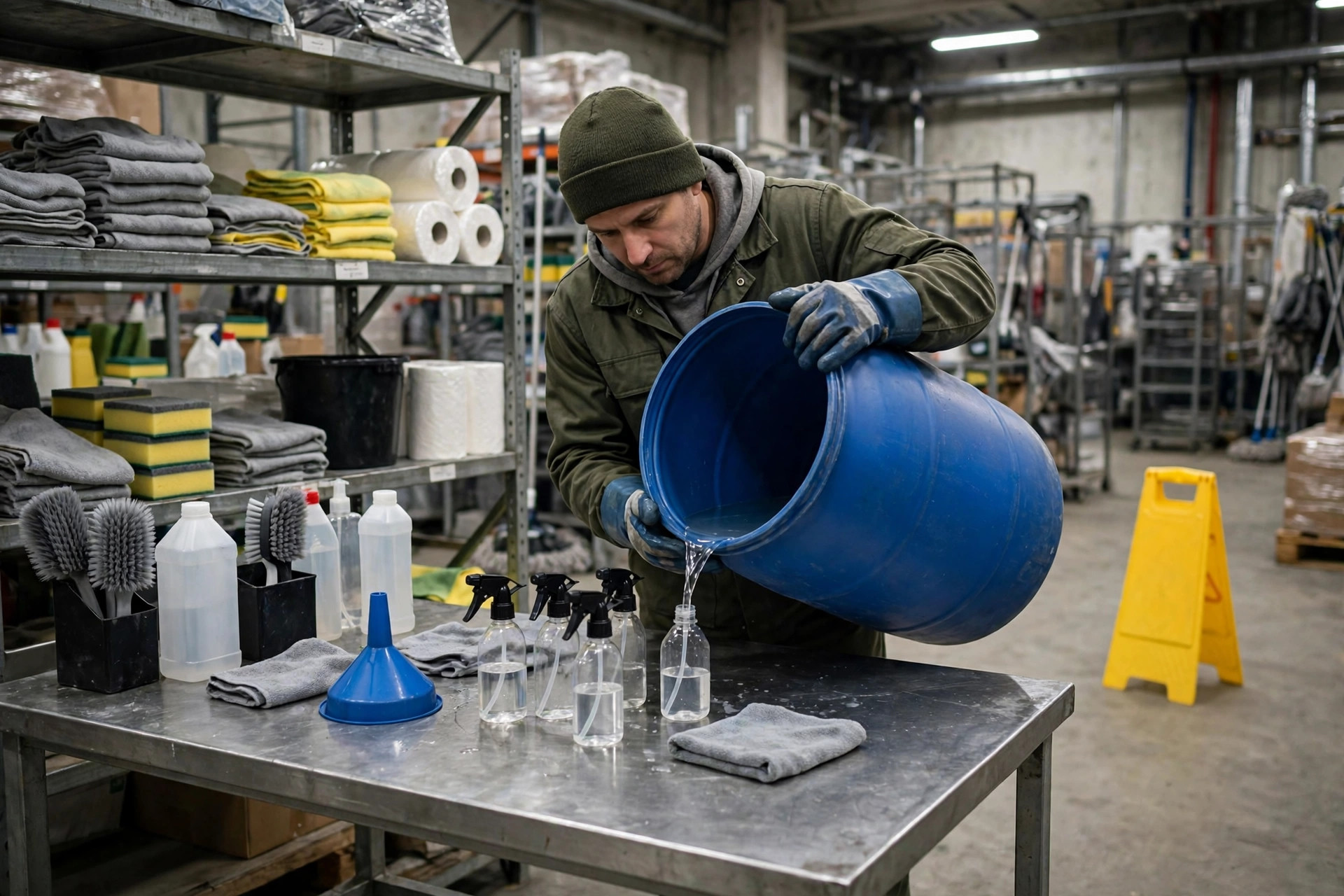
4. Oil. Old forklifts leak hydraulic fluid, lube drums tip over, and an oil film on concrete is nearly invisible — slipperier than ice. Our rule now: clean it the moment you see it, report the forklift for repair the same shift, and every oil drum sits on a spill containment tray.
5. Roof leaks and condensation. In June 2024 our own warehouse got hit: a roof drain pipe cracked overnight, and by dawn the main aisle had two fingers of standing water. A forklift driver hit the brakes, slid, and the truck swung into a picker's foot. Luckily it was just bruising. The real lesson from the review: the most dangerous part wasn't the puddle — it was the transition line between dry and wet. Our old checklist said "any standing water on the floor." Nobody checked the water band at the boundary. The checklist now has its own line item for it.
The True Cost of One Slip-and-Fall: Real Numbers
Everyone thinks "it's just a fall, how bad can it be." Let me run the real math, based on a mid-size 3PL warehouse like ours:
| Item | Ballpark |
|---|---|
| Medical + lost-wage compensation | Several thousand dollars |
| OSHA citation (serious violation) | Per OSHA's latest penalty schedule — a single serious violation can exceed $10,000; willful violations start in the six figures |
| Workers' comp premium increase | Higher experience-mod rates for 2–3 years, several thousand dollars |
| Downtime + overtime for cover | Headcount × days, several thousand dollars |
| Morale and turnover | Hard to quantify, but the night crew watching a stretcher leave does not forget it |
Total: one recordable slip accident easily clears five figures. Now compare that with prevention: a bucket of anti-slip coating costs a few hundred dollars, cable ramps cost tens of dollars, a month of absorbent mats runs a few hundred, and a 15-minute weekly walkthrough costs nothing. You do the math.
Counterintuitive Truth: The Priciest Coating Is Worth Less Than Someone Who Owns the Floor
We learned this the hard way. In 2022 we spent thousands coating the entire floor with anti-slip paint, thinking it would fix the problem for good. Six months of forklift traffic wore it down, and people slipped anyway. It finally clicked: slip prevention is a frequency problem, not a materials problem.
What actually works are three cheap things: swap the mats often, fix leaks the same day, and have someone walk the floor looking down once a week. Equipment is dead; frequency is alive. One more counterintuitive one: a waxed floor is more slippery than an unwaxed one. Some warehouses wax the floor to make it "look clean" — shiny, yes, and the friction coefficient drops a grade. Shiny does not mean safe. Don't let your eyes lie to you.
Warehouse Slip Trip Fall Audit Checklist: Ours, Clause by Clause
This is the version our supervisors use every Monday morning: a 15-minute "walk with your head down," photos on file. Each line maps to a 1910.22 clause, so if OSHA walks in, you hand them the log:
| Clause | What to check | Our practice |
|---|---|---|
| (a)(1) | Floors clean and orderly | 10-minute end-of-shift cleanup: debris, stretch film, nails down to zero |
| (a)(2) | As dry as feasible | Rainy season: dock mats swapped every 2 hours; leaks fixed within 24 hours |
| (a)(3) | No nails, loose objects, oil | Nails collected daily at the breakdown area; oil cleaned on sight + forklift reported |
| (b) | Aisles clear, load limits posted | Main aisle clearance marked, staging zones lined, load-limit signs on the wall |
| (c) | Floor openings covered/guarded | Dock pits and maintenance openings get barriers + warning signs while open, covered immediately after |
| (d) | Regular inspection and repair | Supervisor walkthrough every Monday, 15 minutes, photos on file |
Two extras we added ourselves, not in the rule, that already saved someone: no charging cable touches the floor (overhead trays or ramps), and check the weather forecast before every shift in rainy season — on heavy-rain days we station someone at the dock door with a mop.
A Word for Fellow Warehouse Managers
Three things, take them or leave them. First, don't wait for rainy season to manage your floors — prepare in the dry season: drainage slope, absorbent mats, cable ramps. Rainy season is for grading your work, not starting it. Second, the first thing an OSHA inspector does walking in is look down at the floor — your checklist and walkthrough photos are your best evidence. Third, slips and falls don't care about peak or off-season. Either the floor is managed or it isn't. Your people's knees don't negotiate.
By Chen Feng, Warehouse Operations Manager