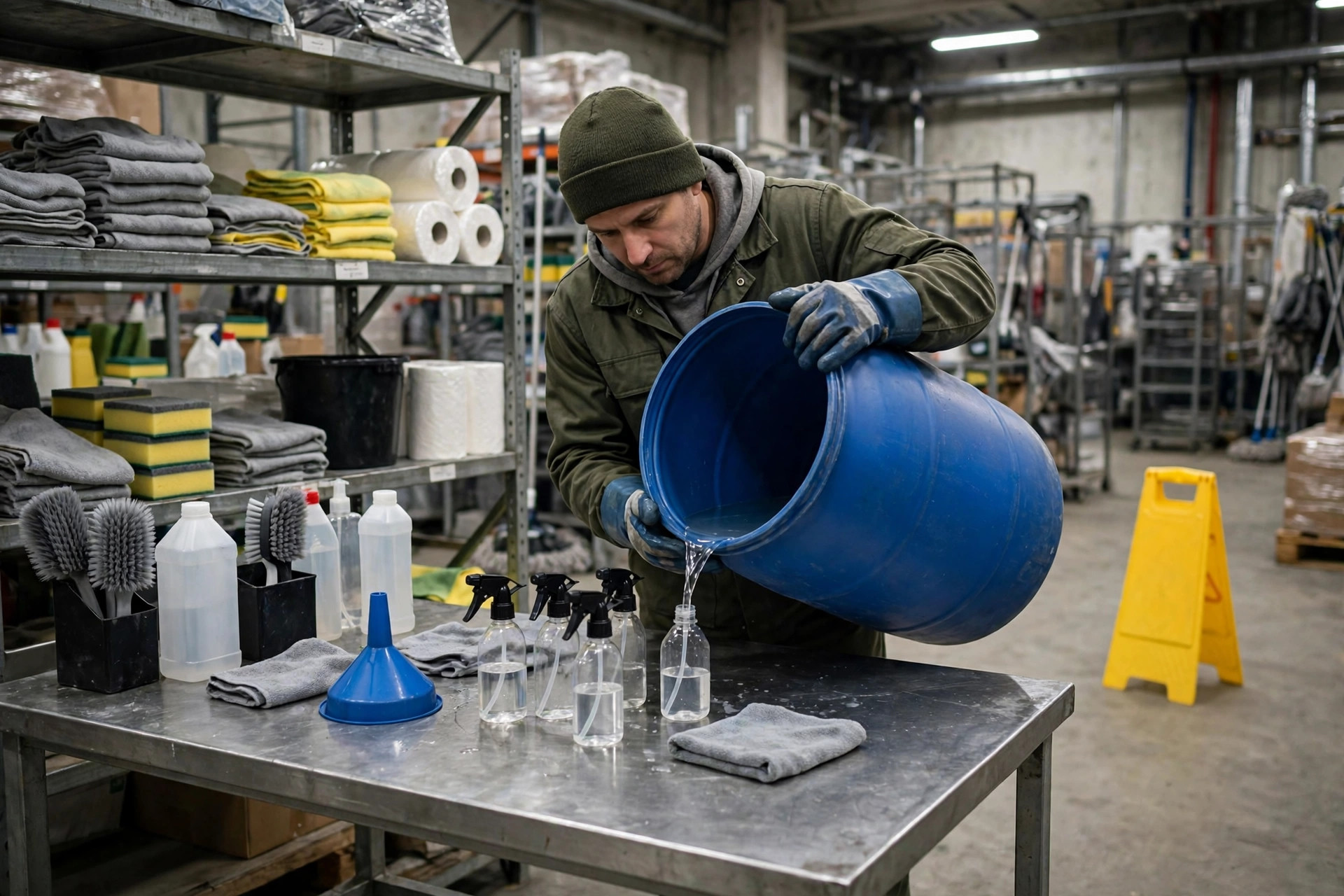
OSHA's Hazard Communication standard (29 CFR 1910.1200) gives warehouses two compliant options for secondary container labeling — the spray bottles and small jugs that cleaning chemicals get decanted into. And yet, walk through almost any US warehouse and you will find the HazCom program's weakest link exactly there: not on the labeled drums in the chemical cage, but on the cleaning cart, in a row of bottles nobody can name.
The enforcement pattern is consistent. HazCom ranks year after year among OSHA's most-cited standards, and an inspector's warehouse walkthrough follows a near-fixed route: first the cleaning cart and decanting area (do the spray bottles have names?), then the SDS file (can it be produced in minutes?), then the employees (do they know what the symbols mean, and where the SDS lives?). Secondary container labeling is the first gate — and the one where the most facilities fall.
Secondary Container Labeling: The Two Options Under 1910.1200(f)(6)
The provision is titled "workplace labeling," and its structure matters: every container of hazardous chemicals in the workplace must be labeled, tagged, or marked — with either of two options. OSHA deliberately left room for employer judgment instead of a single prescription.
Option one, (f)(6)(i): the full label, i.e., the information elements required for shipped containers under (f)(1)(i) through (v) — product identifier, signal word, hazard statement(s), pictogram(s), and precautionary statement(s). In practice, this means transferring the supplier drum's label content onto the small bottle.
Option two, (f)(6)(ii): the product identifier plus words, pictures, symbols, or a combination, providing at least general information about the hazards — combined with the other information immediately available to employees under the hazard communication program (chiefly the SDS), which must give workers the specific physical and health hazard information. NFPA 704 diamonds and HMIS bars both live in this lane, as "pictures, symbols" systems.
Why would OSHA allow the second path? The regulatory logic is worth unpacking. In the HazCom framework, the label is an immediate visual warning, not the chemical's complete dossier; the complete information lives in the SDS. Compliance analysts at J.J. Keller put it precisely: the workplace label exists for at-a-glance hazard recognition, and the product identifier's job is to let the employee locate the matching SDS. Option two was never permission for a sloppy label — it is permission for a label plus an instantly retrievable SDS to jointly form the complete information chain. Every word saved on the label has to be paid back in the SDS and in training.
The trade-off between the two options:
| Option 1: full information (f)(6)(i) | Option 2: simplified label (f)(6)(ii) | |
|---|---|---|
| Label content | Name + signal word + hazard statements + pictograms + precautionary statements | Product identifier + hazard symbols/keywords |
| Production cost | High — a full set per chemical | Low — one symbol system reused |
| Training demand | Lower — the label carries the information | High — workers must read the symbol system and retrieve SDSs |
| Best fit | Few chemicals, high turnover, outsourced janitorial | Many chemicals, mature training program |
| Typical failure | Wrong pictogram, missing signal word | Diamond with no product name; SDS nowhere to be found |
The real decision variables are two: how many chemical products you run, and how mature your training is. A small warehouse with a handful of products should just take option one. A large site with dozens of products and a stable workforce can sustain option two — with real training behind it. The worst combination, and the most commonly cited one, is option two with no supporting training or SDS access.
The "Immediate Use" Exemption Has Three Boundaries
Many warehouses have heard of the immediate-use exemption; more use it wrongly than rightly. The text sits at (f)(8): no label is required on a portable container into which a hazardous chemical is transferred from a labeled container, provided it is "intended only for the immediate use of the employee who performs the transfer."
Unpacked, that is three red lines:
First, the same person. The employee who pours and the employee who uses must be one and the same. A row of filled spray bottles left on the cleaning cart "for whoever needs them" does not qualify — each bottle needs a label.
Second, immediate use. Decanted and used within the same shift, same task — not overnight, not across shifts. Decanted by the night shift for the day shift to use does not qualify. Poured into an open cup "to use in a bit" does not qualify either.
Third, the source must be labeled, and the receiving vessel portable. Decanting from an unlabeled drum has no exemption to begin with.
The logic behind the exemption is worth stating plainly: it holds only while "the information is still in someone's head" — the person who poured knows what is inside and will use it up immediately, so living memory substitutes for the label's information function. The moment the chemical leaves that person or that time window, the information chain breaks, and the label has to be restored. Once you see it this way, questions like "does two hours count as immediate" answer themselves — the test is not elapsed time but whether the information chain is intact.
Warehouse Walkthrough: Secondary Containers From Decanting Station to SDS Station
Translating the rule to the warehouse floor means walking the inspector's route yourself.
At the decanting station: keep only the shift's chemicals there, no stockpiling. Every spray bottle's label should answer three questions — what is inside (product identifier), what is the hazard (symbol or keyword), and where the SDS is (a location reference). Adding the decanting date is good practice for traceability. Keep empty bottles separate from bottles that held chemicals, so nobody inherits the mystery of "what was in this one before."
At the SDS station: one SDS per chemical in use, in the 16-section GHS format. A paper binder or an electronic terminal both satisfy the rule, which requires only that SDSs be "readily accessible to employees in their work area throughout each work shift." Electronic access needs a backup plan for outages — inspectors have asked more than one warehouse that question. New-hire HazCom training follows (h)(1) and must cover the chemicals actually used on site and the site's labeling system, not a generic video.
Two enforcement-side cases show how this logic gets tested.
The first at a Midwest distribution center: the inspector found a row of unlabeled spray bottles on a cleaning cart, and the employee on the spot could not say whether they held disinfectant or adhesive remover. The (f)(6) citation was followed by a training citation when the new-hire HazCom training records turned out to be empty. The lesson: the spray-bottle problem is rarely isolated — it is usually a symptom of missing training. Labels, SDSs, and training are the three legs of HazCom; break one and the other two get found eventually.
The second from a 2023 logistics-park inspection: more than a dozen dock cleaning chemicals — disinfectants, glass cleaner, adhesive remover, rust remover — with no SDSs on file. The inspector cited each missing SDS separately, because HazCom penalties are calculated per violation, and the more products, the longer the citation list. This pattern repeats in OSHA enforcement records with remarkable consistency: cleaning chemicals, being "not production materials," are the easiest to leave out of the hazard communication program — and the dock is exactly where inspectors walk.
Two contrarian points deserve to stand alone.
First, "we stuck an NFPA diamond on it, so we're compliant" is a misunderstanding. The diamond can serve as the (f)(6)(ii) symbol system, but with no product identifier, with employees unable to read the diamond, and with no retrievable SDS, that diamond is decorative. The symbol is one link in the information chain, not the whole chain.
Second, "small bottles don't need labels" is equally wrong. HazCom sets no size-based exemption for workplace labeling. The 2024 rule actually moved the other direction: new (f)(12) sets minimum label information for small shipped containers (100 ml and under, 3 ml and under). The trajectory is tightening, not loosening — "the bottle is small" has no textual support.
Where Enforcement Is Heading After the 2024 Rule
On May 20, 2024, OSHA published the HazCom final rule aligning with GHS Revision 7; it took effect July 19, 2024. In January 2026, OSHA extended the compliance deadlines by four months across the board: for employers, updating workplace labels, the written program, and training is due November 20, 2026 for substances and May 19, 2028 for mixtures (confirm current dates against osha.gov).
The trend call needs evidence, and the evidence is the timeline. Over the next two years, the inspection emphasis will shift from "is it labeled" to "is it labeled correctly": does the label match the updated SDS, can employees genuinely retrieve the SDS on demand, does training cover newly identified hazards. The practical meaning for warehouses: walk your secondary-container labels against the current SDSs now, not in November 2026. The transition window — during which either the old or the new standard may be followed — is the cheapest moment to get the labeling system straight.
One boundary for this article: it covers paper compliance for labels, not chemical storage segregation, stacking, or spill response — those belong to a different set of OSHA, EPA, and NFPA requirements. Warehouses that merge the two into one undifferentiated EHS manual tend to manage neither well.
Labeling secondary containers is not technically hard. What makes it hard is that it sits in a zone nobody owns — EHS assumes operations handles it, operations assumes the janitorial contractor handles it. The open question worth watching: when the November 2026 employer deadline arrives, how many warehouses will still be running 2012-era labels on their spray bottles? The enforcement data will tell.
By Dr. Chen, Supply Chain Researcher