It was 4:40 on a Tuesday morning, two weeks into peak season. I was halfway through my coffee when the night-shift lead called: "Feng, unit 7's brakes are gone. Driver pumped the pedal three times coming down the dock ramp and it went straight to the floor."
Nobody got hurt. The driver steered into a stack of empty pallets and stopped the truck that way — scared the hell out of everyone within fifty feet. When we pulled the inspection sheet for unit 7, the last two weeks were a perfect wall of checkmarks.
Here's the thing nobody wants to admit about the forklift pre-operation inspection checklist OSHA requires: most warehouses don't have an inspection program. They have a signature program.
The Truck That Crashed Had a Perfect Inspection Record
Let me tell you about the summer before that. Third shift, around 11 PM. One of our electric lifts was heading to the dock when the steering went dead on the ramp — a steering hose fitting had worked loose and bled hydraulic fluid all over the floor. The truck kissed a rack upright. Slow speed, no injuries, but a full pallet of product went down — over twenty grand in damaged goods, plus a bent upright we had to replace.
Afterward we found the leak had been there at least two days. The inspection sheets for those two days? All checks. Including the hydraulic lines item.
That's the real enemy of any forklift pre-operation inspection checklist: not laziness — it's inspection theater. A checkmark takes one second. A real walkaround takes three minutes. And "the truck was fine yesterday" feels like a safe bet, right up until the day it isn't.
What OSHA Requires in Your Forklift Pre-Operation Inspection Checklist
Let's get the regulation straight, because this isn't my rule.
OSHA standard 29 CFR 1910.178(q)(7) says powered industrial trucks must be examined before being placed in service, and a truck with any condition adversely affecting safety must not be used. The examination has to happen at least daily — not weekly, not "when we get around to it."
The price of ignoring it: OSHA adjusted penalties for inflation in January 2025. A serious violation runs up to $16,550 per violation; a willful or repeated one up to $165,514. Those figures were unchanged for 2026. Check OSHA's website for the latest numbers.
In March 2024 we got a surprise OSHA visit — a noise complaint, and the inspector decided to look at our forklifts while he was at it. First thing he asked for: six months of forklift inspection records. We had them — continuous, every truck, every day, with the shutdown days noted and explained. He spent twenty minutes on it and moved on. No citation on that item.
A buddy of mine at another 3PL wasn't so lucky. His records had a two-month gap. One serious citation. Sixteen grand — that buys you half a new lift truck.
So here's what I've learned about record retention: the regulation doesn't say how many years to keep the sheets. The inspector is looking for continuity. We scan our paper sheets into a shared drive and keep three years. Accident investigation, insurance claims, a follow-up visit — every one of them starts with "show me the records."
Our 3-Minute Forklift Pre-Operation Inspection Checklist: 12 Fixed Points
After those two incidents, we rebuilt our checklist from scratch. One rule: one driver, three minutes, one loop around the truck. Anything longer than three minutes falls apart during peak.
The order is fixed — you walk one loop, no backtracking:
- Tires: nails, chunking, wear lines (on cushion tires, check the wear markers — when they're gone, the tire is done)
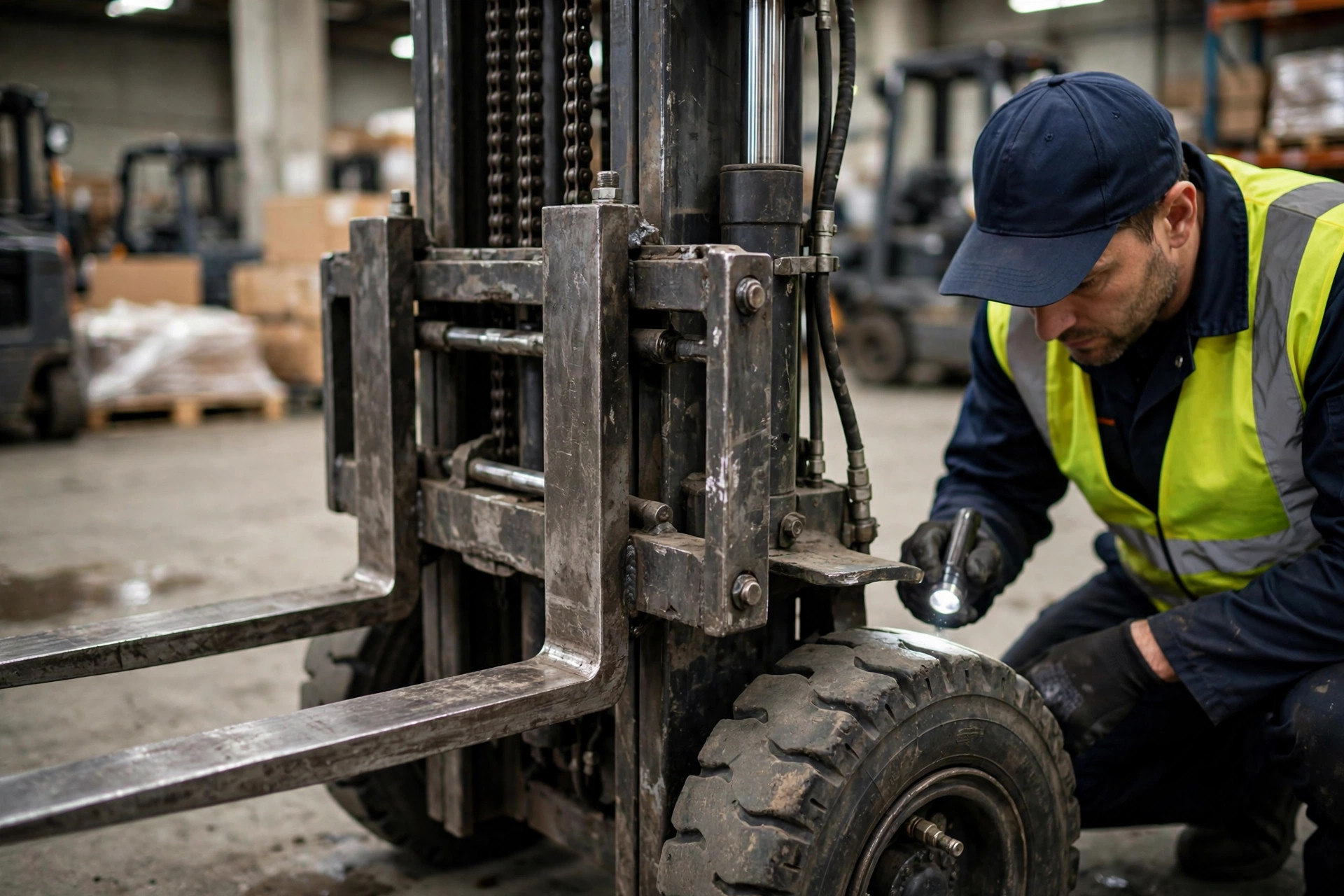
- Forks: cracks, bends, heel wear, height difference between the two forks — get down and look at the fork heels, that's where cracks start
- Mast chains: even tension both sides, lubrication, broken strands
- Hydraulic hoses: leaks, bulges, loose fittings — especially the ones behind the mast
- Brakes: service brake and parking brake, roll half a meter empty to feel them
- Steering: full lock both ways, listen for noise or binding
- Lights, horn, backup alarm: test each one
- Dash: battery and fuel level, any warning lights on
- Seatbelt: yank it, make sure it locks (a broken belt is worse than none — it gives you false confidence)
- Overhead guard and load backrest: bent, cracked welds
- Fire extinguisher: present, needle in the green (non-negotiable on LP trucks)
- The floor under the truck: walk the full loop and look for fresh oil or fluid — if you see it, don't start the truck, call maintenance
Getting drivers to actually do this took three tries. Version one: checklist taped to the truck, driver ticks the boxes. Result: a wall of checkmarks, zero inspections. Version two: supervisors spot-check every morning. Worked fine until peak hit and the supervisors were buried in the operation.
Version three is what stuck, built on three ugly-but-effective tricks:
First, tie it to dispatch. No inspection submitted (now it's a phone scan), no first assignment from the system. Not a fine — you just sit idle. Nothing motivates like watching everyone else get loads.
Second, veterans own the rookies. A new driver's first month, inspections happen with the trainer, and the trainer co-signs — shared accountability. The old hands cursed me for a month. Three months later they were converts, because the process actually caught real defects.
Third, we pay a $50 monthly safety bonus to the driver who reports the most defects. Counterintuitive? A sheet full of reported problems means the inspection is real. The most dangerous warehouse isn't the one finding problems — it's the one with three straight months of perfect checkmarks.
Do the Math: Paper or Digital, and What 3 Minutes Really Costs
Someone always says three minutes slows down shipping. Let's do honest math.
One truck: 3 minutes × 250 working days = 750 minutes, about 12.5 hours a year. What does 12.5 hours buy you?
The cost of running a sick truck: our 2022 rack strike cost over $20,000 in damaged product, plus the upright replacement and labor, plus four days with that truck in the shop — four days of its workload dumped on the rest of the fleet right before peak. And if that truck had hit a person instead of a rack? There's no math for that.
Zoom out further: one OSHA serious citation, up to $16,550. How much is 12.5 hours of labor? You do the math.
And here's the trade-off I'll defend anywhere: I'd rather park a truck for 30 minutes in the morning waiting on maintenance than let it run sick all day. Thirty minutes costs you thirty minutes of capacity. Running sick gambles the whole building. Not a hard call.
One more thing, because inspectors really do look at this: paper or digital? Paper sheets are cheap, drivers like them, the veterans don't push back — but the handwriting is illegible, sheets get lost, and good luck figuring out "which truck keeps breaking" by flipping through a stack. Phone-based checklists (photo plus tap-to-submit) give you bulletproof records with automatic timestamps, and you can actually analyze which trucks and which checkpoints generate the most issues — but the veterans hated it at first, and during peak it feels like one step too many.
Our sequence: paper first, for the better part of a year, until the habit was real — then digital. Don't reverse that order. A tool can't fix a habit problem; once the habit exists, the tool just speeds it up.
Now we pull the data quarterly: which trucks get flagged most, which checkpoints fail most. Last year, tires and hydraulic hoses were sixty percent of our flags — so we doubled the spare stock on both, and night shift hasn't waited on parts since. That's the real value of keeping forklift pre-operation inspection records: not surviving the inspector, but seeing your own operation clearly.
One reminder for fellow operators
Folks, a forklift pre-operation inspection program isn't won by having the prettiest form. It's won in those three minutes every morning, by someone actually walking the loop.
Before the inspector shows up, your records are your shield. After he leaves, they're still your eyes on the fleet. Tomorrow morning, grab a veteran and walk those twelve points with him — you might find out your "perfect checkmarks" are theater, just like ours were.
Find it early. Sleep better.
By Chen Feng, Warehouse Operations Manager