Over the past year, nearly every warehouse operator I have spoken with has asked the same question: we want to turn our SOPs, equipment manuals, and historical work orders into an internal knowledge base with a Q&A bot — should we go with RAG, or fine-tune a large language model? It looks like a technology choice, but underneath it are three ledgers: how fast your knowledge changes, what a wrong answer costs, and which approach your team can actually sustain.
Looking at the landscape first: based on my review of public industry reports and vendor case studies, among enterprise knowledge-base Q&A projects that actually went live between 2024 and 2026, RAG (retrieval-augmented generation) has become the de facto mainstream architecture. The technique was introduced by Meta in 2020 (Lewis et al.), and the core idea is simple: instead of cramming knowledge into model parameters, the model retrieves relevant documents first and then generates answers grounded in what it retrieved. Fine-tuning takes the other road: continue training the model on your own Q&A data so the knowledge gets "pressed" into the parameters. Both roads work, but their cost structures, risk profiles, and boundaries are entirely different — and the price of choosing wrong only shows up about six months after launch.
What RAG Actually Looks Like in a Warehouse: Traceability Is Its Lifeblood
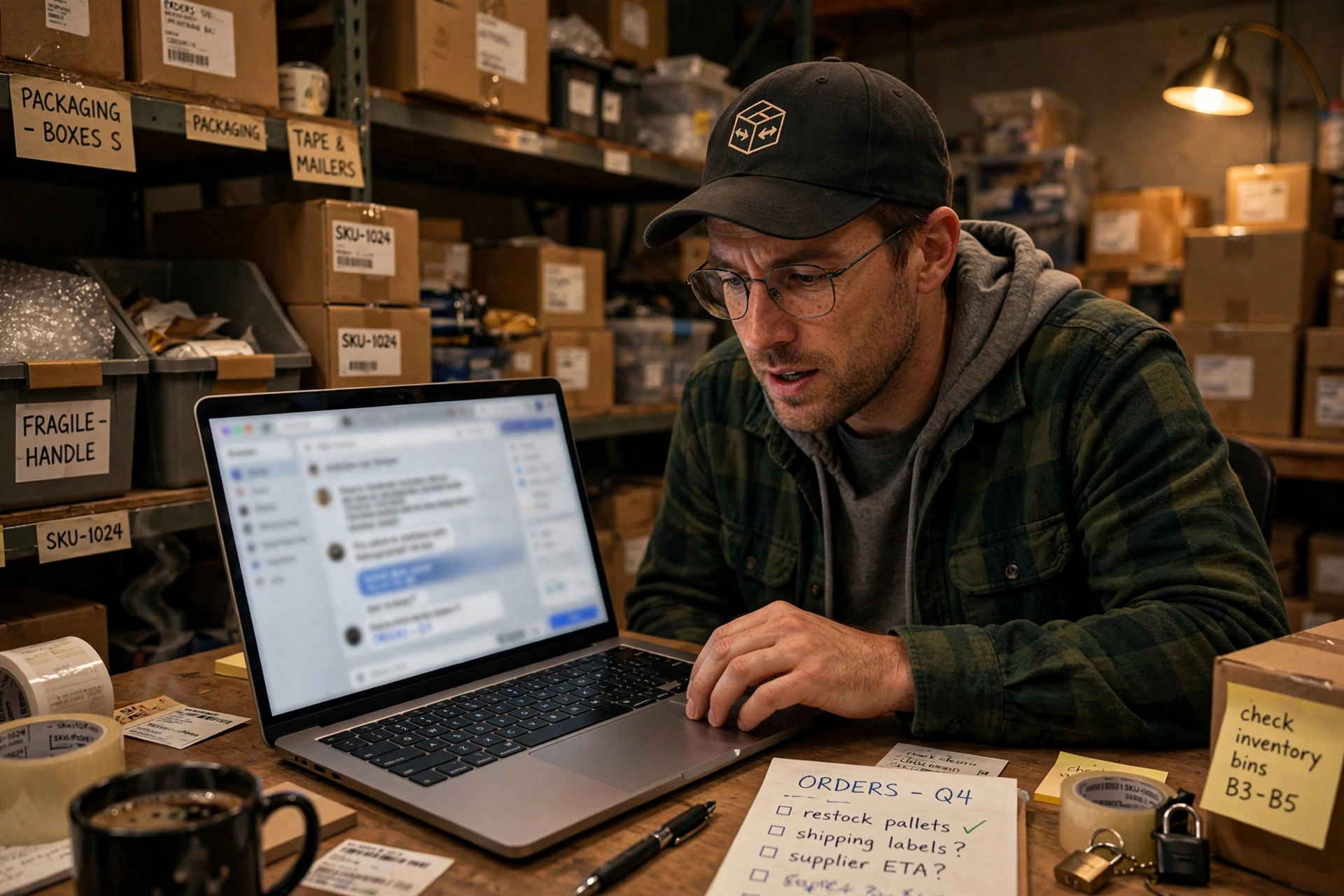
In early 2025, a 3PL warehouse in California's Inland Empire walked me through their project. The facility is roughly 120,000 square feet, serves 40-plus e-commerce brands, and had accumulated tens of thousands of historical work orders and exception records in its WMS, plus several hundred pages of SOPs. Their approach was textbook RAG: chunk the documents, vectorize them, and at query time retrieve the 5–8 most relevant passages, then have the LLM compose an answer from those passages — with every answer carrying its sources, down to the SOP section or the specific work order number.
That "cited sources" design is the whole point. A warehouse is a heavily compliance-driven, audit-driven environment: when a QA inspector asks "what is the sampling ratio for this inbound lot," they don't want a pretty answer — they want an answer they can write into the record and trace back if something goes wrong. RAG answers come with provenance by construction; when one is wrong, you can pinpoint which document went stale and fix the document, not the model. Six months after launch, this 3PL's new-hire onboarding cycle had shortened from about three weeks to roughly ten days. One caveat: that is their internal business metric, and the training process itself was optimized in parallel, so not all of the credit belongs to RAG — but the direction is clear: knowledge became findable and verifiable.
RAG has another advantage that matters enormously in warehouse settings: knowledge updates mean "swapping documents," not "retraining." When an SOP gets revised, you re-chunk and re-index; it takes effect in minutes. For warehouses whose knowledge changes constantly, that is close to decisive.
The Fine-Tuning Failure Case: It Memorized the Spec and Lost the Source
Fine-tuning has its adopters too — and its real failure cases. In mid-2025, a distribution center in eastern China wanted to "teach" a model its equipment maintenance manuals and assembled several thousand Q&A pairs for fine-tuning. During testing, someone asked for the rated load of a particular stacker crane, and the model answered with complete confidence — and the number was wrong. The actual rating was 1.5 tons; it said 2 tons. The postmortem found that an outdated manual revision had slipped into the training data, and the model had "memorized" the error without any awareness that it was wrong.
That is the structural defect of fine-tuning for knowledge bases: once knowledge is compressed into parameters, it is neither traceable nor locally fixable. When you find one error, you cannot just edit a document the way RAG lets you — you have to re-prepare data, retrain, and re-validate everything. Worse, a fine-tuned model states its mistakes with exactly the same confidence as its correct answers. In a warehouse, where a wrong answer can hurt people, damage goods, or break compliance, that unexplainable confidence is the most dangerous property of all.
To be fair, fine-tuning has a legitimate place — just not in memorizing facts. It excels at changing model behavior: fixing output formats, unifying tone of voice, learning a specific reasoning pattern. If your need is "make the model talk like our company's service manual," fine-tuning is a good fit. If your need is "make the model remember three thousand pages of manuals," you are using the wrong tool.
RAG vs Fine-Tuning: A Decision Matrix
Pulling this together, here is a decision matrix I use. Map your own situation onto these four dimensions and the answer usually emerges on its own:
| Dimension | Lean RAG | Lean fine-tuning |
|---|---|---|
| Knowledge update frequency | High — weekly or even daily changes (SOPs, promo rules) | Low — knowledge stable for years (equipment principles, regulations) |
| Accuracy and traceability needs | High — wrong answers are costly, sources must be cited (QA, safety) | Medium to low — style matters more than factual precision |
| Data volume | Many documents but few Q&A pairs (RAG eats documents directly) | Tens of thousands of high-quality Q&A pairs available for training |
| Cost and team | Lightweight start, pay per retrieval, maintenance is just swapping documents | GPU cost of initial plus repeated retraining, plus version-management overhead |
The cost dimension deserves its own calculation. Using public cloud pricing as a reference, one full fine-tune of a 7B-class open model typically runs in the hundreds to low thousands of dollars in GPU rental (check each cloud vendor's official site for current pricing) — but that is just for one training run. The real cost comes after: every knowledge refresh cycle theoretically demands retraining, re-testing, and re-deploying a new model version, which becomes a recurring annual expense. RAG's cost curve is inverted: building the retrieval pipeline takes upfront engineering effort, but day-to-day maintenance is just "swapping documents," with very low marginal cost. One curve is front-loaded, the other back-loaded — the comparison that matters is the three-year total, not the first month's bill.
The Counter-Intuitive Take: For Fast-Changing Warehouses, Fine-Tuning Is a Depreciating Asset
Here is a counter-intuitive judgment worth stating plainly: for warehouses whose knowledge updates frequently, fine-tuning is not a "one-time investment" — it is a depreciating asset. Every SOP revision and every equipment change renders part of the previous fine-tuned model's "memory" obsolete, and you cannot tell which part. So you are forced into a retrain–retest–redeploy loop, spending more and more while the model chases a moving target forever. RAG behaves oppositely in exactly this scenario: the newer, more fragmented, and more scattered the knowledge, the greater the retrieval architecture's advantage.
My read on the trend, then: over the next two to three years, the default shape of warehouse knowledge bases will be hybrid — RAG for the what (facts, traceability, real-time updates) and lightweight fine-tuning for the how (format, tone, domain phrasing). The two approaches were never either-or; they are a division of labor.
One question deserves longer observation, though: whichever path you choose, the quality of the knowledge base itself is the ceiling. Vague SOPs, work-order records with missing fields, equipment manuals with tangled revisions — no RAG pipeline and no fine-tuning run can fix "knowledge governance" problems. Behind the architecture debate, the real dividing line may be this: does your warehouse actually have knowledge worth having an AI learn? That is a question every company building a knowledge base will have to answer for itself.
By Dr. Chen, Supply Chain Researcher