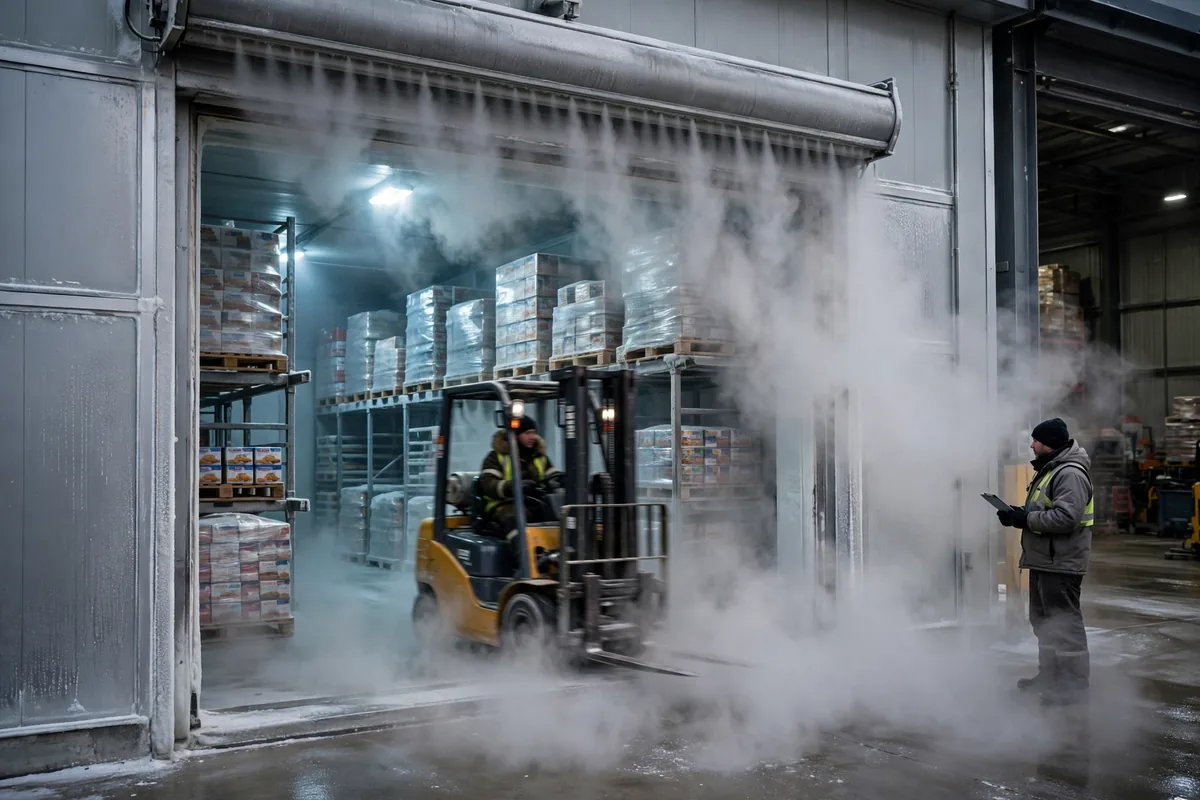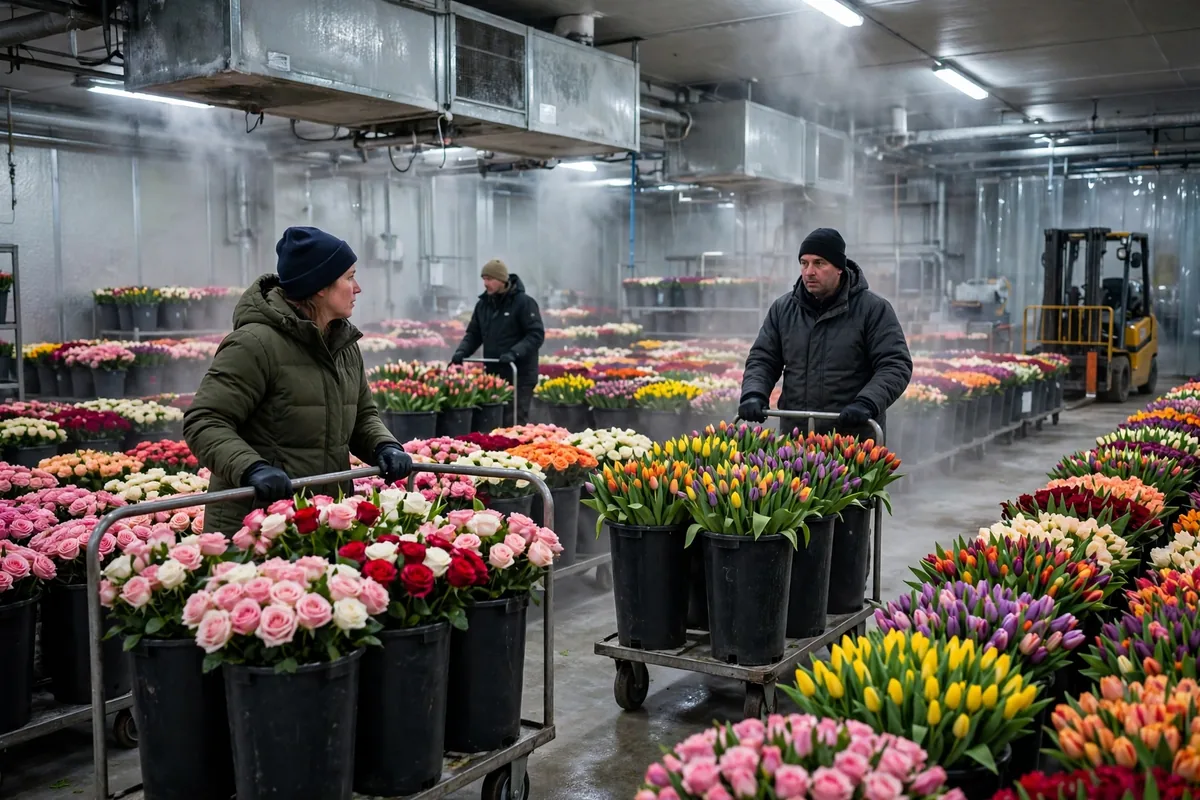
A rose cut on a farm in Kenya travels more than 6,000 kilometres through five handlings, two gradings and one auction before it reaches a florist in Germany, and the only reason it still commands a price is that it never left the cold chain. The netherlands flower export cold chain warehouse system is worth studying not because it uses unusually advanced equipment, but because it turned one of the most perishable products in world trade into a standardised business priced by the hour.
The Netherlands Flower Export Cold Chain Warehouse Network, in Three Sets of Numbers
According to the Dutch Association of Wholesalers in Floricultural Products (VGB) and market analyst Floridata, Dutch flower and plant exports reached 7.0 billion euros in 2024 and 7.2 billion in 2025, with cut flowers accounting for 4.4 billion in 2025. Germany remained the largest destination at 23.7 percent, worth about 1.7 billion euros. Product turnover at Royal FloraHolland, the world's largest flower trading platform, was 5.3 billion euros in 2024 and 5.4 billion in 2025, the second-highest on record after 5.6 billion in 2021.
One detail is easy to miss: much of what the Netherlands sells was grown elsewhere. Royal FloraHolland's 2023 annual report records supply from Kenya at 406 million euros, Ethiopia at 216 million and Israel at 58 million, with international supply revenue up 2 percent to 933 million euros. The country's role is first a marketplace and a hub, and only second a producer: the real subject of its flower export cold chain is moving other countries' flowers, not the size of its own glasshouses.
According to ground handler dnata, its facilities at Schiphol handle up to 42,000 tonnes of flowers a year: 27,000 tonnes of imports, mainly from East Africa and South America, and 15,000 tonnes of exports, mostly home-grown gerbera, gypsophila and peonies.
Inside the Netherlands Flower Export Cold Chain Warehouse Chain: Five Links
First, post-harvest pre-cooling at origin. A flower cut in the field still carries field heat and keeps respiring, consuming the sugars it needs to stay alive; warmer means faster ageing. Under the FlowerWatch standard, cold chain failure is measured in degree-hours: one degree above target for one hour is one degree-hour, and every 500 costs a full day of vase life. Forced-air cooling reaches the target in 15 to 60 minutes; an ordinary cold room alone can take a whole day, and the difference is paid in vase life spent before the flowers are even sold.
Second, grading and packing. Roses are sorted into stem-length bands of 40, 50, 60 and 70 centimetres and above, graded by bud size and stem strength, then packed dry for long-haul air freight or wet for short routes. Carton ventilation and strength matter too: too few holes and cold air never reaches the centre of the box; too many and a damp carton collapses.
Third, pre-auction cold storage: after arriving at Aalsmeer, flowers wait in cold stores before going under the clock, the descending-price auction where buyers stop the clock to buy. In 2025, almost five billion flowers and plants were traded through the clock, with clock turnover above 2 billion euros, while direct trade on Floriday had reached roughly half of total volume. As half of all transactions bypass the auction hall, responsibility spreads from one central operator to many participants, each with its own handover routine.
Fourth, the airport cold chain: inside Schiphol's cargo terminals, flowers move through dedicated cool-chain areas, and handover from truck to freighter is measured in minutes. Imports and exports through dnata's Amsterdam facilities run at roughly 64 to 36.
Fifth, air freight and handover at destination. The temperature in the hold, the wait on the tarmac and the speed of customs clearance and return to cold storage jointly decide how many days of vase life survive to the wholesaler. According to FlowerWatch, at least 20 percent of flower produce is rejected because of cold chain inadequacies and excessive heat exposure: failure rarely happens in a single dramatic moment, but accumulates in short pauses.
Why the Netherlands: Three Structural Reasons
The first reason is market density: roughly 43 million stems trading on a single weekday at Aalsmeer lets any buyer assemble a full assortment in one morning, which no scattered origin market can match.
Second, geography and airport capacity. Schiphol sits in the northwest corner of Europe, a few hours' trucking from the main wholesale markets in Germany, France and the United Kingdom, while its air connections receive flowers from East Africa and South America, and the two directions of traffic fill each other's empty return capacity.
Third, standards and data. The auction's grading standards, the FlowerWatch degree-hour rule and the temperature records kept at every stage form a quality language a buyer can check without visiting a farm in Kenya: the temperature log and the grading report are enough. The more standardised the language, the lower the cost of trust.
Doing the Math: One Day Off the Chain Costs One Day of Vase Life
The table below is not a market quotation but a scenario illustration: 10,000 Kenyan roses travelling from harvest to a German florist over five days, at a target of 2 degrees Celsius, with temperature deviation accumulated at each stage. All figures are a hypothetical calculation.
| Stage | Duration | Actual temperature | Deviation | Degree-hours |
|---|---|---|---|---|
| Farm pre-cooling | 12 hours | 2°C | 0 | 0 |
| Truck to Nairobi airport | 6 hours | 7°C | 5°C | 30 |
| Ground wait and loading | 8 hours | 10°C | 8°C | 64 |
| Air freight | 9 hours | 2°C | 0 | 0 |
| Schiphol unloading and cold storage | 24 hours | 4°C | 2°C | 48 |
| Truck to German wholesaler | 12 hours | 6°C | 4°C | 48 |
| Total | 5 days | — | — | about 190 |
Under the FlowerWatch rule, this batch loses roughly 0.4 days of vase life before it reaches the florist; if those eight hours ran at 18 degrees instead of 10, that stage alone would add 128 degree-hours, pushing the total past 300. The counterintuitive point: the most expensive link is often not the air freight itself but the unaccountable hours on the ground — the airfare is a published price, while the cost of a broken chain is only repaid later, through rejection rates and discounts at the destination.
Pre-cooling at origin is the most thorough and cheapest place to spend money, because field heat has not yet turned into irreversible ageing; by the time the flower reaches the airport, its vase life is already spent, and a cold store can only slow the ageing, never reverse it. Where budgets are limited, invest in pre-cooling and packaging first, and add cold store capacity at the hub afterwards.
Three Things That Are Changing
First, direct trade keeps rising: in 2025 clock sales and direct trade were roughly equal at 50 percent each, so the auction hall's centralised cold storage is dispersing across more nodes, and competition may soon be less about whose cold store is biggest than about whose handover records are most complete.
Second, finer temperature zoning. Most cut flowers store best at 0 to 2 degrees Celsius, but tropical flowers follow different logic: anthuriums suffer chilling injury below about 10 degrees, and tropical orchids need warmer storage. A cold store set to a single temperature will keep damaging one part of the assortment, which is why zoned storage and rules for mixed loads are becoming basic practice.
Third, sustainability pressure is reaching procurement standards. The carbon emissions of air freight and the energy use of the cold chain are entering European buying criteria, so Dutch flower export growth may be judged not only by turnover but by energy use and loss rates per euro traded. According to VGB and Floridata, cut flower export volumes fell 3 percent in 2025 while export value rose 0.3 percent; behind that pattern there may be, alongside price effects, high-loss categories being squeezed out.
A rose's journey ends with an open question, not a verdict. As the auction clock ceases to be the only way flowers are assembled, and as direct trade and zoned cold storage cut the chain into ever finer pieces, how much of the Netherlands flower export cold chain warehouse advantage is portable, and how much is anchored in things no competitor can copy — the auction hall at Aalsmeer, the cargo terminals at Schiphol, or the grading and temperature language that lets buyers bid with their eyes closed? The answer will probably only become clear over the next five years. Until then, one thing is certain: flowers never pay for a lapse at any single link; they simply record it in the vase life they have left.
By Dr. Chen, Supply Chain Researcher