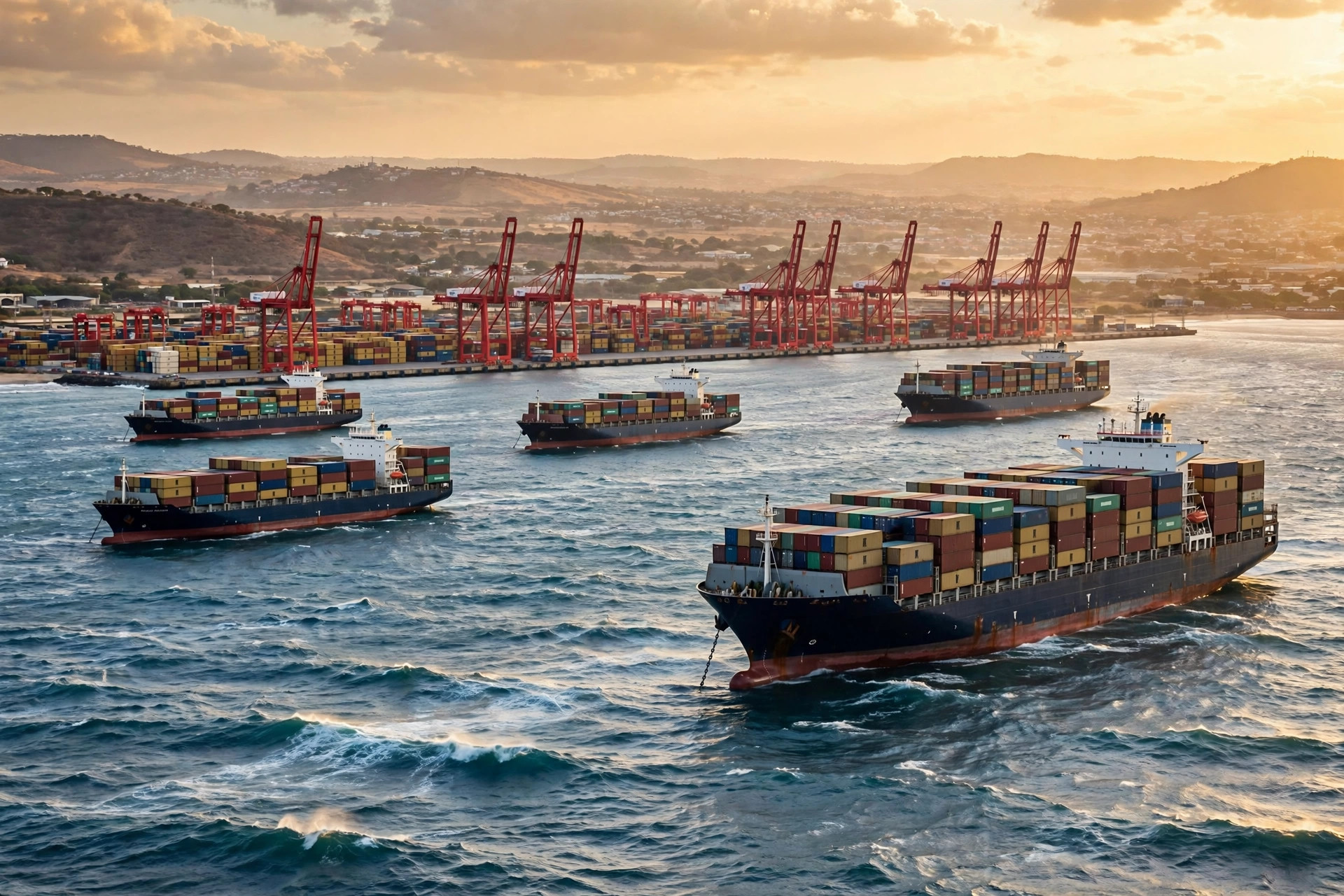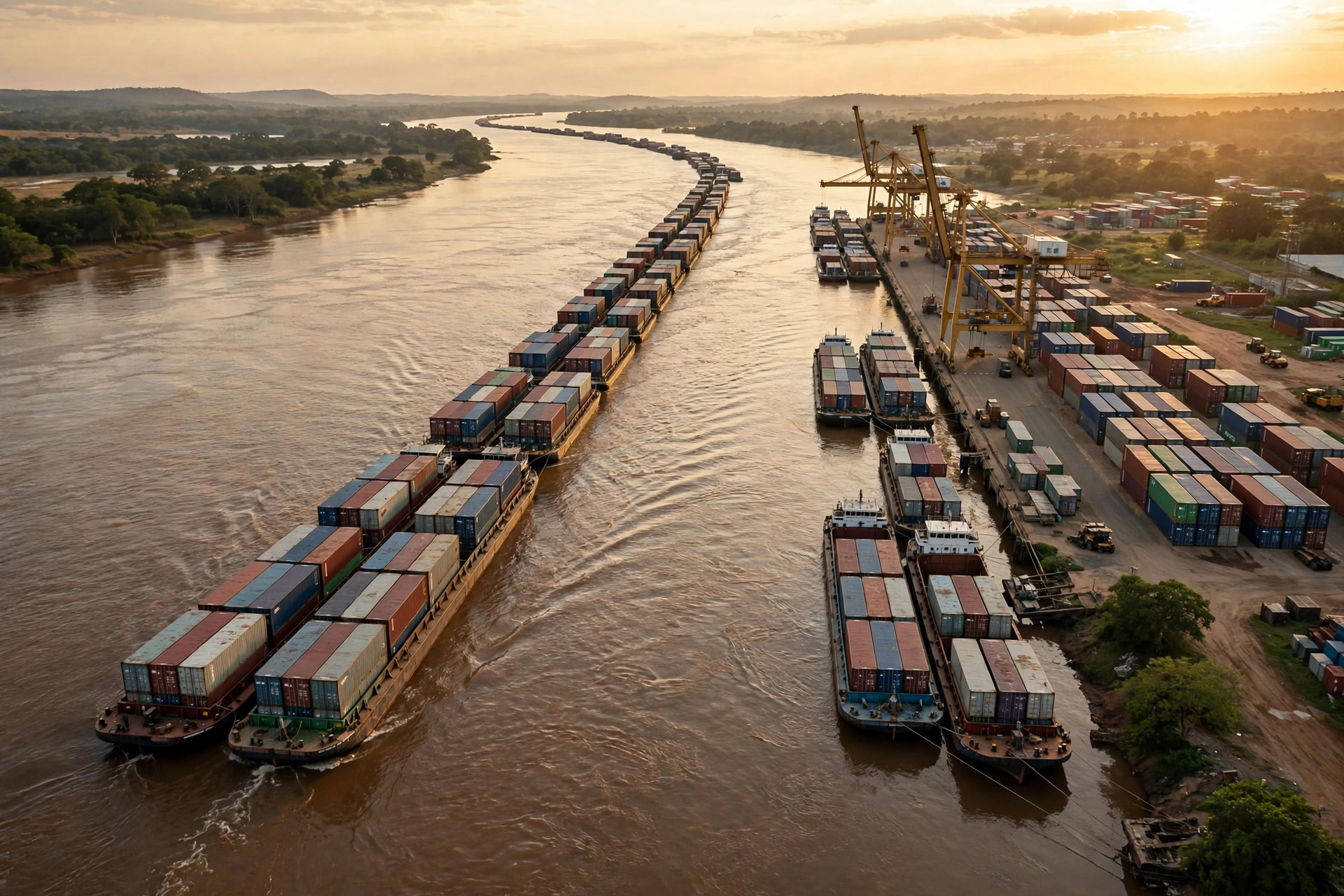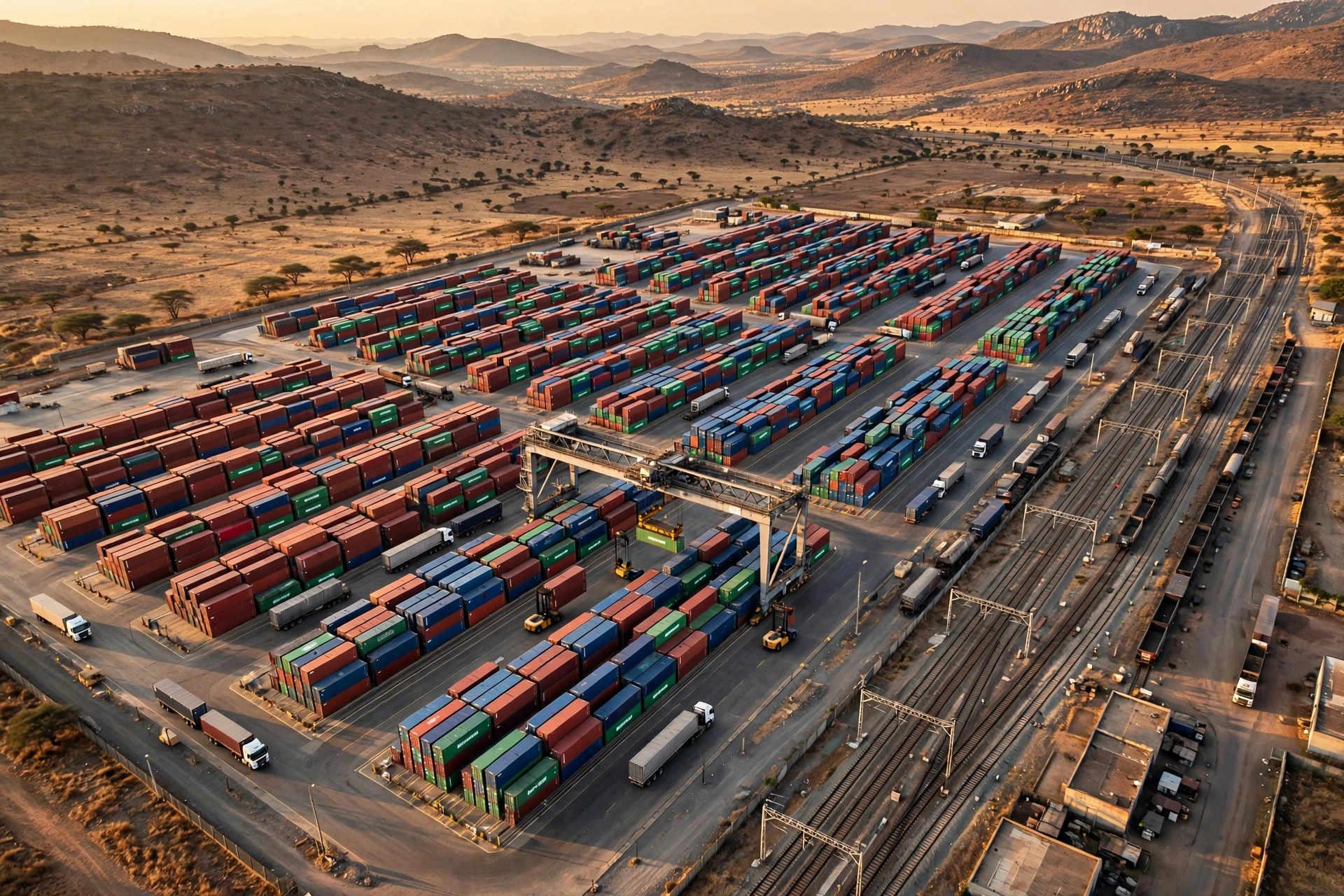
Ethiopia is landlocked, and its import bill runs through one place: Ethiopia's Modjo dry port. More than 90% of the country's foreign trade moves through the Djibouti corridor — World Bank Vice President Ndiamé Diop said in early 2026 in Addis Ababa that the corridor carries about 95% of Ethiopia's land-based trade — and the corridor ends some 70 kilometers from the capital, at Modjo.
Here's the math up front. A 40-foot box discharged at the Port of Djibouti, delivered to a factory gate in Addis Ababa, breaks into three legs: Leg 1, the Djibouti–Modjo trunk (rail or road, 752 km); Leg 2, clearance and dwell at the Modjo dry port; Leg 3, inland distribution from Modjo to the factory or warehouse. The ocean leg is the shipping line's price — you can't touch it. Everything you can actually manage sits in these three legs. My verdict first: the trunk freight is the small money; the time cost in Leg 2 is what eats your margin.
Leg One: Djibouti to the Modjo Dry Port — Rail or Road?
The Addis Ababa–Djibouti railway: 752 km of electrified standard gauge, 120 km/h design speed for freight. It cut the Djibouti–Addis transit from 3+ days by road to 12–20 hours, at a cost at least one-third lower (per the Chinese operators, at the 2024 handover to Ethiopian and Djiboutian management). By 2024 the line had run roughly 7,700 freight trains moving 9.5 million tonnes.
Run the numbers honestly: rail is cheaper and steadier, but only if you can catch the train slots and get a timely transfer from the main line into the dry port yard. The railway has had its bad years — dead locomotives, aging signaling; Ethiopia's transport ministry reported in 2025 that 16 locomotives were back in service and the signaling upgrade was complete. Road? More expensive, but flexible: truck fleets on call, ideal for small lots, rush orders, or rail maintenance windows.
| Rail | Road | |
|---|---|---|
| Transit time | 12–20 hours | 3+ days |
| Cost | At least one-third cheaper than road (operator figures) | Higher, but no slot waiting |
| Risk points | Train slots, yard transfer queues, equipment history | Fuel, drivers, in-transit damage |
| Best for | Large, plannable volumes | Rush orders, small lots, rail outages |
My rule: rail as the workhorse, road as the backup. The workhorse saves real money; the backup buys you continuity. Leave a 2–3 day buffer on rail transfers — never build a production plan on theoretical best-case transit. Theoretical transit is for slide decks.
Leg Two: The Dry Port Time Tax at Modjo
This is the most expensive leg of the three — and the most underestimated.
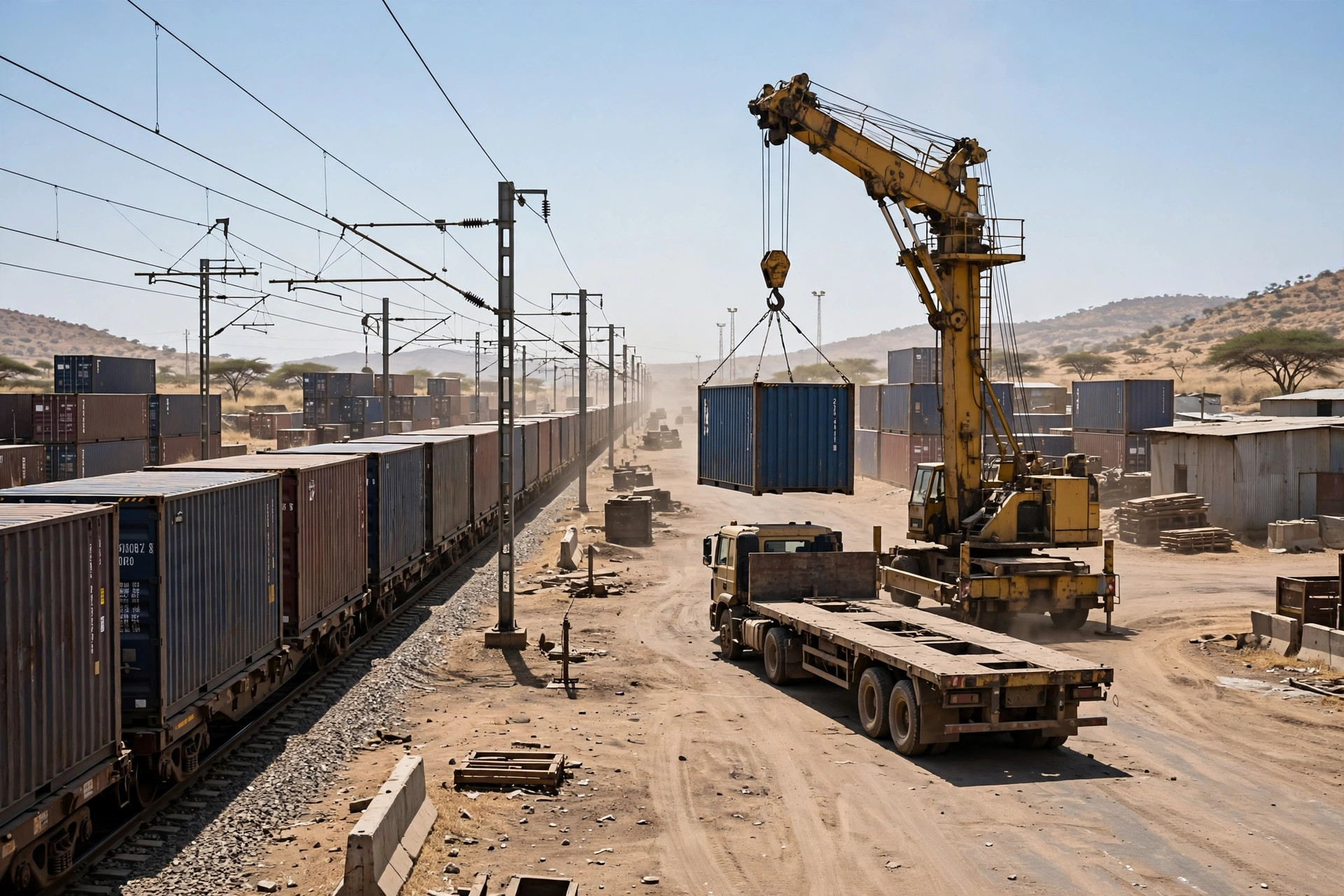
The hardware first. On September 10, 2026, phase one of the expanded Modjo went live: 60 hectares, annual capacity of up to 1 million TEU, and Ethiopia's first rail-mounted gantry (RMG) crane — inaugurated by Prime Minister Abiy Ahmed himself. The money: the World Bank's Ethiopia Trade Logistics Project approved $150 million in 2017 ($120 million of it for Modjo's civil works), plus another $90 million in 2023 — $240 million total (per World Bank project documents cited by Birr Metrics). VP Diop's headline figure: capacity doubled, average container dwell down from 60 days to 8.
Before applauding the 60-to-8, do the math. What does one day of dwell cost?
Take a 40-foot box with $50,000 of cargo inside. At a 12% annual cost of capital, that's about $16 a day just in tied-up cash. Add demurrage — on the East Africa corridor, shipping lines commonly charge $20–50 per box per day (policies vary; check the line's website — I use $30 for this calculation). Yard storage is on top. Conservatively, every extra day a box sits at the dry port burns $45–70.
Sixty days versus eight: 52 days apart. That's $2,300–3,600 per box. An importer moving 200 boxes a year pays $500,000–700,000 a year in time tax. It appears on no quotation — but it comes straight out of your profit.
Now the cold water. Diop's 8 days is a public-remarks figure from early 2026; the Bank's own project documents said in May 2026 that processing times for some cargo had fallen from 60 to 15 days — 8 reads more like a target. And in March 2025, the Bank had rated this project's progress "moderately unsatisfactory." When the speech numbers and the project-file numbers disagree, I calculate with the conservative one. Even at 15 days, the time tax is frightening.
A data-backed reality check: a 2019 academic study measured Modjo's actual dwell from 2014–2019 — 53 days on average, peaking at 60 in 2016 (University of Derby, based on the dry port's operating data). Hawassa Industrial Park employs 30,000+ workers (World Bank figure); its garment factories, with raw-material boxes stuck at the dry port for two months, end up with production lines waiting on inputs. A day of stopped production costs an order of magnitude more than demurrage — and that number never appears on any quotation either.
Then there's the institutional bill. $240 million doubled the hardware, but the "who does business inside the dry port" account was never settled: Modjo once hosted five private operators; by January 2025 only two remained — the Bank's implementation report states plainly that three withdrew over monopolistic behavior by the state-owned Ethiopian Shipping and Logistics (ESL). The government has issued multimodal transport licenses to private firms — the right direction — but in practice ESL still calls the shots.
Here's the contrarian take: for a landlocked country, the most expensive part of logistics isn't distance, it's time — and the most expensive part of time isn't equipment, it's institutional friction. $240 million can double a yard and erect gantry cranes; it can't legislate away a monopoly. The hardware math is easy. The institutional math is hard — and usually bigger.
Leg Three: Stage at Modjo, or Pull Straight from Djibouti?
Modjo sits 73 km from Addis Ababa (per ESL's own site) — those 70-odd kilometers are the final leg. The good news: the Modjo–Hawassa expressway is nearing full opening, cutting Modjo–Hawassa from five hours to three, with vehicle operating costs projected 15–20% lower (World Bank, October 2025). The southern corridor's industrial parks are the direct winners.
But before pricing this leg, make the call: clear and stage at Modjo, or pull the box straight from Djibouti?
| Stage + clear at the Modjo dry port | Pull straight from Djibouti | |
|---|---|---|
| Clearance | Inland clearance, close to your warehouse if issues arise | Port clearance, under time pressure |
| Storage | Dry-port yard fees + demurrage (see the time tax above) | Short free time at seaport, steeper overage rates |
| Flexibility | Stage at Modjo, release in batches | Pull it all at once — your warehouse must be ready |
| Best for | Multi-SKU, split releases, complex documentation | Single commodity, large lots, clean paperwork |
Three decision variables: your clearance capability, your warehouse receiving capacity, your cash cycle. Clean docs, big warehouse, uniform cargo — direct pull saves time. Otherwise, go through Modjo, but front-load your documentation: Modjo's EDI system is live (per Ethiopia's logistics cluster), and today's clearance delays mostly come down to incomplete paperwork. Have the docs ready while the box is still at sea. That one costs nothing — pure management dividend.
The Playbook: Three Rules You Can Calculate With
- Know your D. How many days does your cargo sit at Modjo on average? D × (demurrage + daily capital cost) is your dry-port time tax. Every day shaved off D saves $45–70 per 40-foot box (on the rates used above). Annual volume × D × daily cost = your yearly time tax. Calculate that number before talking about optimization.
- Rail as workhorse, road as backup. Rail is a third cheaper or more — but keep a 2–3 day buffer on transfers. In peak season and rail maintenance windows, road haulage is insurance, not waste.
- Front-load paperwork. Zero cost. Docs complete before the vessel berths. Modjo's digital systems are already there — don't let your paperwork be the slowest link.
One last honest word: stop benchmarking freight quotations alone. For a landlocked importer, freight is the visible bill and time is the hidden one — and the hidden one is usually bigger. Modjo's $240 million bought real hardware dividends; whether you collect them depends on your D. Nobody can calculate that for you.
By Lao Zhou, Logistics Cost Analyst