Multi-agent AMR fleet coordination has been showing up more and more in warehouse automation discussions over the last few years, and the reason is not complicated: when the AMRs in a warehouse grow from a handful to dozens, the problem stops being how one machine moves and becomes how the whole group avoids running into itself.
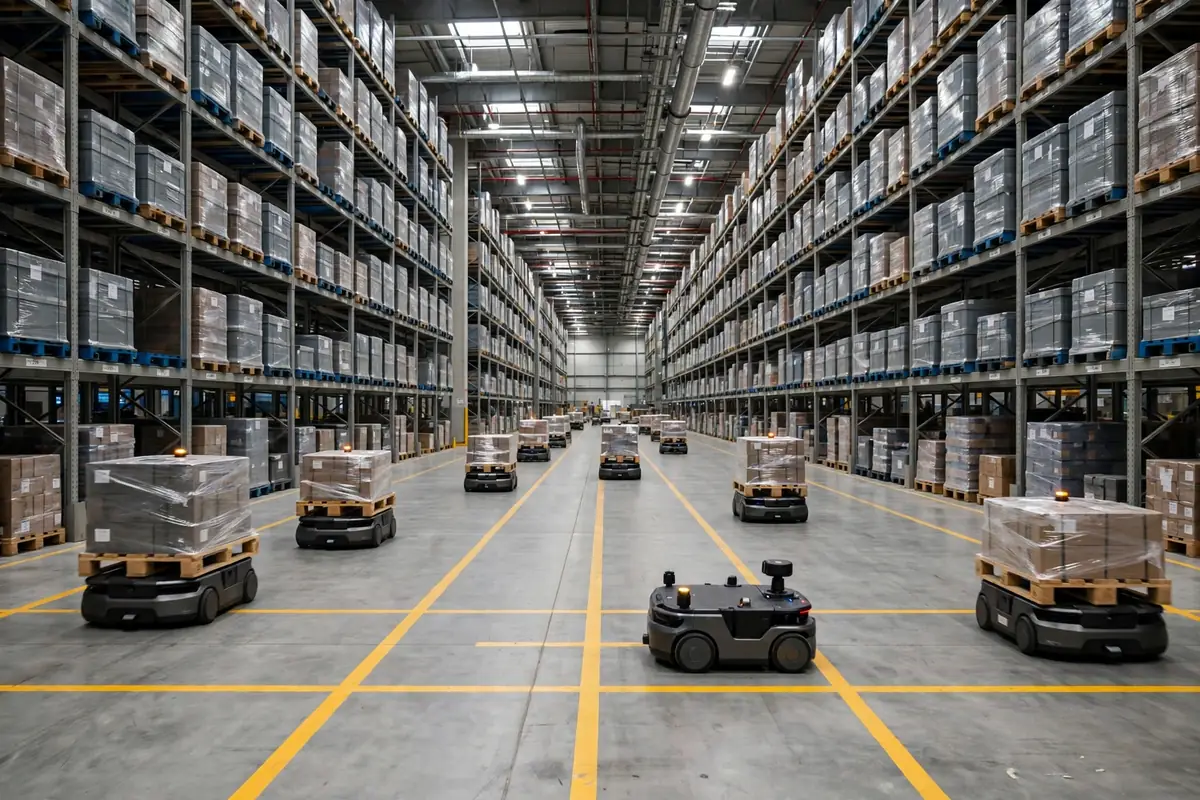
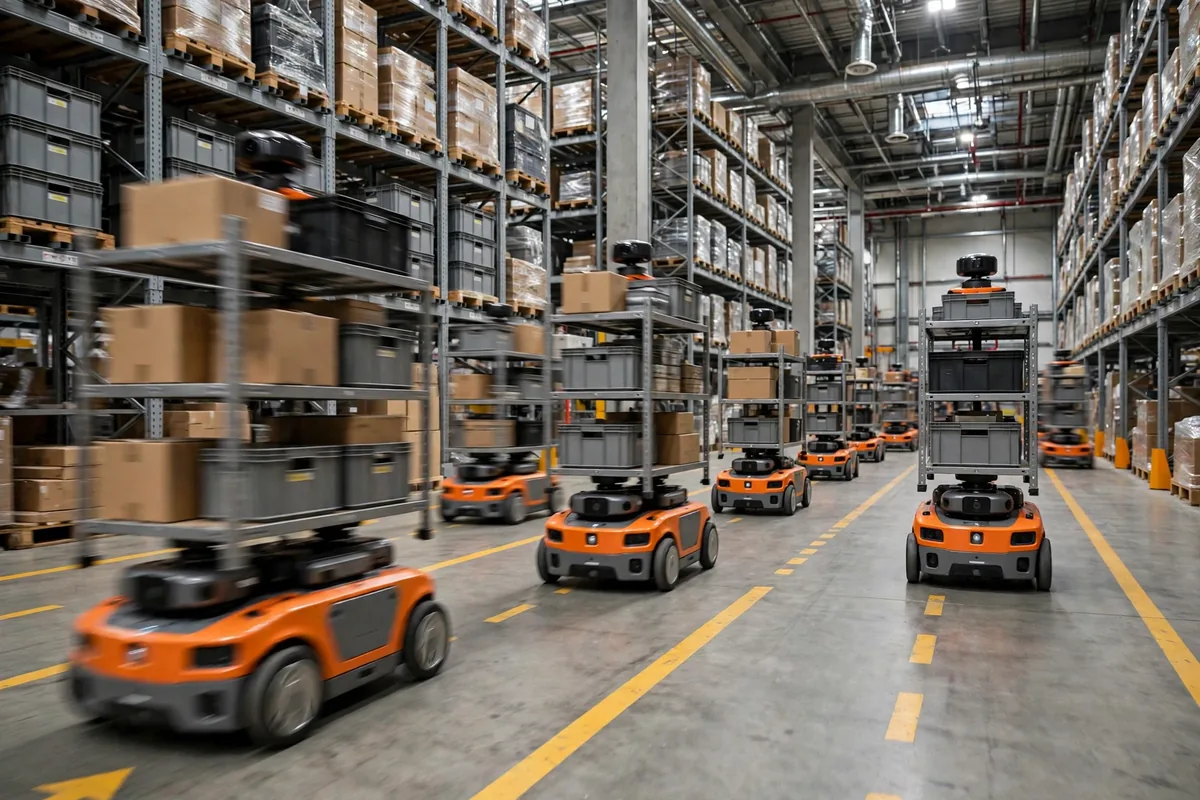
Start with what actually happens. Take a typical mid-sized e-commerce warehouse. The first batch of AMRs is six units, and they run beautifully — picking productivity rises visibly. Encouraged, management expands the fleet to twenty, then forty. But the year the fleet hits forty, a strange scene starts appearing in the warehouse: at the crossroads of the main aisle, several robots sit nose to nose, none of them moving, until someone intervenes manually; and when a picking wave hits, a dozen robots queue up waiting for a narrow aisle while the empty-running rate climbs instead of falling. More robots, barely more work done, and traffic jams learned before anything else. Behind that scene sits the central problem of multi-agent AMR fleet coordination: a single robot chases its own optimal path, while a fleet needs the whole system not to tie itself in knots.
Multi-Agent AMR Fleet Coordination: Centralized or Distributed First
Academics call this class of problem multi-agent path finding, MAPF for short, and it has been studied for decades without producing a single standard answer. In practice, scheduling architectures fall into two camps, centralized and distributed, and each carries its own price.
Centralized scheduling means one brain decides everything: a central server holds every AMR's position, task, and the state of the road network, and computes each vehicle's path and timing together. The advantage is a global view — it can work out an overall optimal or near-optimal plan, and conflicts get resolved before they happen. The price is compute and real-time responsiveness: as the fleet grows, the combination space explodes, and computing one globally optimal plan can take longer than the trip itself. And if the central server goes down, the whole fleet stops with it. The single-point-of-failure risk is real.
Distributed scheduling works the other way: each AMR decides for itself, negotiating right-of-way and queuing with nearby vehicles over machine-to-machine communication. The advantage is resilience to local failures, easy expansion — adding a robot doesn't mean rebuilding the scheduler — and fast real-time responses. The price is that local optima don't add up to a global optimum. Each vehicle sees only its neighborhood, and several robots can politely yield to each other into a loop that never resolves. Academics call it livelock. On the warehouse floor, people call it "the robots dancing."
| Architecture | Decision-making | Strength | Price |
|---|---|---|---|
| Centralized | One server plans for all | Globally optimal, conflicts excluded in advance | Heavy compute load, single-point-of-failure risk |
| Distributed | Each vehicle negotiates locally | Fault-tolerant, easy to scale, fast response | Local optima, possible livelock |
Real warehouses rarely go to either extreme. The common approach is layered: central scheduling handles task assignment and rough routing, while local avoidance and yielding are left to the vehicles in real time. Coarse-grained central, fine-grained distributed — each side carries half the cost. That layered compromise is also what most AMR vendors actually ship today.
Deadlocks and Right-of-Way: The Traffic Rules of Multi-Agent AMR Fleet Coordination
With the architecture settled, the next question is the rules of the road. How does a deadlock happen? The classic scene is a narrow aisle that fits one robot at a time, with two AMRs entering from opposite ends and meeting in the middle. Neither can go forward, neither has an instruction to reverse, and without a pre-designed rule, they sit there until a human steps in. More insidious is a ring deadlock: four robots on a looped aisle, each occupying one segment, each waiting for the one ahead to move, and nothing on the loop can move at all.
Preventing deadlocks doesn't depend on a cleverer single-robot algorithm. It depends on a set of traffic rules agreed in advance. First, one-way lanes: mark the main aisles as one-way, allow a narrow aisle to be entered from one direction only, and half the conflict sources disappear before they start. Second, priority classes: a loaded vehicle outranks an empty one, a vehicle on a main lane outranks one merging from a side lane — priorities written into the scheduling rules, not negotiated at the intersection. Third, reservations: before entering a critical segment, a vehicle books a time window with the scheduler, and if the windows overlap, it waits at the entrance for a few seconds rather than freezing inside the aisle for minutes. Fourth, zoning: divide the warehouse into scheduling zones, hand cross-zone tasks over at boundary points, and keep one vehicle from cutting across the whole warehouse and triggering a chain of conflicts.
These rules don't sound like high technology, and that is exactly why they are the most valuable part of fleet scheduling. Here is the counterintuitive judgment: in an AMR fleet, what usually matters most for throughput is not how fast a robot drives, but how clearly the yielding rules are written. Raise a single vehicle's speed by ten percent and the time saved can be entirely lost to waiting at intersections. Get the right-of-way rules straight, and the fleet's overall throughput goes up instead. Speed is a single-vehicle metric. Flow is a fleet metric. The two often fight each other, and scheduling exists to keep them from fighting.
Task Assignment: Who Takes This Order Is the Algorithm's Call
Beyond paths, scheduling has to answer another question: a new task arrives — which vehicle gets it? The simplest answer is nearest assignment: the closest idle vehicle takes the job. The logic is intuitive and easy to implement. The flaw is that the vehicles near the busy zone are always the busiest, while the ones far away sit idle. Workloads and battery drain go uneven, vehicle conditions diverge over time, and maintenance costs follow.
A more careful approach is auction-based assignment: the scheduler broadcasts the task, and each vehicle bids a "cost" based on its position, battery level, and current job. Lowest bid wins. The idea comes from auction theory, and the academic literature discusses it extensively; there are working deployments too. The benefit is that distance, battery, and task type all fold into one number, so the fleet's load balances itself. The cost is communication and compute overhead — with a heavy task stream, the auction itself becomes a burden — so many systems run auctions only between waves or when tasks pile up, and use a simplified nearest-with-weights rule the rest of the time.
Take an illustrative example. Suppose a fleet of twenty vehicles faces 120 transport tasks an hour at peak. Under nearest assignment, the six vehicles closest to the popular storage zone might take half the tasks, drain their batteries fast, and have to rotate out for charging mid-shift, shrinking the effective fleet to fifteen or sixteen. Under battery-weighted assignment, the tasks spread across all twenty, per-vehicle load drops, and charging rotations can be staggered into the gaps between waves, so the same twenty vehicles deliver higher effective attendance. These numbers are an illustrative worked example, meant to show how assignment rules affect the fleet's effective size — for any real warehouse, the calculation has to be redone against its own task distribution and road network.
Where Multi-Agent AMR Fleet Coordination Is Heading
Pulling the threads together, the direction is fairly clear. First, hybrid architectures will be the mainstream: centralized control for tasks and the big picture, distributed control for avoidance and detail, with a clean interface dividing the two layers rather than one side dominating. Second, scheduling algorithms will lean more on simulation: before a new rule goes live, run thousands of waves in a digital twin, expose the deadlock and congestion scenarios in advance, and only then roll it out to the real warehouse. Third, task assignment will move from "who is nearest" to "who is most suitable," with battery level, task type, and maintenance cycles all feeding into the cost function.
But one reminder belongs at the end: no matter how sophisticated the scheduling algorithm gets, it cannot substitute for the warehouse's own layout. Aisle widths, storage-zone placement, wave rhythm — if the physical design is wrong from the start, even the best algorithm is just patching over a bad road network. Algorithms can keep a group of robots from fighting. They cannot widen a road that was designed wrong. Get the roads right first, then talk about how the fleet should run. That order is unlikely to change for a long time.
By Dr. Chen, Supply Chain Researcher