One development deserves attention: Mozambique cashew export warehouse storage is suddenly a busy trade — exports accelerated sharply in 2025. According to provisional data from the Ministry of Agriculture, export earnings reached USD 121.6 million in 2025, nearly triple the USD 44.1 million of 2024, while volume jumped from 48,403 tonnes to 93,247 tonnes. The main destinations were Vietnam and India. In the same period, cashew commercialization in the 2024/2025 season reached roughly 195,400 tonnes, approaching the historic highs of the 1970s, when Mozambique was the world's second-largest cashew producer at about 210,000 tonnes a year.
Behind these figures, the question for warehousing professionals is structural: when procurement volumes approach historic highs and export volumes double within a year, can the origin warehousing system keep pace? Cashews are extremely sensitive to moisture. If the storage link fails, the prettiest production numbers get sent back at the port inspection.
Mozambique Cashew Export Warehouse Storage: The Numbers First
The key figures, per the Ministry of Agriculture, Environment and Fisheries: cashew commercialization in the 2024/2025 season reached about 195,400 tonnes, above the initial 160,000-tonne target. Exports in 2025 totaled 93,247 tonnes worth USD 121.6 million. In October 2025, the government announced plans to invest USD 374 million in the sector, aiming to raise annual production from 158,000 tonnes to 689,000 tonnes by 2034 and processing capacity from 40,000 tonnes to more than 482,000 tonnes.
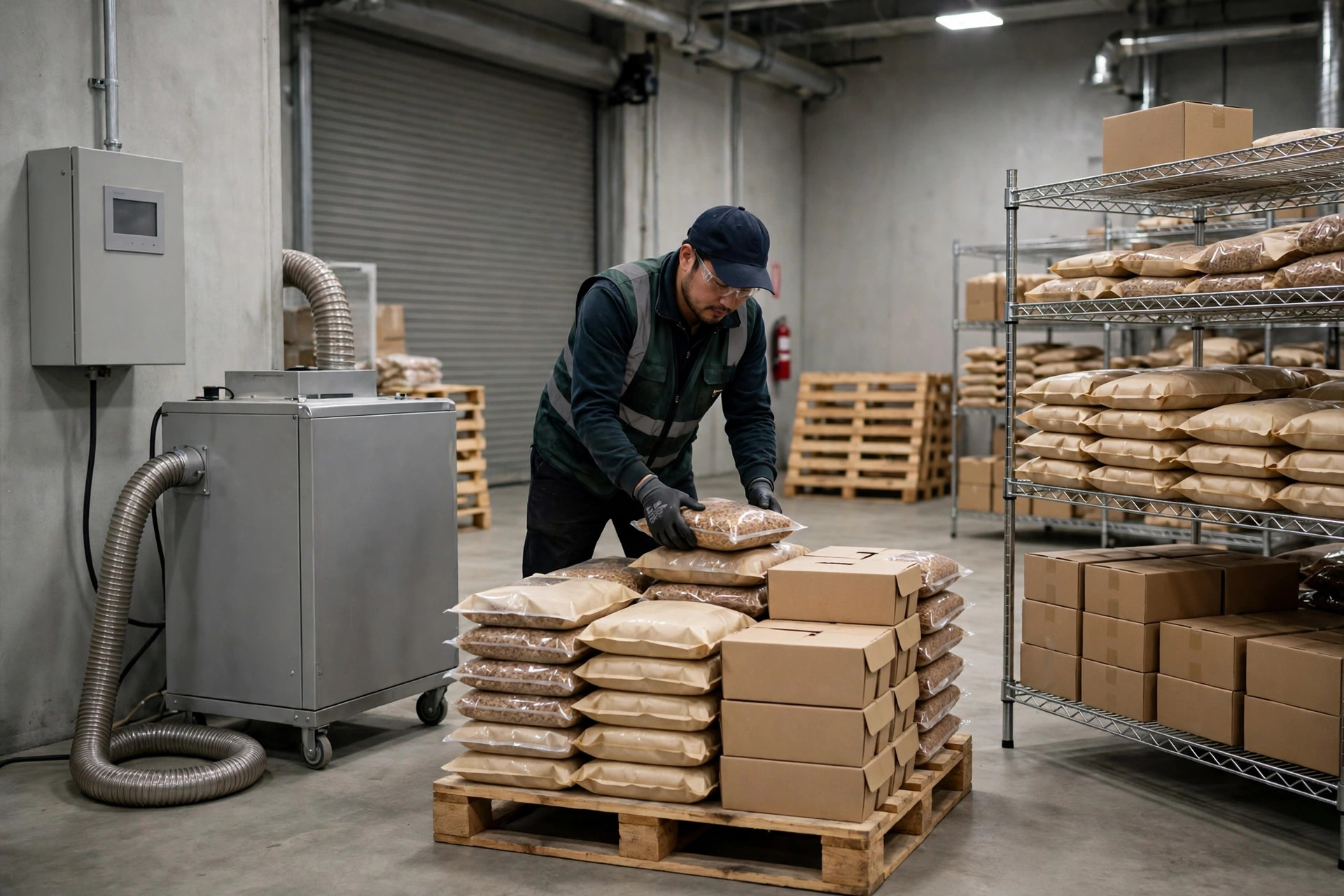
Two signals are worth noting. First, the gap between procurement and exports is large: 195,400 tonnes procured, only 93,247 tonnes exported. Part of the difference is domestic processing; the rest is inventory and loss, much of it during storage. Second, the processing target of 482,000 tonnes is twelve times the current 40,000 tonnes: over the next decade, Mozambique's cashews will increasingly leave as processed kernels rather than raw nuts in shell. Kernels demand stricter storage: tighter moisture control, stronger protection against oxidation and insects, and shorter shelf-life windows.
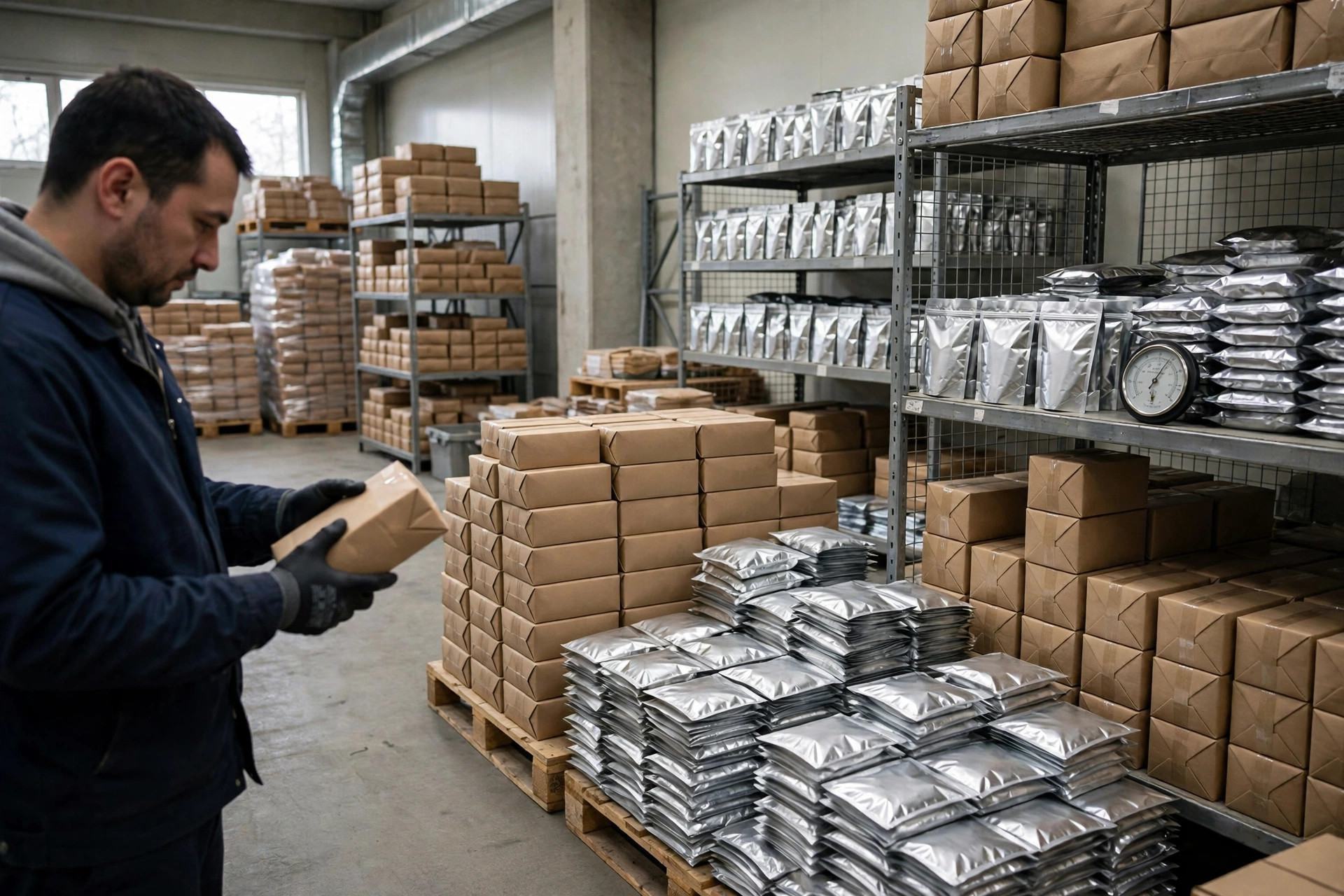
Nampula Province is Mozambique's leading cashew-producing region. Per the University of California Davis Postharvest Technology Center, cashew kernels in refrigerated storage should hold moisture near 8 percent, with optimal storage at 0 to 10 degrees Celsius and 55 to 70 percent relative humidity. Industry grading practice caps raw-nut moisture at 9 percent; the UNECE standard caps kernel moisture at 5 percent. Above these thresholds, mold risk rises sharply, and mold brings aflatoxin — one of the most sensitive indicators in import quarantine inspections. Aflatoxin-producing fungi thrive at 25 to 32 degrees Celsius and relative humidity around 85 percent — in effect, the typical rainy-season climate of Mozambique's producing regions.
Origin Collection: Grading Is the First Line of Defense
Procurement in Nampula is dominated by smallholder farmers, and the buying season is concentrated in the harvest months. The first warehousing action at origin is not storage but grading: the price of raw cashew nuts depends on sampled outturn rate, moisture content, impurity rate, and breakage rate. A lot above 9 percent moisture keeps absorbing humidity in storage, and its mold risk grows with every week it sits.
One practice worth noting is rapid testing at the collection point. Here is an illustrative scenario based on standard industry practice, not a record of a specific company: during the 2025 buying season, a collection point in Nampula sampled three sacks from every incoming truck and sent any lot above 9 percent moisture straight back for sun-drying. The cost is low — one handheld moisture meter and one tester — but the effect is direct: no more damp lots spoiling an entire stack.
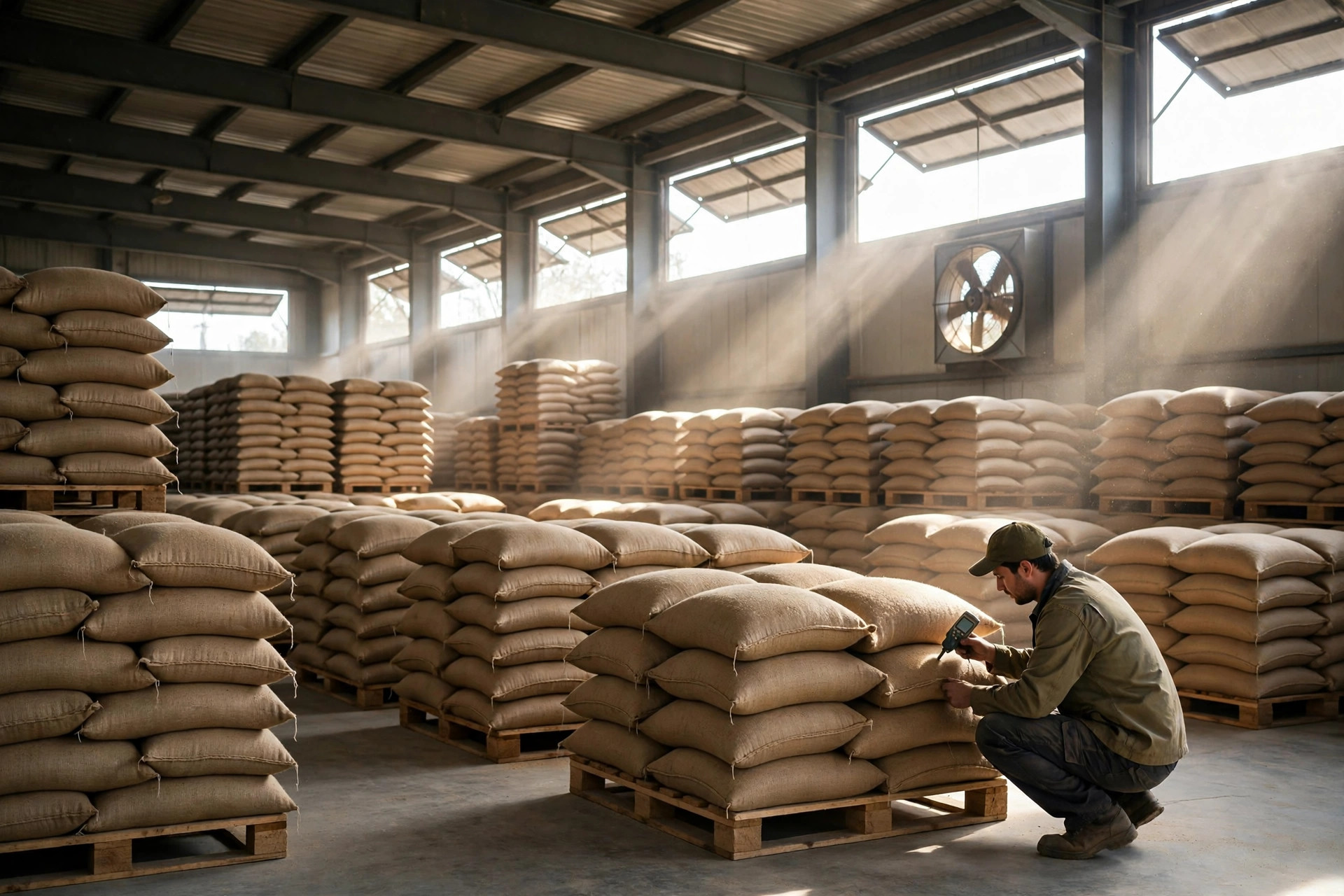
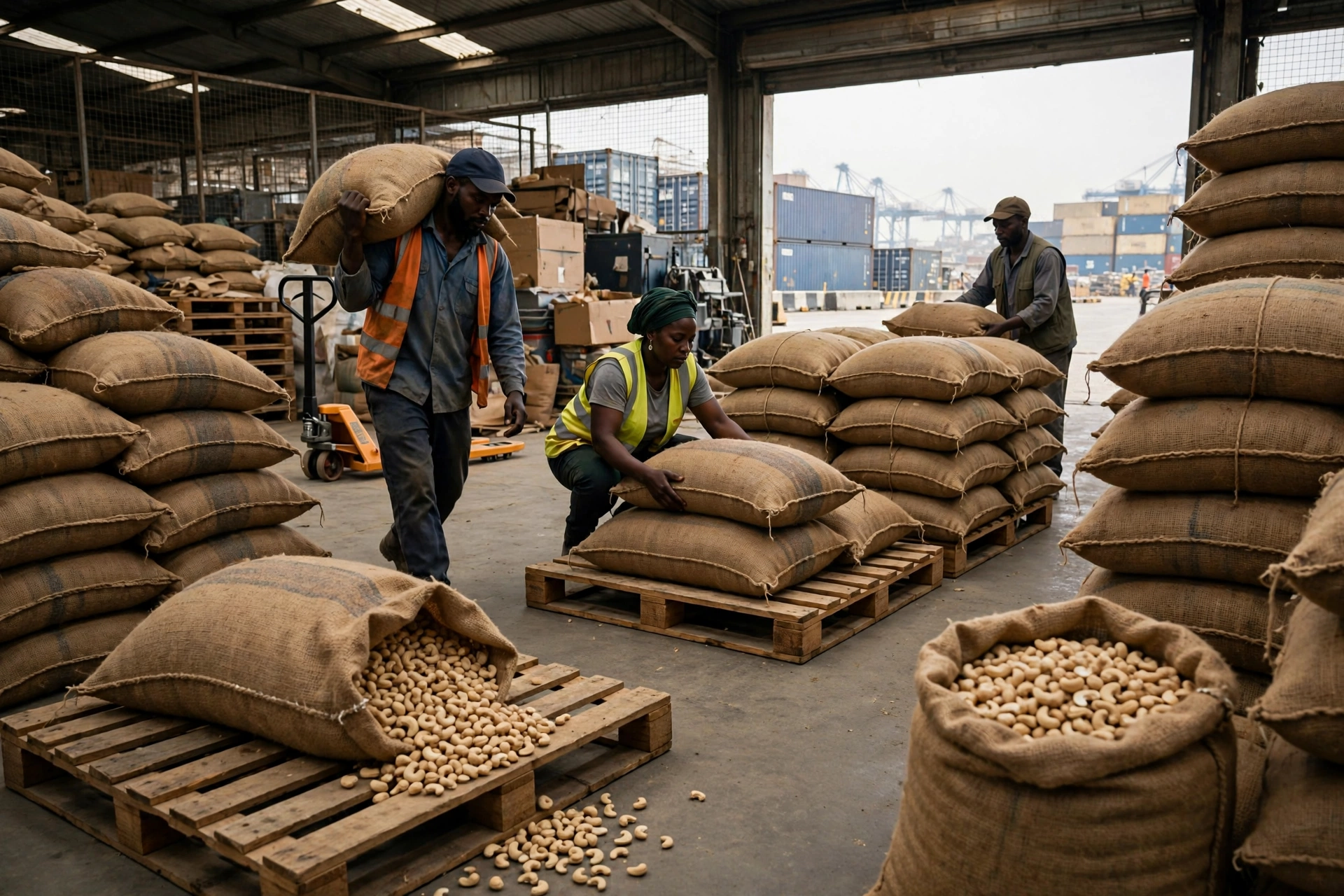
The second line of defense at origin is stacking. Raw nuts are typically packed in 80-kilogram jute bags, stacked on pallets, off the floor, away from the walls, with ventilation aisles left between stacks. Ground damp and wall condensation are the two most common sources of water inside a warehouse. During the rainy season, warehouse relative humidity easily breaks the 65 percent warning line, and at that point ventilation and dehumidification outrank everything else. Many collection points still have no dehumidification equipment, relying on natural ventilation and sun-drying — adequate in the dry season, a clear weakness in the rains.
Beira and Nacala: A Choice Between Two Export Corridors
Mozambique's cashew exports move through two main corridors: the ports of Beira and Nacala. Beira's container terminal, operated by Cornelder de Moçambique, handled 412,100 TEU in 2024, up from 327,300 TEU in 2023, and the World Bank's 2023 Container Port Performance Index ranked it the most efficient container port in Southern Africa. Nacala has the deepest natural harbor on Africa's east coast, but its commercial port handled only about 1.4 million tonnes in 2024.
From Nampula, Nacala is geographically closer, and exporters commonly quote FOB Nacala, with a standard 20-foot container holding about 19 to 22 tonnes and a 40-foot container about 25 to 26 tonnes, per exporters' published quotations. Beira wins on liner frequency and port efficiency. The choice between the two corridors is a trade-off: Nacala saves overland distance and cost but offers fewer sailing options; Beira adds several hundred kilometers of trucking but delivers more reliable schedules. For schedule-sensitive traders, Beira is usually the safer choice; for origin-direct exporters, Nacala is more attractive.
The final step is pre-shipment inspection: every lot is inspected by SGS or Bureau Veritas — quality, weight, moisture, and purity — plus an official phytosanitary certificate and certificate of origin. Vietnam and India, the main buyers, inspect moisture and mold strictly. A container rejected at destination costs not only the cargo value but the credibility of the entire trading chain.
Running the Numbers: What Mozambique Cashew Export Warehouse Storage Costs Versus Downgrade Loss
Here is a worked comparison — an illustrative scenario, with figures based on standard industry practice rather than official rates — for a 20-tonne lot, from an origin warehouse in Nampula to loading at Nacala:
| Item | Illustrative amount | Notes |
|---|---|---|
| Moisture testing (collection plus retest) | About USD 150 | Meter and testing labor |
| Ventilation and dehumidification (2 weeks) | About USD 400 | Fans and temporary dehumidifiers |
| Pallets and stacking labor | About USD 300 | Elevated stacking, ventilation aisles |
| Pre-shipment inspection and certificates | About USD 500 | Third-party inspection, phytosanitary certificate |
| Total moisture investment | About USD 1,350 | About USD 67.50 per tonne |
| Potential loss: full-container downgrade | Several thousand to tens of thousands of dollars | Downgrade or rejection from mold |
The comparison is clear: moisture protection costs about USD 67.50 per tonne, while one downgraded or rejected container can cost several times to more than ten times that. More importantly, downgrade losses are not linear. When moisture rises from 8 to 10 percent, the loss is not 2 percent of the cargo value — it is the grade of the entire lot. Buyers price on the worst sack, not the average. That is the counterintuitive finding: the return on storage investment has to be calculated on the worst case, not the average.
Trend Assessment: Processing Expansion Will Reshape Storage Demand
Under the government's 2025–2034 Cashew Value Chain Development Programme, processing capacity is to expand twelvefold, from 40,000 to more than 482,000 tonnes. If achieved, the industry will shift from selling raw nuts to selling kernels. Kernel storage is considerably stricter: a 5 percent moisture ceiling, tougher insect and oxidation controls, and a shorter shelf-life window. The existing origin system was designed for raw nuts; whether it can carry a kernel era's storage demands is still an open question.
Meanwhile, in August 2026, the government approved new regulations implementing the Cashew Law of 2023, covering the full chain from cultivation through export. Storage is moving from industry convention toward statutory regulation.
One more variable deserves observation. In the first half of 2026, Mozambique's raw cashew exports generated USD 82.9 million, down 17.7 percent year on year, with volume easing from 74,664 tonnes to 73,391 tonnes. Read against the doubling of export volume in 2025, the market is digesting after an explosive year. The real question is whether the storage and quality system can reliably convert 195,400 tonnes of procurement into export-grade cargo.
On the surface, Mozambique's cashew story is one of production recovery. Look deeper, and it is about warehousing capacity. Planted area and policy investment can lift production, but the moisture, mold, and grading inside the warehouse are beyond the reach of policy documents. Over the next decade, what determines how far Mozambique's cashews travel may not be how many trees were planted, but how accurate the warehouse moisture meter is and how high the sacks sit off the floor.
Those questions have no standard answers yet.
By Dr. Chen, Supply Chain Researcher