Last autumn a small lot landed in my warehouse and changed how I think about fine fibre. It was a Mongolia cashmere export warehouse storage job: dehaired cashmere from a mill outside Ulaanbaatar, bound for the port of Tianjin and then overseas. Only a few dozen cartons. The owner, a friend of a friend, called it an easy hold. "Just keep an eye on it for a while," he said. I laughed, because a carton of cashmere can be worth many pallets of ordinary stock, and keeping an eye on it is not the same as parking it in a corner. We are a small warehouse. We cannot burn money the way the big operators do. When I priced a full climate-controlled, nitrogen-flushed setup, I hung up. Not because I did not want it. Because we genuinely could not afford it.
The cartons looked tidy enough on arrival. I opened one for a spot check and the fibre came out soft as a cloud, light in the hand, almost too nice to pack away again. My old hand Lao Chen picked up a tuft and said the thing I have repeated ever since: this stuff goes flat with a little damp, and it attracts moths faster than it attracts money. Our building is an ordinary steel warehouse. The temperature swings between day and night in spring and autumn, and one corner wall sometimes sweats. Cashmere does not fear cold half as much as it fears being shut up, warm and still. Trapped moisture has nowhere to go, and moth eggs love exactly that kind of quiet, undisturbed place. So the real bill in this trade is not rent. It is three hidden bills: grading, moth-proofing, and moisture control. Miss any one of them and the value you lose dwarfs whatever you saved on rent.
Mongolia Cashmere Export Warehouse Storage Is a Grading Game First
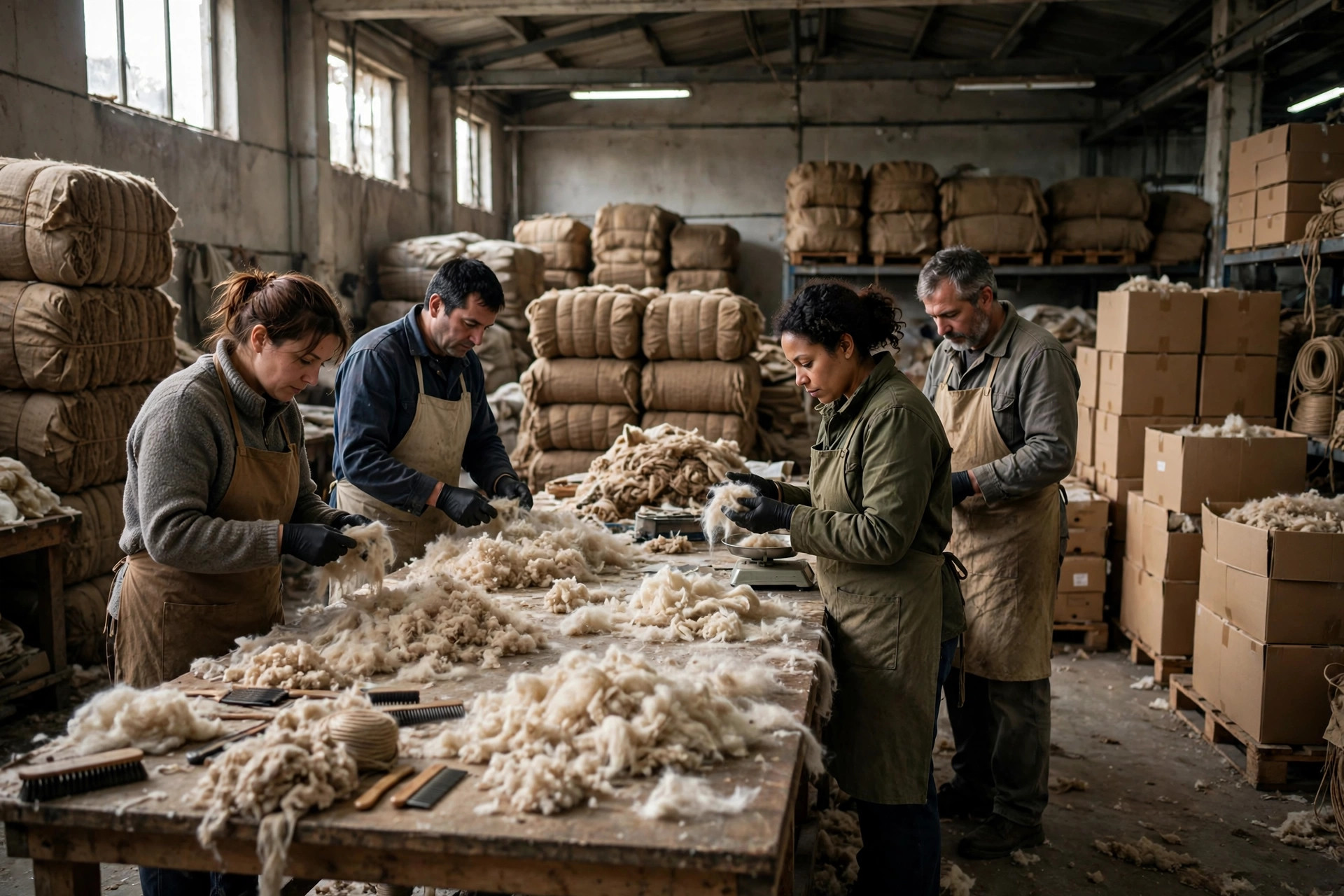
The mill had already graded the fibre, or so the paperwork said. We graded it again anyway. Buyers do not inspect paperwork. They inspect feel and evenness, handful by handful. Our method is embarrassingly simple, and that is why it works. Before anything goes on a shelf, we pull three to five bales from a lot and take a tuft from the top, middle, and bottom of each one. We look at it in natural light and check length and trash content by hand. Once, that check caught a bale of short fibre mixed into a lot that looked identical from the outside. It felt different the second you rolled it between your fingers: loose, weak, ready to fall apart. We tagged it yellow, moved it to its own zone, and wrote "hold, do not blend" on the side. The owner checked later and confirmed it: a batch had crossed over during dehairing. If we had shelved the whole lot in a hurry, the buyer could have downgraded the entire shipment. One lazy afternoon would have cost more than a month of careful work.
Our grading note is deliberately plain. Three things only: batch, sample position, and what our eyes and hands said. No fancy adjectives. We write "long, even, little trash" or "short, loose, more trash" in plain words. The note goes on the side of the carton, and we photograph it. When a buyer asks, we send the photo. Grading slowly for half a day buys you a lot with no blending accidents.
Moth and Moisture: The Mongolia Cashmere Export Warehouse Storage Checklist
Big warehouses fight moths and moisture with equipment. We fight them with routine and stubbornness. Moisture first. Cartons never sit straight on the floor or hard against a wall. Pallets lift them up, and we leave about a fist of space from the wall so air can move. Around the rainy season we check humidity twice a day, morning and evening, with a cheap handheld meter. Whoever is on shift writes the number on a whiteboard. If the numbers keep climbing, we run the fans, or we move the cartons nearest the door further inside. It sounds primitive. Two rainy seasons in a row, we have not lost a single carton to mould.
Moth prevention is mostly about catching trouble early. Before a carton goes in, we check the corners and seams for tiny holes and dust. Anything suspicious gets isolated, away from the good stock, no exceptions. Sticky traps in the corners get changed every week, and we actually look at what they caught. Cleaning matters more than people admit. Floors, pallet gaps, and the dead corners behind racking get swept before cashmere comes in and after it leaves, because loose fibre on the floor is a canteen for moths. One rainy week taught me this the hard way: a row near the door picked up damp at the base of a few cartons. We caught it on a walk-round, moved those cartons to a dry zone, opened them to air for a day, and re-packed them with fresh dry lining. It cost us an afternoon of labour. Two days later, that same row might have needed downgrading. Since then the door row gets checked three times a day in wet weather, and nobody is allowed to call that overkill.
Two more rules, both learned the awkward way. Do not fumigate on a guess. Fumigation touches safety and export compliance, and the rules change, so check the latest official policy and bring in a professional rather than improvising in your own building. And do not store cashmere next to leather or anything perfumed. Fibre picks up smells fast, and a buyer who opens a carton and smells something odd will assume your whole warehouse is sloppy.
The Cheap-versus-Fancy Math for a Small Warehouse
| Approach | Money involved | Moisture and moth protection | Fit for a small warehouse |
|---|---|---|---|
| Full climate-controlled store | High, one big outlay plus upkeep | Steady, but upkeep is also expensive | Poor, small volumes cannot carry it |
| Ordinary warehouse plus strict routine | Low, mostly labour and attention | Good, if the routine actually happens daily | Excellent, built for small lots |
| Renting climate space in a big warehouse | Medium, charged by time | Steady, good for a short peak | Fair, sensible for one very valuable lot |
Here is the counter-intuitive part, and it is the heart of this whole story: the most expensive option is not automatically the most profitable one for small lots of high-value fibre. A climate store is wonderful, but if you only handle a few cashmere lots a year, you pay to maintain it through all the months it sits idle. An ordinary warehouse run with a ruthless routine — raised pallets, space from the wall, twice-daily humidity notes, inbound moth checks, separate zones, zero loose fibre on the floor — costs far less and still meets what an export buyer expects. The cheap workaround is not cutting corners. It is spending money where it counts and spending effort everywhere else.
Outbound deserves the same care. Before loading, spot-check again, especially for soft, damp carton bases and any sign of insect damage at the seals. Load in batch order, first in first out, so no carton gets forgotten in a corner for months. Port, paperwork, and quarantine requirements can change from year to year, so check the latest official policy and walk through the documents with your freight forwarder before the truck reaches Tianjin. Do not discover a missing paper at the port. Our lot cleared its buyer inspection on the first pass, and the owner told me the buyer complimented the grading notes. For a small warehouse, that kind of compliment is worth more than an advertisement.
So here is my advice to other small warehouse owners. First, before you accept high-value light fibre like cashmere, honestly judge whether your moisture and moth routine is up to it. If it is not, do not take the job out of pride. Second, keep records you can show: photos plus plain-language notes, so that if anything goes wrong, the facts are already on the table and nobody has to argue from memory. Third, do not worship equipment. Get the routine right first, and only upgrade equipment once the routine proves where the real gap is. Cashmere pays for carefulness, not for scale.
A small warehouse has its own way of surviving, and ours is simple: treat every carton as if it were your own money sitting on the shelf.
By Xiao Ma, Small Warehouse Owner