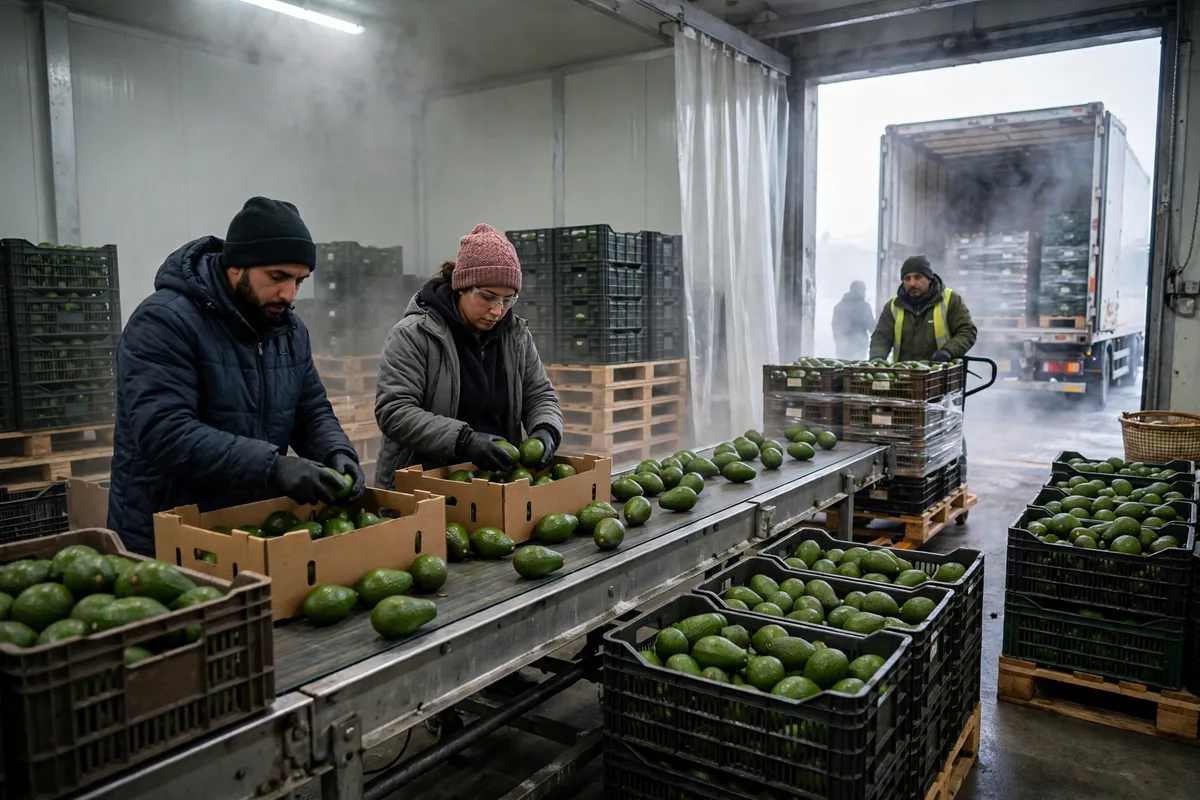
We small warehouses cannot afford to burn money like that — that is the first thought that pops into my head every time someone says "cold chain." Morocco avocado export cold chain warehouse sounds like big-company business: tens of thousands of containers, big ships out of Tangier, supermarket shelves across Europe. But I will say this anyway: small warehouse owners need to know this ledger too, because an avocado shows no mercy. Break the chain once and a whole container turns black on you, and nobody pays for black fruit.
Let me give you the numbers first, so you know I am not making this up. Industry data says Moroccan avocado exports hit a record 112,000 tonnes in the 2024/25 season, with export revenue passing US$300 million for the first time. The previous season was 56,700 tonnes — it doubled in a year. January 2025 alone shipped 32,600 tonnes, more than Morocco exported in the whole 2019/20 season. A product this hot loses money just as fast when the cold chain fails. The next season, exports fell to around 58,000 tonnes: heatwaves, storms, port closures, a shortage of trucks — a few things piling up at once, and the chain snapped.
Morocco Avocado Export Cold Chain Warehouse: Don't Cut Corners on the Harvest Window
The first checkpoint of the avocado export cold chain is not the cold store. It is the orchard. Hass avocados have to come off the tree hard and green. Pick too early and they never ripen properly in Europe; pick too late and ripening has already started on the tree, and the fruit turns black on the road. Maturity is judged on dry matter content — the industry threshold for Hass sits around 23 percent — and it has to be tested by sampling before harvest. Guessing by feel is gambling.
I know a small buyer operating near Agadir who, in the January 2025 shipping rush, was short of pickers and loosened his harvest standard a notch, thinking more fruit picked meant more fruit shipped. When that lot reached Spain, inspection found maturity below standard and the whole container was discounted. He later told me the extra tonnes he squeezed in earned less than the discount cost him. Whatever you save at harvest, the destination port takes back with interest.
Here is the small-warehouse workaround: fruit must go into precooling on the day it is picked. Never overnight. Fruit comes off the tree carrying field heat, and every day of delay pushes respiration and ethylene higher — no precooling, however fast, catches up afterwards. No precooling store of your own? Rent space in a nearby packhouse and pay per pallet. One precooling unit would eat my small warehouse alive for a year; renting someone else's store means paying only in peak season and nothing in the off-season. I ran the numbers once (illustrative scenario, figures are for the sake of the example):
| Option | Upfront cost | Peak-season cost | Off-season cost | Risk |
|---|---|---|---|---|
| Build your own precooling | High, one big outlay | Low | Depreciation and power, still payable | Idle equipment |
| Rent packhouse precooling | Zero | Pay per pallet | Zero | No slot in peak season |
| Leave fruit in the open | Zero | Zero | Zero | Black fruit, total loss |
That third row is a joke, and also something I have genuinely seen someone do. The only risk with renting is peak-season queues, and the fix is to lock your slot a week ahead instead of calling after the fruit is already picked.
Where the Morocco Avocado Export Cold Chain Breaks: Precooling, Temperature, and the Break Points
The temperature numbers for Hass avocados are standard industry practice: store at 4 to 5 degrees Celsius, for at most about four weeks. Set the truck thermostat at 5 degrees for Hass. Fruit at 7 degrees pulp temperature or above should not be loaded, unless the trip is short and the fruit will be ripened on arrival. Precooling should be finished within 24 hours of harvest, and any fruit stored longer than five days has to be cooled through within that window. A refrigerated truck only holds temperature — it cannot cool warm fruit. Load fruit at 10 degrees and it will still be around 9 degrees when it reaches the port, not the 5 degrees you wanted. That is the most common misunderstanding in the cold chain: a truck is an insulated box, not a fridge.
There are three break points, and I will take them one by one. The first is at the packhouse door: precooled fruit is pulled out of the cold store and waits on an open dock in the sun for the container. Half an hour of sun pushes pulp temperature up two or three degrees, and that lot's shelf life just got shorter. The fix is crude but it works: load in the early morning or evening, put a shade canopy over the dock, and precool the reefer before opening the doors. The second break point is the port. In the 2025/26 season, weather shut ports down, trucks queued, and reefer containers sat in the yard running on their own diesel generators. When the fuel runs out, the temperature runs away. The fix is to check sailing schedules and yard congestion before dispatch, carry spare generator fuel, and never arrive at the last possible hour. The third break point is handover: every time fruit changes hands — cold store to truck, truck to reefer — measure pulp temperature and write it down. Temperature logger data is your evidence when a claim lands. Without records, nobody can say whose fault the black fruit is.
And here is the counterintuitive one: colder is not better. Hass avocados suffer chilling injury. Push the temperature too low and the flesh goes wrong anyway — blackened centres, off flavours, only visible once the fruit reaches the shelf. The big-company mindset of "better frozen than warm" is one small warehouses should not copy, and cannot afford to. The right move is to hold the 4 to 5 degree line and measure temperature more often, rather than cranking the dial down and hoping.
From Tangier Med to the European Shelf: How a Small Warehouse Survives
Morocco's biggest advantage is geography: from Tangier Med to southern Europe takes only a few days, far faster than East African fruit rerouted around the Cape of Good Hope. In 2025, over 35 percent of Moroccan avocado exports went to Spain, 25 percent to France, and 22 percent to the Netherlands. A short sea leg means the cold chain actually has more slack than people think — but only if the land legs hold. A few days at sea is no problem; what hurts is the land: orchard to packhouse, packhouse to port. Half a day lost on either leg wipes out the whole advantage of the short crossing.
The small-warehouse way of life is one sentence: don't compete with the big companies on equipment; beat them on rhythm. Lock the harvest window, finish precooling within 24 hours, measure pulp temperature before loading, and leave slack in the sailing schedule. Get those four right and the loss rate on a container comes down. The big companies own the full set of cold stores and fleets. We rent other people's equipment and keep our own schedule tight. The money-saving shortcuts are not about cutting corners — they are about spending on the sharp end. Buy the temperature loggers. Rent the precooling store. Put up the shade canopy. Hold off on buying your own reefer truck.
An avocado stays green because of an unbroken chain, not because of luck — and that is what morocco avocado export cold chain warehouse work really is. From an orchard near Agadir to a shelf in Europe, every handover needs someone measuring temperature and someone signing for it. That is the only way the fruit arrives with confidence. Small warehouses have their own way of surviving: equipment can be rented, but the rhythm cannot slip.
By Xiao Ma, Small Warehouse Owner