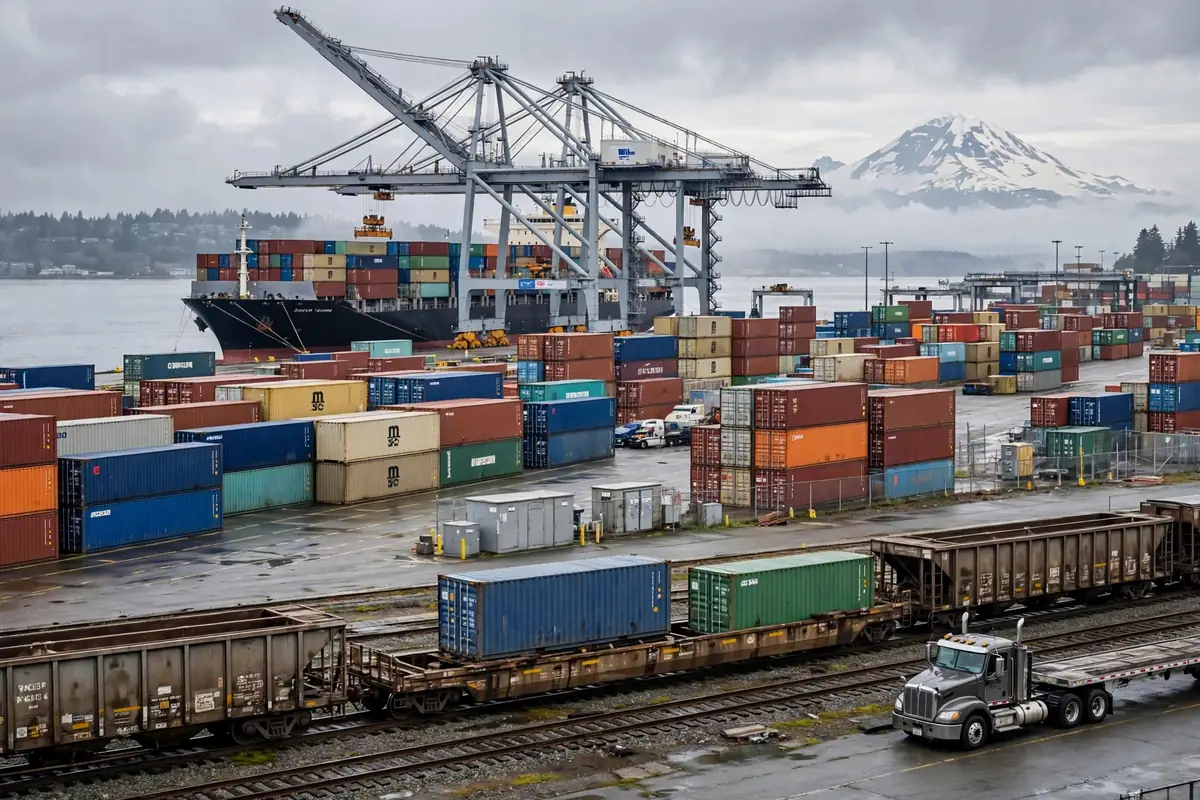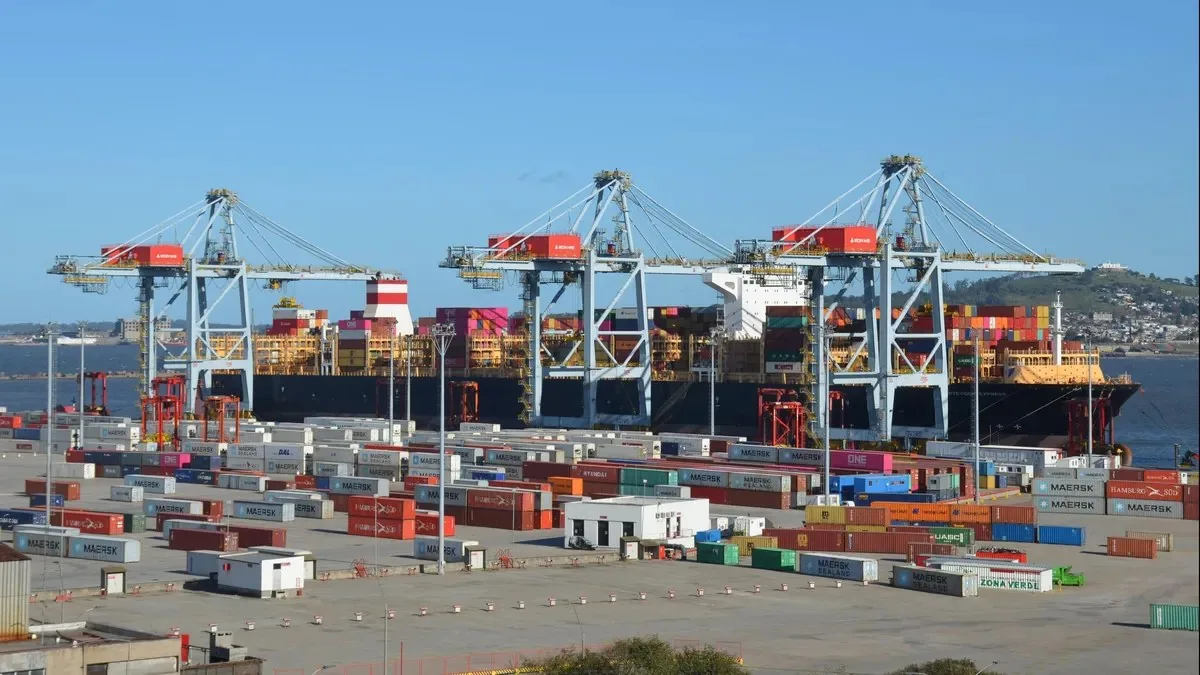
The Port of Montevideo posted a set of numbers in 2024 worth a close look in the Southern Cone port picture: its specialised container terminal handled 1.56 million TEU, up 24 percent year on year, a record. WorldCargo News credited new services and the ability to host larger ships. The same port told a different story in 2025: volume slipped, and Montevideo fell out of the world's million-TEU club. A record and a retreat twelve months apart — the right place to start, because this port's business was never built on Uruguay's own cargo. It is built on transshipment.
Montevideo's Free-Port Ledger: the Tax Break Is the Small Part
Uruguay's free-port regime rests on three rules, set out in the IDB Group's 2023 review summary of the terminal expansion: goods inside the customs enclosure are exempt from all import taxes; their final destination can be changed in port without restriction, permit or formality; and there is no limit on stored volume. Together they support one judgment: the free port's real value is not the tax exemption but reversibility. Cargo arrives, and only then does the owner decide who buys it and where it sails next — a freedom scarce among Southern Cone ports.
Exemption is not cheap, and the two are often confused. The free port waives import taxes, not logistics cost: terminal handling, storage beyond free time and the barge leg are all charged, as are reefer monitoring, consolidation and deconsolidation, and container repair. A hypothetical calculation shows the structure. Take 100 TEU in the port for 21 days, with 7 days free and an assumed rate of 8 dollars per TEU per day beyond free time: the excess bill is 100 times 14 times 8, or 11,200 dollars. Route the same cargo through import clearance and re-export instead: on an assumed value of 500,000 dollars at a combined import tax rate of 20 percent, the tax exposure is on the order of 100,000 dollars. All rates and values here are assumptions, used only to show the shape of the cost. The free port saves money and time, not handling charges, which are billed by the day.
There is another side to the regime: the operating concession is locked in for the long term. In 2021 the government and the terminal operator agreed: Belgium's Katoen Natie would invest around 455 million dollars in the expansion, in exchange for a 50-year concession extension to 2081. Katoen Natie holds 80 percent of the terminal, Uruguay's National Ports Administration holds 20 percent. One 50-year concession ties the policy dividend of the free port to a single operator's long-term investment. For anyone siting a distribution base, the practical meaning is plain: the stability of the port's rules rests largely on how that concession is executed, not on what a given year's government says.
How the Transshipment Chain Works: Warehouse, Port and Ship
This port's transshipment business runs on a river. Paraguay and Bolivia are landlocked, so their export cargo travels south by barge along the Paraná–Paraguay waterway and transfers to ocean vessels at Montevideo, with imports moving the other way. National Ports Administration data puts transit and transshipment volume at 211,699 TEU in January–July 2026, around 40 percent of the port's total box volume in the same period. Four out of every ten boxes the port handles are only passing through. That ratio is the key to the port's warehousing logic: the warehouse exists first as a node where transshipment cargo can pause, split apart and recombine, not as a shed serving the domestic market.
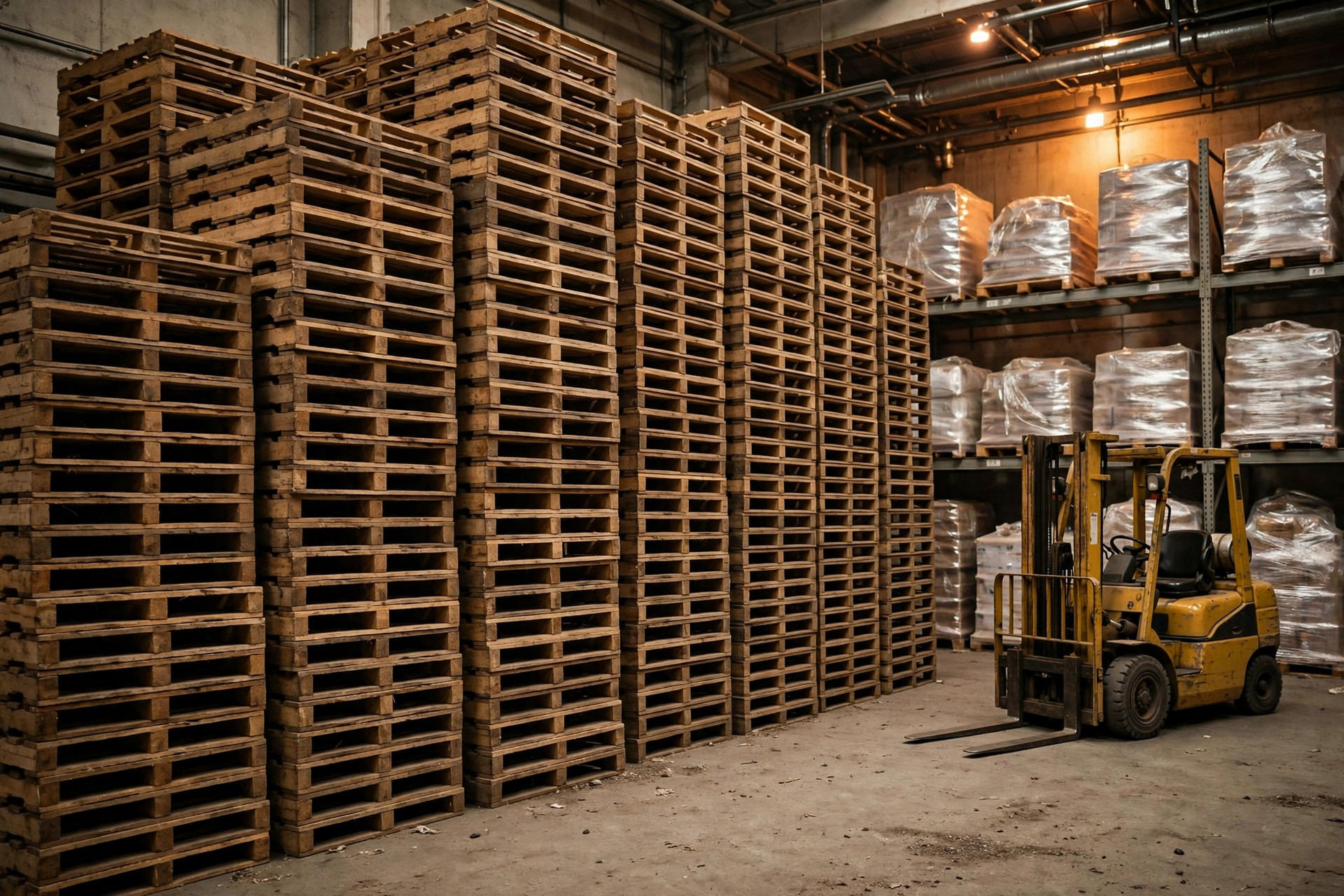
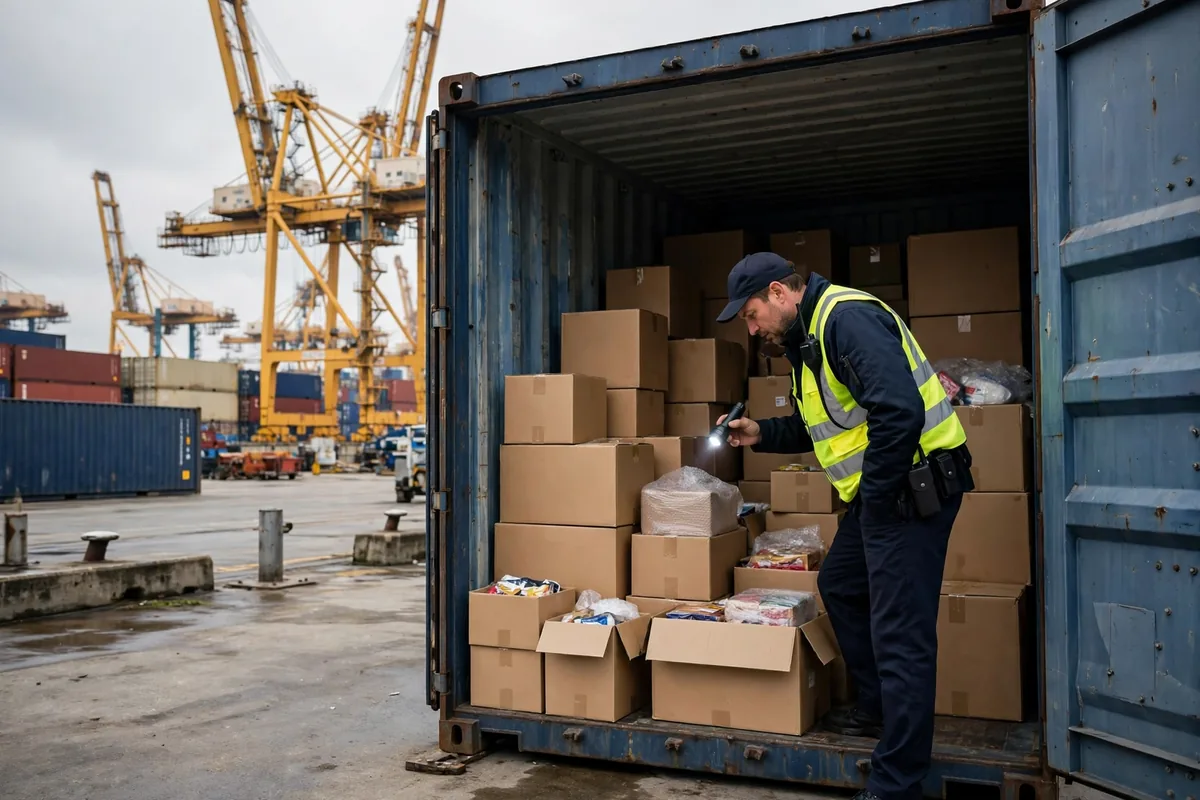
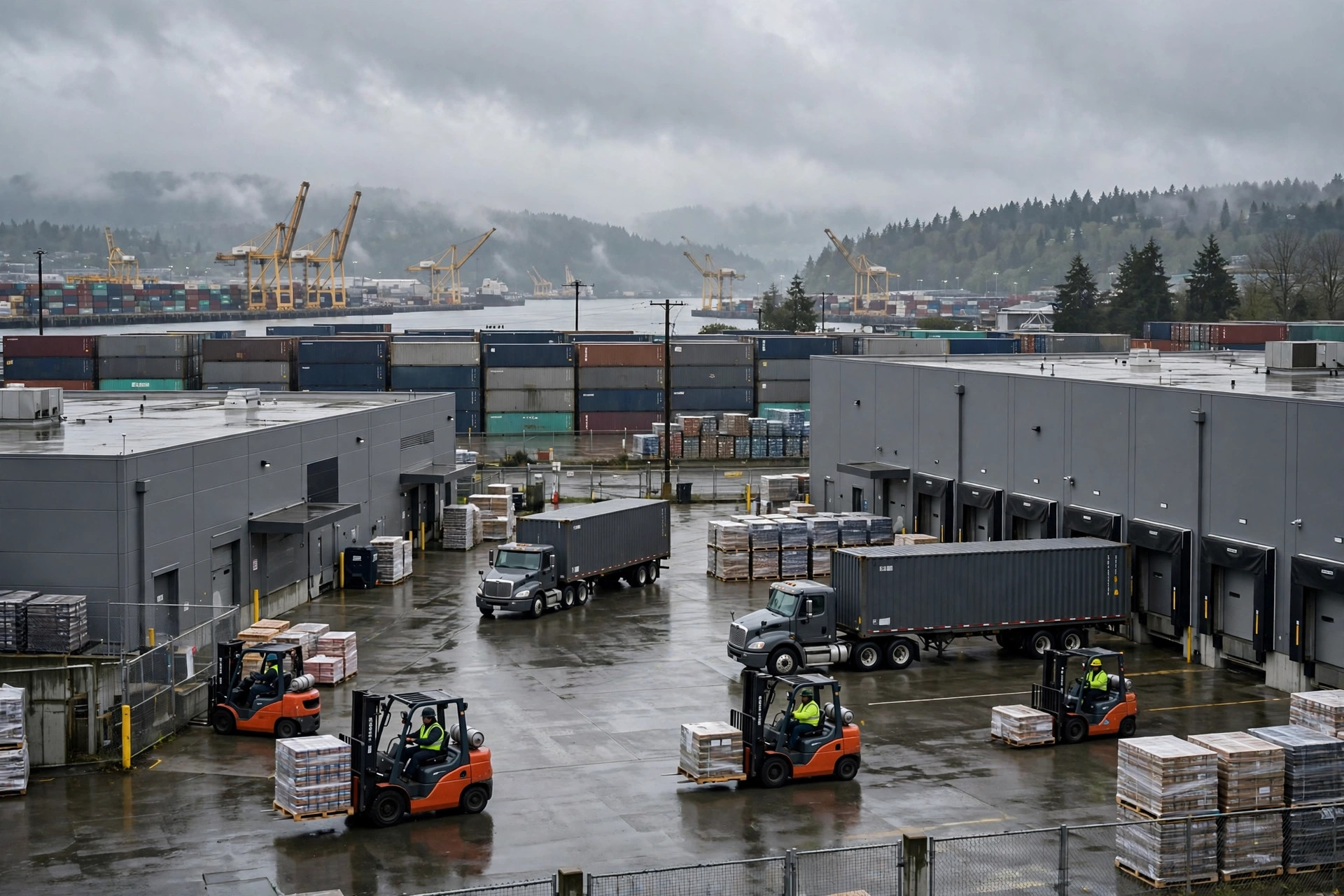
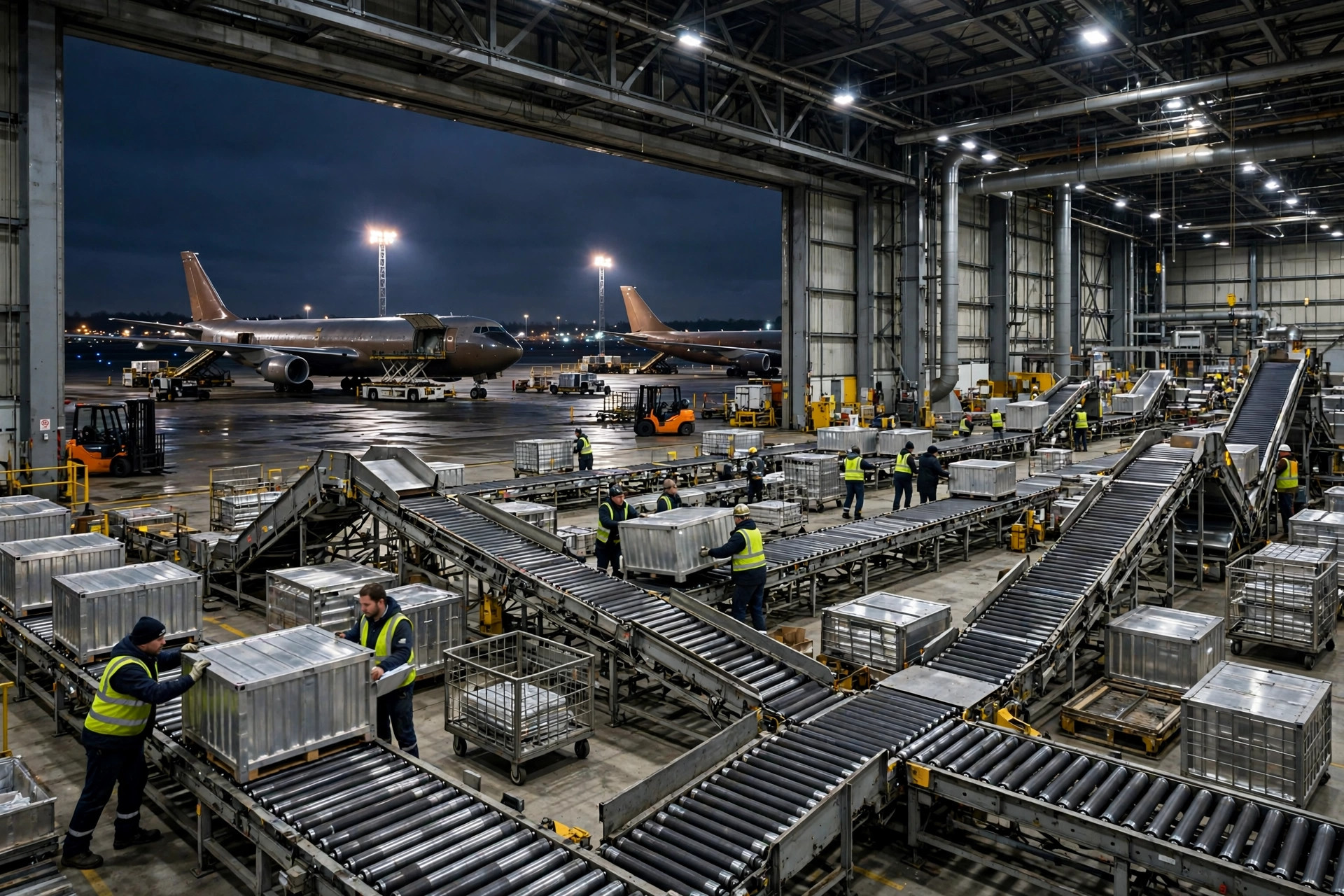
The terminal's service list is built around exactly that node: container handling, reefer connection and monitoring, storage of standard and special boxes, container repair and washing, two warehouse buildings totalling over 7,000 square metres, and consolidation and deconsolidation. Warehousing and port functions are not kept apart here. Cargo can enter a bonded warehouse, be sorted, repacked and reconsolidated, then sail out again without ever triggering an import tax event. Picture the flow: assume 200 TEU of Paraguayan farm products arrive in three barge lots, are sorted by destination in the bonded warehouse, and load onto two ocean services within 48 hours. Volumes and timings here are assumptions. Nothing about the flow is technically remarkable. The remarkable part is the paperwork: not a single import declaration anywhere in the chain.
Set the three Southern Cone export routes side by side. The table below is a judgment framework built on public information, not a rate quotation.
| Route | Free-port regime | Draft | Barge connection | Suits | Main weakness | | Montevideo transshipment | Import taxes waived in the enclosure; destination freely changeable | 14 m at the berth after expansion | Direct link to the Paraná–Paraguay waterway | Transshipment cargo, landlocked-country trade | Small hinterland, transit-dependent | | Buenos Aires | No free-port regime | See the port authority's latest data | Waterway link, more formalities | Argentina's own import and export cargo | Policy volatility, costly transshipment formalities | | Santos direct call | No free-port regime | Deep-water major port | No direct inland waterway link | Brazil's own bulk export cargo | Far from southern Cone markets |
Beyond the table sits one more judgment: this port's rival is not Buenos Aires alone, but the whole logic of where liner services call in the Southern Cone — a carrier calls where a ship can be filled in one stop, not where the policy brochure reads best.
After Montevideo's Expansion, Where Does the Cargo Come From?
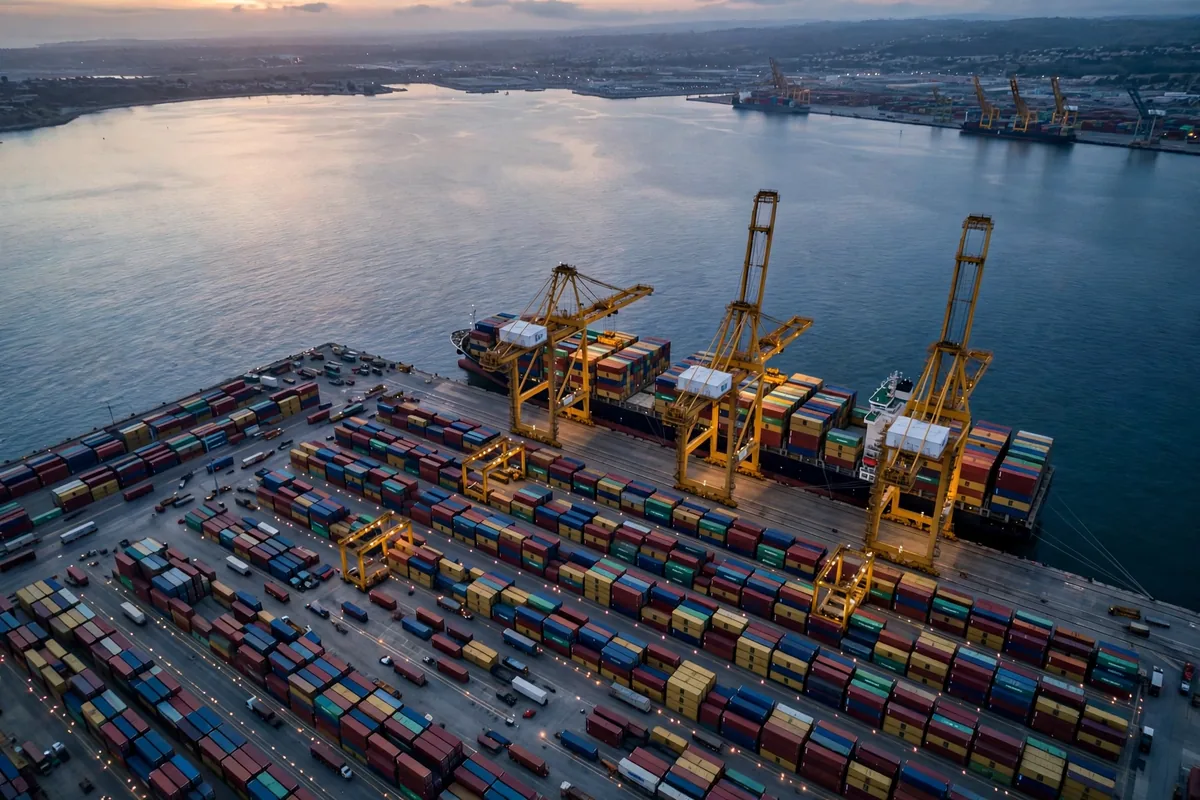
The expansion programme is pushing the port's hardware to another level. According to the IDB Group's 2023 review summary, the expansion adds around 700 metres of new quay, dredged to 14 metres, with room to deepen to 16 metres if needed, and targets capacity above 2.5 million TEU a year. The two existing berths total 638 metres, served by six gantry cranes, four of them super post-Panamax. Equipment maker Kalmar confirmed in January 2024 that the terminal had ordered 20 hybrid straddle carriers, with completion scheduled for 2026. On hardware terms the story is complete: longer quay, deeper water, big ships can call.
In the same period, a second proposal moved the competition into the open. In September 2026, Chile's Neltume Ports submitted a plan to the Uruguayan government for a new container terminal: a 900-million-dollar investment, capacity of 1.15 million TEU a year, around 940 metres of quay, about 38 hectares, independent landside access and a dedicated berth for barge transshipment. It is under government evaluation; no concession structure, schedule or opening date has been disclosed. Montecon, the main operator on the port's public docks, belongs to the same group.
The counterintuitive judgment sits here: capacity is doubling while volume is retreating. The port's exit from the million-TEU club in 2025 stands against the 1.56-million-TEU record of 2024. The expansion answers the question of whether big ships can be received. It does not answer where the cargo comes from. Box growth here depends on Argentina's and Brazil's trade cycles, on Paraguay's and Bolivia's transshipment demand, and on whether carriers shift calls from Buenos Aires or Santos — none of which is in a terminal operator's hands. Capacity running ahead of cargo is normal in port investment, and a risk to price into any distribution-base decision: the first thing new capacity usually produces is price competition, not a surge in volume.
Three Tests for a Southern Cone Distribution Base
Three questions come before signing anything. First, the transshipment share: how much of your cargo is passing through rather than staying. The higher that share, the more the free port's reversibility is worth; if most of the cargo serves Uruguay's domestic market, the free-port dividend barely touches you. Second, the barge and feeder network: can cargo from Paraguay, inland Argentina and southern Brazil actually be brought in. If it cannot, the free port is only a tax break on a small domestic port. Third, the storage tariff against your turnaround rhythm: how many free days, what the excess rate is, and whether it fits your distribution cycle. Profit in the transshipment business is often not eaten by freight — it is ground away, dollar by dollar, by excess storage charges.
Two things are worth watching after 2026: the expansion's utilisation rate once it finishes, and whether Neltume's new terminal wins a concession — which decides whether the port spends the next decade with one terminal in the lead or two competing head to head. When both terminals' capacity comes online together, will transshipment rates fall into a price war first? And when that happens, what is the free-port brand still worth? There is no ready answer; it will be in the service schedules and rate sheets after 2026.
By Dr. Chen, Supply Chain Researcher