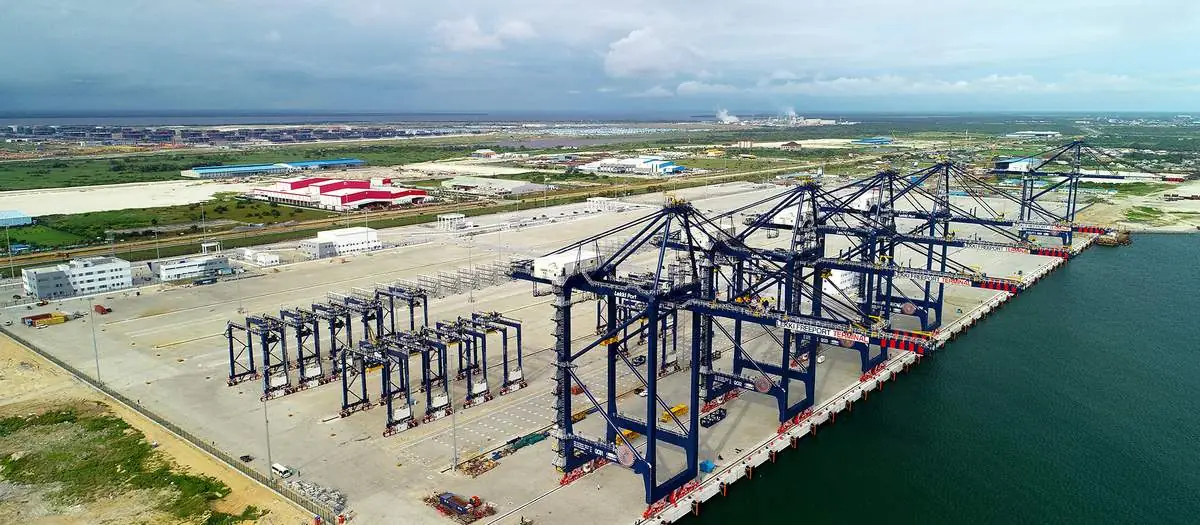
Let me be honest up front: I run a 3,000-square-meter warehouse, and writing about a deep-water port in Nigeria is way outside my lane. It started with a dumb, practical question. Last year a regular customer who sells building materials asked me if I could help ship a load to Lagos, Nigeria. I froze. Lagos was a place I had only seen in the news, and all I could think was "Africa," "far," "expensive." When I looked into it, I found Lekki Deep Sea Port next to Lagos, which started commercial operations on April 1, 2023, as Nigeria's first deep-water port. This is the warehouse and distribution math I pieced together as an outsider, and the keyword to search in English is lekki nigeria deep sea port warehouse logistics.
My first instinct was that this had nothing to do with a small warehouse like mine. A deep-water port sounds like a big-player game. The numbers back that feeling up: 90 hectares, 1,523 meters of quay, three container berths plus three liquid berths and one dry bulk berth, 16.5 meters of water depth, able to take vessels up to 14,000 TEU. Phase one was designed for 1.2 million TEU a year, expandable to 2.5 million TEU in the long term. The bigger the numbers, the smaller I felt. We small warehouses cannot afford to burn money like that. Renting space next to a berth would drink my whole budget.
But the customer's question stuck with me: "Just help me figure out whether shipping through this port actually pays." Fine. Look at the numbers first, decide later.
How Busy Is This Port, Really?
Lekki's throughput climbed a steep slope in three years. In 2023 it handled 54,289 TEU, and that was only nine months of operation. In 2024, its first full year, it handled 238,000 TEU. In the first half of 2025 alone it moved 222,000 TEU, with a full-year target of 500,000 TEU. Lined up, those three numbers tell a clear story: this port is not a showpiece. It is genuinely ramping up.
I did the math on a calculator. In 2024, 238,000 TEU against a design capacity of 1.2 million TEU is under 20 percent utilization. In the first half of 2025, 222,000 TEU nearly matched the whole of 2024, and a 500,000 TEU full-year target still means utilization just over 40 percent. In plain terms: the port is big, and the cargo has not filled it yet.
| Year | Throughput | Note |
|---|---|---|
| 2023 | 54,289 TEU | First year; commercial operations began April 1 |
| 2024 | 238,000 TEU | First full year of operation |
| H1 2025 | 222,000 TEU | Full-year target 500,000 TEU |
Here is the counterintuitive part: the emptier a port is, the better the opening for a small player. A jammed port does not need your cargo, so the terminal and the carriers hold all the cards and will not even look at a small warehouse owner. A half-empty port needs cargo, and that means there is room to talk about space, payment terms, and service. In its first year the port saw 75 vessel calls, handled over 100,000 containers, and transshipped more than 25,000 boxes. Transshipment was roughly a quarter of the total, which tells me it serves more than Nigeria alone. It is eating into regional transshipment business too. A port still climbing is friendlier to small players than a port running at full capacity. If there is one sentence that sums up lekki nigeria deep sea port warehouse logistics for a small player, it is this: the port is the headline, distribution is the business.
The Small Warehouse Playbook: Forget the Quay, Watch Distribution
Once I saw that, my thinking changed. Small warehouses should not rent space hard against the quay. Watch the distribution link instead. In the second half of 2024, that building-materials customer actually sent a trial shipment through Lekki. I went over it with him twice, and the scrappy playbook came down to three moves any small warehouse can copy.
First, do not build your own warehouse. Share an existing distribution warehouse near the port zone. I will not quote rents or fees here; check the latest published rates on the official website. The logic is fixed, though: before volume grows, share space, rent short term, and settle per shipment. Stay flexible. Building your own site is a big-player game, and we small warehouses cannot afford to burn money like that.
Second, do not ship a full load at once. Test the rhythm with small batches. The customer's first shipment was only a few containers, sent specifically to learn the customs clearance, the inland leg, and the pickup rhythm. The terminal is operated by Lekki Freeport Terminal, part of CMA CGM, so a big carrier runs it directly, which makes schedules more reliable than at a small terminal. That is real reassurance for a small player testing the water. Even so, your own cargo rhythm has to be learned one shipment at a time.
There is another shipment worth telling. Early this year a friend who sells daily goods asked me whether cargo bound for a country neighboring Nigeria could also route through Lekki. I told him to look at those 25,000 transshipment boxes from year one. This port was never built to serve Nigeria alone. Neighboring countries' cargo is moving through it too. His goods ended up riding a transshipment routing instead of booking a separate sailing. I will not quote what he saved, because schedules and consolidation change the number completely, but the point stands on its own: Lekki's transshipment function is a ride small players can catch right now, without waiting until they grow up first.
Third, watch the transshipment opening. More than 25,000 transshipment boxes in year one tells me cargo from neighboring countries is moving through this port too. Here is a worked example, labeled as a scenario: suppose you hold two small batches, one bound for Nigeria and one for a neighboring country. Booking each separately is uneconomic, but consolidating them onto one transshipment routing gives you a chance to spread the cost per shipment. Exactly how much you save depends on schedules and consolidation options, so check the latest published terms. The direction is right, though. Small cargo riding big routes is the game small warehouses know best, and it is the cheapest way into lekki nigeria deep sea port warehouse logistics without betting the warehouse on it.
Three Checks Before You Reach for Lekki
First, is your volume steady? Is your cargo to Nigeria a stable long-term flow or a one-off deal? If it is not steady, forget block bookings and long contracts. Ship per order and stay flexible. The port's full-year target of 500,000 TEU is still a ramp-up number, space is not tight, and shipping loose does not cost you.
Second, does the inland leg work? However deep the port is, cargo stuck inside the port zone is worthless. Customs clearance, inland transport, and distribution nodes all need checking in advance, and the policies and charges on that chain should be confirmed against the latest official information before you ship. Do not discover a blockage after the cargo has already arrived.
Third, can your cash flow survive the payment cycle? Ocean freight ties up money for a long time, and a small warehouse runs thin on cash. If a month at sea means a month of money locked up, and that math does not work, do not force it, however good the port looks.
Small warehouses have their own way of surviving. Lekki Deep Sea Port is huge, but it still loads one box at a time, and we are small, but we can still squeeze profit out of one shipment at a time. A deep-water port is not reserved for big players. Empty berths and throughput that has not yet filled up are openings left for the small guys, as long as you do the math first and reach out second.
By Xiao Ma, Small Warehouse Owner