Here's my verdict up front: in the Kenya coffee export warehouse business, storage is where the money is made or lost — and it's the part most people underestimate. A great price at the Nairobi auction means nothing until the beans reach Mombasa in the same condition they were sold in. One damp pallet, one missed handover, one mixed lot, and the premium evaporates. I've watched too many people spend all their energy winning the auction and then hand storage to the cheapest option available.
A friend of mine, an importer who buys Kenyan beans, rented a plain dry-goods warehouse outside Nairobi a few years back. Cheap rent, close to the auction house — what could go wrong? The lot was AA grade, the largest screen size at 7.2 millimeters, and top AA was fetching $450–$523 per 50 kilos at auction, which works out to roughly five or six hundred dollars for a 60-kilo bag. Then the rains came. The floor sweated, and the sacks against the wall went first. The beans looked fine on the surface, but the moisture reading told the truth. The lot went out downgraded, and the whole auction premium went with it. Put plainly, what he saved on rent wouldn't cover the price difference on a single bag.
The Kenya Coffee Export Warehouse Bill Starts at the Auction
Kenyan coffee leaves the country through two channels: the auction or direct export. The Nairobi Coffee Exchange runs a weekly auction, and in the 2025/26 season it traded 770,034 bags — roughly 47,000 tonnes — worth 41.63 billion Kenyan shillings. The average auction price in 2025 was $7.21 per kilo, up from $4.90 in 2024. In the 2024/25 coffee year, Kenya exported 50,675 tonnes for $343.99 million. More than 80% of the crop is exported, the United States is the biggest destination at about 21.4% of export value, and the 2025/26 crop is forecast at 850,000 bags with exports at 840,000. The message in those numbers is simple: the beans keep getting more valuable, and so does every storage mistake.
There's another thing about auctions: winning the bid is the start of delivery, not the end of the deal. The coffee has to be collected, warehoused, re-inspected, and stuffed on schedule. Every day of delay adds storage charges and ties up capital. Plenty of buyers can quote the auction price to the cent and then budget storage as "a few days somewhere." That's two different skills — the auction rewards judgment, the warehouse rewards patience — and you need both.
What Kenya Coffee Fears in the Warehouse: Damp, Delay, and Mixing
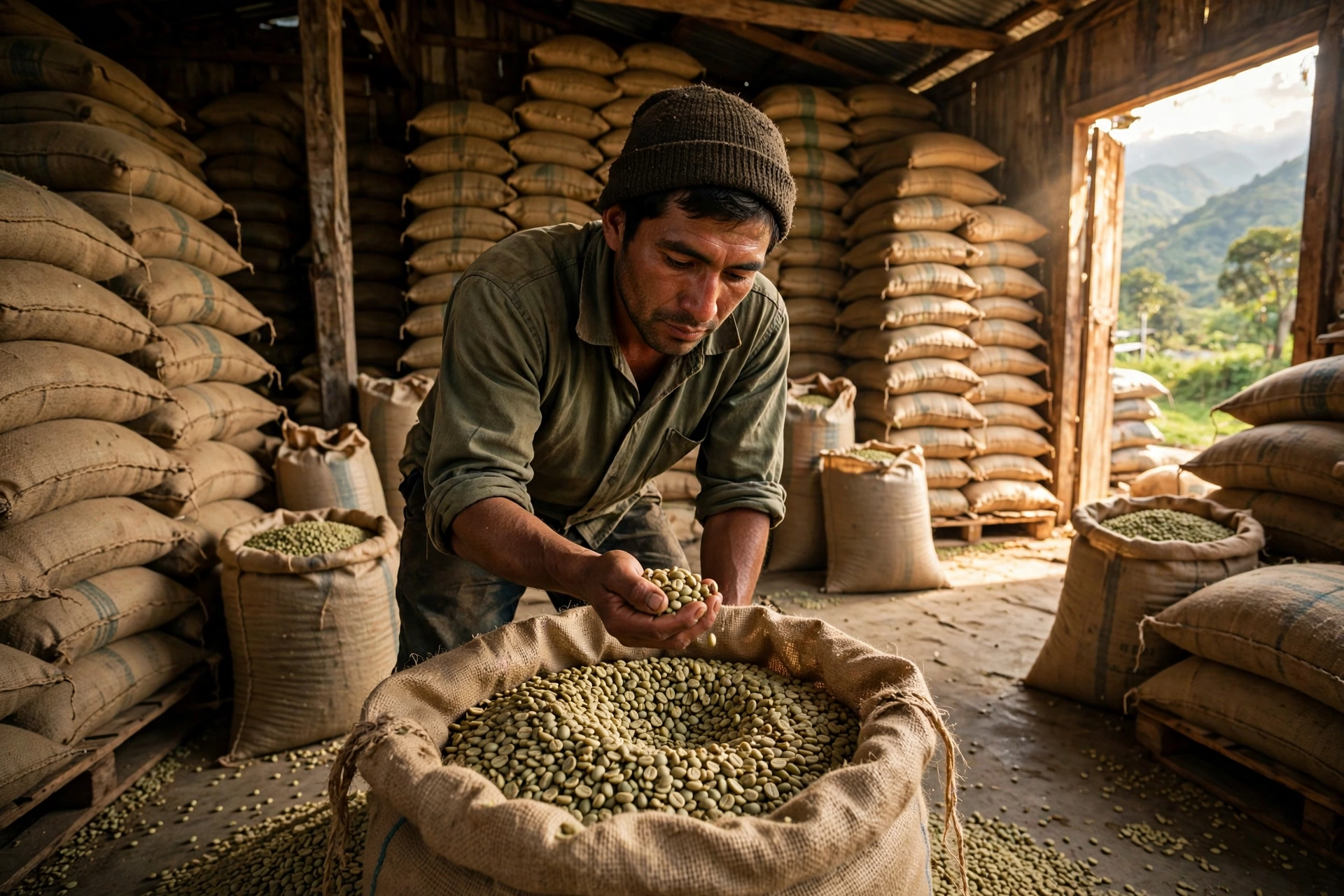
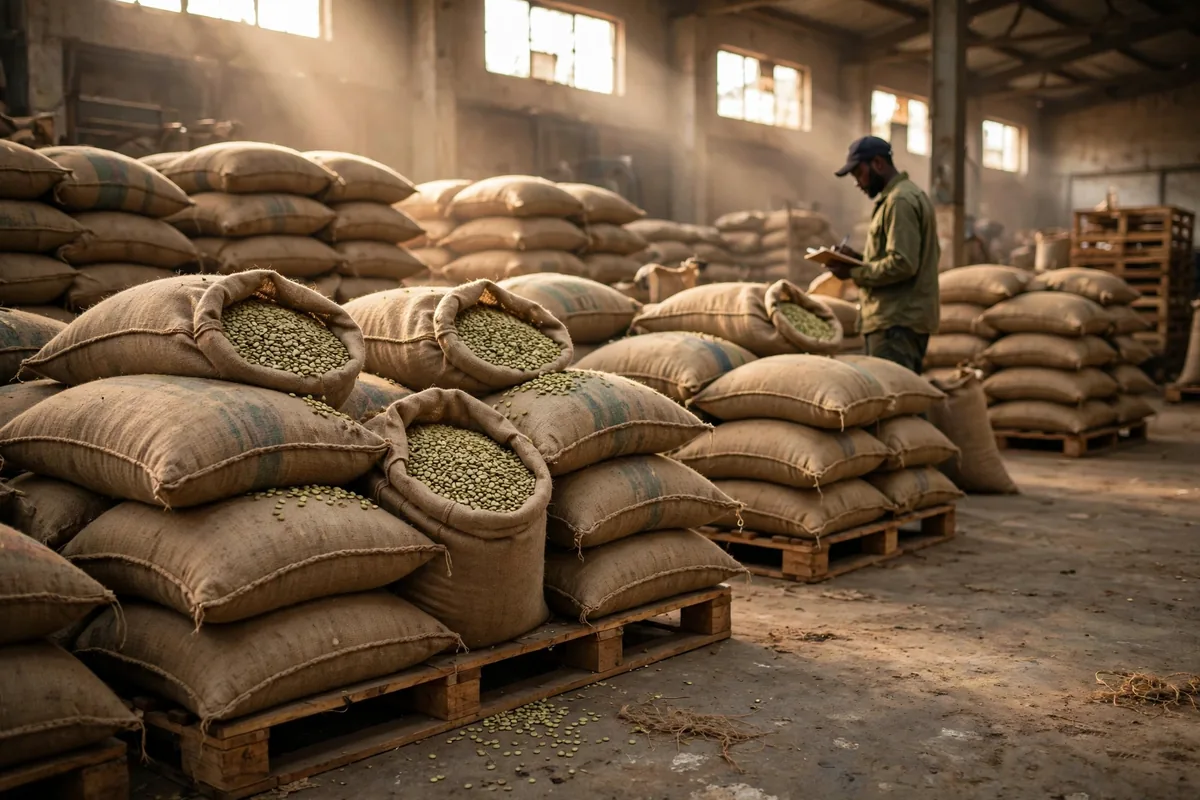
Start with damp. Kenya grows mostly washed Arabica, and the best-known origins — Nyeri, Kirinyaga, and the rest — carry the highest grade premiums. Washed beans don't fear steady damp half as much as they fear wet-dry cycles: a damp week followed by hot sun stresses the bean from the inside out, and quality drops faster than it would in a warehouse that was simply humid all along. The rules are old-fashioned: pallets off the floor, sacks off the walls, air moving between the stacks, and someone checking the bottom sacks in the rainy season. Old-fashioned works because it answers the most common way a lot dies.
Then delay. From Nairobi to Mombasa, the beans pass through several hands — upcountry stores, the exporter's warehouse, the port warehouse. Each handover is another loading, another chance for a sailing to slip. When a vessel is delayed and the coffee sits in a port warehouse for two extra weeks, rent, insurance, and the cost of tied-up money all rise together. Work that bill out before the coffee leaves Nairobi, not after it's stuck at the port.
Then mixing. Never mix origins or grades in one stack. Nyeri AA piled next to a lower grade gets confused the moment the warehouse gets busy, and the grade premium disappears with the confusion. Clear labels on every bay and separate stacking by grade sound like obvious advice. The warehouses that get into trouble are usually the ones that skipped the obvious part.
Choosing the warehouse is itself a trade-off. An upcountry cooperative store sits closest to the beans and makes collection easy, but its moisture protection is the most uneven. An exporter's warehouse in Nairobi sits closest to the auction and makes handover easy, but it turns stock fast and stacks tight. A port warehouse in Mombasa sits closest to the ship and makes stuffing easy, but when a sailing slips, the rent bites by the day. No one option is right all the way through. Picking a warehouse means picking which stretch of the journey you want the risk to sit on.
The Last Checkpoint Before Mombasa
My routine is three inspections: once when the coffee enters the warehouse, once before it leaves for stuffing, and once more before the container doors close. A container is not the end of storage — if the beans go damp inside the box, you find out at the destination port, where a claim is far harder than it was in Nairobi. Desiccants and container liners are small money. Use them.
A worked example, using hypothetical shipment figures: one container of 320 bags at 60 kilos each, priced at the 2025 average auction price of $7.21 per kilo, is worth about $138,000. If a tenth of those beans go damp and have to sell at 80% of the average price, the loss on those 32 bags alone is more than $2,700 — enough to pay for months of proper storage. Saving on rent versus protecting grade is always a trade-off, but once you've done this math, protecting grade wins almost every time.
Here's the counterintuitive part: the most expensive warehouse isn't necessarily the safest. The warehouse closest to the auction house turns stock fastest, with the most traffic in and out — and that's exactly where temperature and humidity go unwatched. Safety doesn't come from the rent you pay; it comes from whether anyone actually follows the process. Three inspections, done properly, are worth more than a brand-new building with nobody checking.
So the next time someone tells you Kenya coffee export warehouse storage is just finding a shed to stack bags in, ask them one question: how much is this lot worth at auction — and how much is it worth after it gets damp? If they can't answer, don't hand them the warehouse keys.
By Lao Mi, Supply Chain Veteran (20 yrs)