Jebel Ali Dubai port warehouse logistics comes down to one question: does your cargo move, or does it sit? Here is my verdict up front. The port is worth using, but not for everyone. Put simply, it is a transshipment machine — port, free zone, and warehouse sold as one package. Use only one piece and the math does not work. Use all three together and it starts making you money.
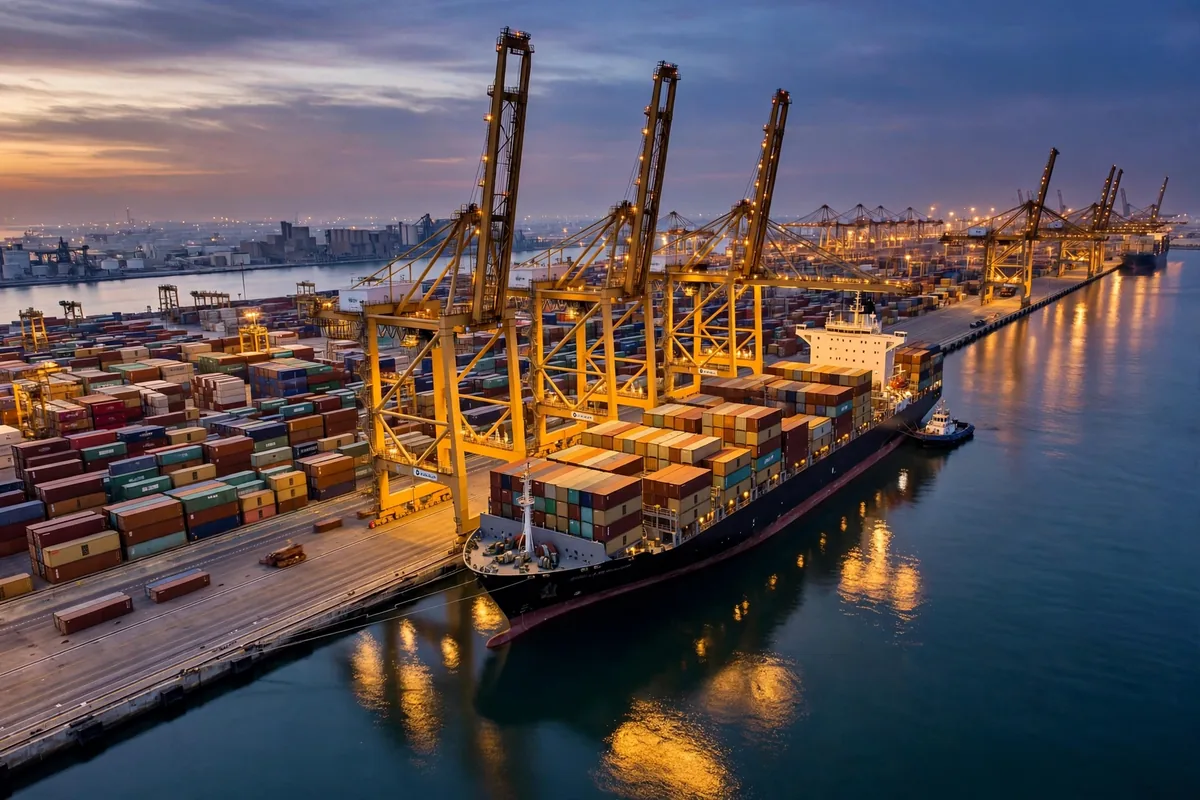
Here is the thing, though. It cuts both ways. Look at the hard numbers first. DP World reported in February 2025 that Jebel Ali handled 15.5 million TEU in 2024 — one million more than in 2023, and the highest since 2015. Annual capacity stands at 19.4 million TEU across four container terminals, more than 100 berths, and 25 kilometers of quay. That 15.5 million is nearly 18 percent of DP World's global total of 88.3 million TEU. Breakbulk grew too: 5.4 million tonnes, up 23 percent year on year. "Largest port in the Middle East" is not a slogan. It is a throughput figure.
The other half is the free zone. The Jebel Ali Free Zone opened in 1985 with 19 companies. Today it hosts more than 11,000 businesses from over 150 countries, including more than 100 Fortune Global 500 companies. By the zone's own account, it is the largest customs-bonded zone in the Middle East, contributes 23.9 percent of Dubai's foreign direct investment, and supports more than 130,000 jobs. The port opened in 1979, the zone in 1985. Dubai has been refining this port-plus-zone play for more than forty years. DP World says the hub connects directly to more than 150 ports and 180 shipping lanes, so cargo can come off a ship and go into a warehouse, get sorted, and go back on a ship without ever leaving the zone. Fewer handoffs, less cost per touch. That is the whole pitch.
Jebel Ali's Hard Numbers — and What They Don't Tell You
I have seen too many Chinese sellers hear "tax-free zone" and light up. A few years ago, a small-appliance client shipping to the Middle East for the first time pushed three containers straight into a zone warehouse. His logic was simple: cargo sits in a bonded zone, no duty is paid, and when orders come in from the Middle East and Africa, he splits the stock and ships. The duty he never pays is his profit.
The orders did not come the way he expected. The cargo sat in the warehouse for four months (illustrative scenario). The Saudi deal fell through. The African agent kept delaying. Rent kept running, his cash was locked up in inventory, and every rate hike made the math worse. In the end he pulled the cargo back to China and ate a heavy loss. The tax break was real. The savings were not — he paid no duty, but rent and carrying costs ate the duty savings and then some.
The root cause was not the port. It was the person. Transshipment is about turnover, not storage. Every extra week cargo sits in the zone, your margin gets thinner. The densest sailing schedule in the region cannot rescue a warehouse with no orders.
There is a second layer people miss: a warehouse inside the zone and one outside it are two different businesses. Inside, you get bonded flexibility — cargo moves in and out without clearing customs first — but rents and compliance demands run higher. Outside, the rent is cheaper, but every movement goes through customs clearance, which costs you time. Which side fits depends on whether your cargo is "in and out" or "in and staying." Work that out before you sign, because moving warehouses after the fact costs enough to hurt.
Making Jebel Ali Transshipment Pay
Another client, in auto parts, took the opposite route. If you want Jebel Ali Dubai port warehouse logistics to work for you, the model matters more than the rent. His cargo comes off the ship and, within 48 hours, is devanned, sorted, and restuffed for Saudi Arabia and East Africa. The warehouse is a conveyor belt, not a storage room. In peak season he moves a dozen-plus containers a month (illustrative scenario), and cargo stays in the zone about five days on average. His words: "I am not renting a warehouse. I am renting an assembly line." Every step has a deadline: pull the container the day the ship berths, strip and sort the next day, restuff and dispatch on the third, with customs paperwork ready a day early. Transshipment runs on lead time. If you start figuring things out after the cargo arrives, you are already late.
Same port, same zone, two models — and the numbers look nothing alike (table below is an illustrative example to show cost structure, not real quotes; rates per the latest official policy):
| Model | Dwell time in the zone | Biggest cost | Fits who | | Stock and wait | Months | Rent + cash locked in stock | Veterans with stable orders and long-term buyers | | Fast cross-dock | 3–7 days | Handling + short-haul | Sellers with scattered orders across several destinations | | Light processing, then re-export | 2–4 weeks | Labor + compliance | Cargo that needs labeling, kitting, or repacking |
See the pattern? Rent is not charged on floor space. It is charged on time. The longer cargo sits, the bigger rent's share of your cost, and the faster the tax break gets eaten alive. That is the counterintuitive part of this whole business: the bigger the port and the sweeter the tax break, the harder you should watch dwell time — not the tax rate.
Three Rules I Learned the Hard Way
First, test with a small batch. That is the first rule of Jebel Ali Dubai port warehouse logistics. Your first shipment should be no more than what you can sell in a month. Get one order through the system, then scale. The worst thing a transshipment warehouse can do is fill up on the first shipment and then watch orders dry up.
Second, put turnaround times in the contract. Agree in writing with your forwarder and warehouse provider: how many hours after berthing to devan, how many hours to dispatch. Verbal promises do not count in peak season. When ships pile up, the cargo with no contract is the cargo that waits.
Third, keep a way back. If the destination order falls apart, can the cargo come home cheaply, or move to another market? Plan the exit before you enter the zone. Cargo with no exit hands the initiative to the market.
One more piece of advice: never compare warehouse quotes on rent alone. Ask for everything — handling, short-haul, documentation, overtime charges — line by line, before you sign. I have seen too many people sign the cheapest rent on the page and then get a month-end invoice where the extras cost more than the rent. Cheap rent usually comes with a bill you never calculated.
So do not ask how big Jebel Ali is. Ask whether your cargo can keep moving. The port is only a stage. Your orders and your turnover do the singing.
By Lao Mi, Supply Chain Veteran (20 yrs)