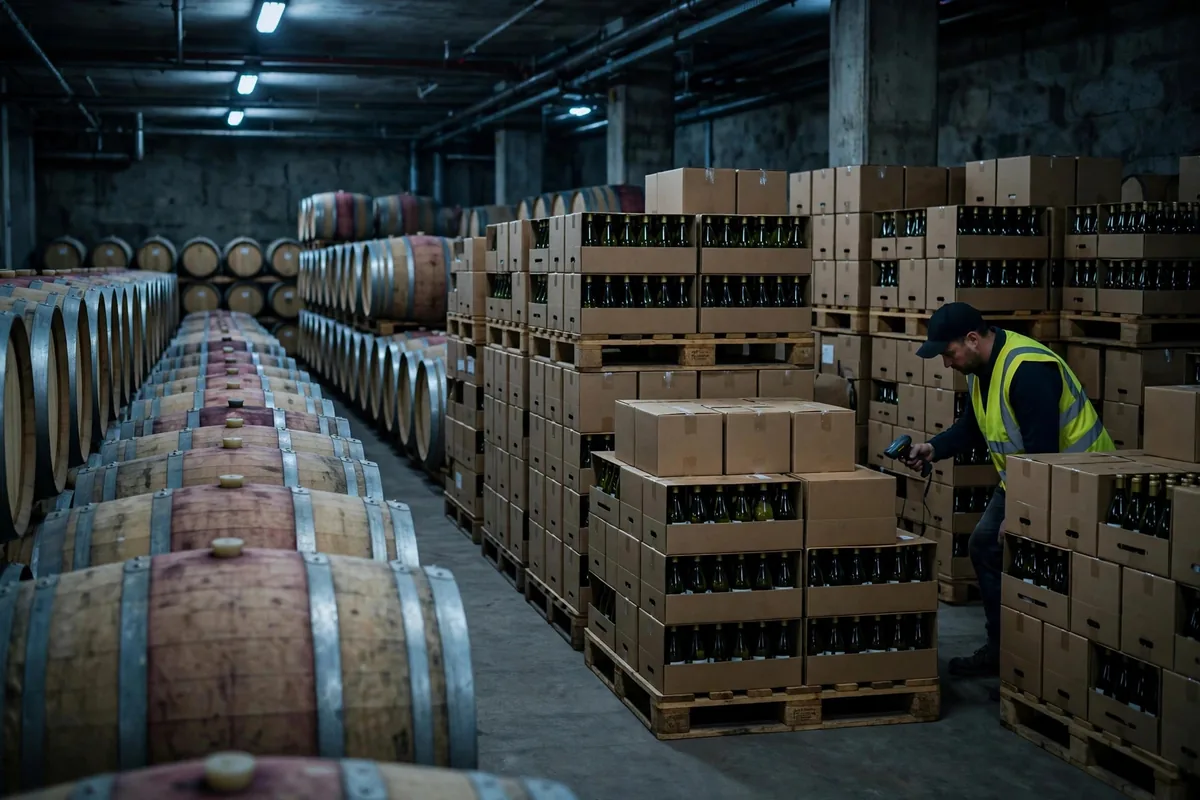
According to the International Organisation of Vine and Wine, Italy produced 44.1 million hectolitres of wine in 2024, up 15% on 2023, reclaiming its place as the world's largest wine producer. In the same year, Italy exported 21.7 million hectolitres worth 8.1 billion euros. Roughly half of everything Italy makes now leaves the country by ship, which means Italy wine export warehouse storage stopped being a matter of cellars a long time ago. It is a chain that runs from the winery warehouse to the container at the port, and when one link fails, the loss never stays confined to the rent line.
In October 2024, I visited a mid-sized winery near Alba, in Piedmont, producing around 80,000 bottles a year. The owner pointed to a stack of unlabelled cases in the corner of the warehouse: a shipment of Barolo bound for North America, held back six weeks because the buyer had changed the sailing date. Six extra weeks was not the problem. The problem was that the warehouse had been built a decade earlier to the standard of table wine, and on summer afternoons the temperature could reach 26°C. The wine had not spoiled, but the owner could not be sure, so he opened two cases for tasting before the shipment left. The tasting cost little. The missed sailing and the uncertainty cost far more.
Italy Wine Export Warehouse Storage Starts With the 2024 Numbers
2023 was a trough year for Italian wine, with production of just 38.3 million hectolitres after frost, heavy rain, and downy mildew took turns hitting the vineyards. Output rebounded 15% in 2024, yet still sat about 6% below the five-year average. Export volume grew 3.2% and export value 5.6%, with Prosecco leading the way at 12% volume growth. The structure of that growth matters for storage: sparkling wine and everyday table wine move in volume and turn over fast, so what they need from a warehouse is speed, not patience. Barolo and other age-worthy reds are the opposite: they dislike handling, temperature swings, and light. Running both categories under one storage standard in one building is asking for trouble.
The export share underlines the scale. At 21.7 million hectolitres, exports amount to nearly half of annual production, so one bottle in two passes through export storage. A winery cellar manages ageing; an export warehouse manages transit, grading, consolidation, and waiting for ships. Those are two different jobs, and building an export warehouse as if it were a larger cellar spends plenty of money while solving neither. Compared with 2019 to 2022, when Italian output ran between 47.5 and 49.8 million hectolitres a year, 2024 production still fell short of the peak, yet exports set a new record, which suggests stocks and export rhythms are being rearranged and warehouses face more turnover pressure than in a bumper year.
The mix matters, too. Prosecco country in Veneto is the largest exporting region, and there the warehouse job is sorting, labelling, and consolidating cases that move fast and must not sit. In Piedmont, Barolo and in Tuscany, Chianti move in smaller volumes at higher prices and cannot tolerate temperature swings, so the warehouse job is guarding temperature and humidity and leaving the wine alone. Inside one exporter's warehouse, the two categories often sit one aisle apart under a single climate setting. The setting is chosen for the high-volume wine, and the age-worthy wine pays for it.
Light, Temperature, and Grading in Italy Wine Export Warehouse Storage
Temperature is the first bill. Cellar guides generally put the storage range at 12–18°C with relative humidity of 60–75%, but stability matters more than the exact number. Above 24°C, ageing accelerates and the damage cannot be reversed. A warehouse that holds a steady 18°C protects wine better than one that swings between 12°C and 20°C. Many winery owners will pay for cooling equipment yet hesitate to pay for insulation and temperature logging, so when the equipment stops, nobody notices, and the money spent on cooling is wasted.
Light is the second bill, and the most underestimated. Ultraviolet light damages wine irreversibly, and direct sun at the loading dock or lights left on for hours both count. Keeping wine dark costs little in equipment and a lot in discipline: no cases near windows, shading at the dock, lights on only when needed. This bill is the hardest to put in a budget because it never appears as a purchase order, only as an operating rule.
Grading is the third bill, and it decides whether the first two were worth paying. Wines of different tiers should not share one room:
| Wine tier | Storage temperature | Biggest risk | Turnover rhythm |
|---|---|---|---|
| Age-worthy reds, e.g. Barolo | 12–15°C, stable | Temperature swings, light | Slow; assign the location before intake |
| Everyday table wine | 15–18°C, stable | Summer heat, long dwell | Fast; out within three months |
| Sparkling, e.g. Prosecco | 12–15°C, dark | Light, heat | Fastest; schedule intake backwards from sailing |
Consider a worked example, labelled as an assumption: 10,000 bottles of table wine at 10 euros ex-cellar. A temperature-controlled warehouse costs 0.15 euros more per bottle per month, so three months of storage adds 4,500 euros. If heat damage forces a 5% price cut from the buyer, the loss is 5,000 euros. The two figures are close, but one is a certain cost and the other an uncertain loss. Storage decisions are, at bottom, about spending a small certain sum to hedge a large uncertain one.
One bill is easy to miss: labels and cartons. When humidity stays above 75% for long, the cork may still be fine while labels grow mould and cartons soften. The label is the first thing a buyer sees when the case opens, and a stained label lowers the perceived tier of the whole shipment. Humidity control protects the look of the wine as well as the wine itself. Consolidation deserves the same care: when wines from different producers and tiers share one container, heat-sensitive and heat-tolerant bottles end up under one middle setting that suits nobody. Grouping by temperature needs before loading saves far more trouble than sorting it out at the port.
Turnover, Not Rent, Is the Real Cost
Every July and August, the container yard at the port of Genoa tests wine hardest. Picture a container full of wine waiting five extra days in an open yard in July: inside temperatures can pass 24°C, and each extra day in the sun adds risk, while the cause of the delay may be nothing more than a full sailing. Nobody at the winery controls temperature at the port, and neither does the forwarder. The only levers are timing shipments away from the hottest months or paying for a refrigerated container.
Here is the counter-intuitive part: in export storage, the most expensive cost is often not rent but the capital tied up in stock. Wine sitting in a warehouse for an extra month is finished, labelled, saleable product with cash locked inside it. Rent is visible on the monthly invoice; the cost of tied-up capital rarely gets its own line. The faster the turnover, the lower that hidden cost. Treating an export warehouse as a free ageing cellar is the most common illusion in this business.
Insurance is another line of defence that gets overlooked. When goods are damaged in storage, a claim rests on intake temperature logs, humidity logs, and handover notes. Without continuous temperature records, an insurer struggles to accept that the loss happened in storage. Many small and mid-sized wineries have no temperature logger in the warehouse at all, so when something goes wrong they absorb it themselves. The fix is cheap: one logger and a routine for reading it, which completes the evidence chain for a claim.
The International Organisation of Vine and Wine's early estimate puts Italian production at 47.4 million hectolitres in 2025, another 8% up on 2024. As output recovers, three questions will arrive together before the next harvest: will temperature-controlled capacity keep up, will grading rules hold, and will peak-season sailings be there when needed? The storage bill has to be settled before the goods ship, not after.
By Dr. Chen, Supply Chain Researcher